Eunectes deschauenseei
| Eunectes deschauenseei | |
|---|---|
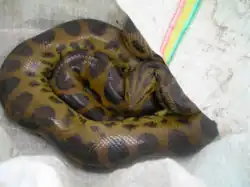 | |
| Dark-spotted anaconda in Beni, Bolivia | |
Scientific classification  | |
| Kingdom: | Animalia |
| Phylum: | Chordata |
| Class: | Reptilia |
| Order: | Squamata |
| Suborder: | Serpentes |
| Family: | Boidae |
| Genus: | Eunectes |
| Species: | E. deschauenseei |
| Binomial name | |
| Eunectes deschauenseei | |
 | |
| Natural range of E. deschauenseei | |

Eunectes deschauenseei, commonly known as the dark-spotted anaconda[1][4] or De Schauensee's anaconda,[5] is a species of snake in the subfamily Boinae of the family Boidae. The species is native to northeastern South America. Like all boas, it kills its prey by constriction (Eunectes deschauenseei mainly eats fish, birds and occasionally mammals).[1] No subspecies are currently recognized.[4]
Taxonomy
The specific name, deschauenseei, is in honor of American ornithologist Rodolphe Meyer de Schauensee,[6] who donated a specimen to the Philadelphia Zoo in 1924.[4] The type locality given is "probably collected on the island of Marajo at the mouth of the Amazon".[3]
Distribution and habitat
Eunectes deschauenseei is found in South America, in northern Brazil (the Pará and Amapá states), French Guiana and possibly Suriname.[1][4] E. deschauenseei is a nocturnal semi-aquatic species usually found in swampy, seasonally flooded freshwater areas at elevations below 300 m (980 ft).[1]
Description
Adult males of E. deschauenseei measure 130–211 cm (51–83 in) and adult females 120–231 cm (47–91 in) in snout-to-vent length (SVL).[7]
Reproduction
Vitellogenesis in E. deschauenseei probably occurs from autumn to spring (May to December). Gestation may last as long as nine months. Litter size among five gravid females ranged from 3 to 27 (mean 10.6). Newborns measure 29–53 cm (11–21 in) in snout–vent length.[7]
Conservation
The savanna habitat of E. deschauenseei is highly threatened by agricultural expansion, but the threat posed on this species is not known.[1]
See also
References
- 1 2 3 4 5 6 Dirksen, L.; Oubotar [sic], P. (2021). "Eunectes deschauenseei ". IUCN Red List of Threatened Species. 2021 e.T176262A18978500. doi:10.2305/IUCN.UK.2021-2.RLTS.T176262A18978500.en. Retrieved 20 November 2021.
- ↑ "Appendices | CITES". cites.org. Retrieved 14 January 2022.
- 1 2 McDiarmid, R.W.; Campbell, J.A.; Toure, T.A. (1999). Snake Species of the World: A Taxonomic and Geographic Reference, Vol. 1. Washington, District of Columbia: Herpetologists' League. ISBN 1-893777-01-4.
- 1 2 3 4 Eunectes deschauenseei at the Reptarium.cz Reptile Database. Accessed 10 September 2018.
- ↑ Smith, Hugo (director), "Amazon Anaconda", Mark O'Shea Official Website, retrieved 1 December 2008
- ↑ Beolens, Bo; Watkins, Michael; Grayson, Michael (2011). The Eponym Dictionary of Reptiles. Baltimore: Johns Hopkins University Press. p. 70. ISBN 978-1-4214-0135-5.
- 1 2 Pizzatto, Lígia; Marques, Otávio A. V. (2007). "Reproductive ecology of Boinae snakes with emphasis on Brazilian species and a comparison to pythons". South American Journal of Herpetology. 2 (2): 107–122. doi:10.2994/1808-9798(2007)2[107:reobsw]2.0.co;2. S2CID 86033920.
Further reading

- Dirksen, Lutz; Henderson, Robert W. (2002). Eunectes deschauenseei. Catalogue of American Amphibians and Reptiles. pp. 755.1 – 755.2. doi:10.15781/T2707WS99. hdl:2152/44652.
- Dirksen, Lutz (2002). Anakondas. Monographische Revision der Gattung Eunectes (Wagler, 1830) (in German). Münster: Natur und Tier-Verlag. ISBN 3-931587-43-6.
- Dirksen, Lutz (2002). "Zur Kenntnis der Anakonda-Arten (Serpentes: Boidae: Eunectes ). I. Eunectes deschauenseei Dunn & Conant, 1936 ". Herpetofauna (in German). 21 (122). Weinstadt: 12–21.
- Dunn, Emmett R.; Conant, Roger (1936). "Notes on Anacondas, with Descriptions of Two New Species". Proceedings of the Academy of Natural Sciences of Philadelphia. 88: 503–506. JSTOR 4064198. (Eunectes deschauenseei, new species).