Euglyphia (protist)
| Euglyphia | |
|---|---|
 | |
| Euglypha | |
Scientific classification  | |
| Domain: | Eukaryota |
| Clade: | Sar |
| Clade: | Rhizaria |
| Phylum: | Cercozoa |
| Subphylum: | Filosa |
| Class: | Imbricatea |
| Superorder: | Euglyphia Cavalier-Smith in Cavalier-Smith, Chao and Lewis, 2018 |
| Orders | |
| |
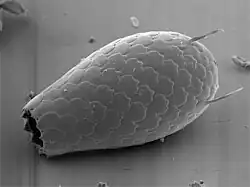
Euglyphia is a group of imbricate protists in the phylum Cercozoa. They are unicellular eukaryotes characterized by a cell body covered in large imbricate scales, and an apical aperture through which they extend either filose pseudopodia or two cilia of different sizes that are not used for gliding.[1]
Classification
Euglyphia is composed of 3 orders and 8 families, with a total of 16 different genera.[1][2]
- Order Euglyphida Copeland, 1956 emend. Cavalier-Smith, 1987
- Family Euglyphidae Wallich, 1864 – Euglypha
- Family Trinematidae Hoogenraad and De Groot, 1940 – Corythion, Trinema
- Family Sphenoderiidae Chatelain et al., 2013 – Sphenoderia, Trachelocorythion
- Family Assulinidae Lara et al., 2006 – Assulina, Placocista
- Family Cyphoderiidae De Saedeleer, 1934 – Cyphoderia, Corothionella, Pseudocorythion
- Family Paulinellidae De Saedeleer, 1934 – Paulinella, Ovulinata, Micropyxidiella
- Order Zoelucasida Cavalier-Smith in Scoble and Cavalier-Smith, 2014
- Family Zoelucasidae Cavalier-Smith in Scoble and Cavalier-Smith, 2014 – Zoelucasa
- Order Trivalvulariida Siemensma and Dumack, 2020
- Family Trivalvulariidae Siemensma and Dumack, 2020 – Trivalvularis, Leptogromia
References
- 1 2 Cavalier-Smith, Thomas; Chao, Ema E.; Lewis, Rhodri (April 2018). "Multigene phylogeny and cell evolution of chromist infrakingdom Rhizaria: contrasting cell organisation of sister phyla Cercozoa and Retaria". Protoplasma. 255 (5): 1517–1574. doi:10.1007/s00709-018-1241-1. PMC 6133090. PMID 29666938.
- ↑ Siemensma, Ferry; Dumack, Kenneth (2020-02-01). "SSU rDNA Phylogeny Indicates the Scale-lacking Trivalvulariida ord. nov. as a Sister Group to the Euglyphida (Cercozoa, Rhizaria)". Protist. 171 (1) 125701. doi:10.1016/j.protis.2019.125701. ISSN 1434-4610.