Eudoxus (lunar crater)
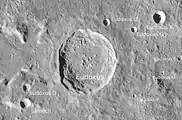
 Lunar Orbiter 4 image | |
| Coordinates | 44°18′N 16°18′E / 44.3°N 16.3°E |
|---|---|
| Diameter | 67 km |
| Depth | 3.4 km |
| Colongitude | 344° at sunrise |
| Formation | Copernican[1] |
| Eponym | Eudoxus of Cnidus |
Eudoxus is a prominent lunar impact crater that lies to the east of the northern tip of the Montes Caucasus range.[2] It is named after the Greek astronomer Eudoxus of Cnidus.[3] It is located to the south of the prominent crater Aristoteles in the northern regions of the visible Moon. To the south is the ruined formation of Alexander, and the small crater Lamèch lies to the southwest.
The rim of Eudoxus has a series of terraces on the interior wall, and slightly worn ramparts about the exterior. It lacks a single central peak, but has a cluster of low hills about the midpoint of the floor. The infrared spectrum of pure crystalline plagioclase has been identified on these rises.[4] The remainder of the interior floor is relatively level. Eudoxus has a ray system, and is consequently mapped as part of the Copernican System.[1]
Gallery


Satellite craters
By convention these features are identified on lunar maps by placing the letter on the side of the crater midpoint that is closest to Eudoxus.
| Eudoxus | Latitude | Longitude | Diameter |
|---|---|---|---|
| A | 45.8° N | 20.0° E | 14 km |
| B | 45.6° N | 17.4° E | 8 km |
| D | 43.3° N | 13.2° E | 10 km |
| E | 44.3° N | 21.1° E | 6 km |
| G | 45.4° N | 18.8° E | 7 km |
| J | 40.8° N | 20.2° E | 4 km |
| U | 43.9° N | 20.3° E | 4 km |
| V | 43.1° N | 18.9° E | 4 km |
References
- 1 2 Wilhelms, Don E.; McCauley, John F.; Trask, Newell J. (1987). The geologic history of the Moon. USGS Professional Paper 1348. Washington: U.S. Government Printing Office. doi:10.3133/pp1348. Plate 11: Copernican System (online)
- ↑ Webb, Rev. T. W. (1962). Celestial Objects for Common Telescopes (6th revised ed.). Dover. pp. 112–113, 154–159. Reprint: ISBN 978-0-486-20917-3
- ↑ "Eudoxus". Gazetteer of Planetary Nomenclature. USGS Astrogeology Research Program.
- ↑ Donaldson Hanna, K. L.; et al. (July 2014). "Global assessment of pure crystalline plagioclase across the Moon and implications for the evolution of the primary crust". Journal of Geophysical Research: Planets. 119 (7): 1516–1545. Bibcode:2014JGRE..119.1516D. doi:10.1002/2013JE004476.
Sources
- Andersson, L. E.; Whitaker, E. A. (1982). NASA Catalogue of Lunar Nomenclature. NASA RP-1097.
- Bussey, B.; Spudis, P. (2004). The Clementine Atlas of the Moon. New York: Cambridge University Press. ISBN 978-0-521-81528-4.
- Cocks, Elijah E.; Cocks, Josiah C. (1995). Who's Who on the Moon: A Biographical Dictionary of Lunar Nomenclature. Tudor Publishers. ISBN 978-0-936389-27-1.
- McDowell, Jonathan (July 15, 2007). "Lunar Nomenclature". Jonathan's Space Report. Archived from the original on 2012-02-08. Retrieved 2007-10-24.
- Menzel, D. H.; Minnaert, M.; Levin, B.; Dollfus, A.; Bell, B. (1971). "Report on Lunar Nomenclature by the Working Group of Commission 17 of the IAU". Space Science Reviews. 12 (2): 136–186. Bibcode:1971SSRv...12..136M. doi:10.1007/BF00171763. S2CID 122125855.
- Moore, Patrick (2001). On the Moon. Sterling Publishing Co. ISBN 978-0-304-35469-6.
- Price, Fred W. (1988). The Moon Observer's Handbook. Cambridge University Press. ISBN 978-0-521-33500-3.
- Rükl, Antonín (1990). Atlas of the Moon. Kalmbach Books. ISBN 978-0-913135-17-4.
- Whitaker, Ewen A. (1999). Mapping and Naming the Moon. Cambridge University Press. ISBN 978-0-521-62248-6.
- Wlasuk, Peter T. (2000). Observing the Moon. Springer. ISBN 978-1-85233-193-1.

| Physical properties |  | |
|---|---|---|
| Orbit | ||
| Surface and features | ||
| Science | ||
| Exploration | ||
| Time-telling and navigation | ||
| Phases and names | ||
| Daily phenomena | ||
| Related |
| |
