Epsilon Coronae Australis
  | |
| Observation data Epoch J2000 Equinox ICRS | |
|---|---|
| Constellation | Corona Australis |
| Right ascension | 18h 58m 43.383s[1] |
| Declination | −37° 06′ 26.381″[1] |
| Apparent magnitude (V) | 4.83±0.02[2] 4.74 Min I: 5.00 Min II: 4.95[3] |
| Characteristics | |
| Spectral type | F4V Fe-0.8[4] |
| U−B color index | +0.01[5] |
| B−V color index | +0.39[5] |
| Variable type | W UMa[3] |
| Astrometry | |
| Radial velocity (Rv) | 57.90±1.2[6] km/s |
| Proper motion (μ) | RA: −131.234 mas/yr[1] Dec.: +98.230 mas/yr[1] |
| Parallax (π) | 31.8084±0.1122 mas[1] |
| Distance | 102.5 ± 0.4 ly (31.4 ± 0.1 pc) |
| Absolute magnitude (MV) | 2.21[7] (2.39 + 4.98)[2] |
| Orbit[2] | |
| Period (P) | 0.59145447(30) days |
| Semi-major axis (a) | 3.82±0.02 R☉ |
| Eccentricity (e) | 0[8] |
| Inclination (i) | 74.02±0.14° |
| Periastron epoch (T) | HJD 3966.6892(0.0696) |
| Semi-amplitude (K1) (primary) | 36.40±0.05 km/s |
| Semi-amplitude (K2) (secondary) | 273.70±0.05 km/s |
| Details[2] | |
| ε CrA A | |
| Mass | 1.89±0.16 M☉ |
| Radius | 2.14±0.09 R☉ |
| Luminosity | 8.9±1.8 L☉ |
| Temperature | 6,820±200 K |
| Rotational velocity (v sin i) | 148.5[9] km/s |
| Age | 2.83±0.28[10] Gyr |
| ε CrA B | |
| Mass | 0.25±0.04 M☉ |
| Radius | 0.84±0.04 R☉ |
| Luminosity | 0.85±0.14 L☉ |
| Surface gravity (log g) | 3.99±0.03 cgs |
| Temperature | 6,050±100 K |
| Age | 2.83±0.28[10] Gyr |
| Other designations | |
| ε CrA, CD−37°13001, CPD−37°8433, HD 175813, HIP 93174, HR 7152, SAO 210781[11] | |
| Database references | |
| SIMBAD | data |
Epsilon Coronae Australis is a close binary star system located in the constellation Corona Australis. Nicolas Louis de Lacaille gave Epsilon Coronae Australis its Bayer designation, which is Latinized from ε Coronae Australis and abbreviated ε CrA or ε CrA. It is also known as HR 7152, and HD 175813.
Varying in brightness between apparent magnitudes of 4.74 to 5 over 14 hours,[3] this is the brightest W Ursae Majoris variable (low mass contact binary) in the night sky. Based on parallax measurements, it is located at a distance of 102.5 light-years (31.4 pc) from the Sun. The system is drifting further away with a line of sight velocity component of 58 km/s.[6]
Properties
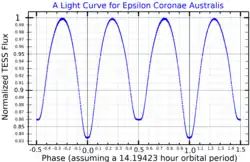
Epsilon Coronae Australis is an F4V dwarf star with an effective temperature of 6000 Kelvin. It ranges between apparent magnitudes of 4.74 to 5 over 14 hours,[13] an absolute magnitude of +2.45, and a mass of 1.1 solar masses. Epsilon Coronae Australis is a W Ursae Majoris variable, indicating that it has a contact companion within the Roche limit of the primary. The pair orbit each other with a period of 14.19 h at a separation of just 3.82 R☉.[2]
Yildiz and colleagues estimated the age of the system at 2.83±0.28 billion years based on study of the properties of the system and estimated rate of mass transfer. They found the current masses of the primary and secondary to be 1.72±0.04 and 0.22±0.02 solar masses respectively, from their original masses of 1.06±0.03 and 2.18±0.06 solar masses.[10] The stars will eventually merge in a not too distant future.[2]
References
- 1 2 3 4 5 Vallenari, A.; et al. (Gaia collaboration) (2023). "Gaia Data Release 3. Summary of the content and survey properties". Astronomy and Astrophysics. 674: A1. arXiv:2208.00211. Bibcode:2023A&A...674A...1G. doi:10.1051/0004-6361/202243940. S2CID 244398875. Gaia DR3 record for this source at VizieR.
- 1 2 3 4 5 6 Bakis, Volkan; et al. (2024-09-25). "Comparative study of the W UMa type binaries S Ant and Epsilon CrA". Publications of the Astronomical Society of Australia. 41. arXiv:2409.17303. Bibcode:2024PASA...41...83B. doi:10.1017/pasa.2024.92.
- 1 2 3 Samus, N. N.; et al. (2017). "General Catalogue of Variable Stars". Astronomy Reports. GCVS 5.1. 61 (1): 80–88. Bibcode:2017ARep...61...80S. Query for 'eps cra'.
- ↑ Gray, R. O.; et al. (2006). "Contributions to the Nearby Stars (NStars) Project: Spectroscopy of Stars Earlier than M0 within 40 pc--The Southern Sample". The Astronomical Journal. 132 (1): 161–170. arXiv:astro-ph/0603770. Bibcode:2006AJ....132..161G. doi:10.1086/504637. S2CID 119476992.
- 1 2 Mermilliod, J.-C. (1986). "Compilation of Eggen's UBV data, transformed to UBV (unpublished)". Catalogue of Eggen's UBV Data. Bibcode:1986EgUBV........0M.
- 1 2 Bilir, S.; et al. (2005). "Kinematics of W Ursae Majoris type binaries and evidence of the two types of formation". Monthly Notices of the Royal Astronomical Society. 357 (2): 497–517. arXiv:astro-ph/0411291. Bibcode:2005MNRAS.357..497B. doi:10.1111/j.1365-2966.2005.08609.x. S2CID 16274339.
- ↑ Eker, Z.; et al. (2009). "New absolute magnitude calibrations for W Ursa Majoris type binaries". Astronomische Nachrichten. 330 (1): 68–77. arXiv:0807.4989. Bibcode:2009AN....330...68E. doi:10.1002/asna.200811041. S2CID 15071352.
- ↑ Wilson, R. E.; Raichur, H. (2011). "Distance and temperature from absolute light curves of three eclipsing binaries". Monthly Notices of the Royal Astronomical Society. 415 (1): 596–604. Bibcode:2011MNRAS.415..596W. doi:10.1111/j.1365-2966.2011.18741.x.
- ↑ Schröder, C.; et al. (January 2009). "Ca II HK emission in rapidly rotating stars. Evidence for an onset of the solar-type dynamo". Astronomy and Astrophysics. 493 (3): 1099–1107. Bibcode:2009A&A...493.1099S. doi:10.1051/0004-6361:200810377.
- 1 2 3 Yildiz (2014). "Origin of W UMa-type contact binaries - age and orbital evolution". Monthly Notices of the Royal Astronomical Society. 437 (1): 185–94. arXiv:1310.5526. Bibcode:2014MNRAS.437..185Y. doi:10.1093/mnras/stt1874.
- ↑ "* eps CrA". SIMBAD. Centre de données astronomiques de Strasbourg. Retrieved 13 March 2017.
- ↑ "MAST: Barbara A. Mikulski Archive for Space Telescopes". Space Telescope Science Institute. Retrieved 8 December 2021.
- ↑ BSJ (4 January 2010). "Epsilon Coronae Australis". AAVSO Website. American Association of Variable Star Observers. Retrieved 22 January 2014.
| Stars |
| ||||||||||
|---|---|---|---|---|---|---|---|---|---|---|---|
| |||||||||||
| |||||||||||
| |||||||||||
 Category | |||||||||||