Elasipodida
| Elasipodida | |
|---|---|
 | |
| Enypniastes sp. | |
Scientific classification  | |
| Kingdom: | Animalia |
| Phylum: | Echinodermata |
| Class: | Holothuroidea |
| Order: | Elasipodida Théel, 1882 |
| Families | |
|
See Text | |
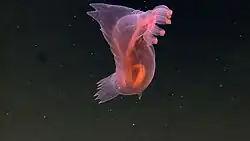
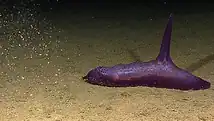
Elasipodida is an order of sea cucumbers. They have numerous appendages, including conical papillae and leaf-like tentacles. Although many species are benthic, a number are pelagic, and may have their appendages modified to form sails or fins. Most members of the order inhabit deep-sea environments, such as the species of the genus Enypniastes.[1]
Classification
The following families are recognised in the order Elasipodida:[2]
- family Elpidiidae Théel, 1882
- family Laetmogonidae Ekman, 1926
- family †Palaeolaetmogonidae Reich, 2012
- family Pelagothuriidae Ludwig, 1893
- family Psychropotidae Théel, 1882
- family Deimatidae? Théel, 1882 Synonym of Benthodytes, Psycheotrephes, and Psychropotes.
 The only true pelagic echinoderm known to date: Pelagothuria natatrix (here close to the Galápagos).
 Benthodytes sp.
 Scotoplanes globosa (a.k.a. "sea pig", family Elpidiidae)
 Pannychia sp. (Laetmogonidae)
References

Wikispecies has information related to Elasipodida.

Wikimedia Commons has media related to Elasipodida.
- Barnes, Robert D. (1982). Invertebrate Zoology. Philadelphia, PA: Holt-Saunders International. p. 995. ISBN 0-03-056747-5.
- Mah, Christopher (September 18, 2012). "Deep-Sea Swimming Sea Cucumbers and the "most bizarre holothurian species in existence"!". The Echinoblog.
Notes
- ↑ Mah, Christopher (September 18, 2012). "Deep-Sea Swimming Sea Cucumbers and the "most bizarre holothurian species in existence"!". The Echinoblog.
- ↑ "WoRMS - World Register of Marine Species - Elasipodida". www.marinespecies.org. Retrieved 2021-07-16.
Categories: