Las Piedras, Uruguay
Las Piedras | |
|---|---|
City | |
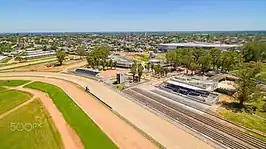
Plaza José Batlle y Ordóñez Parish Church of Saint Isidore the Laborer Monument to Artigas at the Mástil Las Piedras Hippodrome | |
  Las Piedras Location within Uruguay | |
| Country |  Uruguay |
| Department | Canelones |
| Founded | 8 March 1744 |
| Government | |
| • Mayor | Romina Espiga (Broad Front) |
| Population (2023) | |
• Total | 61,292[1] |
| Demonym | Pedrense |
| Time zone | UTC−3 |
| Postal code | 15900[2] |
| Dialling code | +598 2 |


Las Piedras is a city in the Canelones Department of Uruguay and the seat of the Municipality of Las Piedras. It is located in the southern part of the department, on the banks of the Las Piedras Creek, and forms part of the Montevideo metropolitan area.[3] At the 2023 census, it had a population of 61,292.[1] Its inhabitants are known as pedrenses.
Etymology
The name Las Piedras (Spanish for "the stones") derives from the large rocks at a ford on the creek of the same name. At that point, the creek bed of stones and sand could be crossed even during high water, on the road connecting Montevideo with the countryside. Large rocks were also visible from the banks, and the place came to be known as Paso de Las Piedras ("Las Piedras Ford"). The creek, the surrounding area and the city that developed alongside the ford subsequently took the name Las Piedras.[4]
Geography
Territorial setting
Las Piedras forms a continuous urban area with La Paz, Progreso and 18 de Mayo within the Montevideo metropolitan area. These localities retain their own administrations and urban centres, although they are connected by urban expansion and the main transport infrastructure of the micro-region.[5]
El Colorado and Canelón Chico form part of the rural and productive surroundings of the city; territorial planning instruments distinguish them from Las Piedras' urban neighbourhoods.[6]
Relief and geology
The area surrounding the city is characterised by the presence of granite deposits, historically associated with local quarrying. Quarrying has influenced the regional landscape and coexists with urban, suburban and rural areas in and around Las Piedras.[7]
Hydrography and environment
Las Piedras Creek runs through the area surrounding the city and, along part of its course, forms the boundary between the departments of Canelones and Montevideo. It is a tributary of Colorado Creek, in the lower sub-basin of the Santa Lucía River.[8]
The department's territorial planning instruments identify pressures on the creek and its basin associated with urbanisation, drainage and a range of productive activities.[9]
History
According to the Historical Association of Las Piedras, the founding process of the present-day city began on 8 March 1744, when Luis de Sosa Mascareñas received a one-square-league plot of land as a donation.[10]
During the second half of the 18th century, a settlement associated with farms, a chapel and local businesses developed. A chapel dedicated to Saint Isidore the Laborer was established in 1765 and became a parish in 1780.[11]
The Battle of Las Piedras was fought nearby on 18 May 1811. Revolutionary forces led by José Gervasio Artigas defeated Spanish troops commanded by José Posadas. The victory was one of the first important successes of the revolution in the Banda Oriental and enabled an advance towards Montevideo.[12]
In 1838, the architect Carlos Zucchi formalised the urban layout, consisting of a central square and 49 blocks.[13]
The railway arrived on 1 January 1869, strengthening links with Montevideo and encouraging the town's economic and urban development. Las Piedras station was the first railway station outside the capital.[13] On 15 May 1925, Law No. 7,837 officially raised Las Piedras from the status of villa to that of city.[14]
During the 20th century, the metropolitan expansion of Montevideo, internal migration and land subdivision drove the growth of Las Piedras.[15]

Population
At the 2023 census, Las Piedras had a population of 61,292.[1]
| Census year | Population |
|---|---|
| 1908 | 8,109 |
| 1963 | 40,658 |
| 1975 | 53,331 |
| 1985 | 58,283 |
| 1996 | 66,584 |
| 2004 | 69,222 |
| 2011 | 71,268 |
| 2023 | 61,292 |
Economy
Las Piedras is part of the Montevideo metropolitan area and has been characterised as a commuter town. It nevertheless has its own economic activity, with industrial, logistics, institutional and service centres, as well as links to the productive rural area of Canelones.[18]
The city and its surroundings are closely associated with wine growing. The National Institute of Viticulture (Instituto Nacional de Vitivinicultura, INAVI) has its legal headquarters in the city.[19] Its own facilities, inaugurated in 2022, include administrative areas, laboratories, warehouses, an experimental winery and a vineyard.[20]

Horse racing is also part of the local economy. The Las Piedras Hippodrome is part of the Integrated National Turf System and hosts meetings and races involving owners, breeders, trainers, jockeys and related services.[21]
The Parque Tecnológico Canario operates on the site of the former Comargen meat-packing plant. It is intended for productive development, business location, training and the promotion of economic and cultural activities.[22] The park continues to host innovation and training activities linked, among other areas, to agri-food production, sustainable tourism, the circular economy and renewable energy.[23]
Las Piedras Shopping, inaugurated in 2017 on Bulevar del Bicentenario, is one of the principal shopping centres serving the city and its area of influence.[24]
Administration and politics
Municipal administration
Las Piedras is the seat of the municipality of the same name, which is part of Canelones Department. Municipalities are Uruguay's third level of government and administration.[25]
The municipal government is exercised by a Municipal Council composed of five elected members: a mayor, who presides over it, and four councillors.[25] Since July 2025, the mayor has been Romina Espiga.[26]
Within its jurisdiction, the municipality prepares local development programmes, collaborates on public works and carries out responsibilities relating, among other matters, to roads and traffic, public spaces, lighting and stormwater drainage, without prejudice to the powers of the Government of Canelones Department.[27]
Citizen participation
The Intendencia of Canelones and the Municipality of Las Piedras have held sessions of the Tu Municipio + Cerca programme in different neighbourhoods. The programme brings administrative procedures, services and information about local government closer to residents outside the municipal headquarters.[28]
Neighbourhoods
The city's neighbourhoods include Centro, Obelisco, Pueblo Nuevo, Campisteguy, Laures, Herten, Villa Juanita, La Pilarica, Lenzi, Razetti, Santa Rita, Santa Isabel and 19 de Abril.[29][30][31][32][33][34]
Services
Health care

Las Piedras has the public Dr. Alfonso Espínola Hospital, which is run by the State Health Services Administration (Administración de los Servicios de Salud del Estado, ASSE).[35] In the private sector, the city has a sanatorium operated by CRAMI.[36] The sanatorium was inaugurated in 2010.[37]
Education

The city has public institutions providing pre-primary, primary, secondary and technical-vocational education. The National Administration of Public Education (ANEP) operates high schools No. 1 Manuel Rosé, No. 2 Germán Cabrera, No. 3, No. 4 and No. 5.[38][39] Manuel Rosé High School was declared a National Historic Monument in 2005 because of the works of art it houses.[40] School No. 317, inaugurated in 2023, was the city's first arts school.[41]
Technical-vocational education is provided at Las Piedras Higher Technical School, Las Piedras Technical School No. 2 and the Las Piedras Technological Centre, which offers, among other programmes, a technical degree in autotronica.[42][43]
Private provision includes pre-primary, primary, secondary and teacher-training institutions. These include Colegio y Liceo San Isidro; Colegio San José, Liceo María Auxiliadora and the Salesian Teachers' Institute; and Jardín Barbapapá, Colegio Constructivista and the Liceo de Educación Secundaria Integral (ESI).[44][45][46] Colegio Las Piedras and Colegio Nuevo Fabini also operate in the city.[47][48]
Public transport
Public transport services connect Las Piedras with Montevideo and other localities in the metropolitan area. CUTCSA, COETC and COPSA operate metropolitan services along the Route 5 corridor.[49]
The Compañía de Ómnibus del Este (Codeleste) operates departmental and local services. It was founded in 1927 as the Cooperativa de Ómnibus del Este and runs routes between Las Piedras and La Paz, as well as between Las Piedras and Canelones.[50][51] CITA services also include Las Piedras in their routes.[52]
Urban planning

Territorial planning instruments of Canelones recognise the centre of Las Piedras as a regional centre.[53]
Urban structure and facilities
The Territorial Plan for Micro-region 7 identifies neighbourhood centres and a regional centre in the centre of Las Piedras.[54]
The city also has the Las Piedras Sports Centre, at the junction of Dr. Pouey Avenue and the east–west connector avenue. The complex has basketball and volleyball courts, changing rooms and an artistic gymnastics area.[55]
Road links
The city is linked to the national road network by Routes 5, 48 and 67. A project in the urban area connected Routes 48 and 67 to divert heavy traffic.[56]
Culture
Heritage
The Church of Saint Isidore the Laborer is one of the city's main historical and religious landmarks. The present church, of neo-Renaissance inspiration, was built in the 19th century and has been subject to heritage protection measures since 2007.[57]
Las Piedras railway station forms part of the local urban heritage and has been subject to heritage protection measures since 2007.[58]
Parque Artigas, the Obelisk of Las Piedras and the Battle of Las Piedras Open-air Museum form a heritage complex associated with the battle of 1811. The museum includes the battlefield, an interpretation centre in the Bicentennial Pavilion and online content devoted to the historical interpretation of the site.[59]
Festivals and celebrations
The anniversary of the Battle of Las Piedras is commemorated in the city every 18 May. Activities include official ceremonies, parades by educational institutions, and civic, military and traditionalist events, organised with the participation of national, departmental and local institutions.[60]
The city hosts the Fiesta de la Vendimia, a celebration associated with the wine-growing tradition of the region. Law No. 18,088 established the Day of the Vintage and designated Las Piedras as the annual host of the opening parade.[61]
Sport
Juventud de Las Piedras is the city's leading sports club and has competed in both the first and second divisions of professional football in Uruguay.
The city also has a baby football league, made up of local teams and teams from neighbouring cities such as La Paz and Progreso.
The municipal Parque Artigas Stadium was reopened in 2009. Juventud de Las Piedras plays its home matches there, although the stadium is not exclusive to the club and is also used by institutions from nearby cities.[62]
Media
See also
References
- 1 2 3 4 "Población por departamento y localidades. Total País". 2023 Census: Household and Population Tables (in Spanish). National Institute of Statistics. Retrieved 18 July 2026.
- ↑ "Listado de códigos postales" (in Spanish). Correo Uruguayo. Retrieved 15 August 2026.
- ↑ Cánepa, Gustavo. "Acerca del área metropolitana de Montevideo" (PDF) (in Spanish). Academic Support Unit, Interior Coordinating Commission, University of the Republic. Retrieved 18 July 2026.
- ↑ Libro del Bicentenario 1811–2011: 200 años de la Batalla de Las Piedras (in Spanish). Intendencia de Canelones; Departmental Council of Canelones. 2011. ISBN 978-9974-8209-8-2.
- ↑ "Memoria de información" (PDF) (in Spanish). Intendencia de Canelones. p. 11. Retrieved 15 August 2026.
- ↑ "Decreto N.º 24/2016: Plan Territorial de la Microrregión 7" (PDF) (in Spanish). Departmental Council of Canelones. Retrieved 15 August 2026.
- ↑ "Memoria de información" (PDF) (in Spanish). Intendencia de Canelones. p. 9. Retrieved 15 August 2026.
- ↑ "Informe ambiental estratégico" (PDF) (in Spanish). Intendencia de Canelones. p. 10. Retrieved 15 August 2026.
- ↑ "Informe ambiental estratégico" (PDF) (in Spanish). Intendencia de Canelones. pp. 10–11. Retrieved 15 August 2026.
- ↑ "Plaza José Batlle y Ordóñez" (in Spanish). Intendencia de Canelones. Retrieved 15 August 2026.
- ↑ González Araújo, Freddy (2011). "200 años". Libro del Bicentenario 1811–2011: 200 años de la Batalla de Las Piedras (in Spanish). Intendencia de Canelones; Departmental Council of Canelones. pp. 201–203. ISBN 978-9974-8209-8-2.
- ↑ "Batalla de Las Piedras". Parque Artigas – Batalla de Las Piedras (in Spanish). Intendencia de Canelones. Retrieved 15 August 2026.
- 1 2 "Memoria de información" (PDF) (in Spanish). Intendencia de Canelones. p. 3. Retrieved 15 August 2026.
- ↑ "Ley N.º 7837: Elevación de categoría a ciudad" (in Spanish). IMPO. 15 May 1925. Retrieved 15 August 2026.
- ↑ García Sosa, Milton; Castro, Raquel (2011). "Villas y barrios: historias por registrar". Libro del Bicentenario 1811–2011: 200 años de la Batalla de Las Piedras (in Spanish). Intendencia de Canelones; Departmental Council of Canelones. pp. 205–207. ISBN 978-9974-8209-8-2.
- ↑ "Toponimia y categorización jurídica oficial de las localidades urbanas de Uruguay" (PDF) (in Spanish). National Institute of Statistics. Retrieved 18 July 2026.
- ↑ "Programa de monitoreo de cuerpos de agua de Montevideo: informe anual 2013" (PDF) (in Spanish). Intendencia of Montevideo. p. 50. Retrieved 15 August 2026.
- ↑ "Municipios de primera generación: C29 - Las Piedras, Canelones" (PDF) (in Spanish). University of the Republic. Retrieved 2 August 2026.
- ↑ "Resumen del Plan Estratégico 2022" (PDF) (in Spanish). National Institute of Viticulture. Retrieved 2 August 2026.
- ↑ "Nueva sede del Instituto Nacional de Vitivinicultura quedó inaugurada" (in Spanish). Ministry of Livestock, Agriculture and Fisheries. 21 June 2022. Retrieved 2 August 2026.
- ↑ "Indicadores de actividad hípica: Hipódromo Las Piedras" (PDF) (in Spanish). Ministry of Economy and Finance. Retrieved 2 August 2026.
- ↑ "Parque Tecnológico Canario: de proyecto a realidad" (in Spanish). Intendencia de Canelones. 26 October 2011. Retrieved 2 August 2026.
- ↑ "Canelones abre la convocatoria para «El Talentón»: crea el futuro y viaja a Tenerife" (in Spanish). Intendencia de Canelones. 20 July 2026. Retrieved 2 August 2026.
- ↑ "Fue inaugurado «Las Piedras Shopping»" (in Spanish). Intendencia de Canelones. 11 May 2017. Retrieved 2 August 2026.
- 1 2 "Ley N.º 19.272: Descentralización y participación ciudadana" (in Spanish). IMPO. 18 September 2014. Retrieved 15 August 2026.
- ↑ "Continúa la recorrida de instalación de municipios en el eje de Ruta 5" (in Spanish). Intendencia de Canelones. 14 July 2025. Retrieved 15 August 2026.
- ↑ "Ley N.º 19.272: atribuciones y cometidos de los municipios" (in Spanish). IMPO. Retrieved 15 August 2026.
- ↑ "Agenda del Gobierno de Canelones desde el 08 al 24 de marzo de 2024" (in Spanish). Intendencia de Canelones. 8 March 2024. Retrieved 15 August 2026.
- ↑ "La RAP de Canelones Oeste realizará jornadas de fichas médicas en las escuelas de su zona" (in Spanish). State Health Services Administration. Retrieved 15 August 2026.
- ↑ "Nuevo CAIF atenderá a más de 100 niños del barrio Obelisco de Las Piedras" (in Spanish). Presidency of the Republic. Retrieved 15 August 2026.
- ↑ Bosca, Ramiro (2023). "Bajo las piedras: historia y memoria del movimiento estudiantil de 1968 en la ciudad de Las Piedras" (PDF) (in Spanish). University of the Republic. Retrieved 15 August 2026.
- ↑ DISTIKLOS S.A. "Informe ambiental resumen" (PDF) (in Spanish). Ministry of Environment. Retrieved 15 August 2026.
- ↑ "Se realizó la presentación del Plan de Salud Bucal y la inauguración del Móvil Odontológico en Las Piedras" (in Spanish). Intendencia de Canelones. Retrieved 15 August 2026.
- ↑ "Consolidación barrio 19 de Abril" (in Spanish). Intendencia de Canelones. Retrieved 15 August 2026.
- ↑ "Hospital de Las Piedras «Dr. Alfonso Espínola»" (in Spanish). State Health Services Administration. Retrieved 15 August 2026.
- ↑ "CRAMI" (in Spanish). Retrieved 15 August 2026.
- ↑ "CRAMI inauguró en Las Piedras un nuevo sanatorio que cuenta con 80 camas y 4 blocks" (in Spanish). La Red 21. 30 May 2010. Retrieved 4 July 2012.
- ↑ "Programa Uruguay Estudia: nómina" (in Spanish). National Administration of Public Education. Retrieved 15 August 2026.
- ↑ "Plan de reformulación 2006: nómina" (in Spanish). National Administration of Public Education. Retrieved 15 August 2026.
- ↑ Comuna Canaria. "Liceo «Manuel Rosé»". Liceo Manuel Rosé (in Spanish). Retrieved 21 September 2013.
- ↑ "ANEP inauguró primera escuela artística de Las Piedras" (in Spanish). National Administration of Public Education. Retrieved 15 August 2026.
- ↑ "Ciclo Básico Tecnológico: nómina" (in Spanish). National Administration of Public Education. Retrieved 15 August 2026.
- ↑ "UTU–CUTCSA: comenzó la primera experiencia de Educación Dual en el nivel terciario" (in Spanish). Directorate-General for Technical-Vocational Education. 28 April 2026. Retrieved 15 August 2026.
- ↑ "Colegio San Isidro" (in Spanish). Retrieved 15 August 2026.
- ↑ "Salesianas Las Piedras" (in Spanish). Retrieved 15 August 2026.
- ↑ "Liceo" (in Spanish). Colegio Constructivista. Retrieved 15 August 2026.
- ↑ "Colegio Las Piedras" (in Spanish). Retrieved 15 August 2026.
- ↑ "Contacto" (in Spanish). Colegio Nuevo Fabini. Retrieved 15 August 2026.
- ↑ "Se extiende uso de STM a toda el área metropolitana" (in Spanish). Ministry of Transport and Public Works. 3 December 2019. Retrieved 15 August 2026.
- ↑ "Sobre nosotros" (in Spanish). Compañía de Ómnibus del Este. Retrieved 15 August 2026.
- ↑ "Conocé nuestras líneas y recorridos" (in Spanish). Compañía de Ómnibus del Este. Retrieved 15 August 2026.
- ↑ "Horarios por ruta" (in Spanish). CITA S.A. Retrieved 15 August 2026.
- ↑ "Medidas cautelares de ordenamiento territorial: Las Piedras, La Paz y Progreso" (PDF) (in Spanish). Departmental Council of Canelones. 13 April 2011. p. 64. Retrieved 15 August 2026.
- ↑ "Medidas cautelares de ordenamiento territorial: Las Piedras, La Paz y Progreso" (PDF) (in Spanish). Departmental Council of Canelones. 13 April 2011. p. 75. Retrieved 15 August 2026.
- ↑ "Polideportivo Las Piedras" (in Spanish). Intendencia de Canelones. Retrieved 15 August 2026.
- ↑ "Desvío de tránsito pesado: conectividad vial entre Ruta 48 y Ruta 67" (in Spanish). Intendencia de Canelones. Retrieved 15 August 2026.
- ↑ "Iglesia de San Isidro Labrador" (in Spanish). Intendencia de Canelones. Retrieved 15 August 2026.
- ↑ "Estación de Trenes Las Piedras" (in Spanish). Intendencia de Canelones. Retrieved 15 August 2026.
- ↑ "Museo a cielo abierto «Batalla de las Piedras»" (in Spanish). Intendencia de Canelones. Retrieved 15 August 2026.
- ↑ "Aniversario de la «Batalla de Las Piedras»" (in Spanish). Intendencia de Canelones. Retrieved 15 August 2026.
- ↑ "Ley N.º 18.088: Declaración de interés nacional. Turismo enológico. Fiesta de la Vendimia" (in Spanish). IMPO. 5 January 2007. Retrieved 2 August 2026.
- ↑ "Fue reinaugurado el Estadio Municipal del Parque Artigas de Las Piedras" (in Spanish). La Red 21. 20 October 2009. Retrieved 2 July 2012.
External links

Capital: Canelones | ||
| Towns and villages |
|  |
| Resorts of the Ciudad de la Costa | ||
| Sights |
| |
