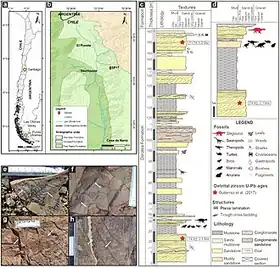
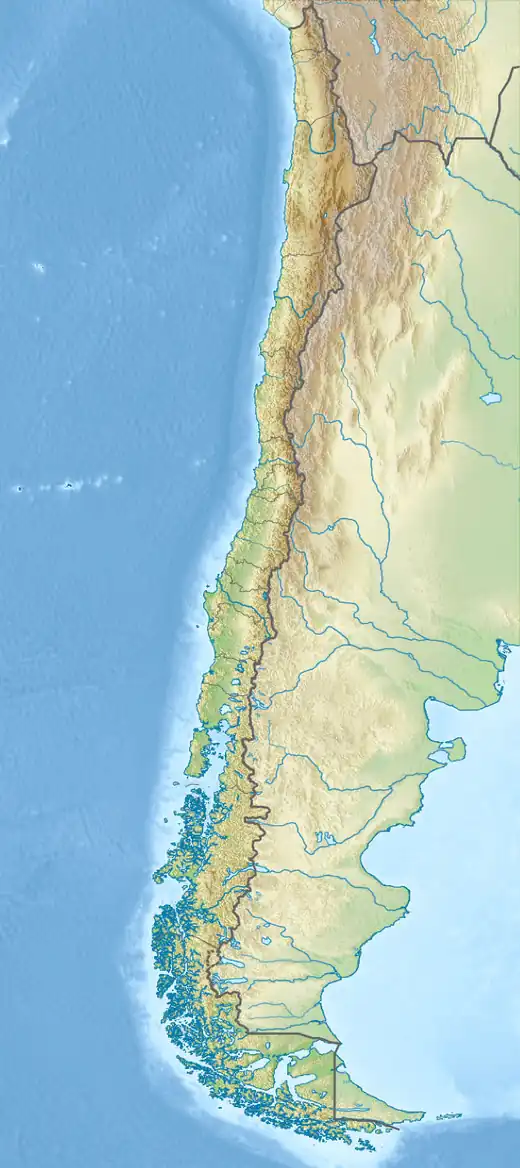
The Dorotea Formation was first described by Katz in 1963. The formation comprises sandstones with frequent conglomerate lenses, concretionary levels and claystones. The Dorotea Formation includes calcareous sandstones with abundant marine invertebrate and fragmentary vertebrate fossils. Hervé et al. (2004) obtained a maximum radiometric age of 67.4 ± 1.5 Ma from detrital zircons contained in sandstones of the Dorotea Formation.[2] Near the top of the formation is an iridium anomaly, correlated with the Cretaceous–Paleogene boundary; this is the southernmost K–Pg boundary site known from South America.[3]
The mudstones and sandstones of the formation were deposited in a fluvialenvironment. The formation conformably overlies the Tres Pasos Formation and is unconformably overlain by the Lutetian to Bartonian Man Aike Formation.[4] The thickness of the formation ranges from 100 metres (330ft) in the Sierra Baguales in the north to 350 metres (1,150ft) in the eponymous Sierra Dorotea in the south.[5]
Fossil content
The following fossils were reported from the formation:[6]
↑Manríquez, Leslie M. E.; Krahl, Guilherme; Carvalho, Marcelo A.; Lavina, Ernesto L. C.; Santiago, Gustavo; Bom, Marlone H. H.; Fauth, Gerson; Leppe, Marcelo (October 2024). "The K/Pg event at high southern latitudes: New evidence from continental deposits in the Magallanes/Austral Basin, Patagonia, South America". Cretaceous Research. 162 105931. Bibcode:2024CrRes.16205931M. doi:10.1016/j.cretres.2024.105931.
↑Püschel, Hans P.; Martinelli, Agustin G.; Soto-Acuña, Sergio; Ortiz, Héctor; Leppe, Marcelo; Vargas, Alexander O. (August 2025). "A subantarctic reigitheriid and the evolution of crushing teeth in these enigmatic Mesozoic mammals". Proceedings of the Royal Society B: Biological Sciences. 292 (2052) 20251056. doi:10.1098/rspb.2025.1056. PMID40763811.
Otero, Rodrigo A; Suárez, Mario E; Le Roux, Jacobus P (July 2009). "First record of Elasmosaurid Plesiosaurs (Sauropterygia: Plesiosauria) in upper levels of the Dorotea Formation, Late Cretaceous (Maastrichtian), Puerto Natales, Chilean Patagonia". Andean Geology. 36 (2). Bibcode:2009AndGe..36b...8O. doi:10.4067/S0718-71062009000200008.
Kuschel, G (1959), "Un curculionido del Cretácico Superior - primer insecto fósil de Chile", Investigaciones Zoológicas Chilenas, 5: 49–54