Dormition Cathedral, Kyiv Pechersk Lavra
| Dormition Cathedral | |
|---|---|
| Cathedral of the Dormition of Theotokos | |
Успенський собор | |
 | |
Dormition Cathedral | |
| 50°26′07″N 30°33′27″E / 50.4353°N 30.5575°E | |
| Location | Kyiv, Ukraine |
| Denomination | Orthodox Church of Ukraine |
| History | |
| Dedication | Dormition of the Mother of God |
| Architecture | |
| Architect | Theodosius of Kiev (originally) |
| Style | Byzantine (originally) Ukrainian Baroque (since 1729) |
| Groundbreaking | 1073 |
| Completed | 1078 |
Official name | Успенський собор з автентичними залишками ХІ-ХVII ст. (Dormition Cathedral with authentic remains from 11th–17th centuries) |
| Type | Architecture |
| Reference no. | 260088/1 |

The Dormition Cathedral (Ukrainian: Собор Успіння Пресвятої Богородиці, romanized: Sobor Uspinnia Presviatoi Bohorodytsi) of the Kyiv Pechersk Lavra, also referred to as the Great Church, is the main cathedral of the monastery complex. In the time of the Kyivan Rus the cathedral also served as the necropolis for the Kyivan princes.
The Dormition Cathedral is an important landmark of the Kyiv Pechersk Lavra National Reserve.[1]
History
The original church was built on initiative of Theodosius of Kiev in 1073–1078.[2] The construction was primarily financed by Sviatoslav II of Kiev.[3] According to the Kyiv Caves Patericon, several Byzantine masters arrived from Constantinople. Several legends exist related to construction of the church, particularly one connected with the Varangian warrior Šimon (Shimon).[4]
Dormition Cathedral has been damaged and restored numerous times. In 13th century it was damaged by the 1230 Kyiv earthquake and the 1240 siege of Kiev by Khan Batu. The cathedral was restored in 1470, but in 1482 it was damaged again during the Crimean raid of Meñli I Giray. It was eventually restored again. In 1718 it was damaged during a Kyiv city fire. In 1729 cathedral was restored in the Ukrainian Baroque style and expanded.
In 1928, the monastery was converted into an anti-religious museum park by the Soviet authorities. The main church of the monastery was destroyed during World War II, two months after the Wehrmacht occupied the city of Kyiv. Retreating Soviet troops conducted the controversial 1941 Khreshchatyk explosions. Scorched earth tactics were also applied to the Kyiv bridges over Dnieper as well as the main Khreshchatyk street and Kyiv Pechersk Lavra.[5] (The destruction of the cathedral followed a pattern of Soviet disregard for cultural heritage, as they previously blew up the ancient St. Michael's Golden-Domed Monastery nearby in the 1930s.)[6]
The destruction of the cathedral on 3 November 1941 has been a matter of some historical controversy, the NKVD having had mined the building on 16–17 September before evacuating the city. Soviet authorities in the 1960s claimed that Soviet saboteurs under Ivan Kudrya were responsible for the demolition, whereas Albert Speer in his memoirs wrote that German Reichskommissar Erich Koch had ordered the demolition.
The church was finally restored in 1995 after Ukraine regained its independence. Its reconstruction was accomplished in two years, and the new Dormition Church consecrated in 2000.[5]

On 15 June 2026 at 2:00 a.m. Russia struck the Dormition Cathedral during a mass drone and missile attack on several cities across Ukraine, setting the church on fire.[7][8] The fire was extinguished by the emergency services at 8:35 a.m.[9] Some 800 m² of the building was damaged.[10] The Security Service of Ukraine (SBU) stated that at least two Geran-2 drones had struck the building, their remains being found at the site.[11] Ukrainian Prime Minister Yulia Svyrydenko condemned the attack as a "brutal assault on our people and our heritage."[12] The attacks killed at least four people in Kyiv.[13]
Gallery
 Illustration from the book Conversations of Saint John Chrysostom (1623)
 1911 photograph of the Cathedral
 Destroyed Dormition Cathedral (1942)
 The cathedral in ruins after WWII (1958)
 Workspace of muralist L. Dmytrenko (2010)
 Aerial view looking east (2015)
 Eastern apses with the Refectory Church in the background
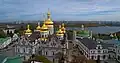 Dormition and Refectory churches side by side
 Dnieper or eastern side of the Cathedral and the Bell Tower
 Cathedral ceiling in front of the iconostasis
 The Cathedral after the attack of 15 June 2026
 The cathedral on fire following the Russian attack
References
- ↑ Успенський собор [Dormition Cathedral]. Kyiv-Pechersk Lavra National Reserve.
- ↑ Києво-Печерська Лавра. Велика церква Успіння Пресвятої Богородиці (Успенський собор). ukrainaincognita.com
- ↑ Успенський собор. Kyiv-Pechersk Lavra National Reserve
- ↑ The Kyiv Pechersk Lavra Dormition Cathedral Archived 28 December 2024 at the Wayback Machine. www.symeon-anthony.info.
- 1 2 "1941: уничтожение Успенского собора в Лавре". BBC News Ukrainian (in Russian). 3 November 2016. Archived from the original on 1 June 2023. Retrieved 2 June 2023.
- ↑ Гогун, Александр (20 September 2021). "Вандалы-орденоносцы. Как Красная армия взрывала Киев". Radio Free Europe/Radio Liberty (in Russian). Archived from the original on 20 September 2021. Retrieved 2 June 2023.
- ↑ Butenko, Victoria; Mogul, Rhea (14 June 2026). "Ukraine's historic Kyiv Pechersk Lavra monastery on fire following major Russian attack". CNN. Retrieved 15 June 2026.
- ↑ Маловічко, Юлія (15 June 2026). "У Києві пряме влучання в лавру, палає Успенський собор: фото НП". RBC-Ukraine (in Ukrainian). Retrieved 15 June 2026.
- ↑ Триває ліквідація наслідків масованого удару рф по Україні, - Ігор Клименко [The elimination of the consequences of the massive Russian strike on Ukraine continues, - Ihor Klymenko]. Ministry of Internal Affairs of Ukraine (in Ukrainian). 15 June 2026. Retrieved 15 June 2026.
- ↑ "Inside the historic Kyiv Pechersk Lavra after Russian strike: Shocking images of destruction". newsukraine.rbc.ua. Retrieved 15 June 2026.
- ↑ "SBU Says Russia Used Geran Drone in Strike on Kyiv-Pechersk Lavra". www.kyivpost.com. Retrieved 15 June 2026.
- ↑ Guinto, Joel (15 June 2026). "Ukraine war: Russian strikes kill nine and historic Kyiv cathedral damaged". BBC. Archived from the original on 15 June 2026. Retrieved 15 June 2026.
- ↑ "Deadly Russian attacks fuel blaze at centuries-old monastery in Kyiv". www.nbcnews.com. Retrieved 15 June 2026.
External links
- Chronicle of the Holy Dormition Kiev-Pechersk Lavra. lavra.ua (in English)
- Holy Dormition Cathedral. www.gpsmycity.com
- Dormition Cathedral of the Kyivan Cave Monastery. www.encyclopediaofukraine.com
- Assumption Cathedral. www.loc.gov
| Churches |
|  |
|---|---|---|
| Other constructions |
| |
| Miscellaneous |
| |