Doo–Sabin subdivision surface
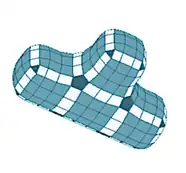
In 3D computer graphics, a Doo–Sabin subdivision surface is a type of subdivision surface based on a generalization of bi-quadratic uniform B-splines, whereas Catmull-Clark was based on generalized bi-cubic uniform B-splines. The subdivision refinement algorithm was developed in 1978 by Daniel Doo and Malcolm Sabin.[1][2]
The Doo-Sabin process generates one new face at each original vertex, new faces along each original edge, and new faces at each original face. A primary characteristic of the Doo–Sabin subdivision method is the creation of four faces and four edges (valence 4) around every new vertex in the refined mesh. A drawback is that the faces created at the original vertices may be triangles or n-gons that are not necessarily coplanar.


Evaluation
Doo–Sabin surfaces are defined recursively. Like all subdivision procedures, each refinement iteration, following the procedure given, replaces the current mesh with a "smoother", more refined mesh.[2] In subdivision terminology, Doo-Sabin is a dual quadrilateral scheme: unlike Catmull-Clark, its topological refinement step splits vertices rather than faces.[3][4] After many iterations, the surface will gradually converge onto a smooth limit surface. Later work has noted that classical Doo-Sabin subdivision can exhibit shape defects near extraordinary points; for convex input meshes these include flatness at the extraordinary point and nearby oscillation.[4]
Just as for Catmull–Clark surfaces, Doo–Sabin limit surfaces can also be evaluated directly without any recursive refinement, by means of the technique of Jos Stam.[5] The solution is, however, not as computationally efficient as for Catmull–Clark surfaces because the Doo–Sabin subdivision matrices are not (in general) diagonalizable.

See also
- Expansion (equivalent geometric operation) - facets are moved apart after being separated, and new facets are formed
- Conway polyhedron notation - a set of related topological polyhedron and polygonal mesh operators
- Catmull-Clark subdivision surface
- Loop subdivision surface
External links
- ↑ D. Doo: A subdivision algorithm for smoothing down irregularly shaped polyhedrons, Proceedings on Interactive Techniques in Computer Aided Design, pp. 157 - 165, 1978 (pdf) Archived 2011-07-07 at the Wayback Machine
- 1 2 D.Doo, M.Sabin: Behaviour of recursive division surfaces near extraordinary points, Computer Aided Design, pp. 356-360, 1978 ()
- ↑ Denis Zorin, Peter Schröder, A Unified Framework for Primal/Dual Quadrilateral Subdivision Schemes, Computer-Aided Geometric Design (pdf).
- 1 2 J. Karciauskas, J. Peters, Point-augmented biquadratic C1 subdivision surfaces, Graphical Models, 2015 (pdf).
- ↑ Jos Stam, Exact Evaluation of Catmull–Clark Subdivision Surfaces at Arbitrary Parameter Values, Proceedings of SIGGRAPH'98. In Computer Graphics Proceedings, ACM SIGGRAPH, 1998, 395–404 (pdf Archived 2018-05-09 at the Wayback Machine, downloadable eigenstructures)