Don Giovanni (1979 film)
| Don Giovanni | |
|---|---|
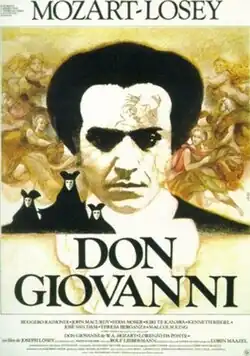 Theatrical poster | |
| Directed by | Joseph Losey |
| Written by | Rolf Liebermann Joseph Losey Patricia Losey Renzo Rossellini Frantz Salieri |
| Based on | |
| Produced by | Joseph Losey Robert Nador Michel Seydoux |
| Starring | Ruggero Raimondi John Macurdy Edda Moser Kiri Te Kanawa Kenneth Riegel José van Dam Teresa Berganza Malcolm King Eric Adjani |
| Cinematography | Gerry Fisher |
| Edited by | Reginald Beck[1] |
| Music by | Wolfgang Amadeus Mozart |
Production company | |
| Distributed by |
|
Release dates |
|
Running time | 185 minutes |
| Country | |
| Language | Italian |
| Budget | US$7 million[3] |
Don Giovanni is a 1979 musical film directed and produced by Joseph Losey, based on Mozart's classic 1787 opera Don Giovanni, itself based on the Don Juan legend of a seducer, destroyed by his excesses. The film stars Ruggero Raimondi in the title role, along with John Macurdy, Edda Moser, Kiri Te Kanawa, Kenneth Riegel, José van Dam and Teresa Berganza. Mozart's score was conducted by Lorin Maazel and performed by the Orchestre de l'Opéra national de Paris.
The film was an international co-production between French, Italian, British, and West German companies. It premiered in New York City on 6 November 1971. The film was a critical success, earning César Awards for Best Production Design and Best Editing, as well as two BAFTA Award nominations. Nearly three decades after its release, Nicholas Wapshott called Don Giovanni a "near perfect amalgamation of opera and the screen".[4][5]
Plot
After an unsuccessful attempt to seduce Donna Anna, Don Giovann kills her father Il Commendatore. The next morning, Giovanni meets Donna Elvira, a woman he previously seduced and abandoned. Later, Giovanni happens upon the preparations for a peasant wedding and tries to seduce the bride-to-be Zerlina, but his ambition is frustrated by Donna Elvira.
Donna Anna soon realizes that Giovanni killed her father, and she pursues the seducer along with her fiancé Don Ottavio. Ever ready to attempt a seduction, Giovanni woos Elvira's maid. As part of his plans, he switches clothes with his servant Leporello, who rapidly finds himself in trouble with people who mistake him for his master. Leporello flees and eventually meets Giovanni at the cemetery where Il Commendatore is buried. They jokingly invite the statue at his grave to dinner. While they are dining, the supernaturally animated statue arrives, and the horrified Giovanni is drawn into an open-pit fire.
Cast
| Role | Voice type | Actor |
|---|---|---|
| Don Giovanni | baritone | Ruggero Raimondi |
| Il Commendatore | bass | John Macurdy |
| Donna Anna | soprano | Edda Moser |
| Don Ottavio | tenor | Kenneth Riegel |
| Donna Elvira | soprano | Kiri Te Kanawa |
| Leporello | bass | José van Dam |
| Masetto | bass | Malcolm King |
| Zerlina | soprano | Teresa Berganza |
| Valet in Black | N/a | Eric Adjani |
Production
In the opera, the action supposedly takes place in Spain, but Mozart's librettist Lorenzo Da Ponte wrote in Italian, and this film uses locations in Venice and Murano. In particular, the film features buildings by Palladio in and around the city of Vicenza (Basilica Palladiana, Villa Rotonda, Villa Caldogno and Teatro Olimpico).[6]
Typically for a musical film, the singers recorded their aria performances separately, and lip-synched in their film performances. As Noel Megahey notes, "dragging the orchestra of the Opéra de Paris around the locations for the length of the production for a live recording is completely unfeasible."[7] However, the recitatives were recorded live on-set, with the actors accompanied on harpsichord by Janine Reiss.[6]
The total budget for the film was about $7,000,000.[8]
Style
The film is not a recording of a stage performance but "an original interpretation of the opera on film".[5] Using the original libretto and music, it was directed as a musical film with a series of scenes, each using multiple cameras and takes. Four years earlier, Losey had directed a film version of Bertolt Brecht's play Galileo using a similar approach; Reginald Beck had also edited the earlier film, along with many others directed by Losey.
Reception
Critical response
Following the 1979 theatrical release of the film, Vincent Canby complimented the singing but concluded that the filming "didn't work". He found the filmed closeups of the singers to be mostly jarring and ineffective. On the other hand, Judith Martin considered it successful. In 2007, Nicholas Wapshott wrote that "One near perfect amalgamation of opera and the screen is Joseph Losey's Don Giovanni".[5][9][10]
Awards and nominations
| Award | Year | Category | Nominee | Result | Ref. |
|---|---|---|---|---|---|
| British Academy Film Awards | 1981 | Best Costume Design | Frantz Salieri | Nominated | [11] |
| Best Sound | Jean-Louis Ducarme, Jacques Maumont | Nominated | |||
| César Awards | 1980 | Best Film | Joseph Losey | Nominated | [12] |
| Best Director | Nominated | ||||
| Best Editing | Reginald Beck | Won | |||
| Best Production Design | Alexandre Trauner | Won | |||
| David di Donatello | 1980 | Best Producer | Joseph Losey | Won |
Home media
A Blu-ray and a region 1 DVD were released by Olive Films in 2013.[13][14]
References
- 1 2 3 4 5 6 7 "Don Giovanni (1979)". BFI Collections Search. Retrieved 16 June 2026.
- 1 2 3 "Don Giovanni (1979)". LUMIERE. Archived from the original on 13 December 2024. Retrieved 16 June 2026.
- ↑ Caute, David (1994). Joseph Losey. Oxford University Press. p. 425.
- ↑ Maddocks, Fiona (19 August 2011). "Top 50 Operas". The Guardian.
- 1 2 3 Wapshott, Nicholas (15 January 2007). "A Screen 'Don Giovanni' With a Hint of Marx". New York Sun.
One near perfect amalgamation of opera and the screen is Joseph Losey's Don Giovanni.
- 1 2 "Une course brûlante et glacée" (in French). 15 November 1979. Retrieved 16 June 2026.
- ↑ Megahey, Noel (2007). "Don Giovanni Review". The Digital Fix. Review of the DVD that details the difficulties of filming the opera.
- ↑ Davis, Peter G. (4 November 1979). "Filming Mozart's 'Don Giovanni'". The New York Times. Article about the production of the film published shortly before its release.
- ↑ Canby, Vincent (6 November 1979). "Losey Brings Mozart's 'Don Giovanni' to the Screen:Philanderer Bar None". The New York Times.
Mr. Losey and his associates haven't destroyed Don Giovanni, but then they haven't illuminated it either. Their film is a busy, disorienting spectacle, superbly sung (and available on a CBS Masterworks recording).
- ↑ Martin, Judith (9 November 1979). "'Don Giovanni': It Works". The Washington Post.
- ↑ "Film". Bafta. Retrieved 16 June 2026.
- ↑ "Cérémonie des César 1980". Académie des César (in French). Retrieved 16 June 2026.
- ↑ Don Giovanni (DVD). Olive Films. 22 February 2013. OCLC 1039408501.
- ↑ Don Giovanni (Blu-Ray). Olive Films. 22 February 2013. OCLC 827950576.
Further reading
- Schwartz, Dennis (23 January 2012). "Don Giovanni".
A nearly great adaptation of Mozart's greatest opera
- Redwine, Ivana (2003). "Review of Don Giovanni". About.com. Archived from the original on 25 July 2011. The review is undated, but was done after the DVD release. It was archived for the first time in 2003.
External links
- Don Giovanni at IMDb
- 1979 films
- 1979 French films
- 1979 German films
- 1979 Italian films
- 1979 Italian-language films
- 1979 musical films
- French musical films
- Italian musical films
- Films based on Don Giovanni
- Films directed by Joseph Losey
- Films produced by Michel Seydoux
- Films set in Venice
- Films set in the 18th century
- German musical films
- Opera films
- West German films
- Films shot in Venice
- Lorin Maazel
- Orchestre de l'Opéra national de Paris