Dihydropyrimidinase
| dihydropyrimidinase | |||||||||
|---|---|---|---|---|---|---|---|---|---|
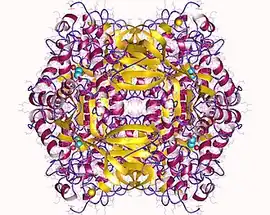 Dihydropyrimidinase tetramer, Human | |||||||||
| Identifiers | |||||||||
| EC no. | 3.5.2.2 | ||||||||
| CAS no. | 9030-74-4 | ||||||||
| Databases | |||||||||
| BRENDA | enzyme data | ||||||||
| ExPASy | NiceZyme view | ||||||||
| KEGG | enzyme entry | ||||||||
| MetaCyc | metabolic pathway | ||||||||
| Rhea | reactions | ||||||||
| PDB structures | RCSB PDB PDBe PDBsum | ||||||||
| Gene Ontology | AmiGO / QuickGO | ||||||||
| |||||||||
In enzymology, a dihydropyrimidinase (EC 3.5.2.2) is an enzyme that catalyzes the chemical reaction
- 5,6-dihydrouracil + H2O 3-ureidopropanoate

Thus, the two substrates of this enzyme are 5,6-dihydrouracil and H2O, whereas its product is 3-ureidopropanoate.
This enzyme belongs to the family of hydrolases, those acting on carbon-nitrogen bonds other than peptide bonds, specifically in cyclic amides. The systematic name of this enzyme class is 5,6-dihydropyrimidine amidohydrolase. Other names in common use include hydantoinase, hydropyrimidine hydrase, hydantoin peptidase, pyrimidine hydrase, and D-hydantoinase. This enzyme participates in 3 metabolic pathways: pyrimidine metabolism, beta-alanine metabolism, and pantothenate and coa biosynthesis.
Structural studies
As of late 2007, 10 structures have been solved for this class of enzymes, with PDB accession codes PDB: 1GKP, PDB: 1GKQ, PDB: 1GKR, PDB: 1NFG, PDB: 1YNY, PDB: 2FTW, PDB: 2FTY, PDB: 2FVK, PDB: 2FVM, and PDB: 2GSE.
References
- Brooks KP, Jones EA, Kim BD, Sander EG (1983). "Bovine liver dihydropyrimidine amidohydrolase: purification, properties, and characterization as a zinc metalloenzyme". Arch. Biochem. Biophys. 226 (2): 469–83. doi:10.1016/0003-9861(83)90316-8. PMID 6639068.
- EADIE GS, BERNHEIM F, BERNHEIM ML (1949). "The partial purification and properties of animal and plant hydantoinases". J. Biol. Chem. 181 (2): 449–58. doi:10.1016/S0021-9258(18)56564-9. PMID 15393763.