4-hydroxy-tetrahydrodipicolinate reductase
| 4-hydroxy-tetrahydrodipicolinate reductase | |||||||||
|---|---|---|---|---|---|---|---|---|---|
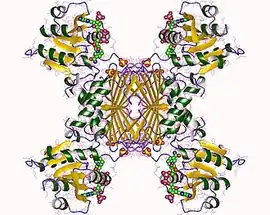 Dihydrodipicolinate reductase tetramer, Corynebacterium glutamicum | |||||||||
| Identifiers | |||||||||
| EC no. | 1.17.1.8 | ||||||||
| CAS no. | 9055-46-3 | ||||||||
| Databases | |||||||||
| BRENDA | enzyme data | ||||||||
| ExPASy | NiceZyme view | ||||||||
| KEGG | enzyme entry | ||||||||
| MetaCyc | metabolic pathway | ||||||||
| Rhea | reactions | ||||||||
| PDB structures | RCSB PDB PDBe PDBsum | ||||||||
| Gene Ontology | AmiGO / QuickGO | ||||||||
| |||||||||
4-hydroxy-tetrahydrodipicolinate reductase (EC 1.17.1.8) is an enzyme that catalyzes the chemical reaction

(2S,4S)-4-hydroxy-2,3,4,5-tetrahydrodipicolinic acid
+ NADH
H+
H2O


(S)-2,3,4,5-tetrahydrodipicolinic acid
+ NAD+
The three substrates of this enzyme are (2S,4S)-4-hydroxy-2,3,4,5-tetrahydrodipicolinic acid, reduced nicotinamide adenine dinucleotide (NADH), and a proton. Its products are (S)-2,3,4,5-tetrahydrodipicolinic acid], oxidised NAD+ and water. Nicotinamide adenine dinucleotide phosphate can be used as an alternative cofactor.[1][2][3]
This enzyme is part of the biosynthesis pathway to lysine.[4]
Nomenclature
This enzyme belongs to the family of oxidoreductases, specifically those acting on CH or CH2 groups with NAD+ or NADP+ as acceptor. The systematic name of this enzyme class is (S)-2,3,4,5-tetrahydropyridine-2,6-dicarboxylate:NAD(P)+ 4-oxidoreductase. Other names in common use include:
- dihydrodipicolinate reductase,
- dihydrodipicolinic acid reductase, and
- 2,3,4,5-tetrahydrodipicolinate:NAD(P)+ oxidoreductase.[1]
References
- 1 2 Enzyme 1.17.1.8 at KEGG Pathway Database.
- ↑ Farkas W, Gilvarg C (Dec 1965). "The reduction step in diaminopimelic acid biosynthesis". The Journal of Biological Chemistry. 240 (12): 4717–22. doi:10.1016/S0021-9258(18)97014-6. PMID 4378965.
- ↑ Tamir H (1971). "Dihydrodipicolinic acid reductase (Escherichia coli)". Metabolism of Amino Acids and Amines Part B. Methods Enzymol. Vol. 17B. pp. 134–139. doi:10.1016/0076-6879(71)17030-9. ISBN 978-0-12-181877-7.
- ↑ Devenish SR, Blunt JW, Gerrard JA (Jun 2010). "NMR studies uncover alternate substrates for dihydrodipicolinate synthase and suggest that dihydrodipicolinate reductase is also a dehydratase". Journal of Medicinal Chemistry. 53 (12): 4808–12. doi:10.1021/jm100349s. PMID 20503968.