Delta Force 2: The Colombian Connection
| Delta Force 2: The Colombian Connection | |
|---|---|
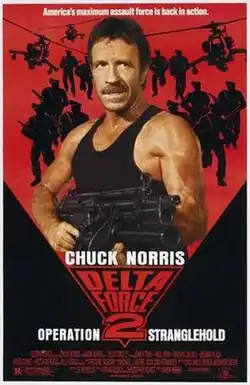 United States theatrical release poster. | |
| Directed by | Aaron Norris |
| Written by | Lee Reynolds |
| Based on | |
| Produced by |
|
| Starring |
|
| Cinematography | João Fernandes |
| Edited by | Michael J. Duthie |
| Music by | Frédéric Talgorn |
Production company | |
| Distributed by | Metro-Goldwyn-Mayer |
Release date |
|
Running time | 111 minutes |
| Country | United States |
| Languages | English Spanish |
| Budget | $16 million[1] |
| Box office | $6.7 million (domestic)[2] |
Delta Force 2: The Colombian Connection (also known as Delta Force 2: Operation Stranglehold or simply Delta Force 2)[3] is a 1990 American action film directed by Aaron Norris and starring Chuck Norris as Colonel Scott McCoy. It is a sequel to the 1986 film The Delta Force and the second installment in the franchise.
The film follows McCoy and his Delta Force team as they attempt to stop drug lord Ramón Cota and dismantle his drug-trafficking operation in the fictional South American country of San Carlos.
The film was produced by The Cannon Group and distributed by Metro-Goldwyn-Mayer. Although set primarily in South America, much of the film was shot in the Philippines, with additional filming taking place in Tennessee. Production was interrupted by a helicopter crash in the Philippines on May 16, 1989, which killed four members of the film crew and later resulted in the death of actor Geoff Brewer. The production subsequently resumed after a six-week hiatus.
Delta Force 2: The Colombian Connection was released in the United States on August 24, 1990. It received generally negative reviews from critics, who criticised its screenplay, clichés, acting and similarities to Norris's earlier outputs for Cannon.
The film grossed approximately $6.7 million in the United States against a reported budget of $16 million. It was followed by Delta Force 3: The Killing Game in 1991, which included an entirely new cast.
Plot
Narcoterrorist and cartel boss Ramón Cota (Billy Drago) controls the cocaine industry with an iron fist. His drugs pour steadily into America, corrupting the country's youth and causing a feud between the DEA and San Carlos, Cota's country of origin.
During a carnival in Rio de Janeiro, an undercover task force led by several DEA agents conducts surveillance on a private party that Cota is attending (similar to a Mardi Gras ball); however, the surveillance team is ambushed and massacred by Cota's hitmen, who are masquerading as carnival performers. Due to the Rio fiasco, the DEA enlists the support of the U.S. Army's Delta Force in order to infiltrate San Carlos. They are aided by an undercover agent within Cota's drug cartel.
General Taylor orders Colonel Scott McCoy (Chuck Norris) and his deputy, Major Bobby Chavez (Paul Perri), to bring Cota to court. They pose as airline passengers while Cota is en route to Geneva to deposit his drug money in a Swiss bank account, and are able to capture him during a short interval in which the plane enters U.S. airspace. However, their efforts amount to nothing as Cota is easily able to post bail and escape. Unable to contain his rage, Chavez furiously lashes out at Cota in court. Cota decides to strike at Chavez by having Chavez's pregnant wife killed.
Out on a personal mission of vengeance, Chavez is captured by Cota's forces and is tortured and killed. When three DEA agents attempt to go in and bring Cota and his army down, they are taken hostage, and are to be executed. During a press conference, a spokesman for the DEA explains that San Carlos's president Alcazar fears a coup and is therefore reluctant to crack down on the cartels, while his corrupt generals benefit from the drug trade and are willing to protect Cota from extradition.
McCoy is parachuted into San Carlos and sent to rescue the hostages in a stealth operation, while Taylor and the rest of the Delta Force perform surveillance. Their mission is supervised by a delegate from the government of San Carlos, which has entered an agreement with the U.S. government that severely limits the scope of the mission. Meanwhile, McCoy scales a tall cliff and infiltrates Cota's mansion.
Later, the government of San Carlos attempts to cancel the U.S. intervention outright by staging a massive drug raid that would make the American mission unnecessary. Upon learning of the hoax, Taylor breaks protocol and heads south of his perimeter in a heavily armed gunship, prompting the San Carlos army to send their own choppers in pursuit. The chopper lands at Cota's mansion and deploys troops to destroy cocaine storehouses and laboratories. McCoy succeeds in releasing the hostages, but is captured by Cota and placed in a chamber filled with toxic gas and isolated by a glass pane. Before the gas can kill him, however, a rocket from Taylor's gunship shatters the glass, allowing him to break through.
With the help of DEA Agent Page, McCoy captures Cota in his own armored limousine and flees the mansion. Cota's bodyguards and a San Carlos attack chopper]] pursue the vehicle and eventually bring it to a halt, but Taylor's gunship saves them. Cota flees on foot through the jungle during the fighting. After the drug lord kills a villager who wanted revenge for the murder of her family, McCoy arrives and beats him. Cota then tries to goad McCoy into killing him, knowing he is wanted alive.
Taylor's gunship arrives to pick up McCoy and his prisoner with ropes, as the last few of Cota's men close in. One of them swings his machete but only manages to partially cut Cota's rope before the gunship heads out to sea to join the American carrier fleet. Hanging beneath the chopper, Cota continues to goad McCoy about his invulnerability, saying that once in court he will walk free again. However, the rope holding Cota grows thinner from the machete cut, until it snaps completely, this time leaving the kingpin to fall thousands of feet to his death.
Cast
- Chuck Norris as Colonel Scott McCoy
- Billy Drago as Ramón Cota
- John P. Ryan as General Taylor
- Richard Jaeckel as DEA Agent John Page
- Paul Perri as Major Bobby Chávez
- Begoña Plaza as Quiquina Esquilinta
- Héctor Mercado as Miguel
- Mark Margolis as General Olmedo
- Mateo Gómez as Ernesto Flores
- Ruth de Sosa as Rita Chávez
- Kelly Wicker as a Judge
- Rick Prieto as Carlos
Pre-production
Writing
Early sequel concepts
Screenwriter James Bruner was tasked with developing a sequel to The Delta Force. He was sent to London to meet with filmmaker Michael Winner and develop a story, with the intention of having Chuck Norris and Lee Marvin reprise their roles as Scott McCoy and Nick Alexander, respectively.[4] Some early promotional and concept posters for a potential sequel included references to Marvin's name and likeness.[5]
According to Bruner, Winner subsequently took control of the writing process, and the script became substantially different from Bruner's original work. Bruner recalled that "the script just got goofier and goofier", and said that although the final screenplay was submitted under his name, it was not the script he had written. The story department at Cannon Films was reportedly dissatisfied with the result.[6]
The project later developed under the working title Delta Force 2: Spitfire, with Michael Dudikoff attached to star and Albert Pyun set to direct. Steve James was also expected to reprise his role as Bobby. The proposed story would have followed Dudikoff and James as they attempted to prevent terrorists from destroying a nuclear reactor in Florida. The project was ultimately abandoned.[7]
Bruner was also involved with a proposed Delta Force television series while Missing in Action III was in production. According to Trunick, Menahem Golan was dissatisfied with the terms offered by CBS, and the project did not proceed.[8]
Development of The Colombian Connection
The screenplay that became Delta Force 2: The Colombian Connection originated as a standalone project titled Stranglehold. Trunick's account describes the screenplay as being adapted into a sequel to The Delta Force, with the characters, setting and premise being overhauled in the midst of development.[9]
The final film was also referred to as Delta Force 2: Operation Stranglehold in some contemporary promotional material, including the U.S. theatrical release poster and home-video market.[10]
The development of Stranglehold took place during a period of financial difficulty for Cannon Films. Contemporary reports described the company's growing debt and financial restructuring, including an agreement with Warner Communications in 1986 and subsequent efforts to reduce costs.[11][12] Trunick places the development of The Colombian Connection within this period of increasingly constrained production budgets.[13]
By the time the project reached its later stages of development, Golan had left Cannon Films.[13] The screenplay was subsequently developed around Chuck Norris's interest in the subject of South American drug trafficking. Norris recalled reading about a powerful, unnamed South American drug lord and hiring writer Lee Reynolds to research the subject and develop a screenplay. He said that the research process took place over several years.[14]
"I researched drug kingpins during the three years we worked to prepare for this movie", stated Norris, "and much of what I read convinced me that you're dealing with unconscionable, truly vicious individuals. It's true, there are some changes in Colombia, but the fighting is still going on, and these people are other places as well. And what you're fighting is billions of dollars. That much money means an enormous amount of power. That's why we portrayed our kingpin that vindictively. It happens. They feel they're above the law, and when you get in their way, they don't just go after you. They kill your wife, aunts, uncles, all relatives. They eliminate your lineage".[1]
Norris also discussed revisions to the screenplay during its development. In December 1988, he said that the script was being rewritten and that he preferred to resolve problems during the writing stage rather than during production.
"It's better to straighten out the problems in the screenplay now, rather than later. I hate it when you start a movie with a script half done; chances are you'll end up with a mediocre movie. The first [installment] was well written", stated Norris.[15]
Norris said that his research into drug trafficking influenced the depiction of the film's antagonist, Ramón Cota. He described major drug traffickers as possessing substantial wealth and power and said that these observations informed the character's violent behavior.[1]
Casting
Lee Marvin had reportedly maintained a good relationship with Golan during the production of The Delta Force and was interested in further projects with Cannon Films. Marvin, however, was in poor health during production of the first film and died in 1987, making his return to the sequel impossible.[16]
Jean-Claude Van Damme was offered a role in the film but declined it in order to star in Cyborg.[17] Van Damme’s relationship with Chuck Norris began in the early 1980s, shortly after Van Damme moved from Belgium to the United States to pursue an acting career. Van Damme later recalled training with Norris three times a week and working for Norris during this period.[18][19][20]
Billy Drago was cast as the film's villain. It was his third collaboration with Norris, following Invasion U.S.A. (1985) and Hero and the Terror (1988). Drago said that he viewed the character as a conventional villain and drew loosely on his knowledge of Pablo Escobar when approaching the role.[21]
"It is, in a sense, a straight-ahead action picture and you're talking about Good vs. Evil", said Drago, "and it is pretty black and white. . . . It's not a matter of becoming someone else as it is really more a matter of finding that dark part of myself that everybody has someplace. I also approach it from an amoral point of view rather than immoral. He was not some cokehead going nuts. And in a sense, that made him scarier...."[22]
Rick Prieto, who portrayed Carlos, Ramón Cota's bodyguard and enforcer, was a longtime associate of Chuck Norris - the relationship went as far back as the late 1960s. Prieto trained under Norris and became a ninth-degree black belt in the Chuck Norris System. He worked with Norris on several film productions, the first collaboration being A Force of One (1979), which served as Prieto's acting debut.[23]
Berto Spoor was initially cast for three to four days' work as a skinhead. However, he was not keen on shaving his head and was subsequently recast as a Delta Force soldier, extending his work on the production to several weeks. He had previously worked with Chuck Norris on Missing in Action (1984) and Missing in Action III (1988).[24]
Production
Filming
Much of the movie was filmed in Tagaytay, Philippines, where production was seriously affected by a helicopter crash near an unfinished hilltop mansion. Four crew members were killed and four others injured. Chuck Norris said he had left the set approximately 30 minutes before the accident and had worked closely with those who died for several years. He emphasized that the helicopter sequence was not a stunt - the shot simply required the helicopter to lift off. The accident subsequently resulted in lawsuits against Cannon Films and Aaron Norris. Aaron Norris rejected claims that safety had been a low priority, describing the crash as a tragic accident and maintaining that no one was at fault.[14][25]
The unfinished hilltop mansion in the mountain resort of Tagaytay was called the People's Park in the Sky - Imelda Marcos started building it in 1983 as a guest house for a visit (never made) by then-U.S. President Ronald Reagan.[26]
"It had never been used", Norris said. "When Marcos was booted out, it was just left, an empty shell. We bought it, made $1 million worth of refurbishments, since it wasn't in good shape, and even built a swimming pool. And then we blew it up."[1]
Helicopter crash
On May 16, 1989, the unit had been filming for two months and was due to be finished on May 27. A helicopter took off to film a scene, then veered to the left and plunged into a 40-foot ravine. Four people on board were killed – electricians Don Marshall and Mike Graham, cameraman Gaddi Dansig, and pilot Jojo Imperial.[26]
Norris stated that production shut down for six weeks, in order for everyone to recuperate and added that the casualties were his close friends.[1] He also stated that production in the Philippines could have continued but the cast and crew were "so devastated" and had to return to the United States to "get our minds functioning again."[27]
The movie is dedicated to the memory of the crew killed.[28][29][30][31]
This was the second helicopter accident in a Norris film. The first happened during the filming of Missing in Action III in the Philippines, when four soldiers working as extras were killed in the crash of the military helicopter the film company was renting.[27]
Eric Hahn performed stunt work on the film and appeared in two scenes as a prisoner at Cota's compound. In a 2005 account of his experiences on the production, Hahn described Chuck Norris as "the nicest and friendliest of all the major actors that I ever met", recalling that Norris would spend hours signing autographs and posing for photographs. Hahn contrasted this with his assessment of director Aaron Norris, whom he described as temperamental and alleged would "scream at the crew constantly". According to Hahn, some crew members left the production because of what he regarded as Aaron Norris's persistent rudeness. Hahn also recalled that Chuck Norris appeared at times to be "ashamed" of his brother's behaviour.[32]
Hahn also discussed the helicopter accident. According to his account, the pilot had raised concerns about the helicopter's maintenance and proposed postponing the filming until the following day. Hahn said that Aaron Norris became angry at the suggestion and threatened to replace the pilot if he did not proceed, after which the filming went ahead as originally planned. Hahn stated that a stunt coordinator was subsequently reprimanded by SAG-AFTRA following the accident. He nevertheless attributed responsibility for the circumstances surrounding the incident to Aaron Norris, rather than to the stunt coordinator.[32]
Numerous production crew members were reportedly fired due to difficulties in acquiring three Sikorsky helicopters, which the Philippine government was reluctant to provide following a prior accident on the set of Missing in Action III. "It turned out to be impossible to get any Sikorsky so an alternative was found in a small French Dauphine, not big enough [for the intended film scenes]", stated actor Berto Spoor in 2013. Spoor narrowly missed being involved in the accident - he was on personal leave from production. He attributed the accident to a combination of the pilot's inexperience with this particular aircraft and the condition of the Dauphine, which he described as "an unwilling plane that didn't had a full check up and had been grounded for several years" prior to its use in the film's production.[24]
Conflicting reports
Contrary to the 1990 Morning Call article,[14] an earlier report by the New York Times suggested around 10 people were hospitalized, including actor John P. Ryan and stuntman and actor Matthew Gomez.[33] It is also noteworthy that the Los Angeles Times cited ten hospitalizations.[26] In addition to the four fatalities, it was also reported that there had been a later fatality - the actor Geoff Brewer - bringing the death toll to five.[34]
Filming after the crash
After the helicopter accident, the production looked at alternative locations, including Puerto Rico. They transferred to Tennessee to complete filming.[35][36]
Release
In 1989, the film was screened at the Senate Theater in Washington D.C. with an audience of approximately eight hundred people, including many members of Congress and their families. Chuck Norris and his brother Aaron were seated in the front row alongside Senators Pete Wilson and Bob Dole.[37]
Theatrical
The film was released to theaters in the United States on August 24, 1990. The Philippines followed on November 29, 1990.[38]
Marketing
MGM spent $5 million on TV advertisements alone.[39]
Home video
Initial VHS copies distributed in the United States referred to the film using the Operation Stronghold subheading.[40]
Reception
Box office
Delta Force 2: The Colombian Connection opened to 909 U.S. theaters and made $1.85 million in its first weekend, landing it in 11th place overall. The total domestic gross was $6.7 million.[41][42]
Critical reception
On Rotten Tomatoes the film has an approval rating of 11% based on reviews from 9 critics.[43]
Preliminary responses
Early reviews were predominantly negative.
Chris Hicks of Deseret News took grievance with the film's contradictory title. "The folder that holds the film's press material boldly displays Delta Force 2: Operation Stranglehold", yet the "opening credits read simply Delta Force 2", while "the [end] credits read Delta Force 2: The Colombian Connection". Hicks summarised the script as a series of "idiotic" stereotypes and cliche. "There are a couple of interesting, if ridiculous, stunts, but that's hardly enough to save the film".[3]
Kevin Thomas of the Los Angeles Times compared it unfavourably with its predecessor, writing that if the first Delta Force "played like a formula TV movie", its sequel was "not even that". He criticised the film's "cardboard and stereotypical" characterisations and "trite" plotting, arguing that these weaknesses prevented the film's elaborate parachuting and helicopter sequences from having much dramatic impact. Thomas also described the film as being notable for its "nonstop violence", while singling out Billy Drago's performance as drug lord Ramón Cota as "the strongest presence in the picture".[44] This lattermost comment contradicts Hicks' view that Drago acted without effort and "eye-rolling lethargy".[3]
Sid Smith of the Chicago Tribune was similarly critical, although his review focused more on the film's appeal as an exaggerated Chuck Norris action vehicle. Smith described the production as "serious stuff" while discussing Norris's established screen persona and the film's cartoon-like approach to violence. He criticised the simplistic nature of the story and characters but recognised that the film was aimed squarely at audiences seeking a Norris-style action spectacle.[45]
Stephen Holden of The New York Times also gave the film an unfavourable assessment in his review, published the day after its United States theatrical release. Holden's review treated the film as a conventional Norris action vehicle and was critical of its formulaic qualities and reliance on the star's familiar persona.[46]
In summary, the early critical response centred on the film's clichéd screenplay, stereotypical characterisation, excessive violence and limited connection to the 1986 original. Critics nevertheless acknowledged the scale of its action sequences and, in some respects, Drago's performance as Ramón Cota.
Contemporary analysis
Academic scholars Yobenj Aucardo Chicangana Bayona and Paula Andrea Barreiro Posada argue that Hollywood films portray Colombia through stereotypes, with such movies as Delta Force 2: The Colombian Connection and Romancing the Stone contributing to a broader depiction of Colombia as a generic and violent Latin American setting.
Furthermore, Chicangana Bayona and Barreiro Posada posit that the film's fictional South American setting, San Carlos, is based on Colombia, but argue that its portrayal of drug trafficking, corruption, and political instability is exaggerated.[47]
A more recent study by the Universidad Distrital Francisco José de Caldas similarly interprets Delta Force 2: The Colombian Connection through the concept of U.S. soft power, arguing that its portrayal of San Carlos, Ramón Cota, the DEA, and the country's political institutions constructs a hierarchy in which American power is positioned above the sovereignty and institutions of the fictional country.[48]
Taken together, these analyses suggest that the film's depiction of narcotrafficking and political corruption not only stereotypes Colombia but also presents U.S. intervention as a source of order and authority.[47][48]
Sequel
The film was followed by the standalone sequel Delta Force 3: The Killing Game in 1991, starring Mike Norris, son of Chuck Norris.
A fourth entry titled Delta Force 4: The Deadly Dozen was to star Aaron Norris, director of the second film and Chuck Norris's sibling and frequent collaborator. However, this went unproduced and coincided with the collapse of Cannon.[49]
See also
References
- 1 2 3 4 5 Smith, Sid (August 26, 1990). "It's serious stuff Don't ever tell Norris he makes 'cartoon-level' films". Chicago Tribune (FINAL, C ed.). p. 8. Archived from the original on August 10, 2020. Retrieved September 8, 2020.
- ↑ "Delta Force 2". Box Office Mojo. Archived from the original on June 26, 2017. Retrieved July 28, 2011.
- 1 2 3 Hicks, Chris (August 30, 1990). "Film review: Delta Force 2", Deseret News. Retrieved 13 August 2026.
- ↑ Trunick, Austin (2022). The Cannon Film Guide Volume II (1985–1987). BearManor Media. pp. 309–310. ISBN 978-1-62933-888-0.
- ↑ Trunick, Austin (2022). The Cannon Film Guide Volume II (1985–1987). BearManor Media. p. 410. ISBN 978-1-62933-888-0.
- ↑ Trunick, Austin (2022). The Cannon Film Guide Volume II (1985–1987). BearManor Media. p. 311. ISBN 978-1-62933-888-0.
- ↑ Trunick, Austin (2022). The Cannon Film Guide Volume II (1985–1987). BearManor Media. p. 419. ISBN 978-1-62933-888-0.
- ↑ Trunick, Austin (2022). The Cannon Film Guide Volume II (1985–1987). BearManor Media. p. 312. ISBN 978-1-62933-888-0.
- ↑ Trunick, Austin (2022). The Cannon Film Guide Volume II (1985–1987). BearManor Media. pp. 410, 419–420. ISBN 978-1-62933-888-0.
- ↑ Trunick, Austin (2022). The Cannon Film Guide Volume II (1985–1987). BearManor Media. p. 410. ISBN 978-1-62933-888-0.
- ↑ "Warner Pact Helps Rescue Cannon". The New York Times. December 24, 1986.
- ↑ "Cannon Loses Some Luster". The New York Times. January 26, 1987.
- 1 2 Trunick, Austin (2022). The Cannon Film Guide Volume II (1985–1987). BearManor Media. p. 420. ISBN 978-1-62933-888-0.
- 1 2 3 Morning Call (August 25, 1990). "Norris Knocks Himself Out for 'Delta Force'". The Morning Call.
- ↑ Beck, Marilyn (December 22, 1988). "Rewriters have 'Stranglehold' on Chuck Norris' latest movie". Orange County Register (EVENING ed.). Santa Ana, California. p. K04.
- ↑ Trunick, Austin (2022). The Cannon Film Guide Volume II (1985–1987). BearManor Media. p. 410. ISBN 978-1-62933-888-0.
- ↑ Thompson, Anne (August 27, 1989). "Punch lineage Van Damme is the actioner's heir apparent". Chicago Tribune (FINAL, C ed.). p. 16.
- ↑ Shanley, Patrick (March 1, 2019). "Jean-Claude Van Damme Reveals Why He Left 'Predator'". The Hollywood Reporter. Retrieved August 12, 2026.
- ↑ "About Us". Woody's Wharf. Retrieved August 12, 2026.
- ↑ Couch, Aaron and Shanley, Patrick (March 1, 2019)."The Hollywood Reporter Jean-Claude Van Damme Takes On His Biggest Myths", The Hollywood Reporter. Retrieved 13 August 2026.
- ↑ Sullivan, Jim (August 24, 1990). "DRAGO PLAYS A BAD GUY, BUT A SNAPPY DRESSER". The Boston Globe (THIRD ed.). p. 42.
- ↑ Sullivan, Jim (August 24, 1990). "DRAGO PLAYS A BAD GUY, BUT A SNAPPY DRESSER". Boston Globe (THIRD ed.). p. 42.
- ↑ "Conversations with Rick Prieto". Voyage Houston. March 4, 2025. Retrieved August 21, 2026.
- 1 2 Spoor, Berto (January 31, 2013). "Delta Force 2". Firebert (personal blog). Retrieved August 22, 2026.
- ↑ "SHORT TAKES 'Delta Force' Deaths Bring Suits". Los Angeles Times (P.M. Final ed.). March 15, 1990. p. 8.
- 1 2 3 "Helicopter in Chuck Norris Movie Crashes; 4 Killed". Los Angeles Times. May 16, 1989.
- 1 2 Beck, Marilyn (July 25, 1989). "Norris hopes he can overcome the tragedy of 'Stranglehold'". Orange County Register (EVENING ed.). Santa Ana, California. p. f04.
- ↑ "Chicago Artist Resource". Archived from the original on November 13, 2011.
- ↑ "Deaths on Movie Sets : Some fatal accidents on movie sets". Los Angeles Times. December 20, 1995. Archived from the original on March 6, 2014. Retrieved November 3, 2011.
- ↑ Svetkey, Benjamin; Fischer, Mary A. (April 16, 1993). "Shoot to Kill – EW.com". Entertainment Weekly. Archived from the original on December 22, 2009. Retrieved November 3, 2011.
- ↑ "3 die while filming Chuck Norris movie". Philippine Daily Inquirer. May 17, 1989. p. 1.
- 1 2 Nada, John (August 2005). "Interview with Eric Hahn". Nanarland. Retrieved August 22, 2026.
- ↑ "Philippine Copter Crash Kills 4 Making Norris Film". The New York Times (Late (East Coast) ed.). AP. May 17, 1989. p. C.16.
- ↑ "Copter Toll at Five". Newsday (CITY ed.). May 19, 1989. p. 12.
- ↑ The Delta Force 2: Original MGM Motion Picture Soundtrack. Intrada Records – Daniel Schweiger, liner notes, p. 5
- ↑ Beck, Marilyn (September 15, 1989). "Court looms if Goldie and ex can't hash out custody terms". Orange County Register (EVENING ed.). p. 15.
- ↑ Norris, Chuck; Abraham, Ken (2004). Against All Odds: My Story. Nashville, Tennessee: Broadman & Holman Publishers. pp. 169–170. ISBN 0-8054-3161-6.
- ↑ "Grand Opening Today". Manila Standard. Kagitingan Publications, Inc. November 29, 1990. p. 22. Retrieved April 19, 2021.
Rated Double "A" By MTRCB
- ↑ BROESKE, PAT H. (August 2, 1990). "The Other Half of Summer A New Wave of Issue-Oriented, Offbeat Movies Are Ready to Roll Into Theaters". Los Angeles Times (Home ed.). p. 1.
- ↑ Trunick, Austin (2022). The Cannon Film Guide Volume II (1985–1987). BearManor Media. p. 417. ISBN 978-1-62933-888-0.
- ↑ Fox, David J. (August 28, 1990). "WEEKEND BOX OFFICE : 'Darkman' Shines Among New Releases". The Los Angeles Times. Archived from the original on November 4, 2012. Retrieved January 1, 2011.
- ↑ "Delta Force 2: The Colombian Connection". Box Office Mojo. Archived from the original on August 18, 2023. Retrieved August 18, 2023.
- ↑ "Delta Force 2: The Colombian Connection (1990)". Rotten Tomatoes. Archived from the original on October 6, 2020. Retrieved May 4, 2020.
- ↑ Thomas, Kevin (August 29, 1990). "Movie Review: Chuck Norris Returns With 'Delta Force 2'". Los Angeles Times. Retrieved August 12, 2026.
- ↑ Smith, Smith (August 26, 1990). "It's serious stuff — Don't ever tell Norris he makes 'cartoon-level' films". Chicago Tribune. p. 8.
- ↑ Holden, Stephen (August 25, 1990). "Review/Films; The Invincible Hero Who Hardly Growls". The New York Times. Retrieved August 12, 2026.
- 1 2 Chicangana Bayona, Yobenj Aucardo; Barreiro Posada, Paula Andrea (2013). "Colombia vista por el Norte: Imágenes desde el cine de Hollywood". Anagramas Rumbos y Sentidos de la Comunicación. 12 (23): 131–158. doi:10.22395/angr.v12n23a7.
- 1 2 Rodríguez Alarcón, Óscar Camilo; Fernández Ocampo, Zharick (2023). El Soft Power en el cine extranjero: Capacidad para estructurar imaginarios de Colombia (Undergraduate monograph) (in Spanish). Universidad Distrital Francisco José de Caldas.
- ↑ Trunick, Austin (2022). The Cannon Film Guide Volume II (1985–1987). BearManor Media. p. 417. ISBN 978-1-62933-888-0.
External links
- 1990 films
- 1990 action films
- 1990 American films
- 1990 English-language films
- American action films
- American films about revenge
- American sequel films
- Films about cocaine
- Films about Colombian drug cartels
- Films about Delta Force
- Films directed by Aaron Norris
- Films produced by Yoram Globus
- Films set in fictional countries
- Films set in Rio de Janeiro (city)
- Films shot in the Philippines
- Golan-Globus films
- Metro-Goldwyn-Mayer films
- Films scored by Frédéric Talgorn
- English-language action films
- Spanish-language American films
- Colombian conflict films
- Films shot in Tennessee