Delhi Transport Corporation
 | |
| Founded | 1 May 1948 |
|---|---|
| Headquarters | DTC Headquarters, I.P. Estate, New Delhi |
| Service area | Delhi, Noida, Ghaziabad, Gurgaon, Faridabad, and Bahadurgarh |
| Service type | Bus transport network |
| Routes | 606
|
| Depots | 37[2] |
| Fleet | 7683
|
Daily ridership | 3.6 million for DTC and DIMTS combined (February 2023)[3] and 2.472 million for DTC (December 2022)[4] |
| Fuel type | CNG and Electric |
| Operator | Government of Delhi |
Chief executive |
|
| Employees | 30591 (as of 31 March 2022)[6] |
| Website | dtc |
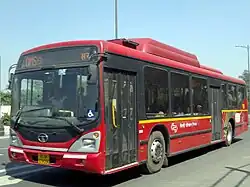
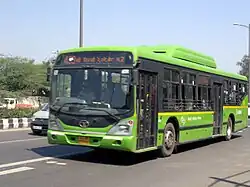
The Delhi Transport Corporation (DTC) is a public sector passenger road transport corporation that manages bus services in the National Capital Territory of Delhi, India. It was incorporated in November 1971 as a wholly owned corporation of the Government of India to provide an efficient, economical and properly coordinated road transport service in Delhi. Its administrative control was transferred to the Department of Transport, Government of Delhi with effect from 5 August 1996.[7]
As of November 2023, DTC was the largest CNG-powered bus service operator in the world.[8][9] In April 2026, DTC has the largest electric bus fleet amongst all public transport operators in India. It operates approximately 6,300 buses, of which 4,538 are electric and 1,759 are CNG.[10][11] It operates from 37 depots and three Interstate Bus Terminals in Delhi: Kashmere Gate ISBT, Anand Vihar ISBT, and Sarai Kale Khan ISBT.
History
The Ministry of Transport, Government of India, took over local bus services in Delhi in May 1948 when the services offered by the incumbent service provider Gwalior and Northern India Transport Company Ltd. was found to be insufficient for the growing demand. For this purpose, a Delhi Road Transport Authority was constituted under the Road Transport Corporation Act, 1950. This authority became an undertaking of Municipal Corporation of Delhi by an Act of Parliament in April 1958.[12]
In 1971, on the recommendations of a working group of the Planning Commission, which concluded that Delhi Transport as an extension of the Municipal Corporation of Delhi had not been functioning efficiently and adequately that was leading to leakage of revenue and very high operational costs, the Government of India took over management of the undertaking by passing the Delhi Road Transport Laws (Amendment) Act.[13] The newly constituted Delhi Transport Corporation took over assets and liabilities from the DTU up until 2 November 1971.
The administrative control of DTC was transferred to the Department of Transport, Government of Delhi, with effect from 5 August 1996 after writing off all the Union government loans along with the interest accrued on them (amounting to ₹2,123 crore (US$220 million)).[14]
Overview
The objectives of the Delhi Transport Corporation are defined under Section 18 of the Delhi Road Transport Laws (Amendment) Act, 1971, in conjunction with Section 22 of the Road Transport Corporation Act, 1950.[15] These objectives encompass the following responsibilities:[12]
- To provide an efficient, economical, reliable and properly coordinated system of road transport in Delhi and any extended area (while acting on business principles).
- To achieve a high level operational efficiency.
- To charge fares not exceeding those prescribed by the State Under Section 43(1)(i) of the Motor Vehicles Act.
- To attain financial self-sufficiency.
Organizational Structure
The management of the Delhi Transport Corporation is overseen by a Board of Directors, which includes the Chairman-cum-Managing Director (CMD) and other directors appointed by the Government of Delhi. The CMD, serving as the organization's Chief Executive, is responsible for managing day-to-day operations. This role is supported by a team comprising four Chief General Managers, six Regional Managers, and Depot Managers.[7]
Services
DTC has an extensive network of bus routes spread all over Delhi. A few routes traverse the neighbouring cities of Noida, Ghaziabad, Gurgaon, and Faridabad. As of June 2023, of the 606 total bus routes in Delhi, 259 were operated by DTC, 209 were operated by DIMTS, and 138 routes were operated on by both the authorities under the Department of Transport's 'Unified Time Table'.[16][17] These routes are serviced by 7,135 buses, with 4,088 of them under DTC, out of 37 depots and 3 ISBTs. The average number of trips in FY 2021-22 was 31,084 per day.[18] The number of routes being operated by the corporation has been steadily falling over the years under the Delhi government's policy of a 50:50 ratio of DTC buses and cluster buses on every route.[19][20]
DTC also provides various other provisions like night services, tourist services, and airport express services.[21] It also provides buses to Delhi Police[22] and used to do so for some schools (however, this was stopped in July 2022).[23][24]
Inter-state bus services
Until 2010, the Delhi Transport Corporation (DTC) operated interstate bus services to cities in North India. These services were discontinued after the fleet transitioned to CNG, a fuel that was not widely available in other states at the time. As of 2023, the Delhi government plans to relaunch interstate services with a fleet of 1,600 premium buses connecting major cities like Dehradun, Jaipur, Shimla, Chandigarh, Amritsar, Jammu, and Agra with Delhi. Under this plan, DTC will manage the services in collaboration with selected private operators. The fleet will include 1,200 electric buses designed for routes up to 200 kilometers (120 miles) and 400 BS-VI CNG buses for longer distances.[25][26][27]
Fleet
As of March 2025, DTC has a fleet of 4,359 buses, with 3,109 CNG buses and 1,250 electric buses.[28] This makes its fleet the largest CNG bus fleet in the world, and the largest electric bus fleet in India.[8][10] The buses are dispatched from 37 bus depots across Delhi.[2] With Delhi's total bus fleet numbering 7,135, 57% of these are operated by the DTC.
DTC has witnessed two major fleet improvements in its history. The first significant overhaul to its fleet happened in anticipation of the 2010 Commonwealth Games,[29] when DTC received 3,125 new CNG low-floor buses (2500 first, followed by 625),[30][31] which increased its fleet size to a high of 6,204 buses.[32] This marked the first time DTC acquired low-floor buses, and since then, all subsequent orders have exclusively been for this type of bus. The new buses consisted of air-conditioned and non-air-conditioned Tata-Marcopolo low-floor Starbuses and Ashok Leyland ultra-low-floor (ULF) buses. The air-conditioned buses were painted red, while the non-air-conditioned ones were painted green, making them easily distinguishable.[33] These new buses had features such as automatic transmission, power steering, ramps for disabled people, and stop-request buttons located on grab bars. With the introduction of these buses, Delhi's fleet of 2,400 privately owned "killer" Blueline buses was gradually phased out.[34][35] In 2011, DTC planned to make use of biogas generated from sewage treatment plants to run its buses.[36]
The second major upgrade to DTC's fleet began in 2021 when the Delhi government decided to exclusively procure electric buses going forward.[37] Subsequently, with deliveries in multiple batches,[38][39][40] DTC's fleet of electric buses has grown to 1,752, making it the largest e-bus fleet in India.[41] The new buses feature digital ticketing, GPS, CCTV, and panic buttons, all connected to a two-way centralised command and control center at Kashmere Gate.[42] The Delhi transport department plans to deploy 2,080 more electric buses in Delhi in 2025.[41]
Depots


DTC manages its operations from 37 bus depots, which are organised into four regions: East, North, South, and West.[43] 36 of these depots are located in Delhi, with 1 located in the neighbouring city of Noida.[2] These facilities handle regular maintenance and cleaning of buses. To complement DTC's existing depots, the Delhi government is constructing 9 additional bus depots at Kirari, East Vinod Nagar 2, Narela, Daurala, Burari, Savda Ghevra, Kapashera, Gadaipur, and Chattarpur.[44][45]
Following are the depots:[2]
| Number | Depot Name |
|---|---|
| 1 | Khanpur Depot |
| 2 | GTB Nagar Depot |
| 3 | Dichaun Kalan Depot |
| 4 | Dwarka Sector 2 Depot |
| 5 | Dwarka Sector 8 Depot |
| 6 | Dwarka Sector 26 Depot |
| 7 | Mayur Vihar II Depot |
| 8 | Ghazipur Depot |
| 9 | Jahangirpuri Depot |
| 10 | Janakpuri-1 Depot |
| 11 | Janakpuri-2 Depot |
| 12 | Patparganj Depot |
| 13 | Okhla Depot |
| 14 | Kanjhawla Depot |
| 15 | Keshopur Depot |
| 16 | Mayapuri Depot |
| 17 | Mundela Kalan Depot |
| 19 | Nand Nagari Depot |
| 19 | Nangloi Depot |
| 20 | Narela Depot |
| 21 | Noida Depot |
| 22 | Paschim Vihar Depot |
| 23 | Rajghat-1 Depot |
| 24 | Rajghat-2 Depot |
| 25 | Rohini Sec-37 Depot |
| 26 | Rohini-1 Depot |
| 27 | Rohini-2 Depot |
| 28 | Rohini-3 Depot |
| 29 | Rohini-4 Depot |
| 30 | Sarojini Nagar Depot |
| 31 | Shadipur-1 Depot |
| 32 | Shadipur-2 Depot |
| 33 | Srinivaspuri Depot |
| 34 | Sukhdev Vihar Depot |
| 35 | Tehkhand Depot |
| 36 | Vasant Vihar Depot |
| 37 | Wazirpur Depot |
Routes rationalisation
The Delhi government commissioned IIT Delhi for a 12-month bus network study from March 2026 to February 2027 "with the objective of improving efficiency, accessibility and overall service quality of Delhi Transport Corporation (DTC) buses".[46][47] The route rationalisation includes 121 routes of East Zone, 181 routes of West Zone, 194 routes of North Zone as well as routes of South Zone.
DTC also plans to utilise IIT Kanpur for digitisation and artificial intelligence (AI) integration for its bus management system.[48]
On July 5, 2026, DTC launched new route 753 ext. to improve central-west connectivity.[49]
Delhi Integrated Multi-Modal Transit System (DIMTS)
The Delhi Integrated Multi-Modal Transit System (DIMTS) is an urban transport and infrastructure development company that was established in 2006 as a 50:50 joint venture between the Government of Delhi and IDFC Foundation.[50][51] As of September 2025, it operated a fleet of 2,700 buses — 1,750 CNG and 839 electric — across Delhi under the cluster scheme, categorised by their colour: orange for non-air-conditioned buses and blue for air-conditioned ones.[52][53] These buses are fitted with GPS devices, which enable real-time tracking of their movement and geographic location through the automatic vehicle location (AVL) system.[54] They are also equipped with electronic ticketing machines (ETMs) as part of an automated fare collection (AFC) system, replacing pre-printed tickets. In January 2018, the Delhi Transport Department began a trial to allow people to use Delhi Metro smart cards for purchasing tickets on these buses.[55]
Under the cluster scheme, private concessionaires are responsible for supplying the buses, ensuring their cleaning and maintenance, and providing staff. In return, they are compensated based on an indexed cost system.[54][56] This system, which includes the components mentioned below, ensures fair compensation while maintaining cost efficiency and service quality.
- A fixed component tied to the cost of the bus,
- A variable component covering fuel and maintenance costs, and
- A wage-related component adjusted according to the Consumer Price Index.
In December 2025, the Delhi government decided to transfer bus operations handled by the DIMTS to DTC by April 2026. With this, all of Delhi's functions related to bus transport would be under a single authority.[57] Since DIMTS charged 3% of operational costs — around ₹60 crore (US$6.2 million) to ₹70 crore (US$7.3 million) — to manage operations, this move is expected to bring significant savings.[58]
See also
References
- ↑ "Delhi bus routes reworked to cut 'dead mileage'; commuters complain of poor frequency, longer wait time". Indian Express. New Delhi. 19 June 2023. Retrieved 15 November 2023.
- 1 2 3 4 "Depot Locator - DTC". dtc.delhi.gov.in. Delhi Transport Corporation. Retrieved 17 November 2023.
- ↑ "Number of pink passes for women in DTC, cluster buses touches 1 bn mark". Press Trust of India. New Delhi. 17 February 2023. Retrieved 14 November 2023.
- ↑ Mathur, Atul (30 December 2022). "Sharp rise in Delhi Transport Corporation's ridership, but losses mount due to gap in operating costs & ticket revenues". Times of India. New Delhi. Retrieved 14 November 2023.
- ↑ "Directory - Delhi Transport Corporation". dtc.delhi.gov.in. Delhi Transport Corporation. Retrieved 15 November 2023.
- ↑ Performance Audit on "Functioning of Delhi Transport Corporation" (PDF). Comptroller and Auditor General of India (Report). New Delhi. 24 March 2025. p. 11. Retrieved 21 September 2025.
- 1 2 "Report of the Comptroller and Auditor General of India on Revenue and Social & Economic Sectors (PSUs) for the year ended 31 March 2015" (PDF). cag.gov.in. CAG of India. 13 June 2016. p. 35. Retrieved 14 November 2023.
- 1 2 Anand, Jatin (6 September 2021). "Dying Delhi Transport Corporation". The Hindu. ISSN 0971-751X. Retrieved 6 September 2021.
- ↑ "City bus transport: Need to chart a new route". 11 June 2016.
- 1 2 "Delhi tops in terms of electric buses after Arvind Kejriwal govt introduces 400 new buses on streets". Live Mint. New Delhi. 8 September 2023. Retrieved 14 November 2023.
- ↑ "Delhi Transport Corporation flags off 200 electric buses".
- 1 2 "Twenty Second Report on Delhi Transport Corporation Including Comparative Analysis of Transport in Metropolitan Cities pertaining to Ministry of Surface Transport" (PDF). eparlib.nic.in. Parliament of India. 30 April 1993. p. 8. Retrieved 15 November 2023.
- ↑ "The Delhi Road Transport Law (Amendment) Act, 1971" (PDF). indiacode.nic.in. Ministry of Law and Justice, Government of India. Retrieved 15 November 2023.
- ↑ "Annual Audit Report - 2019-20" (PDF). transport.delhi.gov.in. Department of Transport, Government of Delhi. p. 22. Retrieved 15 November 2023.
- ↑ "The Road Transport Corporations Act, 1950" (PDF). indiacode.nic.in. Ministry of Law and Justice, Government of India. p. 12. Retrieved 15 November 2023.
- ↑ "Delhi bus routes reworked to cut 'dead mileage'; commuters complain of poor frequency, longer wait time". Indian Express. New Delhi. 19 June 2023. Retrieved 28 November 2023.
- ↑ "Corporatization of Private Stage Carriage Buses Scheme Private". dimts.in. DIMTS. Retrieved 28 November 2023.
DIMTS worked on revamping the entire existing structure and re-grouped the 657 routes of Delhi into 17 economic units termed as distinct route cluster using modelling tool based on digital data. Each route-cluster is to be served by buses of Delhi Transport Corporation (the state transport corporation) and those owned by corporate entities — the latter being selected by a process of competitive bidding — in a 50:50 ratio. Buses of both entities are to operate on every route under a unified time table (UTT) mandated by the State Transport Authority. This makes for optimal utilization and integration of capacity and assets.
- ↑ "Chapter 12, Transport - Economic Survey of Delhi, 2022-23" (PDF). delhiplanning.delhi.gov.in. Delhi government. 20 March 2023. p. 12. Retrieved 28 November 2023.
- ↑ "Citizens Charter (Updated as on July, 2015)" (PDF). transport.delhi.gov.in. Transport Department, Delhi government. Retrieved 28 November 2023.
Government of Delhi has launched a new scheme for corporatization of private stage carriage bus operations in Delhi, in the year 2011. Under this "Cluster Bus Scheme", the city's bus routes have been bundled into seventeen clusters. In each cluster, stage carriage buses will be plied by only two operators, namely, DTC and a private bus company. Under the new scheme 5500 private buses on different routes in Delhi will be plied. DTC and cluster buses operate in 50:50 ratios on every route. The bus operation is based on a Unified Time Table.
- ↑ "Report of the Comptroller and Auditor General of India on Revenue and Social & Economic Sectors (PSUs) for the year ended 31 March 2015" (PDF). cag.gov.in. CAG of India. 31 August 2016. p. 55. Retrieved 28 November 2023.
- ↑ "Services - Delhi Transport Corporation". dtc.delhi.gov.in. DTC. Retrieved 28 November 2023.
- ↑ "Delhi: 360 of 576 buses on special hire to cops brought back". Times of India. New Delhi. 5 February 2021. Retrieved 28 November 2023.
- ↑ "Delhi govt orders withdrawal of 350 DTC buses provided to private schools". Live Mint. New Delhi. 14 July 2022. Retrieved 28 November 2023.
- ↑ Sanyal, Debarghya (22 August 2022). "Delhi schools, students in a jam as state-owned bus fleet is withdrawn". Business Standard. New Delhi. Retrieved 28 November 2023.
- ↑ Mishra, Alok (22 August 2023). "Plans to restart interstate DTC services with 1,600 luxury buses". Hindustan Times. New Delhi. Retrieved 23 November 2023.
- ↑ Rajput, Abhinav (11 January 2023). "Delhi Transport Corporation plans premium buses for long haul". Times of India. New Delhi. Retrieved 23 November 2023.
- ↑ "Delhi government to soon operate premium intercity buses". PTI. New Delhi. 10 January 2023. Retrieved 23 November 2023.
- ↑ "900 New E-Buses To Be Rolled Out Soon". The Times of India. 19 March 2025. ISSN 0971-8257. Retrieved 6 April 2025.
- ↑ Singh, Prakash (9 September 2023). "Delhi Transport Corporation (DTC) buses". gettyimages.in. Prakash Singh. Retrieved 28 November 2023.
Delhi Transport Corporation (DTC) is acquiring a fleet of over 3,000 modern, low-floor buses to roll out the best transportation services during the Oct 3-14 Commonwealth Games.
- ↑ "Report No. 6 of 2011 – Performance Audit of XIXth Commonwealth Games". cag.gov.in. CAG of India. 5 August 2011. p. 757. Retrieved 28 November 2023.
During 2008-09, DTC procured 2500 low floor buses (1000 AC and 1500 Non-AC) at an inordinately high price, which was reported by us in Para 5.2.6 of Report of the CAG (Civil and Commercial), GNCTD, for the year ended March 2009. We found that between September and November 2009, DTC procured additional 625 buses at the same high price, exercising an option clause, which cost the exchequer an additional Rs. 61.10 crore over the justified cost.
- ↑ "Cummins bags DTC order for 3,125 CNG engines". motorindiaonline. Motor India. 18 November 2008. Retrieved 8 December 2023.
Cummins Westport Inc. (CWI), a leading provider of high-performance alternative fuel engines for the global market, and Cummins India Ltd. (CIL) have announced that the Delhi Transport Corporation (DTC) has placed an order for 3,125 natural gas buses equipped with CWI's B Gas Plus engines. The 230 hp B Gas Plus engines, powered by compressed natural gas (CNG), are licensed by CWI and manufactured by CIL.
- ↑ "Baseline Report - Enabling Strategic Plan: Master Plan for Delhi 2041" (PDF). online.dda.org.in. DDA. 16 July 2021. Retrieved 28 November 2023.
- ↑ "DTC Buses: Red, Green and Orange - What do they stand for?". New Delhi. 6 May 2019. Retrieved 28 November 2023.
- ↑ "Blueline buses to be off Delhi roads from December 14". PTI. New Delhi. 25 October 2010. Retrieved 28 November 2023.
- ↑ Mathur, Atul (28 June 2012). "Blueline's 20-year killer run comes to a close". Hindustan Times. New Delhi. Retrieved 28 November 2023.
- ↑ Lalchandani, Neha (10 October 2011). "DTC buses to run on biofuel". Times of India. New Delhi. Retrieved 28 November 2023.
- ↑ Goswami, Sweta (27 October 2021). "Only e-buses will be added to city fleet in future: Kailash Gahlot". Hindustan Times. New Delhi. Retrieved 9 December 2021.
- ↑ "Delhi to enjoy free rides on DTC's e-buses for three days, starting Tuesday". Indian Express. New Delhi. 23 May 2022. Retrieved 28 November 2023.
- ↑ "Delhi CM Arvind Kejriwal flags off 150 electric buses, commuters to get free rides for 3 days". Economic Times. New Delhi. 24 May 2022. Retrieved 28 November 2023.
- ↑ "By 2025-end, Delhi to add 4k electric buses in phases". ANI. New Delhi. 28 November 2023. Retrieved 28 November 2023.
- 1 2 "Delhi transport dept to add 2 000 e-buses to its fleet this year". The Week. Retrieved 22 April 2025.
- ↑ "Delhi expands electric bus fleet: 400 new buses flagged off". ANI. New Delhi. 5 September 2023. Retrieved 15 November 2023.
- ↑ "DTC at a Glance". dtc-elearning.com. DTC Training School. Retrieved 23 November 2023.
- ↑ "World-class bus service station at Savda Ghevra soon: Delhi minister Kailash Gahlot". Times of India. New Delhi. 21 April 2023. Retrieved 28 November 2023.
- ↑ "Delhi Transport Minister Kailash Gahlot Lays Foundation Stone Of Kirari Bus Depot". PTI. New Delhi. 9 April 2023. Retrieved 28 November 2023.
- ↑ "IIT Delhi asked to prepare a route rationalisation study for DTC".
- ↑ "Riding a DTC bus? Your feedback may be taken to help improve connectivity, services".
- ↑ "DTC plans to rope in IIT Kanpur for overhaul of capital bus management system".
- ↑ "Delhi Govt launches DTC Route 753 Extension bus service to improve Central-West connectivity".
- ↑ "Organization Brief - Delhi Integrated Multi Modal Transit System". dimts.in. Retrieved 9 December 2022.
- ↑ "Response to reports in the media on audit of DIMTS by CAG and references to the allegations made in the previous CAG reports against DIMTS and its projects". DIMTS. 30 January 2014. Archived from the original on 1 July 2023. Retrieved 26 April 2026.
DIMTS as mentioned above is a 50:50 joint venture of Government of Delhi and IDFC Foundation (a not-for-profit company constituted under section 25 of The Companies Act, 1956).
- ↑ Mishra, Alok (5 October 2025). "Delhi speeds towards e-transit: DTC phases out iconic red and green buses; CNG fleet to exit by December". Times of India. Retrieved 26 April 2026.
- ↑ "Explore 4 different Types of DTC buses: A Reliable Commute". dtcbus.co.in. Archived from the original on 7 December 2023. Retrieved 26 April 2026.
- 1 2 "Fleet Management - Corporatization of Private Stage Carriage Buses Scheme Private". DIMTS. Archived from the original on 1 July 2023. Retrieved 26 April 2026.
- ↑ "Now travel in 250 Delhi buses with your Metro cards". Hindustan Times. 4 January 2018. Archived from the original on 26 April 2026. Retrieved 26 April 2026.
- ↑ Banerjee, Rumu (21 October 2011). "Delhi's cluster bus scheme drain on govt coffers". Times of India. Retrieved 26 April 2026.
- ↑ "Delhi govt gives nod to transfer of bus services from DIMTS to DTC". PTI. The Week. 23 December 2025. Retrieved 26 April 2026.
- ↑ Sinha, Snehil (24 December 2025). "Delhi to bid adieu to its much-loved cluster buses". Hindustan Times. Retrieved 26 April 2026.
External links


Public transportation in Greater Delhi | |
|---|---|
 Delhi Metro lines | |
| Other urban rail | |
| Commuter/intercity |
|
| Urban bus |
|
| Major terminals |
|
| Misc.transport |
|
| |


