Delaware statutory trust
| This article is part of a series on |
| Corporate law |
|---|
 |

A Delaware statutory trust (DST) is an unincorporated association created under Delaware law through a governing instrument. It may be formed to conduct business or professional activities, or to hold and manage property.[1] Unless its certificate of trust or governing instrument provides otherwise, a DST is a separate legal entity.[1] An interest in a DST that holds real property may qualify as replacement property in a Section 1031 like-kind exchange when the trust and transaction satisfy the conditions described by the Internal Revenue Service (IRS).[2][3]
History
The Delaware Statutory Trust Act was enacted in 1988 and is codified in Title 12, Chapter 38 of the Delaware Code.[1] The statute originally used the term "business trust"; Delaware changed the statutory name to "statutory trust" in 2002.[1]
Formation and governance
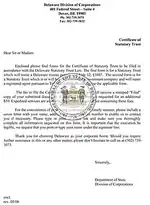
A DST's governing instrument establishes its affairs and the rights and powers of its trustees and beneficial owners. The instrument may consist of one or more agreements and generally is not filed with the state.[1] To form a DST, its trustees file a certificate of trust with the Delaware Secretary of State. The certificate must state the trust's name and the name and address of at least one trustee who satisfies the statutory requirements.[1] The Delaware Division of Corporations publishes forms for trusts that name a Delaware trustee and for registered investment companies that name a registered agent.[4] Under the statute, beneficial owners generally receive the same limitation on personal liability as stockholders of Delaware corporations. Trustees generally are not personally liable to another person for obligations of the trust solely by reason of serving as trustees. A governing instrument may modify these rules.[1]
Federal tax treatment and Section 1031
In Revenue Ruling 2004-86, the IRS considered a DST that held rental real estate. The IRS held that the described DST was an investment trust for federal tax purposes. It also held that a taxpayer could exchange real property for an interest in that DST without recognizing gain or loss under Section 1031, provided the other requirements of Section 1031 were satisfied.[2] The ruling concerned a trust agreement that limited the trustee's powers after the offering closed. Among other things, the agreement did not allow the trustee to:[2]
- accept additional capital contributions;
- renegotiate existing loans or obtain new financing, except in limited circumstances following a tenant's bankruptcy or insolvency;
- reinvest proceeds from the sale of the real estate;
- make more than minor, nonstructural capital improvements, except as required by law;
- invest reserves in anything other than short-term debt obligations;
- retain cash beyond necessary reserves; or
- enter into new leases or renegotiate existing leases, except in limited circumstances following a tenant's bankruptcy or insolvency.
The ruling applies to the arrangement it describes and does not mean that every DST interest automatically qualifies for Section 1031 treatment.[2]
References
- 1 2 3 4 5 6 7 "Title 12, Chapter 38: Treatment of Delaware Statutory Trusts". Delaware Code Online. State of Delaware. Retrieved 2026-08-26.
- 1 2 3 4 "Internal Revenue Bulletin: 2004-33". Internal Revenue Service. 2004-08-16. Retrieved 2026-08-26.
- ↑ "What Is a Delaware Statutory Trust (DST)?". 1031 Exchange. Retrieved 2026-08-26.
- ↑ "Corporate Forms and Certificates for a Statutory Trust". Delaware Division of Corporations. State of Delaware. Retrieved 2026-08-26.