December 1573 lunar eclipse
| Total eclipse | |||||||||||||||||
 | |||||||||||||||||
| Date | December 8, 1573 | ||||||||||||||||
|---|---|---|---|---|---|---|---|---|---|---|---|---|---|---|---|---|---|
| Gamma | 0.1620 | ||||||||||||||||
| Magnitude | 1.5597 | ||||||||||||||||
| Saros cycle | 118 (27 of 73) | ||||||||||||||||
| Totality | 93 minutes, 31 seconds | ||||||||||||||||
| Partiality | 213 minutes, 17 seconds | ||||||||||||||||
| Penumbral | 330 minutes, 53 seconds | ||||||||||||||||
| |||||||||||||||||
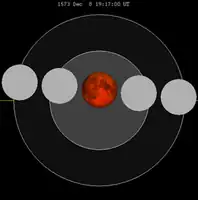
A total lunar eclipse occurred at the Moon's ascending node of orbit on Tuesday,[1] December 8, 1573,[2] with an umbral magnitude of 1.5597. A lunar eclipse occurs when the Moon moves into the Earth's shadow, causing the Moon to be darkened. A total lunar eclipse occurs when the Moon's near side entirely passes into the Earth's umbral shadow. Unlike a total solar eclipse, which can only be viewed from a relatively small area of the world, a lunar eclipse may be viewed from anywhere on the night side of Earth. A total lunar eclipse can last up to nearly two hours, while a total solar eclipse lasts only a few minutes at any given place, because the Moon's shadow is smaller. Occurring about 2.4 days after perigee, the Moon's apparent diameter was larger than average.[3]
Visibility
The eclipse was visible across all of Africa, Europe, and Asia and most of Australia.
- Eclipse visibility diagrams
 Simulated view of Earth from the Moon during the eclipse
- The Moon passed west to east through the center of the Earth's umbral shadow, causing a very dark red eclipse
Observations
It was predicted and then observed by a young Tycho Brahe (assisted by his sister Sophia) at Knutstorp Castle. He said, "I cannot but be very surprised that even at this youthful age of 26 years, I was able to get such accurate results."[4] During the eclipse, the Moon was in the constellation Gemini.[3]
 Diagram of the appearance of the eclipse from Tycho Brahe's De nova stella
 Diagram of the Solar System at the time of the eclipse from Tycho Brahe's De nova stella
Eclipse details
Shown below is a table displaying details about this particular lunar eclipse. It describes various parameters pertaining to this eclipse.[3]
| Parameter | Value |
|---|---|
| Penumbral Magnitude | 2.56170 |
| Umbral Magnitude | 1.55966 |
| Gamma | 0.16203 |
| Sun Right Ascension | 17h46m12.8s |
| Sun Declination | -23°27'24.2" |
| Sun Semi-Diameter | 16'16.0" |
| Sun Equatorial Horizontal Parallax | 08.9" |
| Moon Right Ascension | 05h46m07.6s |
| Moon Declination | +23°36'58.9" |
| Moon Semi-Diameter | 16'14.0" |
| Moon Equatorial Horizontal Parallax | 0°59'34.6" |
| ΔT | 132.3 s |
See also
References
- ↑ "Calendar for Year 1573 (United Kingdom)". www.timeanddate.com. Retrieved August 26, 2026.
- ↑ Espenak, F. (June 7, 2009). "Total Lunar Eclipse of 1573 Dec 08" (PDF). eclipse.gsfc.nasa.gov/eclipse.html. Archived (PDF) from the original on June 25, 2009.
- 1 2 3 Espenak, Fred. "Total Lunar Eclipse of 1573 Dec 08". www.EclipseWise.com. Archived from the original on September 19, 2025. Retrieved August 26, 2026.
- ↑ Espenak, Fred. "Lunar Eclipses of Historical Interest". Archived from the original on May 15, 2014. Retrieved December 28, 2009.
External links
- Curriculum vitae of Tycho Brahe Tycho observes a lunar eclipse together with his 17-year-old sister Sophie. From the observation he finds the perigee of the Sun.
- Sophie Brahe, 1556-1643
- Brahe, Tycho, Complete Dictionary of Scientific Biography
- NASA graphics


