Değirmenüstü, Beşiri
Değirmenüstü | |
|---|---|
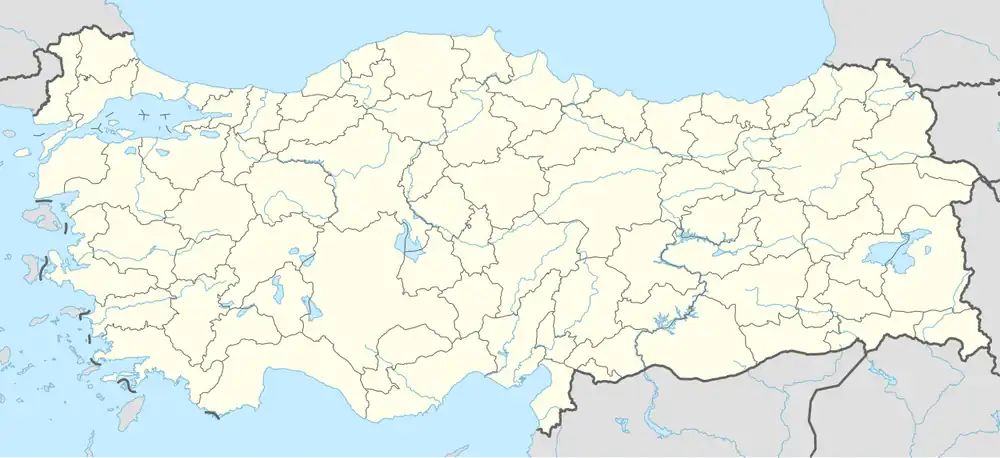  Değirmenüstü Location within Turkey | |
| Coordinates: 37°51′58″N 41°20′35″E / 37.866°N 41.343°E | |
| Country | Turkey |
| Province | Batman |
| District | Beşiri |
| Population (2021)[1] | 358 |
| Time zone | UTC+3 (TRT) |
Değirmenüstü (Kurdish: Azika Jor; Syriac: Azkī)[2][a] is a village in the Beşiri District of Batman Province in Turkey.[4] The village is populated by Kurds of the Reman tribe and had a population of 358 in 2021.[1][5]
History
Azkī (today called Değirmenüstü) was historically inhabited by Kurdish-speaking Syriac Orthodox Christians, Armenians, and Church of the East Christians.[6] In the Syriac Orthodox patriarchal register of dues of 1870, it was recorded that the village had 7 households, who paid 45 dues, and did not have a church or a priest.[2] There were 5 Armenian hearths in 1880.[7] It was located in the Beşiri kaza in the Diyarbakır sanjak in the Diyarbekir vilayet in c. 1900.[8] It was populated by 100 Syriacs in 1914, according to the list presented to the Paris Peace Conference by the Assyro-Chaldean delegation.[9][b] The Armenians were attacked by the Belek, Bekran, Şegro, and other Kurdish tribes in May 1915 amidst the Armenian genocide.[10]
References
Notes
Citations
- 1 2 "31 ARALIK 2021 TARİHLİ ADRESE DAYALI NÜFUS KAYIT SİSTEMİ (ADNKS) SONUÇLARI" (XLS). TÜİK (in Turkish). Retrieved 16 December 2022.
- 1 2 Bcheiry (2009), p. 44.
- ↑ Jongerden & Verheij (2012), p. 319; Kévorkian (2006), p. 270; Bcheiry (2009), p. 44.
- ↑ "Türkiye Mülki İdare Bölümleri Envanteri". T.C. İçişleri Bakanlığı (in Turkish). Retrieved 19 December 2022.
- ↑ Aşiretler raporu (in Turkish) (3rd ed.). Kaynak Yayınları. 2014. p. 273.
- ↑ Jongerden & Verheij (2012), pp. 248, 319.
- ↑ Kévorkian (2006), p. 270.
- ↑ Jongerden & Verheij (2012), p. 319.
- 1 2 Jongerden & Verheij (2012), p. 319; Gaunt (2006), p. 427.
- ↑ Kévorkian (2011), pp. 367–368.
Bibliography
- Bcheiry, Iskandar (2009). The Syriac Orthodox Patriarchal Register of Dues of 1870: An Unpublished Historical Document from the Late Ottoman Period. Gorgias Press. Retrieved 21 March 2025.
- Gaunt, David (2006). Massacres, Resistance, Protectors: Muslim-Christian Relations in Eastern Anatolia during World War I. Gorgias Press. Retrieved 21 May 2023.
- Jongerden, Joost; Verheij, Jelle, eds. (2012). Social Relations in Ottoman Diyarbekir, 1870-1915. Brill. Retrieved 20 November 2024.
- Kévorkian, Raymond H. (2006). "Demographic Changes in the Armenian Population of Diarbekir, 1895-1914". In Richard G. Hovannisian (ed.). Armenian Tigranakert/Diarbekir and Edessa/Urfa. Mazda Publishers. pp. 250–284. Retrieved 20 April 2025.
- Kévorkian, Raymond (2011). The Armenian Genocide: A Complete History. I.B. Tauris.