Crommelin (lunar crater)
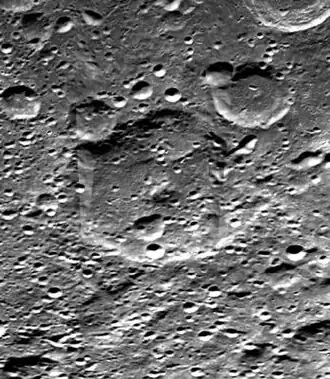 Clementine mosaic | |
| Coordinates | 68°06′S 146°54′W / 68.1°S 146.9°W |
|---|---|
| Diameter | 93.48 km (58.09 mi)[1] |
| Depth | Unknown |
| Colongitude | 152° at sunrise |
| Formation | Pre-Nectarian[2] |
| Eponym | Andrew C. D. Crommelin |

Crommelin is an ancient lunar impact crater that is located in the vicinity of the south pole of the Moon, on the far side.[3] It lies within the South Pole-Aitken basin, to the north of the large crater Zeeman, and to the east-northeast of Numerov. To the north of Crommelin is Lemaître.[4]
On the lunar geologic timescale, Crommelin dates to the Pre-Nectarian period.[2] This formation has been almost completely degraded by subsequent impacts, leaving little more than a crater-riddled depression in the surface. There is an equally worn crater lying across the northern rim, and Crommelin X is attached to the outward-bulging northwest perimeter.[5]: 142
The largest of the craterlets within the interior form a pair near the southern rim. There is a slight central peak, consisting of little more than a low rise in the surface. The spectra of the central peak fits an olivine-bearing gabbroic norite mineralogy, which was excavated from a depth of 3.5 to 9.4 km.[6]
This crater is named after British astronomer Andrew C. D. Crommelin (1865–1939), an expert on comets (1865-1939).[7] Its designation was formally adopted by the International Astronomical Union in 1970.[1]
Satellite craters
By convention these features are identified on Lunar maps by placing the letter on the side of the crater midpoint that is closest to Crommelin.[8]
| Crommelin[5]: 296 | Latitude | Longitude | Diameter |
|---|---|---|---|
| C | 66.4° S | 144.8° W | 44 km |
| W | 66.0° S | 152.7° W | 24 km |
| X | 66.3° S | 150.0° W | 26 km |
References
- 1 2 "Crommelin". Gazetteer of Planetary Nomenclature. USGS Astrogeology Research Program. Retrieved 2026-07-14.
- 1 2 Moriarty, D. P.; Pieters, C. M. (March 2018). "The Character of South Pole-Aitken Basin: Patterns of Surface and Subsurface Composition". Journal of Geophysical Research: Planets. 123 (3): 729–747. Bibcode:2018JGRE..123..729M. doi:10.1002/2017JE005364.
- ↑ Moore, Patrick (2000). The Data Book of Astronomy. CRC Press. p. 67. ISBN 978-1-4200-3344-1.
- ↑ Byrne, Charles J. (2008). The Far Side of the Moon. Springer. p. 72. ISBN 978-1-4899-8806-5.
- 1 2 Bussey, B.; Spudis, P. (2004). The Clementine Atlas of the Moon. New York: Cambridge University Press. ISBN 978-0-521-81528-4.
- ↑ Cahill, J. T. S.; et al. (September 2009). "Compositional variations of the lunar crust: Results from radiative transfer modeling of central peak spectra". Journal of Geophysical Research. 114 (E9) E09001. Bibcode:2009JGRE..114.9001C. doi:10.1029/2008JE003282.
- ↑ Menzel, D. H.; et al. (1971). "Report on Lunar Nomenclature by the Working Group of Commission 17 of the IAU". Space Science Reviews. 12 (2): 136–186. Bibcode:1971SSRv...12..136M. doi:10.1007/BF00171763. S2CID 122125855.
- ↑ Grego, P. (2015). "Satellite Crater". In Hargitai, H.; Kereszturi, Á. (eds.). Encyclopedia of Planetary Landforms. New York, NY: Springer. doi:10.1007/978-1-4614-3134-3_328.
Sources
- Price, Fred W. (1988). The Moon Observer's Handbook. Cambridge University Press. ISBN 978-0-521-33500-3.
- Rükl, Antonín (1990). Atlas of the Moon. Kalmbach Books. ISBN 978-0-913135-17-4.
- Wlasuk, Peter T. (2000). Observing the Moon. Springer. ISBN 978-1-85233-193-1.
| Physical properties |  | |
|---|---|---|
| Orbit | ||
| Surface and features | ||
| Science | ||
| Exploration | ||
| Time-telling and navigation | ||
| Phases and names | ||
| Daily phenomena | ||
| Related |
| |
