Zeeman (crater)
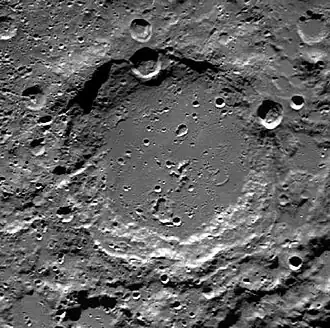 Clementine mosaic | |
| Coordinates | 75°12′S 134°48′W / 75.2°S 134.8°W |
|---|---|
| Diameter | 184 km |
| Depth | Unknown |
| Colongitude | 135° at sunrise |
| Formation | Nectarian[1] |
| Eponym | Pieter Zeeman |

Zeeman is a lunar impact crater located on the far side of the Moon near its south pole.[2] It is not directly visible from the Earth. To the northwest of Zeeman lies the crater Numerov. Southeast of the rim is the crater Ashbrook.
On the lunar geologic timescale, this formation dates to the Nectarian period.[1] The outer rim of Zeeman is eroded somewhat irregularly, with considerable variation in width of the inner slopes. The crater Zeeman Y lies across the northern wall, reaching almost to the relatively flat interior floor. In the western rim is a small crater that joins a gash that runs down to the floor. The surface of the interior is pock-marked by many tiny craterlets, and worn crater features. There is a low central rise, offset to the southeast of the interior midpoint. The infrared spectrum of pure crystalline plagioclase has been identified on this peak.[3]
An unusual, (officially) unnamed massif is present in the northwest section of the rim, which rises about 4.0 km above adjacent parts of the rim and about 7.57 km above the crater floor.[4] The formation of the massif does not appear to be explainable simply on the basis of the impact that created the crater.[5]
Satellite craters
By convention these features are identified on lunar maps by placing the letter on the side of the crater midpoint that is closest to Zeeman.
| Zeeman | Latitude | Longitude | Diameter |
|---|---|---|---|
| E | 74.2° S | 123.9° W | 29 km |
| G | 74.3° S | 107.4° W | 45 km |
| U | 73.8° S | 148.2° W | 26 km |
| X | 71.5° S | 138.1° W | 26 km |
| Y | 72.8° S | 137.6° W | 33 km |
Conspiracy theories
There have been claims that a rectangular shape located on the Zeeman crater is an alien structure and that it was evidence of "foul play at the US Government".[6] The Clementine Conspiracy or Project Golden Dragon is a conspiracy theory that started as a result of the Clementine mission. It posed that located within the Zeeman crater there is an alien machine or a weapon developed by the US government.[7]
References
- 1 2 Moriarty, D. P.; Pieters, C. M. (March 2018). "The Character of South Pole-Aitken Basin: Patterns of Surface and Subsurface Composition". Journal of Geophysical Research: Planets. 123 (3): 729–747. Bibcode:2018JGRE..123..729M. doi:10.1002/2017JE005364.
- ↑ Moore, Patrick (2000). The Data Book of Astronomy. CRC Press. p. 72. ISBN 978-1-4200-3344-1.
- ↑ Donaldson Hanna, K. L.; et al. (July 2014). "Global assessment of pure crystalline plagioclase across the Moon and implications for the evolution of the primary crust". Journal of Geophysical Research: Planets. 119 (7): 1516–1545. Bibcode:2014JGRE..119.1516D. doi:10.1002/2013JE004476.
- ↑ Robinson, M. (November 20, 2017). "Mountains of the Moon: Zeeman Mons". LROC.sese.asu. Arizona State University. Retrieved 5 September 2020.
- ↑ Ruefer, A. C.; James, P. B. (March 2020). "Zeeman Crater's Anomalous Massif" (PDF). 51st Lunar and Planetary Science Conference. p. 2673. Bibcode:2020LPI....51.2673R.
- ↑ Kettley, Sebastian (March 10, 2019). "Alien base on the Moon? Google map is '100 percent PROOF of ET base'". Express.co.uk. Retrieved 2026-04-17.
- ↑ Fougerousse, Peter (June 8, 2017). "The Clementine Conspiracy: Unveiling the Biggest Secret of Mankind". Gratis Global. Retrieved 2026-04-17.
Sources
- Andersson, L. E.; Whitaker, E. A. (1982). NASA Catalogue of Lunar Nomenclature. NASA RP-1097.
- Blue, Jennifer (July 25, 2007). "Gazetteer of Planetary Nomenclature". USGS. Retrieved 2007-08-05.
- Bussey, B.; Spudis, P. (2004). The Clementine Atlas of the Moon. New York: Cambridge University Press. ISBN 978-0-521-81528-4.
- Cocks, Elijah E.; Cocks, Josiah C. (1995). Who's Who on the Moon: A Biographical Dictionary of Lunar Nomenclature. Tudor Publishers. ISBN 978-0-936389-27-1.
- McDowell, Jonathan (July 15, 2007). "Lunar Nomenclature". Jonathan's Space Report. Archived from the original on 2012-02-08. Retrieved 2007-10-24.
- Menzel, D. H.; Minnaert, M.; Levin, B.; Dollfus, A.; Bell, B. (1971). "Report on Lunar Nomenclature by the Working Group of Commission 17 of the IAU". Space Science Reviews. 12 (2): 136–186. Bibcode:1971SSRv...12..136M. doi:10.1007/BF00171763. S2CID 122125855.
- Moore, Patrick (2001). On the Moon. Sterling Publishing Co. ISBN 978-0-304-35469-6.
- Price, Fred W. (1988). The Moon Observer's Handbook. Cambridge University Press. ISBN 978-0-521-33500-3.
- Rükl, Antonín (1990). Atlas of the Moon. Kalmbach Books. ISBN 978-0-913135-17-4.
- Webb, Rev. T. W. (1962). Celestial Objects for Common Telescopes (6th revised ed.). Dover. ISBN 978-0-486-20917-3.
{{cite book}}: ISBN / Date incompatibility (help) - Whitaker, Ewen A. (1999). Mapping and Naming the Moon. Cambridge University Press. ISBN 978-0-521-62248-6.
- Wlasuk, Peter T. (2000). Observing the Moon. Springer. ISBN 978-1-85233-193-1.