Clifford Ross Powell
Clifford Ross Powell | |
|---|---|
 | |
| Acting Governor of New Jersey | |
| In office January 3, 1935 – January 8, 1935 | |
| Preceded by | Arthur H. Moore |
| Succeeded by | Horace G. Prall (acting) |
| Member of the New Jersey State Senate from Burlington County | |
| In office 1928–1940 | |
| Preceded by | Emmor Roberts |
| Succeeded by | Howard Eastwood |
| Member of the New Jersey State Assembly | |
| In office 1922–1925 | |
| 22nd Chief of Staff of New Jersey | |
| In office 1947–1948 | |
| Preceded by | James Isaiah Bowers |
| Succeeded by | Edward C. Rose |
| Personal details | |
| Born | July 26, 1893 |
| Died | March 28, 1973 (aged 79) |
| Party | Republican |
| Military service | |
| Allegiance |  United States |
| Branch/service |  New Jersey National Guard  United States Army |
Years of service | 1913–1948 |
| Rank |  Major General |
| Battles/wars | World War I World War II |
| Awards | Legion of Merit Bronze Star Medal Purple Heart Croix de Guerre New Jersey Distinguished Service Medal |
Clifford Ross Powell (July 26, 1893 – March 28, 1973) was an American attorney, Republican politician, acting governor of New Jersey, and major general in the New Jersey National Guard. [1] During World War II, he served as commander of the 44th Infantry Division and later as Chief of Psychological Warfare for the Twelfth United States Army Group in the European Theater of Operations.
Powell served in the New Jersey General Assembly, where he was majority leader and speaker, and later represented Burlington County in the New Jersey Senate. As president of the Senate, he briefly served as acting governor of New Jersey in January 1935.
Biography
He was born in Lumberton Township, New Jersey on July 26, 1893.[1] He was educated at Mount Holly High School, studied law, and attained admission to the bar. Powell practiced in Mount Holly, New Jersey, and served as an Assistant County Prosecutor for Burlington County, New Jersey and the city or town attorney for several Burlington County municipalities.[2]
Powell enlisted in the New Jersey National Guard as a private in 1913, and advanced to the rank of sergeant. He served in the United States Army during World War I, receiving a commission in the Aviation branch. During World War I, Powell served with the French 9th Bombardment Group and participated in six major operations. He was shot down and wounded on June 1, 1918, and his flight record credited him with the destruction of two enemy aircraft and participation in bombing raids. His World War I decorations included the Purple Heart, the French Croix de Guerre, and the New Jersey Distinguished Service Medal. [3][4]
In 1922 he was elected to the New Jersey State Assembly. He was Majority Leader in 1924, and served as Speaker in 1925.[5][6][7]
He was a member of the New Jersey Senate from Burlington County, New Jersey from 1928 to 1939. He served as acting governor for the last five days of his tenure as President of the New Jersey Senate, after A. Harry Moore resigned to take a seat in the United States Senate.[8] In his brief time as acting governor, he took the opportunity to abolish the New Jersey State Recovery Administration, the state-level counterpart of the National Recovery Administration, which had been establishing minimum prices and other "fair competition" codes.[9] He ran unsuccessfully for governor in 1937.[10][11][12]
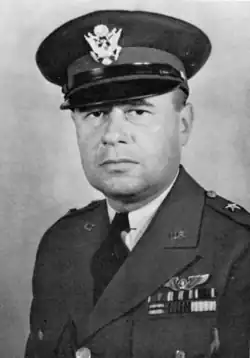
In 1941, Powell was promoted to major general in the New Jersey National Guard and commanded the 44th Infantry Division. [13] He was relieved of division command after the 1941 GHQ maneuvers in North and South Carolina. [14] [15][16] After the United States entered World War II, Powell returned to active duty as a colonel in the Army of the United States.
In the European Theater, Powell served with the Publicity and Psychological Warfare organization of the Twelfth United States Army Group.[17] The New Jersey Department of Military and Veterans Affairs describes him as Chief of Psychological Warfare, 12th U.S. Army Group. [18] A 1945 history of the Second Mobile Radio Broadcasting Company identifies him as Psychological Warfare Officer, Twelfth Army Group, and records that requests for tactical psychological warfare support reached Powell in Paris, where he assigned officers to organize the Psychological Warfare Combat Team, First United States Army. [19]
Before the Normandy invasion, Powell helped plan tactical psychological warfare activities for the coming campaign. The history of the 2d Mobile Radio Broadcasting Company states that Powell’s representatives interviewed trained personnel at Clevedon while Powell was planning the overall tactical psychological warfare activities for the invasion. [19] Twelfth Army Group psychological warfare activities included tactical leaflets, mobile radio broadcasting, loudspeaker appeals, prisoner-of-war interrogation for morale intelligence, tactical newspapers, and support to information-control operations in occupied Germany. A commendation issued by Headquarters, 12th Army Group Publicity and Psychological Warfare credited the Second Mobile Radio Broadcasting Company with making a substantial contribution to psychological warfare operations in support of 12th Army Group military operations. Historian Daniel Lerner later described the Twelfth Army Group under Powell as a major American field center of Allied psychological warfare on the Continent.[20] After the war, Powell and Brigadier General Robert A. McClure served as consultants for the General Board study Psychological Warfare in the European Theater of Operation, Study No. 131. [21][22]
Powell continued to serve in the New Jersey National Guard until his military retirement in 1948. [23][24] As commander of the New Jersey National Guard after World War II, Powell was involved in New Jersey’s early effort to desegregate its Guard units. In 1947, after New Jersey adopted a constitution prohibiting racial segregation in the militia, Governor Alfred E. Driscoll identified Powell as organizing the headquarters of the 372nd Anti-Aircraft Artillery Group as a mixed unit and eliminating segregated armories.[25]
A resident of Lumberton Township, New Jersey, he died on March 28, 1973, at Burlington County Memorial Hospital.[1]
References
- 1 2 3 "Gen. Clifford R. Powell, 80; Jersey Senator Led Guard". The New York Times. March 31, 1973. p. 38. Retrieved June 14, 2007.
- ↑ Josephine A. Fitzgerald, Publisher, Fitzgerald's Legislative Manual, 1922, pages 310 to 311
- ↑ Powell. "The Adjutants General of New Jersey". nj.gov. New Jersey Department of Military and Veterans Affairs. Retrieved June 2, 2026.
- ↑ Who's Who in American Aeronautics, Biography, Clifford Ross Powell, 1922, page 84
- ↑ James Roger Sharp, American Legislative Leaders in the Northeast, 1911–1994, 2000, page 178
- ↑ New Jersey Legislature, Minutes of Votes and Proceedings, 1925, pages 7, 443, 1228
- ↑ Thomas F. Fitzgerald, Fizgerald's Legislative Manual, 1971, page 201
- ↑ Peterson, Iver (October 21, 2001). "On Politics: The State's Next Governor? It Isn't Who You Think It Is". The New York Times. p. 14NJ-2. Retrieved July 21, 2009.
- ↑ Buritt, Richard D. (January 13, 1935). "Republican's Coup Ends Jersey Codes". The New York Times. p. E6.
- ↑ New York Times, Powell to Oppose Dr. Glee in Jersey, July 16, 1937
- ↑ New York Times, Jersey Republicans Open Primary Fight, August 19, 1937
- ↑ Chicago Tribune, Jersey Pastor Victor in G.O.P. Governor Race[link removed], September 22, 1937
- ↑ New York Times, Powell Takes Over Command of Fort Dix; Denies Rumors 44th Division Will Go South, October 26, 1940
- ↑ Reports Powell Relieved of Post; Washington Times-Herald Says He Has Been Succeeded by Muir in Command of 44th, The New York Times, October 8, 1941
- ↑ Christopher Richard Gabel, US Army GHQ Maneuvers of 1941, 1991, page 207
- ↑ John J. Toffey IV, Jack Toffey's War: A Son's Memoir, 2008, pages 23 to 24
- ↑ Friedman, Herb. "The United States PSYOP Organization in Europe During World War II". www.psywarrior.com. Retrieved December 4, 2025.
- ↑ "The Adjutants General of New Jersey" (PDF). New Jersey Department of Military and Veterans Affairs. p. 28. Retrieved June 1, 2026.
- 1 2 Digital Collections, The New York Public Library. "History, Second Mobile Radio Broadcasting Company, December 1943-May 1945. (1945)". The New York Public Library, Astor, Lenox, and Tilden Foundations. Retrieved June 2, 2026.
- ↑ Lerner, Daniel (1971) [1949]. Psychological Warfare Against Nazi Germany: The Sykewar Campaign, D-Day to VE-Day. MIT Press. p. 66. ISBN 978-0-262-62019-2.
- ↑ The General Board, United States Forces, European Theater (1945). Psychological Warfare in the European Theater of Operations, Study No. 131 (PDF) (Report). Reports of the General Board, United States Forces, European Theater. United States Forces, European Theater. Retrieved June 2, 2026.
{{cite report}}: CS1 maint: multiple names: authors list (link) - ↑ U.S. Army and the Interagency Process: Historical Perspectives: The Proceedings of the Combat Studies Institute 2008 Military History Symposium (PDF). Combat Studies Institute Press. 2008. p. 324. Retrieved June 1, 2026.
- ↑ New York Times, Powell Retires From Guard Post, November 17, 1948
- ↑ New York Times, Driscoll, Powell Clash on Politics; Guard Chief in Jersey Resigns, March 9, 1948
- ↑ Olsen, Mark. "New Jersey National Guard pioneered segregation's end". Air National Guard. Air National Guard. Retrieved June 3, 2026.
External links
|  | |
| | |
- 1893 births
- 1973 deaths
- Politicians from Burlington County, New Jersey
- Republican Party governors of New Jersey
- Speakers of the New Jersey General Assembly
- Republican Party members of the New Jersey General Assembly
- Republican Party New Jersey state senators
- People from Lumberton, New Jersey
- Presidents of the New Jersey Senate
- United States Army generals
- United States Army personnel of World War I
- United States Army generals of World War II
- Military personnel from Burlington County, New Jersey
- 20th-century members of the New Jersey Legislature