+ reduced
ferredoxin
Cholestanetriol 26-monooxygenase
| Cholestanetriol 26-monooxygenase | |||||||||
|---|---|---|---|---|---|---|---|---|---|
| Identifiers | |||||||||
| EC no. | 1.14.15.15 | ||||||||
| CAS no. | 52227-77-7 | ||||||||
| Databases | |||||||||
| BRENDA | enzyme data | ||||||||
| ExPASy | NiceZyme view | ||||||||
| KEGG | enzyme entry | ||||||||
| MetaCyc | metabolic pathway | ||||||||
| Rhea | reactions | ||||||||
| PDB structures | RCSB PDB PDBe PDBsum | ||||||||
| Gene Ontology | AmiGO / QuickGO | ||||||||
| |||||||||
Cholestanetriol 26-monooxygenase (EC 1.14.15.15) is an enzyme that catalyzes the overall chemical reaction:[1][2]
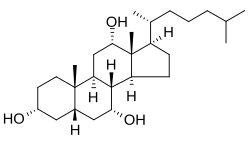
trihydroxycoprostane
3 O2
4 H2O


trihydroxycoprostanic acid
+ oxidised
ferredoxin
ferredoxin
The enzyme is an oxidoreductase that uses molecular oxygen in a multi-step oxidation reaction which specifically converts one terminal methyl group of the steroid to its corresponding bile acid. It requires adrenal ferredoxin to transfer electrons from nicotinamide adenine dinucleotide phosphate to the cytochrome P450 active site.[3][4] The systematic name of this enzyme class is 5beta-cholestane-3alpha,7alpha,12alpha-triol,NADPH:oxygen oxidoreductase (26-hydroxylating). Other names in common use include 5beta-cholestane-3alpha,7alpha,12alpha-triol 26-hydroxylase, 5beta-cholestane-3alpha,7alpha,12alpha-triol hydroxylase, cholestanetriol 26-hydroxylase, sterol 27-hydroxylase, sterol 26-hydroxylase, cholesterol 27-hydroxylase, CYP27A, CYP27A1, and cytochrome P450 27A1'.[5][6][7]
References
- ↑ Wikvall K (1984). "Hydroxylations in biosynthesis of bile acids. Isolation of a cytochrome P-450 from rabbit liver mitochondria catalyzing 26-hydroxylation of C27-steroids". J. Biol. Chem. 259 (6): 3800–4. doi:10.1016/S0021-9258(17)43166-8. PMID 6423637.
- ↑ Andersson S, Davis DL, Dahlback H, Jornvall H, Russell DW (1989). "Cloning, structure, and expression of the mitochondrial cytochrome P-450 sterol 26-hydroxylase, a bile acid biosynthetic enzyme". J. Biol. Chem. 264 (14): 8222–9. doi:10.1016/S0021-9258(18)83172-6. PMID 2722778.
- ↑ Usui E, Noshiro M, Okuda K (1990). "Molecular cloning of cDNA for vitamin D3 25-hydroxylase from rat liver mitochondria". FEBS Lett. 262 (1): 135–8. Bibcode:1990FEBSL.262..135U. doi:10.1016/0014-5793(90)80172-F. PMID 2318307.
- ↑ Furster C, Bergman T, Wikvall K (1999). "Biochemical characterization of a truncated form of CYP27A purified from rabbit liver mitochondria". Biochem. Biophys. Res. Commun. 263 (3): 663–6. Bibcode:1999BBRC..263..663F. doi:10.1006/bbrc.1999.1426. PMID 10512735.
- ↑ Enzyme 1.14.15.15 at KEGG Pathway Database.
- ↑ Holmberg-Betsholtz I, Lund E, Bjorkhem I, Wikvall K (1993). "Sterol 27-hydroxylase in bile acid biosynthesis. Mechanism of oxidation of 5 beta-cholestane-3 alpha,7 alpha,12 alpha,27-tetrol into 3 alpha,7 alpha,12 alpha-trihydroxy-5 beta-cholestanoic acid". J. Biol. Chem. 268 (15): 11079–85. doi:10.1016/S0021-9258(18)82094-4. PMID 8496170.
- ↑ Pikuleva IA, Puchkaev A, Bjorkhem I (2001). "Putative helix F contributes to regioselectivity of hydroxylation in mitochondrial cytochrome P450 27A1". Biochemistry. 40 (25): 7621–9. doi:10.1021/bi010193i. PMID 11412116.