Charniidae
| Charniidae Temporal range: Ediacaran | |
|---|---|
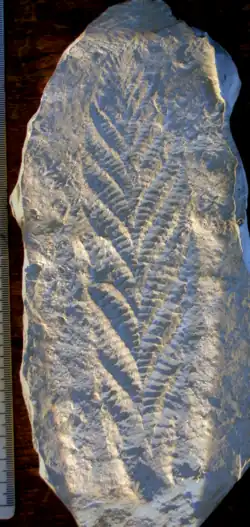 | |
| Charnia masoni. | |
Scientific classification  | |
| Kingdom: | Animalia |
| Phylum: | †Petalonamae |
| Clade: | †Rangeomorpha |
| Family: | †Charniidae Glaessner 1979[1] |
| Type genus | |
| †Charnia Ford, 1958 | |
| Genera | |
|
See text | |
Charniidae is a family of rangeomorphs. It is the only non-monotypic family of Rangeomorpha.[2][3]
Distribution
From the Ediacaran of Australia, Canada, Russia and the United Kingdom, to the Cambrian of Canada.
Taxonomy
The family presents 6 genera:
Gallery
 Artists interpretation of the enigmatic Bomakellia kelleri.
- Fossil specimen of Charnia masoni.
 Artists interpretation of Paracharnia dengyingensis.
See also
References
- ↑ Glaessner, M.F. (1979). "Biogeography and biostratigraphy: Precambrian". In Robinson, R.A.; Teichert, C. (eds.). Treatise on Invertebrate Paleontology: Part A: Fossilization (Taphonomy), Biogeography and Biostratigraphy. Boulder, CO: University of Kansas & Geological Society of America. pp. 79–118. Retrieved 13 April 2026.
- ↑ Steiner, Michael; Reitner, Joachim (2001). "Evidence of organic structures in Ediacara-type fossils and associated microbial mats". Geology. 12 (29): 1119–1122. Bibcode:2001Geo....29.1119S. doi:10.1130/0091-7613(2001)029<1119:EOOSIE>2.0.CO;2.
- ↑ Sun, Weiguo (1986). "Late precambrian pennatulids (sea pens) from the eastern Yangtze Gorge, China: Paracharnia gen. nov". Precambrian Research. 4 (34): 361–375. Bibcode:1986PreR...31..361S. doi:10.1016/0301-9268(86)90040-9.