Ceratocaudia
| Ceratocaudia Temporal range: Jurassic, ~ | |
|---|---|
 | |
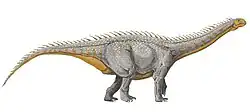
| Speculative restoration of Ceratocaudia | |
Scientific classification  | |
| Kingdom: | Animalia |
| Phylum: | Chordata |
| Class: | Reptilia |
| Clade: | Dinosauria |
| Clade: | Saurischia |
| Clade: | †Sauropodomorpha |
| Clade: | †Sauropoda |
| Clade: | †Macronaria |
| Genus: | †Ceratocaudia Abhishek et al., 2026 |
| Type species | |
| †Ceratocaudia antiqua Abhishek et al., 2026 | |
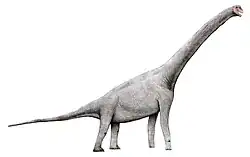
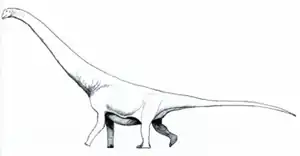
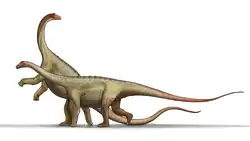
Ceratocaudia (lit. 'horned tail') is a genus of macronarian sauropod dinosaur from the Jurassic Kaladongar Formation of Gujarat, India. The genus contains a single species, the type species Ceratocaudia antiqua, known from a partial skeleton.[1]
Discovery and naming
The Ceratocaudia holotype specimen was collected from the low-energy estuarine sediments of the Khadir Uplift of Kaladongar Formation in Kutch district of Gujarat, India. The holotype specimen consists a cervical (neck) and several caudal (tail) vertebrae, an isolated chevron, and elements of the appendicular skeleton including an interclavicle, an ulna (forearm bone), metacarpals (finger bones), femora (thighbones), tibiae, fibulae (lower leg bones), and a metatarsal (toe bone). They are housed in the Indian Institute of Technology Bombay in Mumbai, India, where they are permanently accessioned under the codes IITBR3 to IITBR59.[1]
In 2026, Abhishek Natarajan and colleagues described the remains as belonging to a new genus and species of sauropod dinosaurs. The generic name, Ceratocaudia, comes from the Ancient Greek word κέρας, meaning 'horn', and the Latin word cauda, meaning 'tail', after the horn-like crest on the anterior caudal neural spine. The specific name, antiqua, is a Latin word meaning 'ancient'.[1]
Description
The Ceratocaudia holotype is estimated to be about 7 metres (23 ft) long, making it one of the smallest known macronarians. There is a possibility that it represents a dwarf taxon.[1]
Paleobiology
Based on histological analysis and the presence of a non-traumatic pathology, the holotype appears to have been a senescent (old) individual. A reconstructed muscle model of the tail suggests it was used as a mild predator deterrent.[1]
Paleoecology
The sediments in which Ceratocaudia was found also consist of abundant petrified wood and bivalves like Protocardia and Indocorbula that lived in brackish waters. The Khadir Uplift, of a different horizon but of the same age, has yielded a large fragmentary sauropod which is estimated to be 20 metres long, as well as a hybodont shark Strophodus magnus. The presence of a large contemporary sauropod suggests niche partitioning between it and Ceratocaudia, though it is unknown what ecological role they had in their environment due to both lacking cranial material.[1]
Classification
To determine the relationships of Ceratocaudia, Abhishek et al. (2026) placed in within the phylogenetic matrices of Mannion & Moore (2025)[2] and Pérez Moreno et al. (2023).[3] Both analyses placed Ceratocaudia within the Macronaria, outside the Titanosauriformes, making it one of the oldest such sauropods and adding to the evidence of a global pre-Bajocian distribution of macronarians. The reduced strict consensus results of the Mannion & Moore (2025) dataset, pruning 21 taxa, is shown in the cladogram below:[1]
References
- 1 2 3 4 5 6 7 Abhishek, N.; Bhosale, S.; Rakshit, N.; Dasgupta, S. (2026). "A new diminutive Jurassic neosauropod from the Kaladongar Formation (Khadir Uplift) of the Kachchh Basin, western India". Journal of Vertebrate Paleontology e2677749. doi:10.1080/02724634.2026.2677749.
- ↑ Mannion, Philip D.; Moore, Andrew J. (2025-10-10). "Critical reappraisal of a putative dicraeosaurid sauropod dinosaur from the Middle Jurassic of Gondwana and a revised view of diplodocoid evolutionary relationships and biogeography". Journal of Systematic Palaeontology. 23 (1). doi:10.1080/14772019.2025.2550760. ISSN 1477-2019.
- ↑ Pérez Moreno, Agustín; Otero, Alejandro; Carballido, José L.; Salgado, Leonardo; Calvo, Jorge O. (2022-10-07). "The appendicular skeleton of Rinconsaurus caudamirus (Sauropoda: Titanosauria) from the Upper Cretaceous of Patagonia, Argentina". Cretaceous Research. 142 105389. Bibcode:2023CrRes.14205389P. doi:10.1016/j.cretres.2022.105389. ISSN 0195-6671. S2CID 252799392.