Cape Canaveral Launch Complex 6
 A PGM-11 Redstone launches from LC-6 in September 1958 | |||||||||||
Interactive map of Launch Complex 6 | |||||||||||
| Launch site | Cape Canaveral Space Force Station | ||||||||||
|---|---|---|---|---|---|---|---|---|---|---|---|
| Location | 28°26′27″N 80°34′22″W / 28.44083°N 80.57278°W | ||||||||||
| Time zone | UTC−05:00 (EST) | ||||||||||
| UTC−04:00 (EDT) | |||||||||||
| Short name | LC-6 | ||||||||||
| Operator | US Army (ABMA) | ||||||||||
| Total launches | 43 | ||||||||||
| Launch pad | 1 | ||||||||||
| |||||||||||

2.5miles

(Various)
Launch Complex 6 (LC-6) at Cape Canaveral Space Force Station, Florida is a launch site used by Redstone and Jupiter series rockets and missiles.[1] It is on the south end of Cape Canaveral, close to Launch Complex 5, with which it shared a blockhouse.[2][3] With LC-5, it was the location of the first tests of the mobile launch concept designed by Kurt H. Debus. This concept was revised and improved and eventually used at LC-39 for the Saturn V and Space Shuttle.
LC-6 was deactivated in 1961.[1] The blockhouse and a 61.96 m (203.3 ft) square concrete pad are the only parts of the complex that remain intact,[3] although the mobile service tower was under restoration as of 2011. The complex is part of the "Cape Canaveral: Then and Now" tour, available from the Kennedy Space Center Visitor Complex.
Gallery
 Blockhouse (2010)
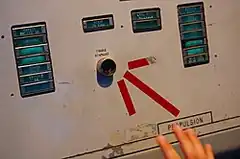 Firing button (2010)
See also
- Cape Canaveral
- Cape Canaveral Launch Complex 5 - used the same blockhouse
References
- 1 2 "Cape Canaveral LC6". www.astronautix.com. Retrieved 2025-01-10.
- ↑ "Cape Canaveral Space Force Museum". ccspacemuseum.org. Retrieved 2025-01-10.
- 1 2 "Cape Canaveral Space Force Museum". ccspacemuseum.org. Retrieved 2025-01-10.