CH Crucis
  | |
| Observation data Epoch J2000 Equinox ICRS | |
|---|---|
| Constellation | Crux[1] |
| Right ascension | 12h 41m 56.56918s[2] |
| Declination | −59° 41′ 08.9544″[2] |
| Apparent magnitude (V) | 4.91[1] |
| Characteristics | |
| Evolutionary stage | subgiant[2] |
| Spectral type | B5III[3] or B6IV[4] |
| U−B color index | −0.37[5] |
| B−V color index | −0.044±0.03[1] |
| Variable type | γ Cas[6] |
| Astrometry | |
| Radial velocity (Rv) | +12.5±2.8[1] km/s |
| Proper motion (μ) | RA: -24.464[2] mas/yr Dec.: -4.226[2] mas/yr |
| Parallax (π) | 3.8643±0.0811 mas[2] |
| Distance | 840 ± 20 ly (259 ± 5 pc) |
| Absolute magnitude (MV) | −2.41[1] |
| Details | |
| Mass | 5.30±0.27[7] M☉ |
| Radius | 11.20±0.22[8] R☉ |
| Luminosity | 1,073[1] L☉ |
| Surface gravity (log g) | 2.90±0.03[8] cgs |
| Temperature | 10,600±106[8] K |
| Rotational velocity (v sin i) | 240[9] km/s |
| Age | 120[10] Myr |
| Other designations | |
| Lumbung, 39 Crucis[11], CH Cru, CPD−59°4393, HD 110335, HIP 61966, HR 4823, SAO 240161[12] | |
| Database references | |
| SIMBAD | data |
CH Crucis (39 Crucis), also named Lumbung,[13] is a solitary[14] variable star in the southern constellation of Crux. It has the Gould designation 39 G. Crucis.[11] The object is visible to the naked eye as a faint, blue-white hued point of light with an apparent visual magnitude that fluctuates around 4.91.[1] The star is located 844.02 light years distant from the Sun based on parallax, with an uncertainty of −17.35/+18.09 light years.[15] and is drifting further away with a radial velocity of about +12.5 km/s.[1] It is a member of the nearby Sco OB2 association.[16]
This is a conventional shell star, which is understood to be a Be star that is being viewed edge-on.[18] Houk (1975) found a stellar classification of B5III,[3] while Hiltner et al. assigned it to B6IV;[4] suggesting it is a B-type star that is evolving off the main sequence.[7]Later literature has also listed the star as B6IVe+sh (Yudin 2001)[19] and B8IV (Arcos et al. 2018),[20] while an older source, Buscombe & Morris (1960) [21]classified it as B7IV and identified it as a spectroscopic binary. indicating some variation in its spectral classification in the literature.
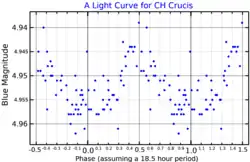
Samus et al. (2017) have tentatively classified it as a Gamma Cassiopeiae variable with a brightness range of 4.88–5.7 mag in the Johnson B band.[6]
CH Crucis has 5.3[7] times the mass of the Sun and 11.2[8] times the Sun's radius. It is radiating 1,073[1] times the luminosity of the Sun from its photosphere at an effective temperature of 10,600 K.[8] It is spinning rapidly with estimates of the projected rotational velocity ranging up to 240 or 250 km/s.[18][9] This is giving the star an oblate shape with an equatorial bulge that is an estimated 18% larger than the polar radius.[9]
The IAU Working Group on Star Names approved the name Lumbung for this star on 22 February 2026.[13] Lumbung is a constellation from Bali (Indonesia), corresponding to Crux. The term is inherited from Malay, Proto-Malayo-Polynesian, meaning a rice barn or granary. The constellation of Lumbung is attested for ~1300 years in the cultural calendar and associated with Wednesday and the third day of an Oceanic market cycle.[22]
References
- 1 2 3 4 5 6 7 8 9 Anderson, E.; Francis, Ch. (2012). "XHIP: An extended hipparcos compilation". Astronomy Letters. 38 (5): 331. arXiv:1108.4971. Bibcode:2012AstL...38..331A. doi:10.1134/S1063773712050015. XHIP record for this object at VizieR.
- 1 2 3 4 5 6 Vallenari, A.; et al. (Gaia collaboration) (2023). "Gaia Data Release 3. Summary of the content and survey properties". Astronomy and Astrophysics. 674: A1. arXiv:2208.00211. Bibcode:2023A&A...674A...1G. doi:10.1051/0004-6361/202243940. S2CID 244398875. Gaia DR3 record for this source at VizieR.
- 1 2 Houk, Nancy (1978), Michigan catalogue of two-dimensional spectral types for the HD stars, vol. 1, Ann Arbor: Dept. of Astronomy, University of Michigan, Bibcode:1975mcts.book.....H.
- 1 2 Hiltner, W. A.; Garrison, R. F.; Schild, R. E. (July 1969), "MK Spectral Types for Bright Southern OB Stars", Astrophysical Journal, 157: 313–326, Bibcode:1969ApJ...157..313H, doi:10.1086/150069.
- ↑ "39 Crucis, a blue subgiant star in Crux", Ashland Astronomy Studio, retrieved 2012-08-23
{{citation}}: CS1 maint: deprecated archival service (link) - 1 2 Samus', N. N; Kazarovets, E. V; Durlevich, O. V; Kireeva, N. N; Pastukhova, E. N (2017), "General catalogue of variable stars: Version GCVS 5.1", Astronomy Reports, 61 (1): 80, Bibcode:2017ARep...61...80S, doi:10.1134/S1063772917010085, S2CID 125853869.
- 1 2 3 Zorec, J.; et al. (2012), "Rotational velocities of A-type stars. IV. Evolution of rotational velocities", Astronomy and Astrophysics, 537: A120, arXiv:1201.2052, Bibcode:2012A&A...537A.120Z, doi:10.1051/0004-6361/201117691, S2CID 55586789.
- 1 2 3 4 5 Arcos, C.; et al. (March 2018), "Stellar parameters and H α line profile variability of Be stars in the BeSOS survey", Monthly Notices of the Royal Astronomical Society, 474 (4): 5287–5299, arXiv:1711.08675, Bibcode:2018MNRAS.474.5287A, doi:10.1093/mnras/stx3075, S2CID 74872624.
- 1 2 3 Belle, G. T. (2012), "Interferometric observations of rapidly rotating stars", The Astronomy and Astrophysics Review, 20 (1) 51, arXiv:1204.2572, Bibcode:2012A&ARv..20...51V, doi:10.1007/s00159-012-0051-2, S2CID 119273474.
- ↑ "HIP 61966", Wolfram Alpha, retrieved 2012-08-23
- 1 2 Gould, Benjamin Apthorp (1879), "Uranometria Argentina catalog of bright southern stars", Resultados del Observatorio Nacional Argentino, 1, Bibcode:1879RNAO....1.....G, retrieved 2012-05-08.
- ↑ "CH Cru". SIMBAD. Centre de données astronomiques de Strasbourg. Retrieved 2019-08-15.
- 1 2 "IAU Catalog of Star Names". Retrieved 22 February 2026.
- ↑ Eggleton, P. P.; Tokovinin, A. A. (September 2008), "A catalogue of multiplicity among bright stellar systems", Monthly Notices of the Royal Astronomical Society, 389 (2): 869–879, arXiv:0806.2878, Bibcode:2008MNRAS.389..869E, doi:10.1111/j.1365-2966.2008.13596.x, S2CID 14878976.
- ↑ Collaboration, Gaia; Vallenari, A.; Brown, A. G. A.; Prusti, T.; de Bruijne, J. H. J.; Arenou, F.; Babusiaux, C.; Biermann, M.; Creevey, O. L.; Ducourant, C.; Evans, D. W.; Eyer, L.; Guerra, R.; Hutton, A.; Jordi, C. (June 2023). "Gaia Data Release 3. Summary of the content and survey properties". Astronomy and Astrophysics. 674: A1. arXiv:2208.00211. Bibcode:2023A&A...674A...1G. doi:10.1051/0004-6361/202243940. ISSN 0004-6361.
- ↑ Hoogerwerf, Ronnie (March 2000), "OB association members in the ACT and TRC catalogues", Monthly Notices of the Royal Astronomical Society, 313 (1): 43–65, Bibcode:2000MNRAS.313...43H, doi:10.1046/j.1365-8711.2000.03192.x.
- ↑ Balona, L. A.; Cuypers, J.; Marang, F. (February 1992). "Intensive photometry of southern Be variables. II. Summer objects". Astronomy & Astrophysics Supplement Series. 92: 533–563. Bibcode:1992A&AS...92..533B. Retrieved 18 December 2021.
- 1 2 Rivinius, Th.; et al. (November 2006), "Bright Be-shell stars", Astronomy and Astrophysics, 459 (1): 137–145, Bibcode:2006A&A...459..137R, doi:10.1051/0004-6361:20053008.
- ↑ Yudin, R. V. (March 2001). "Statistical analysis of intrinsic polarization, IR excess and projected rotational velocity distributions of classical Be stars". Astronomy and Astrophysics. 368 (3): 912–931. Bibcode:2001A&A...368..912Y. doi:10.1051/0004-6361:20000577. ISSN 0004-6361.
- ↑ Arcos, C.; Kanaan, S.; Chávez, J.; Vanzi, L.; Araya, I.; Curé, M. (March 2018). "Stellar parameters and H α line profile variability of Be stars in the BeSOS survey". Monthly Notices of the Royal Astronomical Society. 474 (4): 5287–5299. arXiv:1711.08675. Bibcode:2018MNRAS.474.5287A. doi:10.1093/mnras/stx3075. ISSN 0035-8711.
- ↑ Buscombe, W.; Morris, P. M. (1960). "The Scorpio-Centaurus association: I. Radial velocities of 120 bright stars". Monthly Notices of the Royal Astronomical Society. 121 (3): 263–278. Bibcode:1960MNRAS.121..263B. doi:10.1093/mnras/121.3.263. ISSN 0035-8711.
- ↑ "Lumbung". All Skies Encyclopaedia. IAU Working Group on Star Names. Retrieved 22 February 2026.
