CA7 (drug)
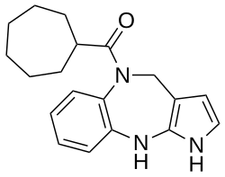 | |
| Clinical data | |
|---|---|
| Other names | Example 52[1] |
| Drug class | Oxytocin receptor agonist |
| ATC code |
|
| Identifiers | |
| |
| PubChem CID | |
| Chemical and physical data | |
| Formula | C19H23N3O |
| Molar mass | 309.413 g·mol−1 |
| 3D model (JSmol) | |
| |
| |
CA7 is a small-molecule oxytocin receptor agonist.[1][2] It is said to be potent as an agonist of the oxytocin receptor and to show considerable selectivity over the vasopressin V1A receptor, where it displayed no functional activity.[1][2] However, the exact affinity and activity values at these receptors do not appear to have been disclosed.[1][2]
The chemical synthesis of CA7 has been described.[1] Along with its close analogue WJ0679, CA7 has the smallest chemical structure known for an oxytocin receptor agonist, with WJ0679 having about 60% of the molecular weight of LIT-001 and both WJ0679 and CA7 lacking LIT-001's tail component.[1][2] Many analogues of WJ0679 and CA7 have been described.[1][2]
CA7 was first described in the scientific literature by a group including Michael Kassiou, Michael Bowen, Iain McGregor, and others at the University of Sydney in 2018.[1][2] This group has founded a startup pharmaceutical company called Kinoxis Therapeutics and is developing small-molecule oxytocin-related drugs like KNX-100 and the KNX-200 series for potential medical use as of the 2020s.[3][4][5][6]
See also
References
- 1 2 3 4 5 6 7 8 WO 2018107216, Kassiou M, Jorgensen W, Werry E, Reekie T, Bowen M, Mcgregor I, "Non-peptide oxytocin receptor agonists", published 12 December 2017, assigned to University of Sydney
- 1 2 3 4 5 6 Nashar PE, Whitfield AA, Mikusek J, Reekie TA (2022). "The Current Status of Drug Discovery for the Oxytocin Receptor". Oxytocin. Methods Mol Biol. Vol. 2384. pp. 153–174. doi:10.1007/978-1-0716-1759-5_10. ISBN 978-1-0716-1758-8. PMID 34550574.
Recent work by Kassiou and colleagues [102] led to the identification of a key motif relevant to functional oxytocin receptor binding. From this motif, they were able to develop a number of nonpeptide OTR agonists, which were considerably smaller than any previously documented, with their lead drug-like molecule WJ0679 (Fig. 7) possessing a molecular weight about 60% that of LIT-001. In behavioral tests, intraperitoneal injection of WJ0679 was demonstrated to increase the amount of time mice spent in close physical contact with one another, indicating prosocial effects [102]. While WJ0679 was demonstrated to show only a mild form of partial agonism for the OTR, making it a less than ideal potential therapeutic, further characterization of other compounds described in the patent has revealed structurally related compound CA7 to be a potent OTR agonist with considerable selectivity over the V1aR, where it exerts no functional activity (Table 2)[102]. While additional details on in vivo activity have yet to be published, with the characterization and development of this group of compounds, their smaller size and receptor potency make them very promising, both as potential therapeutics and as analytical tools for probing the OTR. Given that compounds such as CA7 show activity despite lacking a tail component like those seen in TC OT 39, WAY-267,464 and LIT-001 confound rational design of OTR agonists. [...] Fig. 7 Structural motif and two oxytocin agonist compounds identified by Kassiou and colleagues [102]. In the structural motif, X can be any of a number of substituted or unsubstituted cyclic functional groups as demonstrated by WJ0679 and CA7
- ↑ Sami T (13 January 2026). "Kinoxis and Boehringer to develop oxytocin-targeting treatments for social dysfunction in $181M deal". BioWorld. Retrieved 13 January 2026.
- ↑ Spotlight Showcases: Kinoxis Therapeutics Pty Ltd. 5th Annual Neruoscience Innovation Forum for Business Development, Licensing & Investment 22nd–23rd March 2022, Digital Conference. March 2022.
Kinoxis' lead candidate (KNX100) is being developed for the mitigation of opioid withdrawal symptoms. KNX100 has a novel, undisclosed mechanism of action and a Phase I clinical trial has commenced under a US IND. The company is also exploring other indications for its lead compound, KNX100, as promising preclinical results have been achieved in animal models of cocaine, methamphetamine, nicotine, and alcohol use disorders, as well as models of agitation and aggression. [...] Kinoxis' second series of compounds target the oxytocin receptor, through either selective partial agonism or positive allosteric modulation. The brain oxytocin system has been identified as perhaps the most important molecular target for regulating social behaviour and is therefore a major target of interest for treating a wide range of mental disorders. The development of these compounds will be focused on treating conditions that feature social dysfunction as a core symptom, such as neurodevelopmental disorders (including autism spectrum disorder), social anxiety disorder, dementia (including Alzheimer's disease), PTSD and schizophrenia. The KNX200 series of oxytocin receptor partial agonists are undergoing candidate selection stage using several pre-clinical animal disease models (Alzheimer's, PTSD, ASD) and the KNX300/400 series of oxytocin receptor positive allosteric modulators are undergoing lead optimisation.
- ↑ "Delving into the Latest Updates on Kinoxis Therapeutics Pty Ltd. with Synapse". Synapse. 30 October 2025. Retrieved 19 January 2026.
- ↑ "Kinoxis Fact Sheet" (PDF). Kinoxistherapeutics.com. Retrieved 16 June 2026.