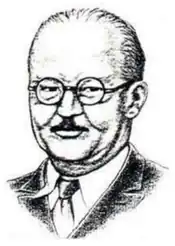
Blas Pablo Reko
Blas Pablo Reko | |
|---|---|
 | |
| Born | Blasius Paul Reko 1877[1] |
| Died | February 1953 |
| Known for | Work with plants and psychedelic drugs |
Blas Pablo Reko (1877 – February 1953) was an Austrian-born physician and amateur ethnobotanist and anthropologist.[1][2][3] He was Slavic and was born Blasius Paul Reko in Austria, but then spent much of his life in Mexico where he adopted the name Blas Pablo Reko.[2][3][1][4]
Reko worked for a mining company for many years in Oaxaca, Mexico, before he started working in the area of plants in 1917.[2][1] He published a number of scholarly works on plants.[2][1][3] Reko, working with Richard Evans Schultes and others, played a key role in the early description and elucidation of the hallucinogenic Mexican plants and fungi teonanácatl (now Psilocybe mexicana), ololiúqui (now Ipomoea corymbosa), and hoja de adivinación (now Salvia divinorum).[5][3][1][6]
He was controversial in having been an ardent supporter of the Nazi Party.[1][3][4][7] Reko had a cousin named Viktor Aloisius Reko, who also worked in the area of psychoactive drugs, with much of the information he published originally having been derived from Blas Pablo Reko.[1][8]
Selected publications
- Reko, Blas Pablo (December 1919). "De los Nombres Botánicos Aztecas" [On Aztec Botanical Names]. El México Antiguo. 1 (5): 113–157. Archived from the original on 28 July 2010.
- Reko, Blas Pablo (1931). "Das Mexikanische Rauschgift Ololiuqui" [The Mexican Narcotic Ololiuqui]. El México Antiguo. 3 (3/4): 1–7. Archived from the original on 22 May 2008.
- Reko, B. P. (April 1940). "Teonanacatl, the Narcotic Mushroom" (PDF). American Anthropologist. 42 (2): 368–369. doi:10.1525/aa.1940.42.2.02a00310.
- Reko, Blas Pablo (1945). Mitobotánica Zapoteca [Zapotec Mythobotany]. Tacubaya, México: Privately printed.
- Reko, B.P. (15 May 1947). "Nombres botánicos del manuscrito badiano" [Botanical names from the Badian manuscript]. Botanical Sciences (5): 23–43. doi:10.17129/botsci.940. ISSN 2007-4476.
See also
References
- 1 2 3 4 5 6 7 8 9 Pérez-Montfort, Ricardo (1 January 2018). "Estudiosos, científicos, esotéricos, literatos y artistas: Conocimiento y creación en torno de las drogas mexicanas (1930-1945)" [Scientists, esoteric scholars, writers and artists. their art and knowledge of Mexican drugs between 1930 and 1945]. Mundo Amazónico. 9 (1). doi:10.15446/ma.v9n1.66268. ISSN 2145-5082. Retrieved 18 June 2026.
- 1 2 3 4 "Reko, Blas Pablo (Blasius Paul) (1877-1953) on JSTOR". Retrieved 18 June 2026.
- 1 2 3 4 5 Spiers, Nicholas; Labate, Beatriz Caiuby; Ermakova, Anna O.; Farrell, Patrick; Romero, Osiris Sinuhé González; Gabriell, Ibrahim; Olvera, Nidia (10 April 2024). "Indigenous psilocybin mushroom practices: An annotated bibliography". Journal of Psychedelic Studies. 8 (1): 3–25. doi:10.1556/2054.2023.00297. hdl:2066/313361. ISSN 2559-9283. Retrieved 18 June 2026.
- 1 2 Davis, Wade (17 January 2023). The Lost Amazon: The Pioneering Expeditions of Richard Evans Schultes. Simon and Schuster. ISBN 979-8-88762-015-2.
[In 1938,] Mexico was thick with German sympathizers, and Reko, Schultes discovered to his dismay, was one of them. As they traveled south by train to Oaxaca, this Mexican citizen of Slavic blood and Austrian birth boasted of his racial purity and spoke confidently of the Germans' imminent takeover of the world. [...] Schultes found himself about to enter the mountains of Oaxaca to search for teonanacatl with an ardent Nazi as a companion.
- ↑ Guzmán, Gastón (2008). "Hallucinogenic Mushrooms in Mexico: An Overview". Economic Botany. 62 (3): 404–412. doi:10.1007/s12231-008-9033-8. ISSN 0013-0001.
The identity of teonanácatl as a mushroom was ultimately confirmed by renowned ethnobotanist Richard Schultes (1939). Schultes acted on information provided to him by the Austrian physician Blas Pablo Reko, who reported that Mazatec Indians in the mountain town of Huautla de Jiménez in northern Oaxaca used mushrooms in religious rites. Reko gathered specimens of the mushrooms, which he sent to anthropologist Roberto Weitlaner. [...] Both Schultes and Reko went to Huautla in 1938 and brought two species of "sacred mushrooms," [...]
- ↑ Heinrich, M; Casselman, I (2018). "Ethnopharmacology – From Mexican Hallucinogens to a Global Transdisciplinary Science". In McKenna, D; Prance, G; De Loenen, B; Davis, W (eds.). Ethnopharmacologic Search for Psychoactive Drugs: 50 Years of Research (1967-2017) (PDF). Synergetic Press. pp. 316–324. ISBN 978-0-907791-68-3. Archived from the original on 17 June 2026.
[...] S. divinorum was first mentioned in western academic literature in 1939 by anthropologist J. Johnson (Johnson, 1939). In 1945, B. Reko reported a "magic plant" used by the Mazatecs called "hoja de adivinación" or "the leaf of the prophecy", indicating that the indigenous people used this plant to produce visions (Valdés, Diaz, and Paul, 1983; Diaz, 1979; Schultes, 1967). Seven years later in 1952, R. Weitlander reported "yerba de Maria" used by curanderos in Oaxaca (Weitlander, 1952). [...]
- ↑ Bramwell, David; Tinsley, Jo (8 January 2019). The Odysseum: Strange journeys that obliterated convention. Quercus. p. 233. ISBN 978-1-4736-8871-1. Retrieved 18 June 2026.
Schultes wasn't alone for this trip. Accompanying him was an Austrian-born but now local botanist, Blas Pablo Reko, an essential guide but - to Schultes's dismay - also an ardent Nazi sympathizer. [...]
- ↑ Tyler VE (1979). "The case for Victor A. Reko--an unrecognized pioneer writer on New World hallucinogens". J Nat Prod. 42 (5): 489–495. doi:10.1021/np50005a009. PMID 392053.
[...] B. Holmstedt (11) quotes a letter from the physician-turned-botanist Blas Pablo Reko to Henry Wassen of the Göteborg Museum under date of January 31, 1937. It reads in part as follows: [...] Schultes continues on to explain that it is probable that V. A. Reko obtained the information he recorded in his book from his cousin B. P. Reko. [...] Such loss of priority may have been the reason why Blas Pablo denounced his cousin Victor in the 1937 letter to Henry Wassén.