Bibliography of John C. Calhoun
John C. Calhoun | |
|---|---|
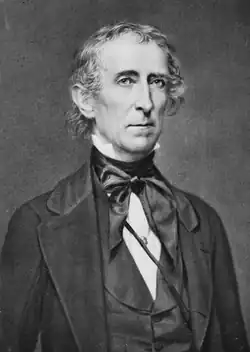
 Portrait of Calhoun, c. 1845 | |
| 7th Vice President of the United States | |
| In office March 4, 1825 – December 28, 1832 | |
| President |
|
| Preceded by | Daniel D. Tompkins |
| Succeeded by | Martin Van Buren |
| United States Senator from South Carolina | |
| In office November 26, 1845 – March 31, 1850 | |
| Preceded by | Daniel Elliott Huger |
| Succeeded by | Franklin H. Elmore |
| United States Senator from South Carolina | |
| In office December 29, 1832 – March 3, 1843 | |
| Preceded by | Robert Y. Hayne |
| Succeeded by | Daniel Elliott Huger |
| 16th United States Secretary of State | |
| In office April 1, 1844 – March 10, 1845 | |
| President | John Tyler James K. Polk |
| Preceded by | Abel P. Upshur |
| Succeeded by | James Buchanan |
| 10th United States Secretary of War | |
| In office December 8, 1817 – March 4, 1825 | |
| President | James Monroe |
| Preceded by | William H. Crawford |
| Succeeded by | James Barbour |
| Member of the U.S. House of Representatives from South Carolina's 6th district | |
| In office March 4, 1811 – November 3, 1817 | |
| Preceded by | Joseph Calhoun |
| Succeeded by | Eldred Simkins |
| Personal details | |
| Born | John Caldwell Calhoun March 18, 1782 |
| Died | March 31, 1850 (aged 68) Washington, D.C., U.S. |
| Resting place | St. Philip's Church |
| Party | Democratic-Republican (before 1828) Democratic (1828, 1839–1850) Nullifier (1828–1839) |
| Spouse | |
| Children | 10, including Anna |
| Parent |
|
| Education | Yale College Litchfield Law School |
| Signature |  |
This is a select bibliography of mainly post World War II books and journal articles about John C. Calhoun (March 18, 1782 – March 31, 1850).
Inclusion criteria
Works included are referenced in the notes or bibliographies of scholarly secondary sources or journals. Included works should either be published by an academic or widely distributed publisher, be authored by a notable subject matter expert as shown by scholarly reviews or have significant scholarly journal reviews about the work. Only items that clearly meet the criteria should be included.
Citation style
This bibliography uses APA style citations. Entries do not use templates. References to reviews and notes for entries do use citation templates. Where books which are only partially related to John C. Calhoun are listed, the titles for chapters or sections should be indicated if possible, meaningful, and not excessive.
If a work has been translated into English, the translator should be included and a footnote with appropriate bibliographic information for the original language version should be included if possible.
When listing works with titles or names published under alternative titles or with alternative English spellings, the form used in the latest published version should be used and the version and relevant bibliographic information noted if it previously was published or reviewed under a different title.
Overview
John Caldwell Calhoun (/kælˈhuːn/; March 18, 1782 – March 31, 1850) was an American statesman, champion of slavery, and political theorist who served as the seventh vice president of the United States from 1825 to 1832. Calhoun began his political career as a nationalist, modernizer and proponent of a strong federal government and protective tariffs. In the late 1820s, his views shifted, and he became a leading proponent of states' rights, limited government, nullification, and opposition to high tariffs, and became notorious as an outspoken defender of slavery in the United States. Calhoun saw Northern acceptance of those policies as a condition of the South remaining in the Union. His beliefs heavily influenced the South's secession from the Union in 1860 and 1861.[a]
Bibliography
Secondary sources
- Bancroft, F. (1928). Calhoun and the South Carolina nullification movement. Johns Hopkins Press.[1][2]
- Barnwell, J. (1982). Love of order: South Carolina's first secession crisis. University of North Carolina Press.[3][4]
- Bartlett, I. H. (1993). John C. Calhoun: A biography. W. W. Norton.[5][6]
- Baskin, D. (1969). The pluralist vision of John C. Calhoun. Polity, 2(1), 49–65. JSTOR 3234088
- Belko, W. S. (2004). John C. Calhoun and the creation of the Bureau of Indian Affairs: An essay on political rivalry, ideology, and policymaking in the Early Republic. South Carolina Historical Magazine, 105(3), 170–197. JSTOR 27570693
- Brown, G. S. (2000). Calhoun's philosophy of politics: A study of A disquisition on government. Mercer University Press.[7]
- Capers, G. M. (1948). A reconsideration of John C. Calhoun's transition from nationalism to nullification. The Journal of Southern History, 14(1), 34. JSTOR 2197709
- Capers, G. M. (1960). John C. Calhoun, opportunist: A reappraisal. University of Florida Press.[8][9]
- Cheek, H. L., Jr. (2001). Calhoun and popular rule: The political theory of the Disquisition and Discourse. University of Missouri Press.[10][11]
- Coit, M. L. (1950). John C. Calhoun: American portrait. Houghton Mifflin.[12][13]
- Coit, M. L. (Ed.). (1970). John C. Calhoun: Great lives observed. Prentice-Hall.
- Current, R. N. (1966). John C. Calhoun. Washington Square Press.[14]
- Drucker, P. F. (1948). A key to American politics: Calhoun's pluralism. The Review of Politics, 10(4), 412–426. doi:10.1017/s0034670500047550
- Elder, R. (2021). Calhoun: American heretic. Basic Books.[15][16]
- Ellis, R. E. (1987). The Union at risk: Jacksonian democracy, states' rights, and the nullification crisis. Oxford University Press.[17][18]
- Ericson, D. F. (1995). The nullification crisis, American republicanism, and the Force Bill debate. The Journal of Southern History, 61(2), 249. JSTOR 2211577
- Fitzgerald, M. S. (1996). Rejecting Calhoun's expansible army plan: The Army Reduction Act of 1821. War in History, 3(2), 161–185. doi:10.1177/096834459600300202
- Ford, L. K., Jr. (1988a). Origins of Southern radicalism: The South Carolina upcountry, 1800–1860. Oxford University Press.[19][20]
- Ford, L. K., Jr. (1988b). Recovering the republic: Calhoun, South Carolina, and the concurrent majority. South Carolina Historical Magazine, 89(3), 146–159. JSTOR 27568041
- Ford, L. K., Jr. (1988c). Republican ideology in a slave society: The political economy of John C. Calhoun. The Journal of Southern History, 54(3), 405. JSTOR 2208996
- Ford, L. K., Jr. (1994). Inventing the concurrent majority: Madison, Calhoun, and the problem of majoritarianism in American political thought. The Journal of Southern History, 60(1), 19. JSTOR 2210719
- Freehling, W. W. (1965). Spoilsmen and interests in the thought and career of John C. Calhoun. The Journal of American History, 52(1), 25. JSTOR 1901122
- Freehling, W. W. (1966). Prelude to Civil War: The nullification controversy in South Carolina, 1816–1836. Harper & Row.[21][22]
- Garson, R. A. (1985). Proslavery as political theory: The examples of John C. Calhoun and George Fitzhugh. South Atlantic Quarterly, 84(2), 197–212. doi:10.1215/00382876-84-2-197
- Greenberg, K. S. (1976). Revolutionary ideology and the proslavery argument: The abolition of slavery in antebellum South Carolina. The Journal of Southern History, 42(3), 365. JSTOR 2207157
- Grove, J. (2015). Calhoun and conservative reform. American Political Thought, 4(2), 203–227. doi:10.1086/680389
- Grove, J. G. (2014). Binding the republic together: The early political thought of John C. Calhoun. South Carolina Historical Magazine, 115(2), 100–121. JSTOR 24332785
- Gutzman, K. R. C. (2002). Paul to Jeremiah: Calhoun's abandonment of nationalism. Journal of Libertarian Studies, 16(2), 3–33.
- Heckscher, G. (1939). Calhoun's idea of "concurrent majority" and the constitutional theory of Hegel. American Political Science Review, 33(4), 585–590. JSTOR 1949492
- Hofstadter, R. (1948). John C. Calhoun: The Marx of the master class. In The American political tradition and the men who made it. Alfred A. Knopf.
- Jarvis, D. E. (2013). The Southern conservative thought of John C. Calhoun and the cultural foundations of the Canadian identity. American Review of Canadian Studies, 43(3), 297–314. doi:10.1080/02722011.2013.819584
- Kateb, G. (1969). The majority principle: Calhoun and his antecedents. Political Science Quarterly, 84(4), 583–605. JSTOR 2147126
- Lerner, R. (1963). Calhoun's new science of politics. American Political Science Review, 57(4), 918–932. JSTOR 1952609
- Meigs, W. M. (1917). The life of John Caldwell Calhoun (2 vols.). Neale Publishing.[23][24]
- Merriam, C. E. (1902). The political theory of Calhoun. American Journal of Sociology, 7(5), 577–594. doi:10.1086/211084
- Niven, J. (1988). John C. Calhoun and the price of union: A biography. Louisiana State University Press.[25][26]
- Park, B. E. (2017). The angel of nullification: Imagining disunion in an era before secession. Journal of the Early Republic, 37(3), 507–536. doi:10.1353/jer.2017.0048
- Peterson, M. D. (1987). The great triumvirate: Webster, Clay, and Calhoun. Oxford University Press.[27][28]
- Rayback, J. G. (1948). The presidential ambitions of John C. Calhoun, 1844–1848. The Journal of Southern History, 14(3), 331. JSTOR 2197879
- Read, J. H. (2009). Majority rule versus consensus: The political thought of John C. Calhoun. University Press of Kansas.[29][30]
- Safford, J. L. (1995). John C. Calhoun, Lani Guinier, and minority rights. PS: Political Science & Politics, 28(2), 211–216. JSTOR 420348
- Salter, A. W. (2014). Calhoun's concurrent majority as a generality norm. Constitutional Political Economy, 26(3), 375–390. doi:10.1007/s10602-014-9183-x
- Sinha, M. (2000). The counterrevolution of slavery: Politics and ideology in antebellum South Carolina. University of North Carolina Press.[31][32]
- Spain, A. O. (1951). The political theory of John C. Calhoun. Bookman Associates.[33][34]
- Vajda, Z. (2001). John C. Calhoun's republicanism revisited. Rhetoric & Public Affairs, 4(3), 433–457. doi:10.1353/rap.2001.0056
- Vajda, Z. (2013). Complicated sympathies: John C. Calhoun's sentimental Union and the South. South Carolina Historical Magazine, 114(3), 210–230. JSTOR 23645453
- Vile, J. R. (1989). John C. Calhoun and the constitutional amending process: Article V and the theory of concurrent majorities. American Review of Politics, 9, 64–76. doi:10.15763/issn.2374-7781.1988.9.0.64-76
- von Holst, H. (1882). John C. Calhoun. Houghton Mifflin.
- Wilson, C. N. (1990). John C. Calhoun: A bibliography. Meckler.
- Wiltse, C. M. (1941). Calhoun's democracy. The Journal of Politics, 3(2), 210–223. JSTOR 2125432
- Wiltse, C. M. (1944). John C. Calhoun, nationalist, 1782–1828. Bobbs-Merrill.[35][36]
- Wiltse, C. M. (1949). John C. Calhoun, nullifier, 1829–1839. Bobbs-Merrill.[37][38]
- Wiltse, C. M. (1951). John C. Calhoun, sectionalist, 1840–1850. Bobbs-Merrill.[39][40]
- Wood, W. K. (2009). History and recovery of the past: John C. Calhoun and the origins of nullification in South Carolina, 1819–1828. Southern Studies, 16, 46–68.
Primary sources
- Boucher, C. S., & Brooks, R. P. (Eds.). (1930). Correspondence addressed to John C. Calhoun, 1837–1849. In Annual report of the American Historical Association for the year 1929 (Sixteenth report of the Historical Manuscripts Commission). Government Printing Office.
- Calhoun, J. C. (1837a). Slavery a positive good [Speech]. United States Senate.
- Calhoun, J. C. (1837b). Speeches of Mr. Calhoun of S. Carolina, on the bill for the admission of Michigan: Delivered in the Senate of the United States, January, 1837.
- Calhoun, J. C. (1870). The works of John C. Calhoun: Reports and public letters (R. K. Crallé, Ed.). D. Appleton.
- Calhoun, J. C. (1953). A disquisition on government and selections from the Discourse (C. G. Post, Ed.). Liberal Arts Press.
- Calhoun, J. C. (1992a). The essential Calhoun: Selections from writings, speeches, and letters (C. N. Wilson, Ed.). Transaction Publishers.
- Calhoun, J. C. (1992b). Union and liberty: The political philosophy of John C. Calhoun (R. M. Lence, Ed.). Liberty Fund.[41]
- Calhoun, J. C. (1995). A disquisition on government and selections from the Discourse (C. G. Post, Ed.). Hackett Publishing.
- Calhoun, J. C. (1999). The papers of John C. Calhoun (C. N. Wilson & S. B. Cook, Eds.; Vol. 25). University of South Carolina Press.[42][43]
- Calhoun, J. C. (2003a). John C. Calhoun: Selected writings and speeches (H. L. Cheek, Jr., Ed.). Regnery Publishing.
- Calhoun, J. C. (2003b). The papers of John C. Calhoun (C. N. Wilson & S. B. Cook, Eds.; Vol. 27). University of South Carolina Press.[44]
- Crallé, R. K. (Ed.). (1851–1856). The works of John C. Calhoun (6 vols.). D. Appleton.
- Freehling, W. W. (Ed.). (1967). The nullification era: A documentary record. Harper & Row.
- Hay, T. R. (1934). John C. Calhoun and the presidential campaign of 1824: Some unpublished Calhoun letters. The American Historical Review, 40(1), 82–96. doi:10.1086/ahr/40.1.82
- Jameson, J. F. (Ed.). (1900). Correspondence of John C. Calhoun. In Annual report of the American Historical Association for the year 1899 (Vol. 2). Government Printing Office.
- Meriwether, R. L., Hemphill, W. E., Wilson, C. N., Cook, S. B., & Moore, A. (Eds.). (1959–2003). The papers of John C. Calhoun (28 vols.). University of South Carolina Press.[45][46]
Background and context
- Baxter, M. G. (1984). One and inseparable: Daniel Webster and the Union. Belknap Press of Harvard University Press.[47]
- Cooper, W. J., Jr. (1978). The South and the politics of slavery, 1828–1856. Louisiana State University Press.[48][49]
- Dangerfield, G. (1965). The awakening of American nationalism, 1815–1828. Harper & Row.[50]
- Faust, D. G. (Ed.). (1981). The ideology of slavery: Proslavery thought in the antebellum South, 1830–1860. Louisiana State University Press.[51]
- Fehrenbacher, D. E., & McAfee, W. M. (2002). The slaveholding republic: An account of the United States government's relations to slavery. Oxford University Press.[52]
- Feller, D. (1995). The Jacksonian promise: America, 1815–1840. Johns Hopkins University Press.[53]
- Forbes, R. P. (2007). The Missouri Compromise and its aftermath: Slavery and the meaning of America. University of North Carolina Press.[54]
- Ford, L. K., Jr. (2009). Deliver us from evil: The slavery question in the Old South. Oxford University Press.[55][56]
- Freehling, W. W. (1990). The road to disunion: Vol. 1. Secessionists at bay, 1776–1854. Oxford University Press.[57][58]
- Genovese, E. D. (1992). The slaveholders' dilemma: Freedom and progress in Southern conservative thought, 1820–1860. University of South Carolina Press.[59][60]
- Hamilton, H. (1964). Prologue to conflict: The crisis and compromise of 1850. University of Kentucky Press.[61]
- Hickey, D. R. (1989). The War of 1812: A forgotten conflict. University of Illinois Press.[62]
- Hietala, T. R. (1985). Manifest design: Anxious aggrandizement in late Jacksonian America. Cornell University Press.[63]
- Holt, M. F. (1999). The rise and fall of the American Whig Party: Jacksonian politics and the onset of the Civil War. Oxford University Press.[64]
- Howe, D. W. (2007). What hath God wrought: The transformation of America, 1815–1848. Oxford University Press.[65]
- Larson, J. L. (2001). Internal improvement: National public works and the promise of popular government in the early United States. University of North Carolina Press.[66]
- McCurry, S. (1995). Masters of small worlds: Yeoman households, gender relations, and the political culture of the antebellum South Carolina low country. Oxford University Press.[67]
- Peterson, M. D. (1982). Olive branch and sword: The Compromise of 1833. Louisiana State University Press.[68][69]
- Remini, R. V. (1988). The life of Andrew Jackson. Harper & Row.[70]
- Remini, R. V. (1991). Henry Clay: Statesman for the Union. W. W. Norton.[71]
- Richards, L. L. (2000). The slave power: The free North and Southern domination, 1780–1860. Louisiana State University Press.[72]
- Satz, R. N. (1975). American Indian policy in the Jacksonian era. University of Nebraska Press.[73]
- Sellers, C. (1991). The market revolution: Jacksonian America, 1815–1846. Oxford University Press.[74]
- Sydnor, C. S. (1948). The development of Southern sectionalism, 1819–1848. Louisiana State University Press.[75]
- Tise, L. E. (1987). Proslavery: A history of the defense of slavery in America, 1701–1840. University of Georgia Press.[76]
- Varon, E. R. (2008). Disunion! The coming of the American Civil War, 1789–1859. University of North Carolina Press.[77]
- Watson, H. L. (1990). Liberty and power: The politics of Jacksonian America. Hill and Wang.[78]
- Wilentz, S. (2005). The rise of American democracy: Jefferson to Lincoln. W. W. Norton.[79]
Official and historic-site links
See also
References
Notes
- ↑ Calhoun was the first of two vice presidents to resign from the position of Vice President, the second being Spiro Agnew, who resigned in 1973.
Citations
- ↑ Boucher, Chauncey S. (1928). "Review of Calhoun and the South Carolina Nullification Movement". The Mississippi Valley Historical Review. 15 (3): 411–413. doi:10.1093/jahist/15.3.411-a.
- ↑ "Review of Calhoun and the South Carolina Nullification Movement". The Journal of Negro History. 14 (1): 100. 1929. JSTOR 2714099.
- ↑ Gara, Larry (1983). "Review of Love of Order: South Carolina's First Secession Crisis". The Journal of Southern History. 49 (2): 301. JSTOR 2207518.
- ↑ Holt, Michael F. (1983). "Review of Love of Order: South Carolina's First Secession Crisis". The American Historical Review. 88 (2): 473. JSTOR 1865550.
- ↑ "Review of John C. Calhoun: A Biography". The Journal of Southern History. 61 (3): 595. 1995. JSTOR 2211897.
- ↑ Lamplugh, George R. (1995). "Review of John C. Calhoun: A Biography". The American Historical Review. 100 (4): 1294. doi:10.1086/ahr/100.4.1294.
- ↑ Dunn, Brendan (2001). "Review of Calhoun's Philosophy of Politics: A Study of A Disquisition on Government". The Review of Politics. 63 (4): 822–824. doi:10.1017/s003467050003223x.
- ↑ Miles, Edwin A. (1961). "Review of John C. Calhoun, Opportunist: A Reappraisal". The Journal of Southern History. 27 (3): 414. JSTOR 2205228.
- ↑ Wiltse, Charles M. (1961). "Review of John C. Calhoun, Opportunist: A Reappraisal". The American Historical Review. 66 (4): 1063–1064. doi:10.1086/ahr/66.4.1063.
- ↑ Duncan, Christopher M. (2002). "Review of Calhoun and Popular Rule: The Political Theory of the Disquisition and Discourse". American Political Science Review. 96 (3): 609. doi:10.1017/s0003055402210369.
- ↑ Ericson, David F. (2003). "Review of Calhoun and Popular Rule: The Political Theory of the Disquisition and Discourse". The Journal of Southern History. 69 (1): 165. JSTOR 30039864.
- ↑ Simms, Henry H. (1950). "Review of John C. Calhoun: American Portrait". The Journal of Southern History. 16 (3): 365. JSTOR 2197764.
- ↑ Pritchett, John Perry (1951). "Review of John C. Calhoun: American Portrait". The American Historical Review. 56 (4): 910–912. doi:10.1086/ahr/56.4.910.
- ↑ Donald, David (1967). "Review of John C. Calhoun". The American Historical Review. 72 (2): 701–702. doi:10.1086/ahr/72.2.701.
- ↑ Schoenbachler, Matthew G. (2022). "Review of Calhoun: American Heretic". The Journal of Southern History. 88 (2): 374–375. doi:10.1353/soh.2022.0067.
- ↑ Woods, Michael E. (2022). "Review of Calhoun: American Heretic". Civil War History. 68 (1): 103–105. doi:10.1353/cwh.2022.0005.
- ↑ Bergeron, Paul H. (1988). "Review of The Union at Risk: Jacksonian Democracy, States' Rights, and the Nullification Crisis". The Journal of American History. 75 (1): 254. JSTOR 1889712.
- ↑ Latner, Richard B. (1988). "Review of The Union at Risk: Jacksonian Democracy, States' Rights, and the Nullification Crisis". The Journal of Southern History. 54 (2): 331. JSTOR 2209421.
- ↑ Cooper, William J. (1990). "Review of Origins of Southern Radicalism: The South Carolina Upcountry, 1800–1860". The Journal of Southern History. 56 (3): 525. JSTOR 2210299.
- ↑ Huff, A. V. (1990). "Review of Origins of Southern Radicalism: The South Carolina Upcountry, 1800–1860". The Journal of American History. 76 (4): 1260. JSTOR 2936629.
- ↑ Lander, Ernest M. (1966). "Review of Prelude to Civil War: The Nullification Controversy in South Carolina, 1816–1836". The Journal of Southern History. 32 (4): 545. JSTOR 2204943.
- ↑ Wiltse, Charles M. (1967). "Review of Prelude to Civil War: The Nullification Controversy in South Carolina, 1816–1836". The Journal of American History. 53 (4): 817–818. JSTOR 1894023.
- ↑ Bassett, John Spencer (1918). "Review of The Life of John Caldwell Calhoun". American Political Science Review. 12 (1): 139–140. JSTOR 1946363.
- ↑ Dodd, William E. (1918). "Review of The Life of John Caldwell Calhoun". The American Historical Review. 23 (4): 872. JSTOR 1836362.
- ↑ O'Brien, Michael (1990). "Review of John C. Calhoun and the Price of Union: A Biography". The Journal of Southern History. 56 (2): 355. JSTOR 2210256.
- ↑ Silbey, Joel H. (1990). "Review of John C. Calhoun and the Price of Union: A Biography". The American Historical Review. 95 (5): 1630. JSTOR 2162891.
- ↑ Birkner, Michael J. (1988). "Review of The Great Triumvirate: Webster, Clay, and Calhoun". The Journal of American History. 75 (3): 949. JSTOR 1901625.
- ↑ Cooper, William J. (1989). "Review of The Great Triumvirate: Webster, Clay, and Calhoun". The Journal of Southern History. 55 (1): 121. JSTOR 2209735.
- ↑ Harp, Gillis J. (2010). "Review of Majority Rule versus Consensus: The Political Thought of John C. Calhoun". The Journal of American History. 96 (4): 1185–1186. doi:10.1093/jahist/96.4.1185a.
- ↑ Schneider, Thomas E. (2010). "Review of Majority Rule versus Consensus: The Political Thought of John C. Calhoun". Perspectives on Politics. 8 (2): 666–668. doi:10.1017/s1537592710000782.
- ↑ Carey, Anthony G. (2001). "Review of The Counterrevolution of Slavery: Politics and Ideology in Antebellum South Carolina". The Journal of American History. 88 (3): 1078. JSTOR 2700446.
- ↑ Ford, Lacy K. (2003). "Review of The Counterrevolution of Slavery: Politics and Ideology in Antebellum South Carolina". The Journal of Southern History. 69 (1): 159. JSTOR 30039860.
- ↑ Coit, Margaret (1952). "Review of The Political Theory of John C. Calhoun". The Journal of Southern History. 18 (3): 372. JSTOR 2954426.
- ↑ Drell, Bernard (1952). "Review of The Political Theory of John C. Calhoun". The American Historical Review. 57 (3): 695–697. doi:10.1086/ahr/57.3.695.
- ↑ Current, Richard N. (1945). "Review of John C. Calhoun, Nationalist, 1782–1828". The American Historical Review. 50 (3): 550–551. doi:10.1086/ahr/50.3.550.
- ↑ Dyer, Brainerd (1945). "Review of John C. Calhoun, Nationalist, 1782–1828". Pacific Historical Review. 14 (4): 483. JSTOR 3634713.
- ↑ Boucher, C. S. (1949). "Review of John C. Calhoun, Nullifier, 1829–1839". The American Historical Review. 55 (1): 161. JSTOR 1841142.
- ↑ Mayo, Bernard (1950). "Review of John C. Calhoun, Nullifier, 1829–1839". The Journal of Southern History. 16 (3): 366. JSTOR 2197765.
- ↑ Nichols, Roy F. (1952). "Review of John C. Calhoun, Sectionalist, 1840–1850". The American Historical Review. 57 (3): 694–695. doi:10.1086/ahr/57.3.694.
- ↑ Current, Richard N. (1952). "Review of John C. Calhoun, Sectionalist, 1840–1850". The Mississippi Valley Historical Review. 38 (4): 707. JSTOR 1892855.
- ↑ Walther, Eric H. (1995). "Review of Union and Liberty: The Political Philosophy of John C. Calhoun". Journal of the Early Republic. 15 (1): 148. JSTOR 3124406.
- ↑ Egerton, Douglas R. (2000). "Review of The Papers of John C. Calhoun, Volume XXV, 1847–1848". Journal of the Early Republic. 20 (4): 715. JSTOR 3125014.
- ↑ Barney, William L. (2001). "Review of The Papers of John C. Calhoun, Volume XXV: 1847–1848". The Journal of Southern History. 67 (3): 659. JSTOR 3070044.
- ↑ Barney, William L. (2004). "Review of The Papers of John C. Calhoun, Volume XXVII: 1849–1850, With Supplement". The Journal of Southern History. 70 (4): 920. JSTOR 27648591.
- ↑ Hamilton, Holman (1960). "Review of The Papers of John C. Calhoun, Volume I, 1801–1817". The American Historical Review. 65 (3): 626. JSTOR 1849667.
- ↑ Arndt, J. Chris (2001). "Review of The Papers of John C. Calhoun, Volume XXVI, 1848–1849". Journal of the Early Republic. 21 (4): 745. JSTOR 3125172.
- ↑ Wilson, Major L. (1985). "Review of One and Inseparable: Daniel Webster and the Union". The Journal of American History. 72 (1): 148. JSTOR 1903773.
- ↑ Alexander, Thomas B. (1979). "Review of The South and the Politics of Slavery, 1828–1856". The American Historical Review. 84 (5): 1477. JSTOR 1861674.
- ↑ Bergeron, Paul H. (1979). "Review of The South and the Politics of Slavery, 1828–1856". The Journal of Southern History. 45 (4): 601. JSTOR 2207726.
- ↑ McCormick, Richard P. (1965). "Review of The Awakening of American Nationalism, 1815–1828". The American Historical Review. 71 (1): 309. doi:10.1086/ahr/71.1.309.
- ↑ Mansfield, Stephen S. (1982). "Review of The Ideology of Slavery: Proslavery Thought in the Antebellum South, 1830–1860". The Journal of Southern History. 48 (3): 424. JSTOR 2207465.
- ↑ Gutzman, K. R. Constantine (2002). "Review of The Slaveholding Republic: An Account of the United States Government's Relations to Slavery". The Journal of Southern History. 68 (4): 957. JSTOR 3069813.
- ↑ Cole, Donald B. (1996). "Review of The Jacksonian Promise: America, 1815–1840". The Journal of American History. 83 (2): 608. JSTOR 2944982.
- ↑ Boman, D. K. (2008). "Review of The Missouri Compromise and Its Aftermath: Slavery and the Meaning of America". The Journal of American History. 94 (4): 1254–1255. JSTOR 25095362.
- ↑ Kolchin, Peter (2010). "Review of Deliver Us from Evil: The Slavery Question in the Old South". The Journal of American History. 97 (1): 141–142. doi:10.2307/jahist/97.1.141.
- ↑ Hammond, John Craig (2011). "Review of Deliver Us from Evil: The Slavery Question in the Old South". Journal of Social History. 45 (1): 285–287. doi:10.1093/jsh/shr020.
- ↑ Degler, Carl N. (1991). "Review of The Road to Disunion, Volume I: Secessionists at Bay, 1776–1854". The Journal of American History. 78 (1): 276. JSTOR 2078104.
- ↑ Ford, Lacy K. (1992). "Review of The Road to Disunion, Volume I: Secessionists at Bay, 1776–1854". The Journal of Southern History. 58 (1): 119. JSTOR 2210479.
- ↑ Kolchin, Peter (1993). "Review of The Slaveholders' Dilemma: Freedom and Progress in Southern Conservative Thought, 1820–1860". The Journal of American History. 79 (4): 1600–1601. JSTOR 2080256.
- ↑ Mathews, Donald G. (1993). "Review of The Slaveholders' Dilemma: Freedom and Progress in Southern Conservative Thought, 1820–1860". The Journal of Southern History. 59 (2): 355. JSTOR 2209805.
- ↑ Capers, Gerald M. (1964). "Review of Prologue to Conflict: The Crisis and Compromise of 1850". The Journal of American History. 51 (3): 499. JSTOR 1894909.
- ↑ Egerton, Douglas R. (1991). "Review of The War of 1812: A Forgotten Conflict". The Journal of American History. 77 (4): 1351–1352. JSTOR 2078304.
- ↑ Bergeron, Paul H. (1986). "Review of Manifest Design: Anxious Aggrandizement in Late Jacksonian America". The Journal of American History. 73 (1): 200. JSTOR 1903658.
- ↑ Kohl, Lawrence Frederick (2000). "Review of The Rise and Fall of the American Whig Party: Jacksonian Politics and the Onset of the Civil War". The American Historical Review. 105 (5): 1744–1745. doi:10.1086/ahr/105.5.1744.
- ↑ Larson, John Lauritz (2009). "Review of What Hath God Wrought: The Transformation of America, 1815–1848". The Journal of American History. 95 (4): 1125–1126. JSTOR 27694569.
- ↑ Ward, James A. (2002). "Review of Internal Improvement: National Public Works and the Promise of Popular Government in the Early United States". The American Historical Review. 107 (1): 192–193. doi:10.1086/ahr/107.1.192.
- ↑ Bellows, Barbara L. (1997). "Review of Masters of Small Worlds: Yeoman Households, Gender Relations, and the Political Culture of the Antebellum South Carolina Low Country". The Journal of Southern History. 63 (1): 164. JSTOR 2211966.
- ↑ Freehling, William W. (1983). "Review of Olive Branch and Sword: The Compromise of 1833". The American Historical Review. 88 (1): 182. JSTOR 1869490.
- ↑ Latner, Richard B. (1983). "Review of Olive Branch and Sword: The Compromise of 1833". The Journal of Southern History. 49 (1): 120. JSTOR 2209324.
- ↑ Silbey, Joel H. (1989). "Review of The Life of Andrew Jackson". The Journal of American History. 76 (2): 595. JSTOR 1908026.
- ↑ Latner, Richard B. (1992). "Review of Henry Clay: Statesman for the Union". The Journal of American History. 79 (2): 651. JSTOR 2080090.
- ↑ Earle, Jonathan H. (2001). "Review of The Slave Power: The Free North and Southern Domination, 1780–1860". The Journal of American History. 88 (3): 1077. JSTOR 2700444.
- ↑ Sheehan, Bernard W. (1975). "Review of American Indian Policy in the Jacksonian Era". The Journal of American History. 62 (3): 694. JSTOR 2936251.
- ↑ Pessen, Edward (1993). "Review of The Market Revolution: Jacksonian America, 1815–1846". The Journal of Southern History. 59 (4): 750. JSTOR 2210552.
- ↑ Owsley, Frank L. (1949). "Review of The Development of Southern Sectionalism, 1819–1848". The Journal of Southern History. 15 (1): 108. JSTOR 2198082.
- ↑ Gara, Larry (1989). "Review of Proslavery: A History of the Defense of Slavery in America, 1701–1840". The Journal of American History. 75 (4): 1301. JSTOR 1908664.
- ↑ Cogan, J. K. (2009). "Review of Disunion! The Coming of the American Civil War, 1789–1859". The Journal of American History. 96 (3): 844. doi:10.1093/jahist/96.3.844.
- ↑ Ashworth, John (1991). "Review of Liberty and Power: The Politics of Jacksonian America". Journal of the Early Republic. 11 (2): 292. JSTOR 3123270.
- ↑ Holt, M. F. (2006). "Review of The Rise of American Democracy: Jefferson to Lincoln". The Journal of American History. 93 (2): 491–493. JSTOR 4486245.
External links
- John C. Calhoun Papers at Clemson University's Special Collections Library
- University of Virginia: John C. Calhoun – Timeline, quotes, & contemporaries, via University of Virginia


| Secretary of State |
|  |
|---|---|---|
| Secretary of the Treasury |
| |
| Secretary of War |
| |
| Attorney General |
| |
| Postmaster General |
| |
| Secretary of the Navy |
| |
- John C. Calhoun
- 19th-century American philosophers
- 19th-century United States representatives
- 19th-century South Carolina politicians
- 19th-century United States senators
- 19th-century vice presidents of the United States
- American political philosophers
- American proslavery activists
- Calhoun family
- Great Triumvirate
- Jackson administration cabinet members
- John Quincy Adams administration cabinet members
- Monroe administration cabinet members
- Origins of the American Civil War
- Slave owners from South Carolina
- Tyler administration cabinet members
- United States secretaries of state
- United States secretaries of war
- United States senators who owned slaves
- Vice presidents of the United States
- Vice presidents of the United States who owned slaves
- Books about politics of the United States
- Bibliographies of people
- Political bibliographies