Bhargava factorial
In mathematics, Bhargava's factorial function, or simply the Bhargava factorial, is a generalization of the factorial function developed by the Fields Medal winning mathematician Manjul Bhargava as part of his bachelor's thesis at Harvard University in 1996. Bhargava subsequently published a revised version in The American Mathematical Monthly in 2000. The Bhargava factorial has the property that many number-theoretic results involving the ordinary factorials remain true even when the factorials are replaced by the Bhargava factorials. Using an arbitrary infinite subset S of the set of integers, Bhargava associated a positive integer with every positive integer k, which he denoted by k !S, with the property that if one takes S = itself, then the integer associated with k, that is k ! , would turn out to be the ordinary factorial of k.[1]

Motivation for the generalization
The factorial of a non-negative integer n, denoted by n!, is the product of all positive integers less than or equal to n. For example, 5! = 5×4×3×2×1 = 120. By convention, the value of 0! is defined as 1. This classical factorial function appears prominently in many theorems in number theory. The following are a few of these theorems.[1]
- For any positive integers m and n, (m + n)! is a multiple of m! n!.
- Let f(x) be a primitive integer polynomial, that is, a polynomial in which the coefficients are integers and are relatively prime to each other. If the degree of f(x) is k then the greatest common divisor of the set of values of f(x) for integer values of x is a divisor of k!.
- Let a0, a1, a2, ... , an be any n + 1 integers. Then the product of their pairwise differences is a multiple of 0! 1! ... n!.
- Let be the set of integers and n any integer. Then the number of polynomial functions from the ring of integers to the quotient ring is given by .


Bhargava posed to himself the following problem and obtained an affirmative answer: In the above theorems, can one replace the set of integers by some other set S (a subset of , or a subset of some ring) and define a function depending on S which assigns a value to each non-negative integer k, denoted by k!S, such that the statements obtained from the theorems given earlier by replacing k! by k!S remain true?
The generalisation
- Let S be an arbitrary infinite subset of the set Z of integers.
- Choose a prime number p.
- Construct an ordered sequence {a0, a1, a2, ... } of numbers chosen from S as follows (such a sequence is called a p-ordering of S):
- a0 is any arbitrary element of S.
- a1 is any arbitrary element of S such that the highest power of p that divides a1 − a0 is minimum.
- a2 is any arbitrary element of S such that the highest power of p that divides (a2 − a0)(a2 − a1) is minimum.
- a3 is any arbitrary element of S such that the highest power of p that divides (a3 − a0)(a3 − a1)(a3 − a2) is minimum.
- ... and so on.
- Construct a p-ordering of S for each prime number p. (For a given prime number p, the p-ordering of S is not unique.)
- For each non-negative integer k, let vk(S, p) be the highest power of p that divides (ak − a0)(ak − a1)(ak − a2) ... (ak − ak − 1). The sequence {v0(S, p), v1(S, p), v2(S, p), v3(S, p), ... } is called the associated p-sequence of S. This is independent of any particular choice of p-ordering of S. (We assume that v0(S, p) = 1 always.)
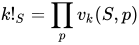
- The factorial of the integer k, associated with the infinite set S, is defined as , where the product is taken over all prime numbers p.
Example: Factorials using set of prime numbers
Let S be the set of all prime numbers P = {2, 3, 5, 7, 11, ... }.
- Choose p = 2 and form a p-ordering of P.
- Choose a0 = 19 arbitrarily from P.
- To choose a1:
- The highest power of p that divides 2 − a0 = −17 is 20 = 1. Also, for any a ≠ 2 in P, a − a0 is divisible by 2. Hence, the highest power of p that divides (a1 − a0) is minimum when a1 = 2 and the minimum power is 1. Thus a1 is chosen as 2 and v1(P, 2) = 1.
- To choose a2:
- It can be seen that for each element a in P, the product x = (a − a0)(a − a1) = (a − 19)(a − 2) is divisible by 2. Also, when a = 5, x is divisible 2 and it is not divisible by any higher power of 2. So, a2 may be chosen as 5. We have v2(P, 2) = 2.
- To choose a3:
- It can be seen that for each element a in P, the product x = (a − a0)(a − a1)(a − a2) = (a − 19)(a − 2)(a − 5) is divisible by 23 = 8. Also, when a = 17, x is divisible by 8 and it is not divisible by any higher power of 2. Choose a3 = 17. Also we have v3(P,2) = 8.
- To choose a4:
- It can be seen that for each element a in P, the product x = (a − a0)(a − a1)(a − a2)(a − a3) = (a − 19)(a − 2)(a − 5)(a − 17) is divisible by 24 = 16. Also, when a = 23, x is divisible 16 and it is not divisible by any higher power of 2. Choose a4 = 23. Also we have v4(P,2) = 16.
- To choose a5:
- It can be seen that for each element a in P, the product x = (a − a0)(a − a1)(a − a2)(a − a3)(a − a4) = (a − 19)(a − 2)(a − 5)(a − 17)(a − 23) is divisible by 27 = 128. Also, when a = 31, x is divisible 128 and it is not divisible by any higher power of 2. Choose a5 = 31. Also we have v5(P,2) = 128.
- The process is continued. Thus a 2-ordering of P is {19, 2, 5, 17, 23, 31, ... } and the associated 2-sequence is {1, 1, 2, 8, 16, 128, ... }, assuming that v0(P, 2) = 1.
- For p = 3, one possible p-ordering of P is the sequence {2, 3, 7, 5, 13, 17, 19, ... } and the associated p-sequence of P is {1, 1, 1, 3, 3, 9, ... }.
- For p = 5, one possible p-ordering of P is the sequence {2, 3, 5, 19, 11, 7, 13, ... } and the associated p-sequence is {1, 1, 1, 1, 1, 5, ...}.
- It can be shown that for p ≥ 7, the first few elements of the associated p-sequences are {1, 1, 1, 1, 1, 1, ... }.
The first few factorials associated with the set of prime numbers are obtained as follows (sequence A053657 in the OEIS).
Table of values of vk(P, p) and k!P
p k | 2 | 3 | 5 | 7 | 11 | ... | k!P | ||
|---|---|---|---|---|---|---|---|---|---|
| 0 | 1 | 1 | 1 | 1 | 1 | ... | 1×1×1×1×1×... = | 1 | |
| 1 | 1 | 1 | 1 | 1 | 1 | ... | 1×1×1×1×1×... = | 1 | |
| 2 | 2 | 1 | 1 | 1 | 1 | ... | 2×1×1×1×1×... = | 2 | |
| 3 | 8 | 3 | 1 | 1 | 1 | ... | 8×3×1×1×1×... = | 24 | |
| 4 | 16 | 3 | 1 | 1 | 1 | ... | 16×3×1×1×1×... = | 48 | |
| 5 | 128 | 9 | 5 | 1 | 1 | ... | 128×9×5×1×1×... = | 5760 | |
| 6 | 256 | 9 | 5 | 1 | 1 | ... | 256×9×5×1×1×... = | 11520 | |
Example: Factorials using the set of natural numbers
Let S be the set of integers .
- For p = 2, the associated p-sequence is {1, 1, 2, 2, 8, 8, 16, 16, 128, 128, 256, 256, ... }.
- For p = 3, the associated p-sequence is {1, 1, 1, 3, 3, 3, 9, 9, 9, 27, 27, 27, 81, 81, 81, ... }.
- For p = 5, the associated p-sequence is {1, 1, 1, 1, 1, 5, 5, 5, 5, 5, 25, 25, 25, 25, 25, ... }.
- For p = 7, the associated p-sequence is {1, 1, 1, 1, 1, 1, 1, 7, 7, 7, 7, 7, 7, 7, ... }.
- ... and so on.
Thus the first few factorials using the integers are
- 0! = 1×1×1×1×1×... = 1.
- 1! = 1×1×1×1×1×... = 1.
- 2! = 2×1×1×1×1×... = 2.
- 3! = 2×3×1×1×1×... = 6.
- 4! = 8×3×1×1×1×... = 24.
- 5! = 8×3×5×1×1×... = 120.
- 6! = 16×9×5×1×1×... = 720.
Examples: Some general expressions
The following table contains the general expressions for k!S for some special cases of S.[1]
| Sl. No. | Set S | k!S |
|---|---|---|
| 1 | Set of integers | k! |
| 2 | Set of even integers | 2k×k! |
| 3 | Set of integers of the form an + b | ak×k! |
| 4 | Set of integers of the form 2n | (2k − 1)(2k − 2) ... (2k − 2k − 1) |
| 5 | Set of integers of the form qn for some prime q | (qk − 1)(qk − q) ... (qk − qk − 1) |
| 6 | Set of squares of integers | (2k)!/2 |
References
- 1 2 3 Bhargava, Manjul (2000). "The Factorial Function and Generalizations" (PDF). The American Mathematical Monthly. 107 (9): 783–799. CiteSeerX 10.1.1.585.2265. doi:10.2307/2695734. JSTOR 2695734.
{{cite journal}}: Cite uses deprecated parameter|citeseerx=(help)