Beryllium nitride
 | |
| Names | |
|---|---|
| IUPAC name
Beryllium nitride | |
| Other names
triberyllium dinitride | |
| Identifiers | |
3D model (JSmol) |
|
| ECHA InfoCard | 100.013.757 |
| EC Number |
|
| UNII | |
| |
| |
| Properties | |
| Be3N2 | |
| Molar mass | 55.051 g·mol−1 |
| Appearance | yellow or white powder |
| Density | 2.71 g/cm3 |
| Melting point | 2,200 °C (3,990 °F; 2,470 K) |
| Boiling point | 2,240 °C (4,060 °F; 2,510 K) (decomposes) |
| decomposes | |
| Solubility | decomposes in solutions of acid and base |
| Structure | |
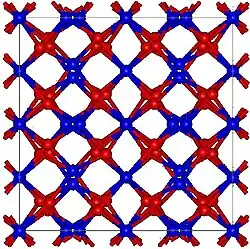
| Cubic, cI80, SpaceGroup = Ia-3, No. 206 (α form) | |
| Hazards | |
| NIOSH (US health exposure limits):[1] | |
PEL (Permissible) |
|
IDLH (Immediate danger) |
4 mg/m3 (as Be) |
| Related compounds | |
Other cations |
|
Except where otherwise noted, data are given for materials in their standard state (at 25 °C [77 °F], 100 kPa).
Infobox references | |


Beryllium nitride, Be3N2, is a nitride of beryllium. It can be prepared from the elements at high temperature (1,100–1,500 °C (2,010–2,730 °F)); unlike beryllium azide or BeN6, it decomposes in vacuum into beryllium and nitrogen. It is readily hydrolysed forming beryllium hydroxide and ammonia. It has two polymorphic forms: cubic α−Be3N2 with a defect anti-fluorite structure, and hexagonal β−Be3N2. It reacts with silicon nitride, Si3N4 in a stream of ammonia at 1,800–1,900 °C (3,270–3,450 °F) to form BeSiN2.[2]
Preparation
Beryllium nitride is prepared by heating beryllium metal powder with dry nitrogen in an oxygen-free atmosphere at temperatures between 700 and 1,400 °C (1,292 and 2,552 °F):[3]
- 3 Be + N2 → B3N2
Uses
It is used in refractory ceramics[4] as well as in nuclear reactors.
It is used to produce radioactive carbon-14 for tracer applications by the 14
7N + n → 14
6C + p reaction. It is favored due to its stability, high nitrogen content (50%), and the very low capture cross section of beryllium for neutrons.[5]
Reactions
Beryllium nitride reacts with mineral acids producing ammonia and the corresponding salts of the acids:
- Be3N2 + 6 HCl → 3 BeCl2 + 2 NH3
In strong alkali solutions, a beryllate forms, with evolution of ammonia:
- Be3N2 + 6 NaOH → 3 Na2BeO2 + 2 NH3
Both the acid and alkali reactions are brisk and vigorous. Reaction with water, however, is very slow:
- Be3N2 + 6 H2O → 3 Be(OH)2 + 2 NH3
Reactions with oxidizing agents are likely to be violent. It is oxidized when heated at 600 °C (1,112 °F) in air.[6]
References
- ↑ "NIOSH Pocket Guide to Chemical Hazards".
- ↑ Holleman, Arnold Frederik; Wiberg, Egon (2001), Wiberg, Nils (ed.), Inorganic Chemistry, translated by Eagleson, Mary; Brewer, William, San Diego/Berlin: Academic Press/De Gruyter, ISBN 0-12-352651-5
- ↑ "Crystal structure and Uses of Beryllium nitride_Chemicalbook". www.chemicalbook.com. Retrieved 2026-06-23.
- ↑ Pierson, Hugh O. (1996). Handbook of refractory carbides and nitrides: properties, characteristics, processing, and applications. Park Ridge, N.J: Noyes Publications. ISBN 0-8155-1392-5.
- ↑ Shields, R. P. (1956-02-01). The Production of C14 by the Be3N2 Process (Report). Oak Ridge National Lab. (ORNL), Oak Ridge, TN (United States). doi:10.2172/4324224. OSTI 4324224.
- ↑ "Beryllium Nitride". QS Study. Retrieved 2026-06-23.