Benjamin Wadsworth (clergyman)
Benjamin Wadsworth | |
|---|---|
 | |
| 8th President of Harvard College | |
| In office 1725–1737 | |
| Preceded by | John Leverett |
| Succeeded by | Edward Holyoke |
| Personal details | |
| Born | February 28, 1670 Milton, Massachusetts, U.S. |
| Died | March 16, 1737 (aged 67) Cambridge, Middlesex, Massachusetts |
| Spouse | Ruth Boardman |
| Alma mater | Harvard College |
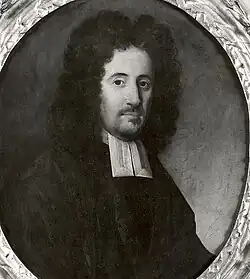
Benjamin Wadsworth (February 28, 1670 – March 16, 1737) was a Colonial American Congregational clergyman and educator. He was trained at Harvard College (B.A., 1690; M.A., 1693). Wadsworth served as minister of the First Church in Boston; and as president of Harvard from 1725 until his death.
Wadsworth House
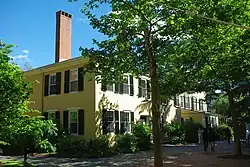
Built in Cambridge, Massachusetts in 1726 for the president of Harvard, Benjamin Wadsworth, and his wife, Wadsworth House has had a long and illustrious history. It is the second oldest building at Harvard (the first being Massachusetts Hall), built on the site where Harvard's earliest building, the Peyntree House, had previously stood.[1][2][3] General George Washington, with the assistance of his second-in-command Charles Lee, set up his first headquarters in the house.[4] It was used as Washington's headquarters from July 2 to July 16, 1775, before transferring to the larger John Vasall House (now the Longfellow House) on Brattle Street.
In Wadsworth House nine Harvard presidents lived from 1726 to 1849.[5] In 1849, when Jared Sparks decided to stay in his nearby home, Harvard presidents ceased to live in Wadsworth House. After that time, Wadsworth House took in student boarders (including Ralph Waldo Emerson '21) and visiting preachers, among others. The Wadsworth House lost its front yard when Massachusetts Avenue was widened.
Today, the building houses the Office of the University Marshal, the Commencement Office, Prof. Robert Darnton the University Librarian, the Harvard Office for Scholarly Communication (headed by Peter Suber), and several professors.[6] It is the last remaining wooden building in Harvard Yard[7] and is the second oldest of surviving Harvard building.
Personal life
In 1712, Wadsworth was one of the first to write about abortion in America, saying those involved either directly or indirectly were guilty of, "murder in God's eyes".[8] Wadsworth owned two slaves during his lifetime, both of whom were forced to work as domestic laborers at Wadsworth House. One of the slaves was a Black man named Titan. On October 25, 1726, Wadsworth purchased an enslaved "negro wench" (thought to be under 20 years old) from a Boston sailmaker named Mr. Bulfinch for 85 Massachusetts pounds. Although Wadsworth did not name her, subsequent reviews of digitized church records by historians indicate her name was likely Venus.[9]
See also
References
- ↑ "The Benjamin Wadsworth House (1726)" by Daniel Sterner at http://mass.historicbuildingsct.com/?p=32 Archived 2014-04-16 at the Wayback Machine
- ↑
- ↑
- ↑ "Wadsworth House".
- ↑ Harvard University. Education, bricks and mortar: Harvard buildings and their contribution to the advancement of learning. Cambridge, Massachusetts : The University, c1949.
- ↑ Wadsworth House History
- ↑
- ↑ Alesha E. Doan (2007). Opposition and Intimidation:The abortion wars and strategies of political harassment. University of Michigan. p. 46. ISBN 9780472099757.
- ↑ https://www.thecrimson.com/article/2022/4/26/harvard-legacy-of-slavery-report/
Further reading
- "Who are the slaves that Harvard will honor?", Boston Globe, April 6, 2016,
Owned by Benjamin Wadsworth
- 1670 births
- 1737 deaths
- Harvard University faculty
- Presidents of Harvard University
- People from colonial Boston
- Slave owners from the Thirteen Colonies
- Slave owners from Massachusetts
- Harvard College alumni
- Clergy from colonial Massachusetts
- People from Milton, Massachusetts
- Educators from Cambridge, Massachusetts
- Clergy from Cambridge, Massachusetts
- American academic administrator stubs