Beautiful Michoacán
| Beautiful Michoacán | |
|---|---|
 | |
| Directed by | Ismael Rodríguez |
| Written by | Ernesto Cortázar Álvaro Gálvez y Fuentes |
| Starring | Tito Guízar Gloria Marín Víctor Manuel Mendoza |
| Cinematography | José Ortiz Ramos |
| Edited by | Jorge Busto |
| Music by | Francisco Domínguez |
Production company | Producciones Rodríguez Hermanos |
| Distributed by | Clasa Films Mundiales |
Release date |
|
Running time | 112 minutes |
| Country | Mexico |
| Language | Spanish |
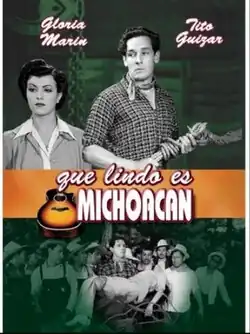
Beautiful Michoacán (Spanish: ¡Qué lindo es Michoacán!) is a 1943 Mexican musical comedy film directed by Ismael Rodríguez and starring Tito Guízar, Gloria Marín and Víctor Manuel Mendoza.[1] It was shot at the Clasa Studios in Mexico City and on location around Michoacán. The film's sets were designed by the art director Ramón Rodríguez Granada.
Plot
Gloria (Gloria Marín), a wealthy, highly sophisticated young woman from Mexico City, travels to the state of Michoacán to inspect a rural estate she has recently inherited from her family.[2] Steeped in high-society city habits, she arrives at the property with an arrogant, condescending attitude toward provincial life and rural customs.[3][4] Upon her arrival, she crosses paths with Roque (Tito Guízar), a proud, charming, and highly respected local rancher who manages neighboring properties and deeply values regional traditions.[5][6] Their initial meeting instantly sparks a fierce clash of personalities, as Gloria's urban elitism directly insults Roque's provincial pride, leading to a series of sharp arguments and mutual rejections.[2][4]
Determined to teach the arrogant city woman a lesson in humility, Roque plays along with her demanding whims while subtly orchestrating situations to expose her complete inability to handle rural ranch work.[4][6] The regional dynamic complicates when Santos (Víctor Manuel Mendoza), a hot-tempered and aggressive local suitor, notices Gloria's presence and begins aggressively courting her, sparking intense masculine rivalries with Roque.[5][4] As Gloria spends more time navigating the breathtaking landscapes, horseback rides, and community festivals of Michoacán, her superficial city defenses begin to crumble.[2][3] She witnesses the deep honesty, community solidarity, and artistic richness of the local people, triggering a profound internal moral awakening that forces her to reconsider her vanity.[3][4]
Recognizing her change of heart, Roque realizes he has fallen deeply and unconditionally in love with Gloria, and she gradually reciprocates his romantic feelings.[2][4] However, the budding romance is severely threatened by the jealous Santos, who triggers a volatile confrontation to sabotage their relationship and reclaim Gloria by force.[4] Through a series of fast-paced rural pursuits, public standoffs during a traditional regional celebration, and a final show of bravery by Roque, Santos's aggressive plans are completely neutralized.[4][6] Gloria openly rejects her old high-society life in the capital, choosing instead to stand proudly by Roque's side.[3] The narrative reaches a festive climax as the couple reconciles, celebrating their authentic romantic bond through a grand musical performance that serves as a cinematic homage to the cultural identity, traditional folklore, and natural beauty of Michoacán.[2][4]
Cast
- Tito Guízar as Ernesto
- Gloria Marín as Gloria Santibáñez
- Víctor Manuel Mendoza as Roque
- Evita Muñoz ("Chachita") as Chachita
- Dolores Camarillo as Nacha
- Jesús Graña as Evaristo
- Manuel Noriega as Padre Francisco
- Arturo Soto Rangel as Licenciado
- Carolina Barret as Julia
- Julio Ahuet as Valentín
- Ángel Garasa as Gastón
- Lupe del Castillo as Pianista
- Emma Duval as Nana
References
- ↑ Hellier-Tinoco p.282
- 1 2 3 4 5 "Cinema 22 - ¡Qué lindo es Michoacán!". Cinema 22 — Canal 22. Retrieved August 10, 2026.
- 1 2 3 4 "¡Qué lindo es Michoacán! (1943)". FilmAffinity. Retrieved August 10, 2026.
- 1 2 3 4 5 6 7 8 9 "Crítica de estrenos en la capital: ¡Qué lindo es Michoacán!". Cine-Mundial. XXVIII (1): 18–19. January 20, 1943.
- 1 2 "¡Qué lindo es Michoacán! (1943)". IMDb. Retrieved August 10, 2026.
- 1 2 3 "¡Qué lindo es Michoacán! (1943) directed by Ismael Rodríguez". Letterboxd. Retrieved August 10, 2026.
Bibliography
- Ruth Hellier-Tinoco. Embodying Mexico: Tourism, Nationalism & Performance. Oxford University Press, 2011. ISBN 978-0-19-534036-5.