Barbilla National Park
| Barbilla National Park | |
|---|---|
 The ranger station at Barbilla National Park. | |
Barbilla National Park area. | |
| Location | Costa Rica |
| Nearest city | Siquirres |
| Coordinates | 9°56′31″N 83°25′12″W / 9.942°N 83.42°W[1] |
| Area | 119 km2 (46 sq mi) |
| Established | 1982 |
| Governing body | National System of Conservation Areas (SINAC) |
  Location in Costa Rica | |
Barbilla National Park is a national park in the Caribbean La Amistad Conservation Area located on the eastern slopes of the Cordillera de Talamanca of Costa Rica.[3][4] It was designated a biological preserve in 1982, then upgraded to a national park in 1998.[5]
Geography
The park consists of over 29,500 acres (11,938 ha)[3] or more[6] in both Cartago and Limón Provinces.[4] With elevations ranging from 330 to 4,920 feet (100 to 1,500 m) and higher, the park has both lowland rainforests and cloud forests.[4] The highest point is Cerro Tigre, at 1,167 metres (3,829 ft).[3]
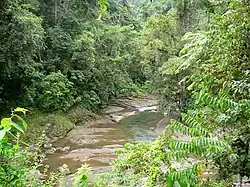
The watershed of the Rio Danta (Dantas River) is an important source of water for the people and animals.[3][7] The Rio Barbilla is another major river in the park.[3][6] Another water feature is Laguna Ayil.[8]
Ecology
It is home to over 350 bird species and 135 mammal species.[6] Various species, including endangered ones, live within the park, including the jaguar, ocelot, puma, Baird's tapir (the country's largest land mammal), capuchin monkey, howler monkey, and two-toed sloth.[4][3] Bird species include the sun heron,[3] keel-billed toucan, harpy eagle and the critically endangered great green macaw.[4] Other species include the eyelash viper, green basilisk (also known as the Jesus Christ lizard for its ability to run on water), and poison dart frog.[4]
Plants include ferns, bromeliads, and orchids.[3]
Climate
Rainfall averages between 3,500–4,500 millimetres (140–180 in) per year.[3][8] Temperatures range from 64 to 82 °F (18 to 28 °C).[8]
Indigenous residents
Barbilla National Park and the surrounding area are the home of the indigenous Cabécar people.[3][8]
Conservation
The park's isolated location has protected it to a great extent, but poaching and illegal logging still present dangers.[4]
Facilities
The park has the Barbilla Biological Station on site,[3] as well as an administrative building located in Brisas de Pacuarito. Access is via an unpaved road, 17 km long starting about 3 kilometres (1.9 mi) from Siquirres.[5]
References
- ↑ Barbilla National Park globalspecies.org
- ↑ Barbilla National Park globalspecies.org
- 1 2 3 4 5 6 7 8 9 10 11 "Barbilla National Park: A Sanctuary of Biodiversity and Indigenous Heritage". Latin America & Caribbean Geographic. 25 September 2024. Retrieved 24 May 2026.
- 1 2 3 4 5 6 7 "Barbilla National Park". National Parks Association. Retrieved 24 May 2026.
- 1 2 Franke, Joseph (2009). Costa Rica National Parks and Preserves (Third ed.). p. 220. ISBN 978-1-59485-035-6. Retrieved 24 May 2026.
- 1 2 3 "Barbilla National Park, a Hidden Gem in Costa Rica". The Costa Rica News. 1 April 2024. Retrieved 24 May 2026.
- ↑ Stater, Adam. "Barbilla National Park". Retrieved 24 May 2026.
- 1 2 3 4 "Barbilla National Park". Retrieved 24 May 2026.
External links
- Barbilla National Park at Costa Rica National Parks
- Map of the park, courtesy of SINAC
