Baltit Fort
| Baltit Fort قلعہ بلتت | |
|---|---|
 Baltit Fort | |
Interactive map of the Baltit Fort قلعہ بلتت area | |
General information | |
| Location | Karimabad, Gilgit-Baltistan, Pakistan |
| Coordinates | 36°19′32″N 74°40′11″E / 36.325556°N 74.669722°E |
Baltit Fort (Urdu: قلعہ بلتت) is a palatial fort in the Hunza Valley, near the town of Karimabad, in the Gilgit-Baltistan region of northern Pakistan. It has been on the UNESCO World Heritage Tentative list since 2004.[1]
The conversation work carried out in the last decade of 20th-century indicated that the core structures, including the defensive stone and timber tower, date to the 8th century CE.[1] The architecture of the fort reflects Tibetan influences. In the 16th-century, Ayasho II, the Mir of Hunza, married Shah Khatun, a princess from Skardu and the granddaughter of Ali Sher Khan Anchan. The father-in-law Abdal Khan sent artisans who rebuilt the fort. Abdal Khan also sent a cannon in dowry which bears date of 1539 CE.[2]
The Mirs of Hunza abandoned the fort in 1945, and moved to a new palace down the hill. The fort started to decay which caused concern that it might possibly fall into ruin. Following a survey by the Royal Geographical Society of London a restoration programme was initiated and supported by the Aga Khan Trust for Culture Historic Cities Support Programme. The programme was completed in 1996 and the fort is now a museum run by the Baltit Heritage Trust.
Awards
Gallery
 Baltit Fort
 Spantik as viewed to the south-east from the fort
 Ultar Peak towers above the fort
 Dance with traditional music at Baltit Fort
 The fort is decorated with simple stain-glassed windows
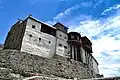 View of Baltit Fort
 Baltit Fort, Hunza Valley
 The fort's historic cannon is now on display for visitors
 The fort's guards wear distinctive uniforms
 The fort displays local antiques
 Antique Russian rifles gifted to Mir of Hunza
Bibliography
- Biddulph John, Tribes of Hindoo Koosh, The Superintendent of Government Printing-Calcutta, India 1880, Reprint: Ali Kamran Publishers, Lahore-Pakistan, 1995.
See also
References
- 1 2 "Baltit Fort". UNESCO World Heritage Centre. Retrieved 27 September 2025.
- ↑ Dani, Ahmad Hasan (1991) [1989]. History of Northern Areas of Pakistan (2nd ed.). Islamabad: National Institute of Historical and Cultural Research, Quaid-i-Azam University. p. 197. ISBN 978-969-415-016-1.
- ↑ Baker, Aryn (27 June 2005). "Best of Asia: Baltit Fort Hunza Valley, Pakistan". Time Asia. Archived from the original on 12 September 2005. Retrieved 11 December 2006.
External links

| Azad Kashmir |
|  |
|---|---|---|
| Balochistan |
| |
| Gilgit-Baltistan | ||
| Punjab |
| |
| Sindh | ||
| Khyber Pakhtunkhwa | ||