BCPC (herbicide)
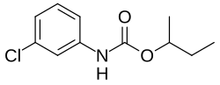 | |
| Names | |
|---|---|
| IUPAC name
(2RS)-butan-2-yl (3-chlorophenyl)carbamate | |
| Preferred IUPAC name
rac-(2R)-butan-2-yl (3-chlorophenyl)carbamate | |
| Other names | |
| Identifiers | |
3D model (JSmol) |
|
| ChemSpider | |
PubChem CID |
|
| UNII | |
CompTox Dashboard (EPA) |
|
| |
| Properties | |
| C11H14ClNO2 | |
| Molar mass | 227.69 g·mol−1 |
| Density | 1,193 kg/cu.m[1] |
| Boiling point | 269.4 °C (516.9 °F; 542.5 K) [1] |
| Hazards | |
| Flash point | 116.8 °C (242.2 °F; 389.9 K) [1] |
Except where otherwise noted, data are given for materials in their standard state (at 25 °C [77 °F], 100 kPa).
Infobox references | |
BCPC (short for butan-2-yl (3-chlorophenyl)carbamate) is a defunct carbamate herbicide used prëemergently to control weeds on cotton. It was widely used in the 1970s, rare by the 2000s and considered obsolete in 2010.[1][4]
It is not registered for use in the UK or the EU.[1]
Chemically, BCPC is racemic.[2]
Under the HRAC classification BCPC is a Group E (Australia), Group K2 (global), Group 23 (numeric) herbicide,[1] acting by inhibiting cell division and microtubule organization and polymerization.
References
- 1 2 3 4 5 6 7 8 9 10 11 Hertfordshire, University of. "BCPC (Ref: NSC-2475)". sitem.herts.ac.uk. Pesticide Properties Database (PPDB). Retrieved 30 March 2026.
- 1 2 "NCATS Inxight Drugs — SEC-BUTYL N-(3-CHLOROPHENYL)CARBAMATE". drugs.ncats.io.
- 1 2 "CAS Common Chemistry". commonchemistry.cas.org.
- ↑ "BCPC data sheet". www.bcpcpesticidecompendium.org. BCPC. Retrieved 30 March 2026.
External links
- BCPC (herbicide) in the Pesticide Properties DataBase (PPDB)