Ayyur (mythology)
| Ayyur | |
|---|---|
 | |
| Other names | IERU, Iru [1] |
| Venerated in | Algeria |
| Major cult centre | Numidia |
| Abode | Moon |
| Symbol | Crescent |
| Adherents | Berbers |
| Festivals | Yennayer |
| Genealogy | |
| Spouse | Tafukt |
| Equivalents | |
| Greek | Diana |
| Roman | Luna |
Ayyur (Berber languages: ⴰⵢⵢⵓⵔ[2]) is a lunar deity[3] in Berber traditional religion and was the chief god of Numidia in ancient times. The name ayyur literally means "the moon" in Berber languages. The name also refers to the lunar month.[4] The deity is "represented by a personage whose head is radiated as that of an astral deity would be".[4]
History
Herodotus wrote in the fifth century BC that the Berbers sacrificed to the sun and moon.[5] In addition, Ibn Khaldun reports that at the time of the Arab invasion of their territory, "those of the Berbers who had not been converted to the Christian faith worshipped the sun and the moon, as well as statues of deities".[6] The name Ayyur appears in several inscriptions left by the Berbers of antiquity.
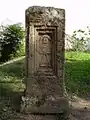
Among the local iconographic particularities in Cuicul, Mons and Sitifis, Saturn and the deities of the Sun (Tafukt) and the Moon (Ayyur) are highly venerated and occupy the same register or are put on the same level.[7]
| Part of a series on |
| Libyco-Berber religion |
|---|
 |
Symbology
In Berber tradition, the moon is associated with fertility, culture, beauty, femininity and humidity. Among the Tuaregs, the link with water and fertility is even more explicit, as evidenced by a ritual recorded in the Hoggar at the beginning of the 20th century by Charles de Foucauld on the occasion of the new moon.[4]
Moon in different Berber dialects
| Berber Dialect | Word for Moon/Month | Word for moonlight |
|---|---|---|
| Tamazight | ayur / ayuren | tiziri (moon/full moon) |
| Chaoui | ayur / iyuren | tiziri |
| Kabyle | ayyur > aggur | tiziri |
| Mozabite | yur / iyaren | tiziri |
| Ouaragla | yur / iyaren (Crescent of moon) | tiziri (Moon when not crescent) |
| Beni Snous | yur | tiziri |
| Rifi | ayur / yyur | tiziri |
| Tachelhit | ayyûr / yîren | - |
| Ghadames | ûyer / uyerâwen (Crescent Moon) | tiziri (Full moon) |
| Tuareg | éôr / éôren | - |
| Zenaga | YR / ŽR, lexical form: é'žir and é'žžer | - |
Prayer to the moon god
Traditionally, the Tuareg people prayed to Ayyur at the new moon. They fire guns in the new month, saying:
"Grant us victory over our enemies, whoever they may be! Give us your protection in this world and in the hereafter! God grant that you will be a blessed month. May he who plunged you into darkness make you appear to his light!" (Charles de Foucaud…, Textes touaregs en prose, Aix-en-Provence, Édisud, 1984 [texte n° 172, « Nouvelle lune », p. 293]).[8]
References
- ↑ ""Iru" Moon Encyclopédie berbere". journals.openedition.org. p. 3642-3642. Retrieved 2026-02-20.
- ↑ "DGLAi". tal.ircam.ma. Archived from the original on 2023-05-30. Retrieved 2026-02-20.
- ↑ "Mythologie berbère :Ayyur et Tiziri et Itige, Cultes du Soleil et de la Lune chez les Libyques". MESMAR (in French). 2019-09-01. Retrieved 2026-02-20.
- 1 2 3 Chaker, S. (2008). "Lune: Compléments linguistiques et ethnologiques (Berbères Nord)". Encyclopédie berbère. 28–29: 4444–4447. doi:10.4000/encyclopedieberbere.368. ISSN 1015-7344.
- ↑ "Hassan Majdi, The Cult of Saints and the Pilgrimages, University of Paris 8, May 2009" (PDF).
- ↑ Servier, Jean (2017-03-01). Les Berbères: « Que sais-je ? » n° 718 (in French). Humensis. ISBN 978-2-13-079523-0.
- ↑ Benseddik, Nacéra (2019). "Saturne". Encyclopédie berbère (in French) (42): 7218–7227. doi:10.4000/14u1m. ISSN 1015-7344.
- ↑ Norris, H. T. (1987). "Charles De Foucauld and Calassanti-Motylinski A. De: Textes touaregs en prose. Editions critiques avec traduction par Salem Chaker. [Revised edition.] (Collection Monde Berbère [Université de Provence].) 359 pp. Aix-en-Provence: Edisud [and] CNRS, 1984". Bulletin of the School of Oriental and African Studies. 50 (1): 145–146. doi:10.1017/s0041977x00053453. ISSN 0041-977X.
Bibliography
- S. Chaker, « Lune », dans Encyclopédie berbère, vol. 28-29 : Kirtēsii-Lutte, Édisud, 2008 (DOI 10.4000/encyclopedieberbere.368), p. 4444-4447
- Hassan Majdi (2009). "Les références et les fondements historiques du phénomène hagiographique au Maroc". Le Culte des saints et les pèlerinages des Juifs au Maroc ? (PDF). Université Paris 8. p. 174-175.