Authoritarianism during the Trump presidencies
| Part of a series on |
| Authoritarianism during the Trump presidencies |
|---|


| ||
|---|---|---|
|
Life and business 45th and 47th President of the United States Tenure
Impeachments Prosecutions   |
||

There is significant academic and political debate about the extent to which the United States has embodied authoritarianism during the Trump presidencies. Many scholars classify the US as a hybrid "proto-authoritarian" or competitive authoritarian regime, as opposed to being a healthy democracy or a highly-centralized authoritarian regime. This is the result of significant democratic backsliding, which accelerated during Donald Trump's first presidency, plateaued during Joe Biden's presidency, and accelerated again during Trump's second presidency at a faster, unprecedented rate.
Accusations of authoritarianism center around the concentration of executive power, killings by ICE agents during immigration enforcement operations, controlling information and attacks on free press, suppressing dissent and crackdowns on protests, aggressive foreign policy, undermining democratic institutions and law, dismantling social protections and rights, corruption, and attacking academia.
Concepts and strategy
Democratic backsliding
Democratic backsliding is "a process of regime change towards autocracy that makes the exercise of political power more arbitrary and repressive, and that restricts the space for public contestation and political participation in the process of government selection."[3][4]

The 21st century saw the erosion of voting rights and the rise of partisan gerrymandering by state legislatures.[6] The first presidency of Donald Trump accelerated the undermining of democratic norms.[6][7] A paper published in The Annals of the American Academy of Political and Social Science said, "Trump undermined faith in elections, encouraged political violence, vilified the mainstream media, [and] positioned himself as a law-and-order strongman challenging immigrants and suppressing protests."[6]
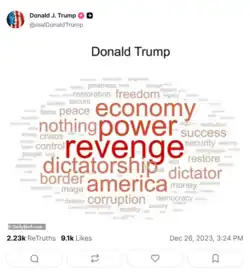
Quickly after resuming office for his second term in 2025, Trump became increasingly criticized by political scientists, scholars, and other significant figures for threatening American democracy. Early on, many cited the expansion of executive power and the reduction of agency workforces and regulations by the Department of Government Efficiency as an example of such threats.[9] Freedom House described the pardon of January 6 United States Capitol attack defendants as an attempt to "excuse a violent assault on a key element of democracy".[10]
The V-Dem Institute said in 2026 that "the speed with which American democracy is currently dismantled is unprecedented in modern history".[11][12] The institute noted executive overreach undermining the rule of law, suppression and intimidation of the media and dissenting voices, loss of legislative constraints, and declining civil rights, equality, and freedom of expression, reaching a 50-year low.[11]
Competitive authoritarianism
In competitive authoritarian regimes, "formal democratic institutions exist and are widely viewed as the primary means of gaining power, but [...] incumbents' abuse of the state places them at a significant advantage vis-à-vis their opponents."[13][14] Competitive authoritarian regimes differ from fully authoritarian regimes in that elections are regularly held, the opposition can openly operate without a high risk of exile or imprisonment and "democratic procedures are sufficiently meaningful for opposition groups to take them seriously as arenas through which to contest for power."[13] Competitive authoritarian regimes lack one or more of the three characteristics of democracies such as free elections (i.e. elections untainted by substantial fraud or voter intimidation); protection of civil liberties (i.e. the freedom of speech, press and association) and an even playing field (in terms of access to resources, the media and legal recourse).[15]
In 2019, political scientists Robert R. Kaufman and Stephan Haggard saw "striking parallels in terms of democratic dysfunction, polarization, the nature of autocratic appeals, and the processes through which autocratic incumbents sought to exploit elected office" in the United States under Trump compared to other backsliding countries (Venezuela, Turkey, and Hungary).[16] They argued that a transition to competitive authoritarianism is possible but unlikely.[16] In 2020, Kurt Weyland presented a qualitative model for assessing democratic continuity and reversal using historical data from the experience of other countries. His study concluded that the United States is immune to democratic reversal.[17] In 2021, political scientists Matias López and Juan Pablo Luna criticized his methodology and selection of parameters and argued that both democratic continuity and reversal are possible. With regard to the state of scholarly research on the subject, they wrote that "the probability of observing democratic backsliding in the United States remains an open and important question".[18] According to some Canadian security experts, Canada may reevaluate historically close Canada–United States relations in response to democratic backsliding in the U.S., which could bring instability to the region and compromise Canada's greatest source of intelligence, and Canadian Prime Minister Mark Carney has openly said that U.S.–Canadian relations have entered a new chapter wherein the United States will no longer be seen as a trustworthy partner.[19][20][21]
Steven Levitsky found the first two months of the second Trump administration to be the most aggressively and openly authoritarian case of democratic backsliding that he has seen, expressing particular concern about attacks on the courts.[22] In September 2025, Ray Dalio, the founder of Bridgewater Associates, has warned that the United States was heading towards 1930s-style authoritarian policies.[23]
Proto-authoritarianism

Professor Christina Pagel mapped the first actions of the Trump administration in a Venn diagram that identifies "five broad domains that correspond to features of proto-authoritarian states". These five domains are: undermining democratic institutions and the rule of law, dismantling federal government; dismantling social protections and rights, enrichment and corruption; suppressing dissent and controlling information; attacking science, environment, health, arts and education, particularly universities; aggressive foreign policy and global destabilization.[25]
Unitary executive theory
Unitary executive theory is a theory of United States constitutional law holding that the president, as head of the federal government's executive branch, must retain sole authority over executive administration and officials,[26] structurally centralizing control within a unified hierarchy. Weaker formulations are less controversial than maximalist versions, which face constitutional and practical criticism.[27] During the Reagan era, conservative organizations, including the Federalist Society and the Heritage Foundation, and some Supreme Court justices, most notably Antonin Scalia, began favoring the theory.[28][29][30][31][32]
Trump exerted more control over the executive than any modern president, citing Article II in 2019, "where I have the right to do whatever I want as president."[33][34][27] Before his confirmation as attorney general, Bill Barr supported the theory in a 2018 memo criticizing the Mueller special counsel investigation.[35][36]
By 2018, five justices on the Supreme Court had been executive branch lawyers from the Reagan and Bush eras focused on expanding presidential power.[37] In Seila Law LLC v. Consumer Financial Protection Bureau (2020), the Roberts Court held 5–4 that the Executive Vesting Clause gives "the entire 'executive Power' ... to the President alone". The dissent said the constitutional text does not say "entire 'executive power'" or "anything about the President's power to remove subordinate officials at will".[38][39]
This precedent guided Collins v. Yellen (2021), a 7–2 ruling[40][41][39] where Alito wrote the Constitution prohibits even "modest restrictions" on the president's removing single-officer agency heads. The Court reaffirmed that precedents found in Humphrey's Executor and Morrison were the only exceptions to this removal power.[42]
The New York Times and The Guardian reported that Project 2025 sought to establish a framework for expanding presidential power during the second Trump administration based on a maximalist and "contested" version of the unitary executive theory.[43][33] The BBC called Project 2025's application of the theory to independent agencies "controversial".[44] Robert Shea, a former OMB official in the George W. Bush administration, told The Atlantic: "I can't overstate my level of concern about the damage this would do to the institution of the federal government."[45]
Trump v. United States (2024), viewed by some as embracing the theory, further empowered the presidency.[46][47]
Trump's second term expanded control over agencies and the civil service.[48][49] He ordered the targeting of political opponents and civil society.[50][51] He undertook mass firings of employees, inspectors general, and independent agency and oversight board members who might obstruct him.
Legal analysts said these actions set up Supreme Court tests on agencies Congress insulated from presidential control.[37] The Court subsequently ruled in favor of the administration and an expansive view of presidential power.[52]
Under the theory, the administration says the Constitution grants it a right to control or cease law enforcement, which legal experts called a "constitutional power to immunize private parties to commit otherwise illegal acts with impunity".[53] In February 2025, Attorney General Pam Bondi warned career Justice Department lawyers they could not "substitute personal political views or judgments for those that prevailed in the election" and could face discipline if they failed to vigorously defend the administration's policies.[54] Emil Bove sent a similar letter to Danielle Sassoon, triggering a wave of resignations as each federal prosecutor instructed to seek dismissal of the Eric Adams indictment refused to do so. According to Michael C. Dorf, the administration's stance reflected its expansive view of presidential power.[55]
Trump and his subordinates are seen as embracing an extreme version of the theory, under which[56][57] the administration pursued a revived impoundment power, with Russell Vought and Mark Paoletta citing Article II's Executive Vesting, Faithful Execution, and Commander-in-Chief Clauses as authorizing executive power to decline spending congressionally appropriated funds and as undermining the constitutionality of the Impoundment Control Act of 1974. Impoundment has not been a central feature of the unitary executive, but the administration has tried to extend the theory outward to override this explicit legislative act constraining how the executive interacts with Congress's constitutional power.[58] Though the Supreme Court has not ruled on the extent of the president's constitutional authority, if any, to impound funds,[59] Chief Justice Roberts and Justice Brett Kavanaugh previously wrote against impoundment,[60][61] and in Consumer Financial Protection Bureau v. Community Financial Services Association of America, Ltd. (2024), the Court wrote, "our Constitution gives Congress control over the public fisc" under the Appropriations Clause.[62]
In March 2025, the D.C. Circuit held that the president could remove members of the National Labor Relations Board and Merit Systems Protection Board, finding removal restrictions unconstitutional.[63] The theory's impact on federal administration raised concerns over loss of federal expertise.[64]
After stressing the First and Second Bank of the United States as historical precedents to the Federal Reserve,[65] the Court decided Trump v. Cook (2026).
Journalist Martin Sandu and authoritarian politics researcher Alex Norris described the maximalist interpretation of executive power in Trump's second term as president, including sweeping executive orders, the federal funding freeze, actions against political opponents and the media, pardons of those involved in the January 6th Capitol attack, the actions of Elon Musk's Department of Government Efficiency, and the like as an attempted self-coup.[66][67] The political scientist Lee Morgenbesser argued the actions of DOGE are a form of state capture.[68]
Oligarchy
The Trump administration has been accused of operating like an oligarchy, a type of authoritarian regime based on the concentration of political power into a small group of people or dominant single party.[69][70]
In his presidential farewell address on January 15, 2025, outgoing U.S. President Joe Biden warned that an oligarchy was taking shape in America which threatened democracy, basic rights, and freedom, aided by a tech–industrial complex in what Politico described as "echoing Roosevelt's language in calling out the 'robber barons' of a new dystopian Gilded Age".[71][72][73] Elon Musk, a close collaborator of Donald Trump during his 2024 campaign and head of the Department of Government Efficiency (DOGE), has been described as an oligarch due to his extensive influence on Trump during his second presidency.[74][75][76][77][78][79] Musk contributed over $200 million into the 2024 election, creating a Super PAC to promote Trump's campaign.[80][81][82] Two-time presidential candidate and progressive leader Bernie Sanders started his Fighting Oligarchy ("Where We Go from Here") Tour across America in response to Trump's election victory.[83]
Nationalism
President Donald Trump was described as a nationalist,[84] and he embraced the term himself.[85] Researchers describe the Republican Party in the 21st century as becoming right-wing populist and nationalist, more specifically classified as neo-nationalist,[91] with strongly anti-pluralist,[87] white nationalist and ethnonationalist themes.{{refn|name=WhiteNat|*"Polity V Regime Narrative: United States (2025)" (PDF). Polity Data Series. January 20, 2025. pp. 12–15. Retrieved April 3, 2026.
In a February 2017 article in The Atlantic, journalist Uri Friedman described "populist economic nationalist" as a new nationalist movement "modeled on the 'populism' of the 19th-century U.S. President Andrew Jackson" which was introduced in Trump's remarks to the Republican National Convention in a speech written by Stephen Miller and Steve Bannon. Miller had adopted Senator Jeff Sessions' form of "nation-state populism" while working as his aide.[92] By September 2017, The Washington Post journalist Greg Sargent observed that "Trump's nationalism" as "defined" by Bannon, Breitbart, Miller and "the rest of the 'populist economic nationalist' contingent around Trump" was beginning to have wavering support among Trump voters.[93] Some Republican members of Congress were also described as nationalists during the Trump era, such as Representative Steve King,[94] Representative Matt Gaetz,[95] Senator Tom Cotton[96] and Senator Josh Hawley.[97]
During the Trump era, commonly identified American nationalist political commentators included Rush Limbaugh, Ann Coulter,[98] Michelle Malkin,[99] Lou Dobbs,[100] Alex Jones,[101] Charlie Kirk,[102] Laura Ingraham,[98] Candace Owens,[103] Michael Savage,[104] Tucker Carlson,[105] Mike Cernovich,[106] and Nick Fuentes.[107]
Fascism
Fascism is a far-right, authoritarian, and ultranationalist political ideology and movement that rose to prominence in early-20th-century Europe.[108][109][110] Fascism is characterized by support for a dictatorial leader, centralized autocracy, militarism, forcible suppression of opposition, belief in a natural social hierarchy, subordination of individual interests for the perceived interest of the nation or race, and strong regimentation of society and the economy.[110][111] Opposed to communism, democracy, liberalism, pluralism, and socialism,[112][113] fascism is at the far-right of the traditional left–right spectrum.[108][113][114] What constitutes a precise definition of fascism has been a longrunning and complex debate among scholars.
A number of prominent scholars, former officials and critics have drawn comparisons between Trump and fascist leaders with respect to authoritarian actions and rhetoric,[a] while others have rejected the label.
Trump has supported political violence against opponents; many academics cited Trump's involvement in the January 6 U.S. Capitol attack as an example of fascism. Trump has been accused of racism and xenophobia with respect to his rhetoric about illegal immigrants and his policies of mass deportation and family separation. Trump's base, referred to as the MAGA movement, is sometimes analyzed as a cult of personality. Especially during his second term, several experts of fascism have characterized Trump and his allies' rhetoric and style of governance as authoritarian, and have compared them to previous fascist leaders'. In contrast, some scholars have described Trump variously as an authoritarian populist, a far-right populist, a nationalist, or of a different ideology.[116][117]
Flood-the-zone

"Flood the zone" is a political strategy in which a political figure aims to gain media attention, disorient opponents, and distract the public from undesirable reports by rapidly forwarding large volumes of newsworthy information to the media.[119][120][121][122] The strategy has been attributed to U.S. President Donald Trump's former chief political strategist Steve Bannon.[122][123][124]
The strategy came to public light after Bannon told Michael Lewis in 2018 that "The Democrats don't matter [...] The real opposition is the media. And the way to deal with them is to flood the zone with shit".[125] Trump adopted the strategy during the 2016 presidential election,[121][126] followed by other right-wing political figures such as Éric Zemmour and Elon Musk.[127][128][129][130]
Authoritarian actions
Targeting of press

Attacks against journalists have become more frequent since the Donald Trump 2016 presidential campaign, with journalists — especially those reporting on political news — being victims of assault,[131][132] equipment theft and damage,[133] detainment,[134] arrest,[134] cyberattacks,[135] and doxxing[132] at increasing rates by police, civilians, and immigration enforcement agents.[135] Trump's actions have contributed to a significant decline in the freedom of the press.[b]
These are widely considered the result of a combination of factors. Recent police attacks against journalists have been widely attributed to militarization of police in the U.S.,[143][144] the degree of influence of pro-Israel lobbies and lobbyists on crackdowns on the Gaza war protests by government and university officials,[145][146] and Trump's militarization[147] and deployment[148][149] of law enforcement. Civilian attacks against journalists have increased largely as a result of Trump's legal and rhetorical attacks against journalists who are critical of his platform and due to his role propagating election denial conspiracy theories, often resulting in his supporters taking violent action.[150][131][151]
In a Pew Research survey of 11,889 U.S. journalists conducted from February 16 to March 17, 2022, 57% stated that they were "extremely" or "very" concerned about the prospect of press restrictions being imposed in the United States.[152] The U.S.'s Reporters Without Borders (RSF) Press Freedom Index ranking fell from 20th in 2010 to 57th in 2025.[153] According to RSF, "after a century of gradual expansion of press rights in the United States, the country is experiencing its first significant and prolonged decline in press freedom in modern history, and Donald Trump's return to the presidency is greatly exacerbating the situation."[154] During Trump's second presidency, Immigration and Customs Enforcement (ICE) agents have repeatedly assaulted and arrested journalists.
- 2026 Delaney Hall hunger strike and protests – Reporters Without Borders said "these attacks are unconstitutional repression typical of an authoritarian regime" of the May 31 mass arrests/journalist charges.[155]
Targeting of transgender people
During the second presidency of Donald Trump, the United States government has taken a series of actions to persecute people who are transgender. These actions have been accompanied by anti-transgender rhetoric and misinformation, often to dehumanize and scapegoat transgender people and portray them as a social threat.
The administration has restricted, defunded, and blocked gender-affirming care—especially in the case of minors—as well as research and education related to transgender issues. It has utilized censorship of inclusive language for the purpose of anti-transgender policy and directed law enforcement and the FBI to investigate the promotion of "radical gender ideology". The Trump administration has undergone purges of transgender military personnel, prohibited transgender girls and women from participating in women's sports, discriminated against transgender inmates, and has created restrictions on passports and international travel for transgender people.
The Trump administration's actions targeting transgender people draw much of their design from the anti-transgender movement in the United Kingdom, and form part of the broader 2020s anti-LGBTQ movement in the United States and the anti-gender movement. The administration's actions have been referred to by some advocates as the early stages of genocide similar to that of persecution of transgender people in Nazi Germany, arguing they seek to "marginalize them socially and economically".[156]
Targeting of elections
Donald Trump's targeting of elections stems from his loss in the 2020 United States Presidential Election, in which he was defeated by Joe Biden. Donald Trump, shortly after his defeat, began spreading conspiracy theories and false information regarding the election integrity of the election, claiming that the election was stolen.[157] His primary arguments for making this claim were because of illegal immigrants voting, dead people voting, mail-in ballots, and rigged voting machines.[158]
During his 2024 campaign, Donald Trump began promoting the SAVE act, which would require in-person voter registration, proof of citizenship when registering to vote, mandatory photo ID when voting, heavily restricting mail-in and absentee ballots, requiring that states submit their voter rolls to the Department of Homeland Security so that noncitizens can be purged from the list, and criminal punishments for election officials that do not comply with the SAVE act provisions.[159] Donald Trump makes the claim that this bill is a security measure for future elections, however multiple critics point out that the very strict rules could make many US citizens, most notably married women who changed their last names, ineligible to vote in elections.[160] Critics also point out that the SAVE act would act as a voter suppression law against low-income and rural Americans who do not have easy access to proof of identification and access to polling locations.[161][162] Currently, the bill has passed the House of Representatives multiple times, with some provisions of the SAVE act piggybacking on other legislative items, however the bill keeps stalling in the Senate.
During Trump's second term in office, he has signed numerous executive orders to target mail-in ballots, ordering the United States Postal Service (USPS) to create a list of approved mail-in voters, creating a standard mail-in ballot envelope design with upgraded security features, mandated non-delivery of unauthorized mail-in ballots, and criminal actions against non-compliance.[163] Donald Trump also signed a separate executive order that would require the USPS to stop delivering mail-in ballots to the 23 states that did not provide the federal government with unredacted voter rolls. All or most of the provisions in his executive orders attacking mail-in ballots have been shot down by federal courts or have faced fierce opposition by states that do not comply with his executive orders.[164]
Apart from the SAVE act, Donald Trump is also responsible for igniting the redistricting battle before the 2026 United States midterm elections. On July 7, 2025, Donald Trump made a formal request to Texas governor Greg Abbot and the Texas Legislature to gerrymander the congressional districts to help republicans gain 5 extra seats, in an attempt to hold the narrow majority (220-212) republicans maintained in the 2024 House of Representatives Elections.[165] His reasons for this request was to dilute voting power of democrats in Texas, especially ahead of an anticipated Democratic wave year, and anticipating that further Republican controlled states would join in on redrawing maps.[166] Although Democratic controlled states attempted to fight back with their own maps, Republicans are currently forecasted to have a net gain of 10 seats through redistricting efforts.[167][168]
Donald Trump, during the redistricting efforts, also filed an amicus brief challenging section 2 of the Voting Rights Act, in the Supreme Court case of Louisiana v. Callais. The section prohibited states from racially gerrymandering in order to dilute the voting power of minority voters.[169] After the decision, Donald Trump publicly thanked Justice Samuel Alito for writing the majority opinion. Donald Trump called the eliminating of Louisiana's majority black district as a "Big win" and "The kind of ruling I like".[170]
Targeting of civil society
During Donald Trump's second presidency, the Trump administration took a series of actions using the government to target his political opponents and civil society. News outlets described his actions as part of his promised "retribution" and "revenge" campaign, within the context of a strongly personalist and leader-centered conception of politics.[171][172][173][174] During his 2024 presidential campaign, Trump repeatedly stated that he had "every right" to go after his political opponents.[175]
He undertook a massive expansion of presidential power under a maximalist interpretation of the unitary executive theory.[176] Several of his actions ignored or violated federal laws, regulations, and the Constitution according to American legal scholars,[177][178][179] the Government Accountability Office,[180] and federal judges.[181][182][183] He threatened, signed executive actions against, and ordered investigations into his political opponents, critics, and organizations aligned with the Democratic Party.[184] He politicized the civil service,[176] undertaking mass layoffs of government employees to recruit workers more loyal to himself.[185] He ended the post-Watergate norm of Justice Department independence, weaponizing it and ordering it to target his political enemies.[186] He utilized several government agencies to retaliate against his political enemies and continued filing personal lawsuits against his political opponents, companies, and news organizations that angered him.[173][187]
By July 2025, Trump had extracted more than $1.2 billion in settlements in a "cultural crackdown" against a variety of institutions that largely chose to settle rather than fight back.[188] He engaged in an unprecedented targeting of law firms and lawyers that previously represented positions adverse to himself.[189][190] He targeted higher education by demanding it give federal oversight of curriculum and targeted activists, legal immigrants, tourists, and students with visas who expressed criticism of his policies or engaged in pro-Palestinian advocacy.[191] He also detained and deported United States citizens.[192]
Trump's actions against civil society have been described by legal experts and political scientists as authoritarian and contributing to democratic backsliding,[193][194][195] as well as negatively impacting freedom of the press,[196][197][198] free speech, and the rule of law.[186][199][200][201]
In February 2026, during his State of the Union address to Congress, Trump was publicly criticized by Representatives Ilhan Omar and Rashida Tlaib, who challenged his immigration policies and accused his administration of harming U.S. citizens. In response, Trump posted on his social media platform Truth Social, suggesting that the lawmakers "should be sent back from where they came". Omar, a naturalized U.S. citizen born in Somalia, and Tlaib, a U.S.-born citizen of Palestinian descent, were both widely reported to have been the focus of these remarks. Media outlets and civil rights organizations described Trump's comments as xenophobic and controversial, drawing bipartisan criticism for targeting members of Congress based on their heritage.[202][203][204]
Persecutions of political opponents
Midway through the first year of his second term, Trump made several posts on Truth Social account Pam Bondi ordering her to prosecute his political opponents, specifically naming Senator Adam Schiff, former FBI Director James Comey, and New York Attorney General Letitia James. Trump stated "We can't delay any longer, it's killing our reputation and credibility." According to an administration official, the posts were intended to be direct messages and were accidentally posted publicly.[205]
Months later, Comey and James were indicted, on charges that were later dismissed. In July 2026, journalists Maggie Haberman and Jonathan Swan reported that Trump told a White House advisor that he did not care whether the prosecution of James was successful and that the only purpose was to drag James into court. "I want to make her life miserable," Trump reportedly told the advisor.[206][207]
After six members of congress posted a video[208] advising service members not to carry out illegal orders, the administration investigated the representatives[209][210][211] and sought an indictment, but a grand jury declined to bring charges.[212] The administration also convicted John Bolton, prosecuted LaMonica McIver,[213] and indicted Comey again, this time on an Instagram post prosecutors claim was a threat against the president.[214] The Trump administration has also opened investigations into political opponents Jerome Powell,[215] Tim Walz, Jacob Frey,[216] Gavin Newsom, Jennifer Siebel Newsom, George Soros, Alexander Soros, Jack Smith, John Brennan, E. Jean Carroll, Reid Hoffman, Miles Taylor, and Christopher Krebs.[217]
Immigration enforcement


Donald Trump was inaugurated for his second term as President of the United States on January 20, 2025, with one of his key campaign promises being to crack down on immigration.[219] That evening, Trump signed several executive orders related to immigration, including declaring a national emergency at the Mexico–United States border, blocking asylum seekers from entering the U.S., expanding the detention of apprehended migrants pending removal proceedings, ending birthright citizenship for new children born to parents who are not U.S. permanent residents, suspending almost all refugee admissions to the U.S., and officially designating certain international cartels and criminal organizations as terrorists.[220] Trump signed the Laken Riley Act on January 29, 2025, which mandates the detention of immigrants who are arrested, charged with, or convicted of certain crimes.
Border encounters between migrants and U.S. Customs and Border Protection (CBP) continued to decline[221] since Trump took office in 2025; refugee admissions have also plummeted. The administration has also expanded its immigration detention and deportation operations. The overall strategy of the Trump administration, and the often maximalist tactics employed, primarily by the U.S. Department of Homeland Security, have received widespread criticism, and protests have erupted across the country in response.
In 2025, Congress passed and President Donald Trump signed the One Big Beautiful Bill Act which appropriated $170 billion to immigration enforcement through 2029. In 2026, Congress passed and President Trump signed the Secure America Act which appropriated, through 2029, an additional $69.5 billion dollars.[222]
Domestic military actions
During his second presidency, Donald Trump ordered deployments of National Guard troops to select U.S. cities in 2025 and certain deployments have continued into 2026. Trump has given multiple explanations for the deployments, saying they are officially part of crackdowns on protests, civil unrest, crime, homelessness, and illegal immigration. The actions targeted Democratic Party-led cities and sparked significant controversy, with critics labeling them as abuses of power and potential violations of laws like the Posse Comitatus Act, which limits military involvement in domestic law enforcement.[223][224][225] The moves came amidst broader expansions of the military's domestic use during the second Trump administration,[226] and Trump's prior comments during his presidential campaign to use the military to end civil unrest and protests without consent from state governors and target "the enemy within".[227][228]
Deployments began in Los Angeles in June 2025 and expanded to Washington, D.C., in August 2025, before presidential authorizations were issued to expand to Memphis, Tennessee, and Portland, Oregon, in September 2025. Federal forces arrived in Memphis in October 2025.[229] Plans were underway for Chicago and potentially other cities like New York, Baltimore, San Francisco, and Oakland, California.[230][231][232][233] In September 2025, Trump told military leaders to view the deployments as "training grounds for our military" and described America as under "invasion" and waging "a war from within".[234] In October 2025, Trump authorized federal troop deployments in Chicago as part of Operation Midway Blitz, a multi-agency surge aimed at "criminal illegal aliens" in Illinois and moved on to New Orleans in December.[235][236][237]
On September 2, 2025, a federal judge ruled that the administration had illegally sent troops into Los Angeles in violation of the Posse Comitatus Act, a development described as potentially complicating Trump's threats for further military deployment.[238] Further court cases and appeals questioned the legality of the deployments, with the U.S. Supreme Court rejecting an administration emergency appeal of a lower court ruling blocking the National Guard deployment to Chicago.[239][240][241] On December 31, Trump announced that the administration would be ending its efforts to deploy the National Guard to Los Angeles, Portland, and Chicago, while suggesting that future National Guard deployments in those cities were still possible.[242][243] In January 2026, all troops deployed to Chicago, Portland, and Los Angeles were withdrawn,[244] while the National Guard deployment to the District of Columbia was extended to the end of the year.[245]
In the same month, the Congressional Budget Office estimated that the deployments to Los Angeles, Memphis, Portland, Chicago, and the District of Columbia cost $496 million from June through December 2025, and would cost $93 million per month if all five deployments and the deployment in New Orleans were continued in 2026 (which would amount to $1.1 billion in total if continued for the whole year).[246][247] A minority staff report issued by the Senate Homeland Security Committee in February 2026 estimated that the deployment to the District of Columbia alone from August 2025 through the end of the month would cost $332 million (or $602 million on an annualized basis), which compared with a $599 million budget for the Metropolitan Police Department for fiscal year 2026.[248][249] As noted by local elected and law enforcement officials,[250][251][252] crime statistics from before the National Guard deployments showed falling violent crime and property crime rates in Portland,[253][254][255] Los Angeles,[256][255] Chicago,[257][258] Memphis,[256][255] New Orleans,[252][255] and the District of Columbia.[259][256][255]
Activism and intervention
The detention of Mahmoud Khalil (March 8–June 20, 2025; 104 days) was the US federal government's incarceration and attempted deportation of Mahmoud Khalil, a student at Columbia University and a lead negotiator of the Gaza Solidarity Encampment during the Gaza war and genocide. On March 8, 2025, plainclothes US Immigration and Customs Enforcement (ICE) agents took Khalil—who had not been accused of, charged with, or convicted of any crime[260][261]—from his Columbia residential apartment building in the Morningside Heights neighborhood of New York City.[262][263][264] The agents did not have a warrant[265] and were acting on orders from the State Department to revoke Khalil's student visa. When the agents were informed that Khalil is a lawful permanent resident, they said that status would be revoked instead.[262] By March 10, ICE had transported Khalil to its LaSalle Detention Center in Jena, Louisiana,[263][266] where he was held until being released on bail on June 20.[267]

Speaking to reporters at the White House during the June 2025 Los Angeles protests, Trump described the protesters as "insurrectionists" and then later via Truth Social while also placing the blame on Governor Newsom.[268][269] Many in the media speculated that this language could give him a rationale for invoking the 1807 Insurrection Act.[270] Trump further suggested that Governor Newsom should be arrested, saying, "I would do it if I were Tom", referring to Tom Homan, whom Newsom has taunted to go to California to arrest him. Newsom responded shortly after, saying: "This is a day I hoped I would never see in America" and "this is an unmistakable step toward authoritarianism."[271]
The No Kings protests are a series of three protests (June 2025, October 2025 and March 2026), mainly held in the United States, opposing the actions and policies of the second Trump administration. The group also held a concert, entitled "Rise Up, Sing Out," on June 14, 2026, to compete with America250's concert and the UFC Freedom 250 fight.
On January 7, 2026, Renée Nicole Macklin Good, a 37-year-old American woman, was fatally shot by United States Immigration and Customs Enforcement (ICE) agent Jonathan Ross[c] in Minneapolis, Minnesota, during Operation Metro Surge. Good was in her car stopped sideways in the street, which led Ross to circle her vehicle on foot. Other agents approached, and one ordered her to get out of the car while reaching through her open window. Good briefly reversed, then began moving forward and to the right, into the direction of traffic. At this point, Ross was at the front-left of the vehicle which was turning away, when he fired three shots, killing her. The killing sparked national protests and multiple investigations.
In January–February 2026, protests occurred throughout the United States in response to the shootings by immigration agents in the second Trump administration, most notably the killing of Renée Good and the shooting of two people in Portland, Oregon.[276] At least 36 arrests were made, including 30 in Minneapolis[277] and six in Portland.[278] The protests were later further fueled by the killing of Alex Pretti,[279] and anti-ICE protests have continued throughout the year.[280]

On May 22, 2026, in Newark, New Jersey, immigrants detained in Delaney Hall, a private prison run by GEO Group used for holding immigrants detained by Immigration and Customs Enforcement (ICE), held a month-long hunger and labor strike protesting conditions inside the facility. Detainees have been given expired food with worms or mold, sleep on the floor in overcrowded rooms, have been denied medical care for serious conditions, and have reportedly been abused by guards. Protests supporting the strikers escalated outside the facility with over 90 arrests. Conditions inside the facility worsened, with reports of batons, pepper spray, and tear gas being used against strikers and multiple ambulances arriving at the facility throughout the strike. The strikes ended due to actions taken by guards to intimidate, segregate, and discipline strikers, such as by putting strike leaders in solitary confinement, threatening to force-feed strikers, and transporting strikers to unknown facilities around the country.
Some protesters blocked ICE vehicles from entering or exiting the facility. ICE agents attacked protesters and journalists with batons, pepper spray, and tasers. Local officials including Governor Mikie Sherrill were denied access to the facility, and Senator Andy Kim was pepper sprayed by ICE while trying to de-escalate.
Governor Sherrill ordered the New Jersey State Police (NJSP) to take over operations outside the facility for ICE, and she also established "protest zones" for protesters to move inside, while Newark mayor Ras Baraka established an overnight curfew surrounding Delaney Hall. Riot police were then repeatedly deployed and used batons, pepper spray, tear gas, flash grenades, rubber bullets, horseback police, SWAT teams, armored vehicles, and undercover police to disperse, kettle, arrest, and criminally charge protesters who refused to leave, with many journalists being injured or arrested.
The Department of Homeland Security (DHS) has characterized protesters as agitators and rioters, saying "There is NO hunger strike at Delaney Hall. There are NO subprime conditions or abuse at the facility."[281][282][283] Governor Sherrill accused some protesters of being from "national extremist groups" without naming specific groups,[284][285][286] and Mayor Baraka has criticized both protesters and police, saying the police's actions were "in some cases, unconstitutional."[287] Municipal, state, and federal actions have sparked significant backlash from advocacy groups and the political left.
Other incidents and aspects
A month after the beginning of the presidency, the government had been sued 200 times for "executive overreach", which the administration lost for the most part.[288] On Twitter, Trump justified his policies by quoting Napoleon: "He who saves his Country does not violate any Law".[34] In reaction, the American Left accused him of acting as a dictator.[289][290][291]
The right-wing and left-wing media both claim that their policies allowed a hitherto concentration of executive power in US history. Experts and newspapers feared a constitutional crisis because of frequent checks and balances breaches.[34] The Trump administration often questioned the legitimacy of judges blocking his executive orders.[289][290][292]
According to The New Yorker, Trump's new governance based itself on unconditional loyalty towards himself. Trump allegedly implemented a climate where any criticism even among the Republicans is sanctioned. Figures like Jack Posobiec and Laura Loomer acted as ideological safeguards by listing potential dissidents among the party.[293]
The administrations openly wanted to concentrate political powers within Trump's hands. They justify it with the unitary executive theory, alleging that by having been elected and with the approval of the Constitution, Trump is warranted in having unchecked and absolute power on the judicial branch, and on politics in general.[288] Legal expert Julien Jeanneney argued that the "unconstitutional" policies of Trump are backed by the Supreme Court, of which a third of the judges had been appointed by Trump during his first presidency, hence making Republican judges the majority. According to Jeanneney most of the judges "seem clearly on Trump's side concerning most of his policies, even when they violate the Court's long-lived principles".[294]
Numerous experts of fascism and historians (Jason Stanley, Marci Shore, Timothy Snyder,[295] Johann Chapoutot,[296] Paul Lerner, Anne Berg,[297] Diana Garvin, Tiffany Florvil, Claudia Koonz,[298] Asma Mhalla,[299] and Ben Worthy[300]) denounced the authoritarianism of the presidency, which they explicitly linked to fascism. However experts Christopher R. Browning,[297] Roger Griffin,[301] Janos Bourgeois,[302] Lloyd Cox and Brendon O'Connor[129] contested this comparison, although Browning noted "uncanny resemblances" between Trump and Hitler,[297] and Cox and O'Connor talked about "proto-fascist phenomenon".[129]
See also
Further reading
- Levitsky, Steven; Way, Lucan A. (2010). Competitive Authoritarianism: Hybrid Regimes after the Cold War. Problems of International Politics. Cambridge University Press. ISBN 978-0521882521.
Notes
- ↑ Trumpism has been likened to Benito Mussolini's Italian fascism by historians and election experts.[115]
- ↑ Attributed to multiple references:[136][137][138][139][140][141][142]
- ↑ At the time of the shooting, Ross worked as an officer under the Office of Enforcement and Removal Operations (ERO) of ICE, which is the directorate in charge of detentions and deportations. ICE agent is commonly used by English-language speakers and media to refer to ERO officers. Ross was identified by cross-referencing statements made by federal officials concerning a dragging incident the shooter was involved in with court documents.[273] His name had not been released by federal authorities.[274][275]
References
- ↑ Oreskes, Benjamin (February 19, 2025). "'Long Live the King': Trump Likens Himself to Royalty on Truth Social". The New York Times. Retrieved July 22, 2025.
Some of his policy moves have rested on a far more expansive legal theory — known as the unitary executive theory — of presidential power.
- ↑ Coppedge, Michael; John Gerring; Carl Henrik Knutsen; Staffan I. Lindberg; Jan Teorell; David Altman; Michael Bernhard; Agnes Cornell; M. Steven Fish; Lisa Gastaldi; Haakon Gjerløw; Adam Glynn; Allen Hicken; Anna Lührmann; Seraphine F. Maerz; Kyle L. Marquardt; Kelly McMann; Valeriya Mechkova; Pamela Paxton; Daniel Pemstein; Johannes vonRömer; Brigitte Seim; Rachel Sigman; Svend-Erik Skaaning; Jeffrey Staton; Aksel Sundtröm; EitanTzelgov; Luca Uberti; Yi-ting Wang; Tore Wig; and Daniel Ziblatt (2021). "V-Dem Codebook v11". Varieties of Democracy (V-Dem) Project. Archived 8 June 2021 at the Wayback Machine.
- ↑ Cassani, Andrea; Tomini, Luca (2019). "What Autocratization Is". Autocratization in post-Cold War Political Regimes. Springer International Publishing. pp. 15–35. ISBN 978-3-030-03125-1.
- ↑ Walder, D.; Lust, E. (2018). "Unwelcome Change: Coming to Terms with Democratic Backsliding". Annual Review of Political Science. 21 (1): 93–113. doi:10.1146/annurev-polisci-050517-114628.
Backsliding entails a deterioration of qualities associated with democratic governance, within any regime. In democratic regimes, it is a decline in the quality of democracy; in autocracies, it is a decline in democratic qualities of governance.
- ↑ Alizada, Nazifa; Cole, Rowan; Gastaldi, Lisa; Grahn, Sandra; Hellmeier, Sebastian; Kolvani, Palina; Lachapelle, Jean; Lührmann, Anna; Maerz, Seraphine F.; Pillai, Shreeya; Lindberg, Staffan I. (2021). "Autocratization Turns Viral. Democracy Report 2021" (PDF). University of Gothenburg: V-Dem Institute. Archived (PDF) from the original on September 14, 2021. Retrieved November 13, 2022.
- 1 2 3 Jardina & Mickey 2022, first section.
- ↑ Rowland 2021, p. 158.
- ↑ Guilfoil, Kyla (December 27, 2023). "Trump posts word cloud boasting voters associate 'revenge' and 'dictatorship' with a second term". NBC News. Retrieved March 22, 2026.
- ↑ "'This is a coup': Trump and Musk's purge is cutting more than costs, say experts". The Guardian. February 17, 2025.
- ↑ "United States: Clemency Actions Cast Shadow over Democracy on Inauguration Day". Freedom House. January 21, 2025.
- 1 2 "Democracy Report 2026 / Unraveling The Democratic Era?" (PDF). V-Dem Institute. March 2026. p. 33 In Focus: Autocratization in the USA. Archived (PDF) from the original on March 20, 2026.
● Raw data presented at: "Country Graph". V-Dem Institute. March 2026. Archived from the original on March 1, 2026. (Choose "United States of America" and select "Election Democracy Index" and "Liberal Democracy Index".) - ↑ Gambino, Lauren (24 Mar 2026). "US democracy has settled into diminished state, experts find". The Guardian. Retrieved July 9, 2025.
- 1 2 Levitsky & Way 2010, pp. 5–7.
- ↑ Mufti, Mariam (2018). "What Do We Know about Hybrid Regimes after Two Decades of Scholarship?". Politics and Governance. 6 (5): 112–119. doi:10.17645/pag.v6i2.1400.
- ↑ Levitsky & Way 2010, pp. 7–12.
- 1 2 Kaufman & Haggard 2019, p. 417.
- ↑ Weyland 2020.
- ↑ López & Luna 2021, p. 421.
- ↑ Gillies 2022.
- ↑ Tunney, Catharine (May 19, 2022). "Canada should rethink relationship with U.S. as democratic 'backsliding' worsens: security experts". CBC News. Retrieved May 29, 2022.
- ↑ Sullivan, Rory (March 28, 2025). "Era of close US-Canadian relations is 'over', warns Prime Minister Mark Carney". Euro News. Retrieved January 13, 2026.
- ↑ Taub, Amanda (March 20, 2025). "The Interpreter: 'This is worse': Trump's judicial defiance veers beyond the autocrat playbook". The New York Times. Retrieved April 17, 2025.
- ↑ "The US is transforming into a 1930s-style autocracy, says billionaire Ray Dalio". CNN.
- ↑ The Editorial Board (August 20, 2026). "Trump's Election Meddling Erodes Our Democracy". The New York Times. The editorial board wrote that "clearest sign that a democracy has died is that a leader and his party make it impossible for their opponents to win an election and hold power".
- ↑ Kottke, Jason (February 14, 2025). "The Venn Diagram of Trump's Authoritarian Actions". kottke.org. Retrieved February 14, 2025.
- ↑ Cornell Law School. Legal Information Institute Unitary Executive Theory (UET). (Web). Retrieved September 24, 2024.
- 1 2 Dodds, Graham G. (2023). "Is the President a King? The Unitary Executive Theory and the Presidency of Donald J. Trump". In Akande, Adebowale (ed.). U.S. Democracy in Danger: The American Political System Under Assault. Springer Studies on Populism, Identity Politics and Social Justice. Cham: Springer Nature Switzerland. pp. 487–517. doi:10.1007/978-3-031-36099-2_21. ISBN 978-3-031-36099-2. Retrieved 2024-07-12.
- ↑ Khardori, Ankush (August 12, 2024). "JD Vance's 'Constitutional Crisis' in the Making". Politico. Retrieved 24 October 2024.
- ↑ Barrón-López, Laura (2024-07-09). "A look at the Project 2025 plan to reshape government and Trump's links to its authors". PBS News. Retrieved 2024-08-15.
- ↑ Savage, Charlie (2024-07-04). "Legal Conservatives' Long Game: Amp Up Presidential Power but Kneecap Federal Agencies". The New York Times. ISSN 0362-4331. Retrieved 2024-08-15.
- ↑ Shapiro, Ari (July 2, 2024). "Immunity ruling continues a trend of expanding presidential power, scholar says". WFAE 90.7 – Charlotte's NPR News Source. Retrieved 2024-08-15.
When the Supreme Court dramatically expanded presidential power yesterday, it continued a trend that's been going in one direction for a long time.
- ↑ Chemerinsky, Erwin (December 3, 2025). "Morrison v. Olson and the triumph of the unitary executive theory". SCOTUSblog.
[It] should be remembered that when the court considered the unitary executive theory in the 1988 case of Morrison v. Olson, the justices, by a vote of 7–1, emphatically rejected it. Only Justice Antonin Scalia dissented and embraced it. His view is now likely that of the six conservative justices on the Supreme Court.
- 1 2 Swan, Jonathan; Savage, Charlie; Maggie, Haberman (July 17, 2023). "Trump and Allies Forge Plans to Increase Presidential Power in 2025". The New York Times. Retrieved December 6, 2023.
- 1 2 3 "Trump Faces Backlash for Invoking Napoleon to Justify Presidential Authority". Ground News. February 15, 2025. Archived from the original on February 19, 2025.
- ↑ McCarthy, Tom (January 13, 2019). "Trump's attorney general pick raises fears of a president above the law". The Guardian. ISSN 0261-3077. Retrieved July 11, 2024.
- ↑ "Deconstructed Podcast: Is Bill Barr the Most Dangerous Trump Official?". The Intercept. May 21, 2020. Retrieved July 11, 2024.
- 1 2 Savage, Charlie (2025-01-29). "Defying Legal Limits, Trump Firings Set Up Tests That Could Expand His Power". The New York Times. ISSN 0362-4331. Retrieved 2025-02-24.
- ↑ Sitaraman, Ganesh (2020). "The Political Economy of the Removal Power" (PDF). Harvard Law Review. 134: 380.
Justice Kagan dissented from the constitutional analysis, along with the three other liberal Justices. In an opinion filled with sharp, cutting language, Justice Kagan protested that there was nothing neutral about the majority's reasoning or its unitary executive theory of the separation of powers. She systematically argued that 'constitutional text, history, and precedent invalidate the majority's thesis.' Justice Kagan even accused the majority of 'gerrymander[ing]' their 'made up' rule to strike down the CFPB's independent structure. For a separation of powers case, this was about as bloody a fight as it gets.
- 1 2 Millhiser, Ian (2020-06-29). "The Supreme Court's big decision on the CFPB and the "unitary executive," explained". Vox.com. Retrieved 2024-08-05.
- ↑ "U.S. Supreme Court bolsters presidential power over housing finance agency". CNBC. Reuters. June 23, 2021. Retrieved June 23, 2021.
- ↑ Collins v. Yellen, 594 U.S. 220 (2021).
- ↑ Adler, Jonathan (June 29, 2020). "With Chief in Charge, SCOTUS Strikes Down Louisiana Abortion Law and Eliminates CFPB Independence". Reason. Archived from the original on June 29, 2020. Retrieved August 5, 2024.
- ↑ Pengelly, Martin (2023-09-15). "US hard-right policy group condemned for 'dehumanising' anti-LGBTQ+ rhetoric". The Guardian. ISSN 0261-3077. Retrieved 2024-07-11.
- ↑ Wendling, Mike (July 7, 2024). "Project 2025: A wish list for a Trump presidency, explained". BBC.
a controversial idea known as 'unitary executive theory'
- ↑ Berman, Russell (2023-09-24). "The Open Plot to Dismantle the Federal Government". The Atlantic. Retrieved 2026-05-31.
- ↑ The Project 2025 plan and Trump's links to its authors. PBS News Hour. July 9, 2024. Retrieved July 11, 2024.
- ↑ Tucker, Eric (July 2, 2024). "Supreme Court opinion conferring broad immunity could embolden Trump as he seeks to return to power". ABC News. Associated Press.
'This is a full-throated endorsement of the unitary executive theory' in a dramatic way, said legal scholar Michael Dorf, referring to the theory that the U.S. Constitution gives the president expansive control over the government's executive branch.
- ↑ Pilkington, Ed (June 7, 2024). "Trump plots capture of DoJ in renewed assault on US justice system". The Guardian. ISSN 0261-3077. Retrieved July 11, 2024.
- ↑ "Who will stop Donald Trump's drive for unchecked power?". The Economist. April 24, 2025. Retrieved May 4, 2025.
- ↑ Dreisbach, Tom (April 28, 2025). "Trump has used government powers to target more than 100 perceived enemies". NPR. Retrieved April 29, 2025.
In the first 100 days of his second term, President Trump has moved aggressively to fulfill his promise of retribution against an extraordinary range of individuals and organizations, targeting political opponents, news organizations, former government officials, universities, international student protesters and law firms.
- ↑ Vogel, Kenneth P.; Goldmacher, Shane (March 19, 2025). "With Orders, Investigations and Innuendo, Trump and G.O.P. Aim to Cripple the Left". The New York Times. Retrieved March 20, 2025.
- ↑ Dwyer, Devin (July 7, 2025). "Supreme Court's expansive view of presidential power is 'solidly' pro-Trump: ANALYSIS". ABC News. Retrieved July 23, 2025.
Despite the nation's narrow political divide, the court delivered rulings disproportionately advantageous to interests of the Republican political establishment in power.
- ↑ Savage, Charlie (July 3, 2025). "Trump Claims Sweeping Power to Nullify Laws, Letters on TikTok Ban Show". The New York Times. Retrieved August 23, 2025.
Essentially, legal experts said, Mr. Trump is claiming a constitutional power to immunize private parties to commit otherwise illegal acts with impunity.
- ↑ Goudsward, Andrew (July 14, 2025). "Two-thirds of the DOJ Unit Defending Trump Policies in Court Have Quit". Reuters.
- ↑ Dorf, Michael C. (February 17, 2025). "Saturday Night Massacre, The Sequel: The Unitary Executive Theory Run Amok". Justia Verdict.
- ↑ Kruzel, John (February 14, 2025). "'Unitary executive' theory may reach Supreme Court as Trump wields sweeping power". Reuters.
- ↑ Glenza, Jessica (February 19, 2025). "Trump signs order making independent regulators answerable to White House". The Guardian. Retrieved February 23, 2025.
- ↑ Joyce, Philip (2025). "High Noon for the Separation of Powers?: Trump and the Impoundment Control Act". Public Budgeting & Finance. 45 (4): 3–14. doi:10.1111/pbaf.70004. ISSN 0275-1100.
- ↑ "ArtII.S3.3.7 Impounding Appropriated Funds". Congress.gov. Constitution Annotated. Library of Congress. Retrieved 5 July 2026.
- ↑ Sirota, David (28 January 2025). "Roberts Memo Could Complicate Trump's Spending Freeze". The Lever. Retrieved 5 July 2026.
- ↑ Rosalsky, Greg (18 February 2025). "Can President Trump Ignore Congress' Spending Laws? The Debate over 'Impoundment'". Planet Money. NPR. Retrieved 5 July 2026.
- ↑ CFPB v. Community Financial Services Association of America, 601 U.S. 416 (U.S. 2024).
- ↑ Hsu, Andrea (March 28, 2025). "Appeals court rules Trump can fire board members of independent agencies". NPR. Retrieved April 1, 2025.
- ↑ Foer, Franklin (2026-01-11). "The Purged". The Atlantic. Retrieved 2026-05-31.
By wiping out many of the bureaucracy's most experienced practitioners, Trump has severed the chain that allowed one generation of civil servants to pass on the habits of effective government to the next.
- ↑ Trump v. Wilcox, No. 24A966, 605 U.S. ____ (2025)
- ↑ Sandbu, Martin (January 30, 2025). "Donald Trump's administrative self-coup". Financial Times. Retrieved February 14, 2025.
This assault on both Congress's power of the purse and on the US's administrative state is as much of a self-coup as was the spurring of insurrectionists on January 6, 2021.
- ↑ Norris, Alex (February 13, 2025). "Is It a Coup?". Liberal Currents. Retrieved February 14, 2025.
Verdict: Self coup, in-progress, success still unknown
- ↑ Morgebesser, Lee (February 13, 2025). "Why we should be worried about Elon Musk's siege of the US government". The Independent. Retrieved February 14, 2025.
More accurately, Musk's siege amounts to a form of 'state capture'. This refers to 'the appropriation of state resources by political actors for their own ends: either private or political.'
- ↑ Ezrow, Natasha M.; Frantz, Erica (2011). Dictators and Dictatorships: Understanding Authoritarian Regimes and Their Leaders. Bloomsbury Academic. p. 17. ISBN 978-1-4411-7396-6.
- ↑ Lai, Brian; Slater, Dan (2006). "Institutions of the Offensive: Domestic Sources of Dispute Initiation in Authoritarian Regimes, 1950–1992". American Journal of Political Science. 50 (1): 113–126. doi:10.1111/j.1540-5907.2006.00173.x. JSTOR 3694260.
- ↑ Wren, Adam (January 16, 2025). "Playbook: The 'tech-industrial complex' comes to Washington". Politico. Retrieved January 16, 2025.
- ↑ Watson, Kathryn (January 16, 2025). "In final address, Biden warns of rise of "tech industrial complex" while outlining threats, challenges". CBS News. Retrieved January 16, 2025.
- ↑ "Biden warns of dangers of oligarchy taking shape in US". BBC News. January 16, 2025. Retrieved January 16, 2025.
- ↑ Lunday, Chris (February 18, 2025). "Germany's Habeck slams 'tech oligarch' Musk, calls for a European X". Politico Europe. Retrieved February 20, 2025.
- ↑ Inskeep, Steve (February 4, 2025). "What Americans can learn from the story of Russia's oligarchs". NPR. Retrieved February 14, 2025.
- ↑ Kuper, Simon (October 28, 2023). "From Putin to Musk: the making of a modern-day oligarch". Financial Times. Retrieved February 4, 2025.
- ↑ Merrin, William; Hoskins, Andrew. Sharded Media: Trump's Rage Against the Mainstream. Palgrave Macmillan. pp. 83–108. doi:10.1007/978-3-031-84786-8_5. ISBN 978-3-031-84786-8. Retrieved April 21, 2025.
- ↑ Pruszyinski, Katie (March 24, 2025). "Trump 2.0 and the New American Oligarchy". Political Insight. 16 (1): 8–11. doi:10.1177/20419058251332336a. Retrieved April 21, 2025.
- ↑ Naudé, Wim (22 March 2025). The Economic Decline of the West: Guns, Oil, and Oligarchs. Palgrave Macmillan. pp. 55–96. doi:10.1007/978-3-031-82299-5_3. ISBN 978-3-031-82298-8. Retrieved April 21, 2025.
- ↑ Boak, Josh (January 16, 2025). "Biden warns the US risks becoming an 'oligarchy.' What does the term mean?". Associated Press. Retrieved February 19, 2025.
- ↑ Piper, Jessica (December 5, 2024). "Elon Musk was behind mysterious pro-Trump super PAC that invoked Ruth Bader Ginsburg". Politico. Retrieved February 15, 2024.
- ↑ Kim, Whizy (November 25, 2024). "Elon Musk and the age of shameless oligarchy". Vox.com. Retrieved April 21, 2025.
- ↑ Semafor: AOC, Sanders erase Biden as progressive movement moves on
- ↑ "Trump visits Poland and not everyone is happy about it". USA Today. July 3, 2017.
- ↑ "Trump: I Am A Nationalist In A True Sense". RealClearPolitics. February 27, 2017.
- ↑ Boot, Max (2024-09-08). "How the GOP Went From Reagan to Trump". The Atlantic. Retrieved 2026-05-04.
The Trump-dominated, populist-nationalist GOP is certainly very different from the conservative party that Reagan led in the 1980s [...]
- 1 2 "DEMOCRACY REPORT 2026: Unraveling The Democratic Era?" (PDF). V-Dem Institute. March 17, 2026. Retrieved March 22, 2026.
One notable shift is the transformation of the Republican Party to endorsing a far-right, nationalist, and anti-pluralist agenda. Nationalist, anti-liberal, far-right parties and leaders have largely driven the "third wave of autocratization." Yet the USA stands out as the only case where such movement seized control over one party in a rigid two-party system.
- ↑ De Matas, Jarrel (2017). "Making the Nation Great Again: Trumpism, Euro-Scepticism and the Surge of Populist Nationalism" (PDF). Journal of Comparative Politics. 10 (2): 19–36. ISSN 1338-1385. Retrieved July 29, 2026.
This study explores the emerging trend of neo-nationalist, more pertinently, isolationist sentiments that have gained popularity, specifically in the United States of America and in Europe. The phenomenon, which distinguishes these two regions include the snowballing popularity of Republican presidential nominee, Donald Trump, and across the Atlantic, the growth of far-right leadership and euro-scepticism.
- ↑ Haynes, Jeffrey (2021). Trump and the Politics of Neo-Nationalism: The Christian Right and Secular Nationalism in America. New York: Routledge. p. 3. ISBN 978-0-367-64166-5. Retrieved July 29, 2026.
The USA's culture wars were not new, but Donald Trump successfully exploited them for political gain like no other. He also added another controversial issue to the already fraught political landscape: neo-nationalism.
- ↑ Zhou, Shaoqing (December 8, 2022). "The origins, characteristics and trends of neo-nationalism in the 21st century". International Journal of Anthropology and Ethnology. 6 (1) 18. doi:10.1186/s41257-022-00079-4. PMC 9735003. PMID 36532330.
In order to distinguish it from classical nationalism, Western academia and media collectively referred to far-right nationalism and evangelical nationalism as neo-nationalism, that is, new phenomena appearing in Western countries since the early 21st century. On a practical level, the United Kingdom's withdrawal from the European Union and Trump's election as the United States president are regarded as typical events of neo-nationalism.
- ↑ The GOP is classified as populist-nationalist,[86][87] more specifically neo-nationalist.[88][89][90]
- ↑ Friedman, Uri (February 27, 2017). "What is a populist? And is Donald Trump one?". The Atlantic. Retrieved September 15, 2017.
- ↑ Sargent, Greg (September 15, 2017). "Trump's top supporters are in a full-blown panic. They're right to be afraid". The Washington Post. Retrieved September 15, 2017.
- ↑ "Steve King ingests the poison of nationalist ideology". Washington Examiner. March 13, 2017.
- ↑ "'It's a horror film': Matt Gaetz warns of Democratic rule at Republican convention". Tampa Bay Times. August 25, 2020.
- ↑ "How Sen. Tom Cotton emerged as one of Trumpism's leading voices - The Washington Post". The Washington Post.
- ↑ "Polishing the Nationalist Brand in the Trump Era". The New York Times. 19 July 2019.
- 1 2 Brownstein, Ronald (2017-04-16). "Why Trump's Agenda Is Tilting in a More Conventional Direction". The Atlantic.
- ↑ "Free speech continues to be squelched from left and right". Atlanta Journal-Constitution. Atlanta. January 16, 2020.
- ↑ "Donald Trump 'Cherishes' Lou Dobbs So Much He Puts Him on Speakerphone for Oval Office Meetings". The Daily Beast. October 26, 2019.
- ↑ "Donald Trump still calls Alex Jones for advice, claims the InfoWars founder and far right conspiracy theorist". The Independent. 2017-02-23.
- ↑ Stone, Peter (October 23, 2021). "Money and misinformation: how Turning Point USA became a formidable pro-Trump force". The Guardian. Retrieved 26 October 2021.
- ↑ "After backlash, conservative pundit Candace Owens clarifies viral Hitler comment".
- ↑ "Misunderstood Nationalist — Understanding Michael Savage". National Summary. Archived from the original on January 22, 2008. Retrieved June 24, 2009.
- ↑ Coppins, McKay (2017-02-23). "Tucker Carlson: The Bow-Tied Bard of Populism". The Atlantic.
- ↑ Stack, Liam (April 5, 2017). "Who Is Mike Cernovich? A Guide". The New York Times.
- ↑ "Nick Fuentes". Southern Poverty Law Center. Retrieved 2025-01-23.
- 1 2 Davies & Lynch (2002), pp. 1–5
- ↑ Badie, Berg-Schlosser & Morlino (2011), pp. 887–888, Fascism
Payne (1975), p. 162: "[...] goals of radical and authoritarian nationalism"
Larsen, Hagtvet & Myklebust (1984), p. 424: "[...] organized form of integrative radical nationalist authoritarianism"
Paxton (2004), pp. 32, 45, 173: (32) "[...] antiliberal values, more aggressive nationalism and racism, and a new aesthetic of instinct and violence"; (173) "[...] overtly violent racism and nationalism. [...] its defining elements—unlimited particular sovereignty, a relish for war, and a society based on violent exclusion"
Nolte (1965), p. 300: "National fascism, as we have shown, is distinguished from nationalism by, among other things, the fact it demands the destruction of a neighbouring state whose very existence appears to threaten its own position of power and the historic remains of its past dominant status in the area."
Merriam-Webster Fascism - 1 2 Encyclopedia Britannica Fascism: "extreme militaristic nationalism, contempt for electoral democracy and political and cultural liberalism, a belief in natural social hierarchy and the rule of elites, and the desire to create a Volksgemeinschaft (German: "people's community"), in which individual interests would be subordinated to the good of the nation"
- ↑ Merriam-Webster Fascism.
- ↑ Larsen, Hagtvet & Myklebust (1984), pp. 22–23, 30, 35; Payne (1992), p. 168; Davies & Lynch (2002), pp. 96, 103, 129–130; Kallis (2003b), pp. 20–21, 234; Paxton (2004); Blamires (2006), pp. 5, 8, 16–17, 21; Copsey (2008), pp. 12, 79; Badie, Berg-Schlosser & Morlino (2011), p. 889, Fascism; Eley (2013), pp. 3–9; Richardson (2017), p. 21–32; Copsey (2023), pp. 271–272
- 1 2 Holocaust Encyclopedia Fascism.
- ↑ Griffin (1995), pp. 8, 307; Hartley (2004), p. 187; Reich (1970), p. 73; Payne (1992), pp. 167–175; Copsey (2008); Goodwin (2011), pp. 1–9; Woodley (2010), pp. 9–10; Blamires (2006), pp. xxi–xxii; Richardson (2017), pp. 18–19, 21–22; Eley (2013), p. 75; Davies & Lynch (2002), pp. 5–6; Wistrich (1976); Staudenmaier (2004), p. 517
- ↑ Haltiwanger 2020.
- ↑ Thulin, Lila (January 22, 2025). "There's a term for Trump's political style: Authoritarian populism". UC Berkeley News. Archived from the original on January 23, 2025.
- ↑ Müller 2024.
- ↑ "Executive orders by president: Who has signed the most?". USAFacts. 2026-04-01. Retrieved 2026-07-25.
- ↑ "Le conseil de Steve Bannon: «Inondez la zone avec de la m…»". Le Temps (in French). 2020-09-26. ISSN 1423-3967. Retrieved 2025-11-20.
- ↑ "Trump's 'Flood the Zone' Strategy Leaves Opponents Gasping in Outrage". 2025-01-28. Retrieved 2025-11-19.
- 1 2 Stelter, Brian (2021-11-16). "This infamous Steve Bannon quote is key to understanding America's crazy politics". CNN. Retrieved 2025-11-19.
- 1 2 "Steve Bannon is in prison, but Trump is using his 'flood the zone' media strategy". The Hill. 2024-10-14. Archived from the original on 2025-04-25. Retrieved 2025-11-19.
- ↑ "Mark Carney is flooding the zone. This is what he could be trying to distract us from". Toronto Star. 2025-11-10. Retrieved 2025-11-19.
- ↑ Wirestone, Clay (2024-05-06). "Kansas GOP leaders follow Bannon's advice for manipulating media: 'Flood the zone with s***' • Kansas Reflector". Kansas Reflector. Retrieved 2025-11-20.
- ↑ https://www.bloomberg.com/opinion/articles/2018-02-09/has-anyone-seen-the-president
- ↑ Illing, Sean (2020-01-16). ""Flood the zone with shit": How misinformation overwhelmed our democracy". Vox. Retrieved 2025-11-20.
- ↑ Montgomery, Blake (2025-02-11). "How Musk and Trump are flooding the zone". The Guardian. ISSN 0261-3077. Retrieved 2025-11-20.
- ↑ "Musk's strategy is becoming clearer: Flood the zone with BS". The Independent. 2023-06-05. Retrieved 2025-11-20.
- 1 2 3 Cox, Lloyd; O'Connor, Brendon (March 26, 2025). "Trumpism, fascism and neoliberalism". Distinktion: Journal of Social Theory. 27: 29–46. doi:10.1080/1600910X.2025.2481159. ISSN 1600-910X.
- ↑ Serhan, Yasmeen (2021-10-27). "The Trump Playbook Hits France". The Atlantic. Retrieved 2025-11-20.
- 1 2 "Assault". U.S. Press Freedom Tracker. Freedom of the Press Foundation. Archived from the original on August 13, 2025. Retrieved August 13, 2025.
- 1 2 "IWMF Report Finds Journalists Under Threat in U.S." (Press release). International Women's Media Foundation. October 17, 2024. Archived from the original on October 9, 2025. Retrieved August 13, 2025.
- ↑ "Equipment Damage". U.S. Press Freedom Tracker. Freedom of the Press Foundation. August 8, 2025. Archived from the original on August 13, 2025. Retrieved August 13, 2025.
- 1 2 "Arrest/Criminal Charge". U.S. Press Freedom Tracker. Freedom of the Press Foundation. August 8, 2025. Archived from the original on August 10, 2025. Retrieved August 13, 2025.
- 1 2 McLaughlin, Jenna (June 24, 2024). "Why cyberattack cases against journalists are increasing". Morning Edition. NPR. Archived from the original on August 31, 2025. Retrieved August 13, 2025.
- ↑ Ferragamo, Mariel (May 2, 2025). "World Press Freedom Continues Decline at a Time of Upheaval". Council on Foreign Relations. Archived from the original on October 10, 2025. Retrieved January 15, 2026.
- ↑ "United States". Reporters Without Borders. Archived from the original on July 27, 2022. Retrieved January 15, 2026.
- ↑ "Press freedom in the US". Committee to Protect Journalists. Archived from the original on January 12, 2026. Retrieved January 15, 2026.
- ↑ "Will press freedom decline further?". Media Diversity Institute. January 6, 2026. Archived from the original on February 10, 2026. Retrieved January 15, 2026.
- ↑ West, Sonja R. (2018). "Presidential Attacks on the Press". Missouri Law Review. 83: 915. Archived from the original on September 7, 2025. Retrieved January 16, 2026.
- ↑ Jones, RonNell Andersen; West, Sonja R. (2017). "The Fragility of the Free American Press". Northwestern University Law Review. 112 (3): 567. Archived from the original on July 15, 2025. Retrieved January 16, 2026.
- ↑ Kalb, Marvin (2018). Enemy of the People: Trump's War on the Press, the New McCarthyism, and the Threat to American Democracy. Brookings Institution Press. Archived from the original on January 16, 2026. Retrieved January 16, 2026.
- ↑ Mummolo, Jonathan (September 11, 2018). "Militarization fails to enhance police safety or reduce crime but may harm police reputation". Proceedings of the National Academy of Sciences. 115 (37): 9181–9186. Bibcode:2018PNAS..115.9181M. doi:10.1073/pnas.1805161115. PMC 6140536. PMID 30126997.
- ↑ Jacobsen, Katherine; Negrón Almodóvar, Coral N.; Westcott, Lucy (September 10, 2020). "When police patrol protests in military gear, journalists face a hostile reporting environment". Committee to Protect Journalists. Archived from the original on September 5, 2025. Retrieved August 15, 2025.
- ↑ "Business titans privately urged NYC mayor to use police on Columbia protesters, chats show". The Washington Post. May 16, 2024. Retrieved August 30, 2025.
- ↑ "Pro-Israel billionaires urged New York crackdown on Gaza protests: Report". Al Jazeera. May 16, 2024. Archived from the original on August 22, 2025. Retrieved August 30, 2025.
- ↑ Lopez, German (August 28, 2017). "Trump Restores Program Sending Surplus Military Equipment To Police". NPR. Retrieved August 30, 2025.
- ↑ DHS Had Authority to Deploy Federal Law Enforcement Officers to Protect Federal Facilities in Portland, Oregon, but Should Ensure Better Planning and Execution in Future Cross-Component Activities (PDF) (Report). U.S. Department of Homeland Security, Office of Inspector General. April 16, 2021. Archived (PDF) from the original on September 7, 2025. Retrieved August 30, 2025.
Between June 4 and August 31, 2020, 755 DHS officers participated in Operation Diligent Valor.
- ↑ Harris, Shane (July 30, 2020). "DHS compiled 'intelligence reports' on journalists who published leaked documents". The Washington Post. Archived from the original on July 22, 2025. Retrieved August 30, 2025.
- ↑ Jacobsen, Katherine (April 30, 2025). Alarm bells: Trump's first 100 days ramp up fear for the press, democracy (Report). Committee to Protect Journalists. Archived from the original on August 19, 2025. Retrieved August 13, 2025.
- ↑ "'Murder the media': What the Jan. 6 attack on the Capitol meant for US journalists". Committee to Protect Journalists. January 6, 2023. Archived from the original on July 19, 2025. Retrieved August 15, 2025.
- ↑ Gottfried, Jeffrey; Mitchell, Amy; Jurkowitz, Mark; Liedke, Jacob (June 14, 2022). "Journalists Sense Turmoil in Their Industry Amid Continued Passion for Their Work". Pew Research Center's Journalism Project. Archived from the original on June 14, 2022. Retrieved June 14, 2022.
- ↑ "United States | RSF". rsf.org. Archived from the original on July 27, 2022. Retrieved July 25, 2022.
- ↑ "United States". Reporters Without Borders. Reporters Sans Frontières. 2025. Archived from the original on July 27, 2022. Retrieved August 13, 2025.
- ↑ "CPJ, partners condemn journalist arrests, assaults at Delaney Hall immigration detention center". Committee to Protect Journalists. June 5, 2026. Retrieved June 24, 2026.
- ↑ Bragman 2026.
- ↑ Baker, Peter; Haberman, Maggie (2020-11-06). "In Torrent of Falsehoods, Trump Claims Election Is Being Stolen". The New York Times. ISSN 0362-4331. Retrieved 2026-07-26.
- ↑ Arnsdorf, Isaac; Strobel, Warren P. (2026-07-16). "Trump's speech stops short of offering evidence of vote tampering". The Washington Post. ISSN 0190-8286. Retrieved 2026-07-26.
- ↑ visceral_dev_admin (2026-07-17). "Six Things to Know About the SAVE America Act". Bipartisan Policy Center. Retrieved 2026-07-26.
- ↑ J; u; l; i; a; n; a; K; i (2025-04-13). "Will the SAVE Act make it harder for married women to vote? We ask legal experts". NPR. Retrieved 2026-07-26.
- ↑ "SAVE America Act Fact Sheet: 2026". LWV Ohio. Retrieved 2026-07-26.
- ↑ "Threats to Low-Income Voter Engagement | National Low Income Housing Coalition". nlihc.org. 2026-07-20. Retrieved 2026-07-26.
- ↑ "Trump executive order would give federal government huge role in 2026 midterms". Votebeat. 2026-03-31. Retrieved 2026-07-26.
- ↑ "Trump executive order would give federal government huge role in 2026 midterms". Votebeat. 2026-03-31. Retrieved 2026-07-26.
- ↑ Cappelletti, Joey; Riccardi, Nicholas (2025-07-15). "Trump tells Texas Republicans to redraw the state congressional map to help keep House majority". AP News. Retrieved 2026-07-28.
- ↑ Cappelletti, Joey; Riccardi, Nicholas (2025-07-15). "Trump tells Texas Republicans to redraw the state congressional map to help keep House majority". AP News. Retrieved 2026-07-28.
- ↑ "California Proposition 50, Use of Legislative Congressional Redistricting Map Amendment (2025)". Ballotpedia. 2025-10-20. Retrieved 2026-07-28.
- ↑ "Redistricting ahead of the 2026 elections". Ballotpedia. Retrieved 2026-07-28.
- ↑ Dudley, Reed (2025-09-25). "NRF Responds to Trump DOJ's Shameful Amicus Brief Attempting to Undermine the Voting Rights Act". NRF. Retrieved 2026-08-04.
- ↑ Strikes, Balls & (2025-10-31). "Republican Politicians Are Already Celebrating the End of the Voting Rights Act". Balls and Strikes. Retrieved 2026-08-04.
- ↑ Mazaetti, Mark; Swan, Jonathan; Haberman, Maggie; Schmidt, Michael S. (January 28, 2025). "In Exacting Retribution, Trump Aims at the Future as Well as the Past". The New York Times. ISSN 0362-4331. Retrieved January 28, 2025.
In his first week in office, President Trump made clear that his promises to exact revenge on his perceived enemies were not empty campaign pledges — and that his retribution is intended not just to impose punishment for the past but also to intimidate anyone who might cross him in the future.
- ↑ Collinson, Stephen (January 28, 2025). "Trump sets about his retribution agenda with relish". CNN. Retrieved January 28, 2025.
The president is wasting no time in following through on his frequent campaign trail vows for retribution – with a torrent of purges and pardons.
- 1 2 Dreisbach, Tom (April 28, 2025). "Trump has used government powers to target more than 100 perceived enemies". NPR. Retrieved April 29, 2025.
In the first 100 days of his second term, President Trump has moved aggressively to fulfill his promise of retribution against an extraordinary range of individuals and organizations, targeting political opponents, news organizations, former government officials, universities, international student protesters and law firms.
- ↑ Moynihan, Donald (July 10, 2025). "Trump, Personalism, and US Administrative Capacity". Politics and Policy. 53 (4) e70059. doi:10.1111/polp.70059. ISSN 1555-5623.
- ↑ Tau, Byron (January 22, 2025). "White House would have many ways to upend lives of Trump's enemies". Associated Press News. Archived from the original on January 22, 2025. Retrieved January 23, 2025.
- 1 2 "Who will stop Donald Trump's drive for unchecked power?". The Economist. April 24, 2025. Retrieved May 4, 2025.
- ↑ Savage, Charlie (February 5, 2025). "Trump Brazenly Defies Laws in Escalating Executive Power Grab". The New York Times. Retrieved February 5, 2025.
- ↑ Rein, Lisa (January 29, 2025). "How Trump is stretching laws to make the federal government more political". The Washington Post. Retrieved February 4, 2025.
- ↑ Pereira, Ivan (January 28, 2025). "Trump funding freeze a blatant violation of Constitution, federal law: Legal experts". ABC News. Retrieved February 4, 2025.
- ↑ Touchberry, Ramsay (August 9, 2025). "Trump spending freezes spur quiet pushback from Senate Republicans". The Washington Examiner. Retrieved August 16, 2025.
The Government Accountability Office, a congressional watchdog, has repeatedly ruled that canceled or delayed funding for biomedical research, K-12 education, and more is illegal and runs afoul of the Impoundment Control Act, a federal law regulating when presidents can withhold spending.
- ↑ Waldman, Annie (June 17, 2025). "Federal Judge Deems Trump Administration's Termination of NIH Grants Illegal". ProPublica. Retrieved August 16, 2025.
- ↑ Stelter, Brian (March 31, 2026). "Federal judge rules Trump order ending NPR and PBS funding was unconstitutional". CNN. Retrieved May 26, 2026.
- ↑ Anderson, Mae (April 20, 2026). "Businesses can claim refunds for tariffs declared unconstitutional". The Los Angeles Times. Retrieved May 26, 2026.
- ↑ Vogel, Kenneth P.; Goldmacher, Shane (March 19, 2025). "With Orders, Investigations and Innuendo, Trump and G.O.P. Aim to Cripple the Left". The New York Times. Retrieved March 20, 2025.
- ↑ Basu, Zachary; Lawler, Dave (January 27, 2025). "Trump's bureaucracy goes to war". Axios. Retrieved January 28, 2025.
- 1 2 Savage, Charlie (April 30, 2025). "Trump's Maximalist Assertion of Presidential Power Tests the Rule of Law". The New York Times. Retrieved May 4, 2025.
The president, far more than in his first term, has cast aside a post-Watergate norm that the White House should stay out of law enforcement decisions. After years of baselessly accusing Barack Obama and Joseph R. Biden Jr. of directing investigations into him, he has made a reality the very weaponization of the Justice Department he once railed against.
- ↑ Cooper, Jonathan J. (September 6, 2025). "How Donald Trump is weaponizing the government to settle personal scores and pursue his agenda". The Associated Press. Retrieved September 7, 2025.
- ↑ Basu, Zachary (July 30, 2025). "Trump's billion-dollar settlement spree". Axios. Retrieved July 30, 2025.
America's most elite institutions have largely succumbed to the Trump administration's cultural crackdown, opting to pay up — often to the tune of tens or even hundreds of millions of dollars — rather than fight back.
- ↑ Lucas, Ryan (March 19, 2025). "Experts say Trump's targeting of law firms is unprecedented". All Things Considered. Retrieved April 13, 2025.
- ↑ Scarcella, Mike; Merken, Sara; Sloan, Karen (March 21, 2025). "Law firm Paul Weiss defends deal with Trump as lawyers sound alarm". Reuters. Retrieved April 13, 2025.
... marked an unprecedented attack on their ability to do business.
- ↑ Kanno-Youngs, Zolan; Pager, Tyler; Aleaziz, Hamed (March 21, 2025). "As Trump Broadens Crackdown, Focus Expands to Legal Immigrants and Tourists". The New York Times. ISSN 0362-4331. Retrieved March 29, 2025.
- ↑ Danner, Chas (May 3, 2025). "All the U.S. Citizens Who've Been Caught Up in Trump's Immigration Crackdown". New York Magazine. Retrieved May 4, 2025.
- ↑ Riccardi, Nicholas (March 1, 2025). "Trump's moves test the limits of presidential power and the resilience of US democracy". AP News. Retrieved April 13, 2025.
"Trump is using the classic elected authoritarian playbook," said Brendan Nyhan of Dartmouth College, who joined more than 800 other political scientists in signing a letter warning that Trump is undermining the rule of law and the basic constitutional principle of checks and balances.
- ↑ Leingang, Rachel; Noor, Dharna (April 10, 2025). "Fear spreads as Trump targets lawyers and non-profits in 'authoritarian' takedown". The Guardian. Retrieved April 13, 2025.
- ↑ Mascaro, Lisa (April 18, 2025). "Law firms, universities and now civil society groups are in Trump's sights for punitive action". AP News. Retrieved April 25, 2025.
- ↑ Fischer, Sara (2025-05-02). "U.S. press freedom falls to historical low". Axios. Retrieved 2026-01-20.
- ↑ Kalb, Marvin (2018). Enemy of the People: Trump's War on the Press, the New McCarthyism, and the Threat to American Democracy. Brookings Institution Press. ISBN 978-0-8157-3530-4. JSTOR 10.7864/j.ctt1zxskqf. Retrieved 2026-01-20.
- ↑ Andersen Jones, RonNell; West, Sonja R. (2022). "The Disappearing Freedom of the Press". Washington and Lee Law Review. 79 (4): 1377. Retrieved 2026-01-20.
- ↑ Abels, Grace; Sherman, Amy (April 29, 2025). "President Trump said he 'brought back free speech.' His first 100 days tell a different story". PolitiFact. Retrieved May 4, 2025.
- ↑ Hall, Daniel (April 24, 2025). "Trump's aggressive actions against free speech speak a lot louder than his words defending it". The Conversation. Retrieved May 4, 2025.
- ↑ Gilliand, Olivia; Dumalaon, Janelle (April 26, 2025). "Trump's attacks on media test US press freedom rules". Deutsche Welle. Retrieved May 4, 2025.
- ↑ ""Trump says Muslim lawmakers Omar, Tlaib should be removed from US after speech clash"". Reuters. February 25, 2026.
- ↑ "Trump says Muslim congresswomen should be removed from US over speech clash". ABC News. February 26, 2026. Retrieved February 26, 2026.
- ↑ "Trump says Muslim lawmakers should be sent 'back from where they came' after State of the Union clash". NBC News. February 25, 2026. Retrieved February 26, 2026.
- ↑ "Trump accidentally posted message pressuring Pam Bondi to charge his enemies, source says". NBC News. 2025-10-10. Archived from the original on 2026-06-24. Retrieved 2026-07-30.
- ↑ "CNN.com - Transcripts". transcripts.cnn.com. CNN. Retrieved 2026-07-29.
- ↑ Haberman, Maggie; Swan, Jonathan (June 23, 2026). Regime Change: Inside the Imperial Presidency of Donald Trump. Simon & Schuster. ISBN 9781668067246.
- ↑ Sen. Mark Kelly tells service members they can refuse illegal orders. The Arizona Republic – via YouTube.
- ↑ Winter, Jana; Ax, Joseph (November 26, 2025). "FBI probes congressional Democrats who warned military about illegal orders". Reuters.
- ↑ Hale, Erin (January 15, 2026). "Five US lawmakers investigated over warning troops about illegal orders". Al Jazeera.
- ↑ Jaffe, Greg (January 15, 2026). "4 More Lawmakers in Video Say Federal Prosecutors Are Investigating Them". The New York Times. ISSN 0362-4331. Retrieved July 30, 2026.
- ↑ Feuer, Alan; Thrush, Glenn; Schmidt, Michael S. (February 11, 2026). "Prosecutors Fail to Bring Charges Against Democrats Involved in Illegal Orders Video". The New York Times. ISSN 0362-4331. Retrieved February 11, 2026.
- ↑ Millhiser, Ian (September 26, 2025). "Trump's prosecution of a Democratic lawmaker is a test run for authoritarian rule". Vox.com.
- ↑ Rosen, Jacob; Jacobs, Jennifer; Lynch, Sarah N.; Quinn, Melissa (April 28, 2026). "James Comey indicted again by Justice Department". CBS News.
- ↑ Faguy, Ana; Chia, Osmond (January 12, 2026). "US Fed chair Jerome Powell under criminal investigation". BBC News.
- ↑ Johnson, Carrie (January 16, 2026). "Justice Department opens investigation into Minnesota governor and Minneapolis mayor". NPR.
- ↑ Charalambous, Peter; Siegel, Benjamin; Mallin, Alexander; Faulders, Katherine; Schulze, Elizabeth (July 10, 2026). "Here's a list of the individuals, including James Comey, targeted by the Trump administration". ABC News. Retrieved 2026-07-30.
- ↑ Staff, MPR News (2026-01-13). "Woman dragged by ICE agents into unmarked car, private data being used to intimidate observers". MPR News. Retrieved 2026-02-25.
- ↑ Savage, Charlie; Haberman, Maggie; Swan, Jonathan (November 11, 2023). "Sweeping Raids, Giant Camps and Mass Deportations: Inside Trump's 2025 Immigration Plans". The New York Times. Archived from the original on November 11, 2023.
The plans would sharply restrict both legal and illegal immigration in a multitude of ways.
- ↑ Kanno-Youngs, Zolan; Aleaziz, Hamed; Sullivan, Eileen (January 20, 2025). "Trump Starts Immigration Crackdown, Enlisting the Military and Testing the Law". The New York Times. Archived from the original on January 21, 2025. Retrieved January 21, 2025.
{{cite web}}: CS1 maint: bot: original URL status unknown (link) - ↑ Aleaziz, Hamed (January 10, 2025). "Border Crossings Continue to Drop Before Trump's Second Term". The New York Times.
- ↑ "What's in the Secure America Act?". American Immigration Council.
On June 10, 2026, President Donald Trump signed into law the Secure America Act. (...) The bill gives ICE and CBP a total of $69.5 billion dollars until September 30, 2029, which includes almost an entire fiscal year of the next president's first term following the 2028 election. This funding adds to the $170 billion dollars that DHS received last summer in the One Big Beautiful Bill Act (OBBBA), which also lasts through September 30, 2029.
- ↑ "Trump's threat to invoke Insurrection Act escalates showdown with Democratic cities". Reuters. Archived from the original on November 2, 2025. Retrieved November 10, 2025.
- ↑ Kim, Juliana (2025-10-16). "Where has Trump suggested sending troops? In cities run by Democratic mayors". NPR. Retrieved 2025-11-10.
- ↑ Boyette, Hanna Park, Andy Rose, Chris (2025-10-02). "What to know about Trump's latest federal deployments in Memphis, Portland and other US cities". CNN. Archived from the original on October 2, 2025. Retrieved 2025-11-10.
{{cite web}}: CS1 maint: multiple names: authors list (link) - ↑ Broadwater, Luke (June 11, 2025). "Suggesting More Troops in More Cities, Trump Bends Military's Role". The New York Times. Archived from the original on June 11, 2025. Retrieved September 6, 2025.
- ↑ Savage, Charlie (June 8, 2025). "Key Legal Questions in Trump's Order of National Guard to LA Protests". The New York Times. ISSN 0362-4331. Archived from the original on September 30, 2025. Retrieved June 10, 2025.
- ↑ Pilkington, Ed (June 9, 2025). "Trump LA protest response risks turning US military into political force, veterans warn". The Guardian. Retrieved June 10, 2025.
- ↑ Armstrong, Jack (October 3, 2025). "What federal agencies are in Memphis Safe Task Force? Here's all of them and what they do". The Commercial Appeal. Archived from the original on October 3, 2025. Retrieved October 5, 2025.
- ↑ Seldon, Aja (August 22, 2025). "Trump threatens to send National Guard to San Francisco". KTVU FOX 2. Retrieved August 24, 2025.
- ↑ Hernandez, Joe (August 24, 2025). "Illinois officials blast Trump's threat to deploy National Guard in Chicago". NPR. Archived from the original on August 24, 2025. Retrieved August 24, 2025.
- ↑ "Trump threatens to send federal troops into Chicago and New York City". MSNBC.com. August 22, 2025. Archived from the original on August 23, 2025. Retrieved August 24, 2025.
- ↑ "Trump threatens to send the military to Baltimore to 'clean up' crime". NBC News. August 24, 2025. Archived from the original on August 24, 2025. Retrieved August 24, 2025.
- ↑ Samuels, Brett (September 30, 2025). "Trump suggests using 'dangerous' US cities as 'training grounds' for military". The Hill. Archived from the original on September 30, 2025. Retrieved September 30, 2025.
- ↑ Weis, Kati (December 31, 2025). "National Guard troops patrol New Orleans on New Year's a year after Bourbon Street attack". CBS News. Archived from the original on December 31, 2025. Retrieved December 31, 2025.
- ↑ Hayes, Cristal (6 October 2025). "Trump authorises deployment of 300 National Guard troops to Chicago". BBC.
US President Donald Trump has authorised the deployment of 300 US troops to Chicago, to address what he said was out-of-control crime.
- ↑ Cline, Sara; Brook, Jack (December 2, 2025). "Trump says National Guard will be sent to New Orleans". Associated Press. Archived from the original on December 2, 2025. Retrieved December 2, 2025.
- ↑ Savage, Charlie (September 2, 2025). "L.A. Ruling Complicates Trump's Threats to Send Troops to More Cities". The New York Times. Archived from the original on September 5, 2025. Retrieved September 6, 2025.
- ↑ Totenberg, Nina; Lonsdorf, Kat (December 23, 2025). "Supreme Court rules against Trump in National Guard case". NPR News. Retrieved January 6, 2025.
- ↑ Sherman, Mark (December 23, 2025). "Supreme Court keeps Trump's National Guard deployment blocked in the Chicago area, for now". Associated Press. Retrieved December 23, 2025.
- ↑ Gerstein, Josh; Cheney, Kyle (December 23, 2025). "Supreme Court blocks Trump effort to deploy National Guard troops to Illinois". Politico. Axel Springer SE. Archived from the original on December 24, 2025. Retrieved December 25, 2025.
- ↑ Price, Michelle L.; Ding, Jaimie (December 31, 2025). "Trump says he's dropping push for National Guard in Chicago, LA and Portland, Oregon, for now". Associated Press. Archived from the original on December 31, 2025. Retrieved December 31, 2025.
- ↑ Judd, Donald (December 31, 2025). "Trump says he's withdrawing National Guard from Chicago, Los Angeles and Portland". CNN. Retrieved December 31, 2025.
- ↑ Jester, Julia; Lim, Clarissa-Jan (February 11, 2026). "Trump administration withdraws National Guard from Chicago, LA, Portland". MS NOW. Retrieved February 12, 2026.
- ↑ Toropin, Konstantin (January 16, 2026). "National Guard troops to stay on Washington, DC, streets through 2026". Associated Press. Archived from the original on February 8, 2026. Retrieved February 11, 2026.
- ↑ Timotija, Filip (January 28, 2026). "Trump's deployment of National Guard costs taxpayers nearly $500 million, CBO says". The Hill. Nexstar Media Group. Retrieved January 29, 2026.
- ↑ Fayaz, Aleena (January 29, 2026). "Trump's National Guard deployments have cost taxpayers nearly $500 million". CNN. Archived from the original on January 30, 2026. Retrieved January 29, 2026.
- ↑ Thorp V, Frank; Guilfoil, Kyla (February 5, 2026). "Democrats criticize cost of National Guard deployment in D.C. and its results in new report". NBC News. Retrieved February 7, 2026.
- ↑ Fields, Ashleigh (February 5, 2026). "DC National Guard deployment costs more than $1M per day, has no public safety impact: Democrats". The Hill. Nexstar Media Group. Archived from the original on February 10, 2026. Retrieved February 7, 2026.
- ↑ Kim, Julianna (August 19, 2025). "D.C.'s crime numbers are all the buzz. But how do we interpret them accurately?". NPR. Retrieved September 6, 2025.
- ↑ Mattise, Jonathan (September 26, 2025). "What to know about the National Guard and federal agencies coming to Memphis". Associated Press. Archived from the original on October 4, 2025. Retrieved October 4, 2025.
- 1 2 Brook, Jack; Murphy, Sean (September 30, 2025). "New Orleans police official says crime is down after governor requests National Guard troops". Associated Press. Archived from the original on November 22, 2025. Retrieved December 3, 2025.
- ↑ Shaikh, Zaeem (September 19, 2025). "Portland crime data contradicts Trump's 'living in hell' claim". The Oregonian. Retrieved February 7, 2026.
- ↑ "Portland has one of the highest property crime rates in the U.S." KOIN. The Hill. October 21, 2025. Retrieved February 7, 2026.
- 1 2 3 4 5 Rhoades, Amanda (November 11, 2025). "Report shows violent crime was already going down in Portland and other cities". KOIN. Retrieved February 7, 2026.
- 1 2 3 Watford, Amanda (October 17, 2025). "Trump isn't sending troops to cities with highest crime rates, data shows". States Newsroom. Archived from the original on February 15, 2026. Retrieved February 7, 2026.
- ↑ Tenenbaum, Sara (September 3, 2025). "Is Chicago crime out of control, as Trump claims? The data says no". WBBM. Archived from the original on February 15, 2026. Retrieved February 7, 2026.
- ↑ Kaufmann, Justin (November 10, 2025). "Chicago's crime decline weakens Trump's argument for federal takeover". Axios. Cox Enterprises. Archived from the original on February 9, 2026. Retrieved February 7, 2026.
- ↑ Webb, Susie (September 10, 2025). "Here's the latest on Washington, D.C.'s crime numbers 30 days after National Guard deployment". WBAL. Archived from the original on February 13, 2026. Retrieved February 7, 2026.
- ↑ "What You Need to Know About Mahmoud Khalil's Legal Case". NYCLU. Retrieved 2026-05-06.
- ↑ Bromwich, Jonah E.; Bayya, Anusha (March 12, 2025). "Mahmoud Khalil Has Not Been Allowed to Speak Privately With Lawyers". The New York Times. ISSN 0362-4331. Archived from the original on March 12, 2025. Retrieved March 13, 2025.
He has not been charged with any crime.
- 1 2 Offenhartz, Jake (March 9, 2025). "Immigration agents arrest Palestinian activist who helped lead Columbia University protests". Associated Press. Retrieved March 10, 2025.
- 1 2 "Pro-Palestinian student protester detained by US immigration officials, says lawyer". BBC News. March 10, 2025. Archived from the original on March 10, 2025. Retrieved March 10, 2025.
- ↑ "ICE arrests Palestinian activist who helped lead Columbia protests, lawyer says". The Guardian. March 9, 2025. ISSN 0261-3077. Retrieved March 10, 2025.
- ↑ "Columbia student Mahmoud Khalil was detained without an arrest warrant, Trump administration says". NBC News. April 26, 2025. Retrieved April 26, 2025.
- ↑ Chappell, Bill (March 12, 2025). "Mahmoud Khalil case goes to court, spotlighting green card holders' rights". NPR. Retrieved March 13, 2025.
- ↑ Bromwich, Jonah E. (2025-06-20). "Mahmoud Khalil Must Be Released on Bail, Federal Judge Orders". The New York Times. ISSN 0362-4331. Retrieved 2025-06-20.
- ↑ Gangitano, Alex (June 9, 2025). "Trump says LA officials were 'afraid' to act amid protests". The Hill. Archived from the original on June 9, 2025. Retrieved June 9, 2025.
- ↑ Sanger, David E. (June 9, 2025). "Trump Calls Protesters in Los Angeles 'Insurrectionists'". The New York Times. ISSN 0362-4331. Archived from the original on June 9, 2025. Retrieved June 9, 2025.
- ↑ Good, Lindsay; Lethang, Marlene (June 9, 2025). "SEIU president David Huerta charged". NBC News. Archived from the original on June 9, 2025. Retrieved June 9, 2025.
- ↑ Benen, Steve (June 9, 2025). "As Trump endorses his arrest, Newsom sees 'unmistakable step toward authoritarianism'". MSNBC. Archived from the original on June 9, 2025. Retrieved June 9, 2025.
- ↑ Lybrand, Holmes; Lear, Justin; Dewberry, Sarah (January 9, 2026). "ICE Agent's Cellphone Captures Fatal Confrontation in Minneapolis". CNN. Archived from the original on January 10, 2026. Retrieved January 11, 2026.
- ↑ Sawyer, Liz; Mannix, Andy; Nelson, Sara (January 8, 2026). "Star Tribune Identifies ICE Agent Who Fatally Shot Woman in Minneapolis". Minnesota Star Tribune. Archived from the original on January 8, 2026. Retrieved January 8, 2026.
- ↑ Chapman, Isabelle; Lybrand, Holmes; Gordon, Allison; Winter, Jeff; Tolan, Casey (January 9, 2026). "ICE Officer Who Shot Woman in Minneapolis Was Dragged and Injured in Traffic Stop Last Year". CNN. Retrieved January 9, 2026.
- ↑ Sacchetti, Maria (January 9, 2026). "ICE Officer in Minneapolis Shooting Was Dragged by a Driver Months Earlier". The Washington Post. Retrieved January 9, 2026.
- ↑ "ICE shooting live updates: Minnesota and Portland shootings fuel protests". NBC News. January 9, 2026. Archived from the original on January 9, 2026. Retrieved January 9, 2026.
- ↑ Thompson, Howard (January 10, 2026). "Minneapolis ICE shooting: 30 detained as Hilton Canopy Hotel protests escalate overnight". Fox 9. Archived from the original on January 11, 2026. Retrieved January 11, 2026.
- ↑ "PPB Monitors Protest Activity Near ICE Facility; Six Arrests Made". Portland.gov. January 9, 2026. Archived from the original on January 9, 2026. Retrieved January 9, 2026.
To date, the total number of arrests related to ICE protest activity is 79.
- ↑ "Minneapolis Live Updates: Videos Appear to Contradict Federal Account of Killing". The New York Times. January 24, 2026. Archived from the original on January 26, 2026. Retrieved January 24, 2026.
- ↑ News 12 Staff (May 3, 2026). "Multiple ICE protesters arrested during demonstration outside Wyckoff Medical Center". News 12 Brooklyn. Retrieved May 3, 2026.
{{cite news}}: CS1 maint: numeric names: authors list (link) - ↑ Boyette, Chris; Dewberry, Sarah; Romine, Taylor (2026-05-25). "Protesters clash with agents outside New Jersey ICE facility. Inside, detainees continue their hunger strike, attorneys say". CNN. Archived from the original on 2026-05-29. Retrieved 2026-05-27.
- ↑ Kim, CeFaan (2026-05-26). "Tensions escalate between protesters, ICE agents at Delaney Hall in Newark". ABC7 New York. Archived from the original on 2026-05-27. Retrieved 2026-05-27.
- ↑ Olivares, José; Luscombe, Richard; Bekiempis, Victoria (2026-05-26). "US senator says he was pepper-sprayed by federal agents during protest at ICE facility". The Guardian. Archived from the original on 2026-05-29. Retrieved 2026-05-27.
- ↑ Pazmino, Gloria; Riess, Rebekah; Tucker, Emma (June 1, 2026). "After weekend clashes, protests continue under curfew near Newark ICE facility". CNN. Retrieved June 24, 2026.
- ↑ Rivard, Ry (June 4, 2026). "New Jersey's Mikie Sherrill rejects criticism of State Police response at Delaney Hall". Politico. Retrieved June 27, 2026.
- ↑ Freifeld, Karen (May 30, 2026). "New Jersey governor blames out-of-state agitators for inflaming Newark ICE detention protests". Reuters. Retrieved July 9, 2026.
- ↑ Sheldon, Chris (June 2, 2026). "Mayor calls police response to Delaney Hall protests 'overly aggressive, unnecessary'". NJ.com. Advance Local Media LLC. Retrieved July 1, 2026.
- 1 2 ARTE (October 28, 2025). Trump contre la loi (Documentary) (in French). Retrieved November 2, 2025 – via YouTube.
- 1 2 Reinstein, Julia. "Trump post has critics saying he's declaring himself above the law". ABC News. Retrieved December 10, 2025.
- 1 2 Chiacu, Doina (February 16, 2025). "Trump: If it saves the country, it's not illegal". Reuters. Archived from the original on March 17, 2025. Retrieved December 10, 2025.
- ↑ Klein, Betsy; Polantz, Katelyn; Cohen, Zachary (February 17, 2025). "Trump appears to channel Napoleon in vision for executive authority: 'He who saves his Country does not violate any Law'". CNN. Retrieved December 10, 2025.
- ↑ "US judges alarmed over rise in violent threats as Trump and Musk lambast them". The Guardian. March 6, 2025. ISSN 0261-3077. Retrieved December 10, 2025.
- ↑ Hitchens, Antonia (April 21, 2025). "How Trump Worship Took Hold in Washington". The New Yorker. ISSN 0028-792X. Retrieved December 10, 2025.
- ↑ Jeanneney, Julien (December 9, 2025). "La Cour suprême et le président : un siècle de bras de fer". L'Histoire (in French). Retrieved December 10, 2025.
- ↑ New York Times Opinion (May 18, 2025). We're Experts in Fascism. We're Leaving the U.S. Retrieved December 10, 2025 – via YouTube.
- ↑ France Culture (March 10, 2025). Fascisme en 2025 : comment en est-on arrivé là ?. Retrieved December 10, 2025 – via YouTube.
- 1 2 3 Trouillard, Stéphanie (March 7, 2025). "What parallels do historians see between the Trump administration and the Nazi regime?". France 24. Retrieved December 10, 2025.
- ↑ Matei, Adrienne (September 21, 2025). "From Nazi Germany to Trump's America: why strongmen rely on women at home". The Guardian. ISSN 0261-3077. Retrieved December 10, 2025.
- ↑ HugoDécrypte – Grands formats (October 1, 2025). Vous n'avez rien vu, Trump a déjà changé votre monde (avec Asma Mhalla). Retrieved December 10, 2025 – via YouTube.
- ↑ Worthy, Ben (September 10, 2025). "The Fascism of Donald Trump". Political Insight. 16 (3): 31–33. doi:10.1177/20419058251376785. ISSN 2041-9058.
- ↑ Cambridge Union (February 16, 2025). This House Believes Trump is a 21st Century Fascist. Retrieved December 10, 2025 – via YouTube.
- ↑ Bourgeois, Jano (January 12, 2026). "Mieux diagnostiquer la dérive américaine pour mieux y résister" [To better diagnose the American drift to better tackle it]. Le Devoir.
- Jardina, Ashley; Mickey, Robert (2022). "White Racial Solidarity and Opposition to American Democracy". The Annals of the American Academy of Political and Social Science. 699 (1): 79–89. doi:10.1177/00027162211069730. S2CID 247499954.

| General |
| ||||||||||||||
|---|---|---|---|---|---|---|---|---|---|---|---|---|---|---|---|
| Events |
| ||||||||||||||
| Policies |
| ||||||||||||||
| Democratic backsliding |
| ||||||||||||||
| Protests | |||||||||||||||
| Related |
| ||||||||||||||