Australian Merino
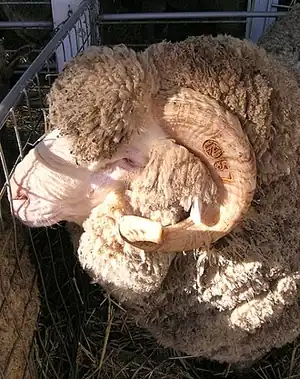 Head of a ram | |
 Ewes and lambs | |
| Conservation status | |
|---|---|
| Country of origin | Australia |
| Distribution |
|
| Use |
|
| Traits | |
| Horn status |
|
| |

The Australian Merino is an Australian breed or group of breeds of sheep, forming a significant part of the Merino group of breeds world-wide. Its origins lie in Merino sheep imported to Australia from South Africa in 1797. By about 1830 there were almost two million Merinos in the country.[3]: 746
History
In 1790, Charles IV of Spain sent a gift of Merino sheep from the Escorial cavana to the government of the Dutch Republic.[4]: 9 They did not thrive there, but did well in the Dutch Cape Colony, in what is now South Africa.[3]: 746
The origins of the Australian Merino lie in a shipment of twenty-six of these sheep bought in the Cape Colony in 1797 by Henry Waterhouse and William Kent; approximately half the flock survived the voyage to Australia.[5][6] Some stock from this shipment was sold to Elizabeth and John Macarthur of Elizabeth Farm in Parramatta.[7][8] By about 1830, there were almost two million Merinos in the country.[3]: 746
Breeds, strains and lines
The original strain bred by the Macarthurs survives as the Camden Park or Macarthur Merino.[9] The four principal breeds or strains that developed within the Australian Merino group were the Peppin,[10] the Saxon,[11] the South Australian[12] and the Spanish.[3]: 746 [13][14] The Poll Merino or Australian Poll Merino is a recently created polled variant.[3]: 747 [15] Other strains recognised as breeds include the Booroola Merino,[16] the Bungaree Merino,[17] the Dohne Merino,[18] the Fonthill Merino,[19] the Tasmanian Merino (which derives from the Saxon);[3]: 746 [20] and the Trangie Fertility.[21]
Use
The Merino is reared for wool. Depending on the breed or bloodline, the sheep can yield wool of varying fineness, ranging from strong through medium, medium-fine, fine and superfine to ultrafine, which is among the finest of all wools.[14]
 Hoggets being drenched near Walcha in New South Wales
 On the New England Tablelands
References

- ↑ Barbara Rischkowsky, Dafydd Pilling (editors) (2007). List of breeds documented in the Global Databank for Animal Genetic Resources, annex to The State of the World's Animal Genetic Resources for Food and Agriculture. Rome: Commission on Genetic Resources for Food and Agriculture, Food and Agriculture Organization of the United Nations. ISBN 9789251057629. Archived 23 June 2020.
- ↑ Breed data sheet: Australian Merino / Australia (Sheep). Domestic Animal Diversity Information System of the Food and Agriculture Organization of the United Nations. Accessed June 2021.
- 1 2 3 4 5 6 Valerie Porter, Lawrence Alderson, Stephen J.G. Hall, D. Phillip Sponenberg (2016). Mason's World Encyclopedia of Livestock Breeds and Breeding (sixth edition). Wallingford: CABI. ISBN 9781780647944.
- ↑ David Cottle (2010). International Sheep and Wool Handbook. Nottingham: Nottingham University Press. ISBN 9781904761860.
- ↑ Vivienne Parsons (1967). Henry Waterhouse (1770–1812). Australian Dictionary of Biography, volume 2. Melbourne: Melbourne University Press; published online 2006.
- ↑ On the sheep’s back: 1797: Introduction of the merino sheep to Australia. Digital Classroom. Canberra: National Museum of Australia. Archived 20 May 2026.
- ↑ Australian agricultural and rural life: Macarthurs. Sydney: State Library of New South Wales. Accessed August 2026.
- ↑ Margaret Steven (1967). John Macarthur (1767–1834). Australian Dictionary of Biography, volume 2. Melbourne: Melbourne University Press; published online 2006.
- ↑ Breed data sheet: Camden Park / Australia (Sheep). Domestic Animal Diversity Information System of the Food and Agriculture Organization of the United Nations. Accessed June 2021.
- ↑ Breed data sheet: Peppin / Australia (Sheep). Domestic Animal Diversity Information System of the Food and Agriculture Organization of the United Nations. Accessed June 2021.
- ↑ Breed data sheet: Saxon / Australia (Sheep). Domestic Animal Diversity Information System of the Food and Agriculture Organization of the United Nations. Accessed June 2021.
- ↑ Breed data sheet: South Australian Merino/ Australia (Sheep). Domestic Animal Diversity Information System of the Food and Agriculture Organization of the United Nations. Accessed June 2021.
- ↑ Breed data sheet: Spanish / Australia (Sheep). Domestic Animal Diversity Information System of the Food and Agriculture Organization of the United Nations. Accessed June 2021.
- 1 2 Evolution of the Australian Merino. Williamstown, Victoria: Australian Association of Stud Merino Breeders. Archived 14 August 2026.
- ↑ Breed data sheet: Poll Merino / Australia (Sheep). Domestic Animal Diversity Information System of the Food and Agriculture Organization of the United Nations. Accessed June 2021.
- ↑ Breed data sheet: Booroola Merino / Australia (Sheep). Domestic Animal Diversity Information System of the Food and Agriculture Organization of the United Nations. Accessed June 2021.
- ↑ data sheet: Bungaree Merino / Australia (Sheep). Domestic Animal Diversity Information System of the Food and Agriculture Organization of the United Nations. Accessed June 2021.
- ↑ Breed data sheet: Dohne Merino / Australia (Sheep). Domestic Animal Diversity Information System of the Food and Agriculture Organization of the United Nations. Accessed June 2021.
- ↑ Breed data sheet: Fonthill Merino / Australia (Sheep). Domestic Animal Diversity Information System of the Food and Agriculture Organization of the United Nations. Accessed June 2021.
- ↑ Breed data sheet: Tasmanian Merino / Australia (Sheep). Domestic Animal Diversity Information System of the Food and Agriculture Organization of the United Nations. Accessed June 2021.
- ↑ Breed data sheet: Trangie Fertility / Australia (Sheep). Domestic Animal Diversity Information System of the Food and Agriculture Organization of the United Nations. Accessed June 2021.