Antiparochí
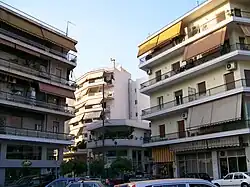
Antiparochí (Greek: αντιπαροχή, lit. 'property swap') is an equity financing mechanism, common in Greece and Cyprus during the postwar period, which entails the conclusion of an agreement between a real estate developer and a landowner, in terms of which the landowner contributes immovable property to be used for residential property development, in exchange for a portion of the real estate unit or units upon completion of the development.[1] The mechanism was facilitated in Greece by the passage, in 1929, of the Law of Property Division,[2] and the General Building Regulation,[3] which provided the legal framework for collective ownership of a property unit, and prescribed technical rules for the construction of apartments, respectively.
The system is credited with increasing access to low-cost housing and contributing to economic growth in Greece during the postwar period.[1] It has also, however, been criticised for precipitating the demolition of much of Greece's 19th-century neoclassical architecture, transforming Greek cities, particularly Athens, into what have been referred to as "form-less, border-less and placeless urban landscape[s]".[4]
References
- 1 2 Petris, Dotsis and Panayotis (2020). "The "flats-for-land" system in Greece: An idiosyncratic equity financing mechanism in the post-War period" (PDF). The Journal of European Economic History. 49 (2): 175–202. ISSN 2499-8281. Retrieved 15 July 2026.
- ↑ Law 3741/1929 “Horizontal Property Division”, Official Government Gazette 4/A/09- 01-1929 (Νόμος 3741/1929 – ΦΕΚ 4/ /09-01-1929, ‘’Πέρι της Ιδιοκτησίας κατ’ ορόφους’’), National Printing House
- ↑ Presidential Decree 03-04-1929 “General Building Regulation”, Official Government
- ↑ Yannis Aesopos, Yorgos Simeoforidis, "The contemporary Greek city", in The Contemporary (Greek) City, ed. Yannis Aesopos and Yorgos Simeoforidis (Athens: Metapolis Press, 2001), 32–60.