Ada Yonath
Ada E. Yonath | |
|---|---|
עדה יונת | |
 Yonath in 2013 | |
| Born | Ada Lifshitz 22 June 1939 |
| Died | 31 August 2026 (aged 87) |
| Citizenship | Israeli |
| Education | |
| Known for | Cryo bio-crystallography |
| Awards | Harvey Prize (2002) Wolf Prize in Chemistry (2006) L'Oréal-UNESCO Award for Women in Science (2008) Albert Einstein World Award of Science (2008) Nobel Prize in Chemistry (2009) |
| Scientific career | |
| Fields | Crystallography |
| Workplaces | Weizmann Institute of Science University of Chicago |
| Wolfie Traub, F. Albert Cotton | |
Ada E. Yonath (Hebrew: עדה יונת, pronounced [ˈada joˈnat]; 22 June 1939 – 31 August 2026) was an Israeli crystallographer and Nobel laureate in Chemistry, best known for her pioneering work on the structure of ribosomes. She was the director of the Helen and Milton A. Kimmelman Center for Biomolecular Structure and Assembly of the Weizmann Institute of Science.
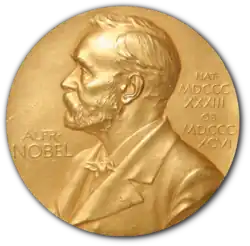
In 2009, Yonath received the Nobel Prize in Chemistry along with Venkatraman Ramakrishnan and Thomas A. Steitz for her studies on the structure and function of the ribosome, becoming the first Israeli woman to win the Nobel Prize out of ten Israeli Nobel laureates,[1] the first woman from the Middle East to win a Nobel prize in the sciences,[2] and the first woman in 45 years to win the Nobel Prize for Chemistry.[3]
Background
Ada Lifshitz (later Yonath)[4] was born in the Geula quarter of Jerusalem on 22 June 1939.[5][6] Her parents, Hillel and Esther Lifshitz, were Zionist Jews who had immigrated to the British Mandate of Palestine (now Israel) from Zduńska Wola, Poland in 1933 before the establishment of Israel.[7] Her father was a rabbi and came from a rabbinical family. They settled in Jerusalem and ran a grocery, but found it difficult to make ends meet. They lived in cramped quarters with several other families, and Yonath remembers "books" being the only thing she had to keep her occupied.[8] Despite their poverty, her parents sent her to school in the upscale Beit HaKerem neighborhood to assure her a good education. When her father died at the age of 42, the family moved to Tel Aviv.[9]
Yonath was accepted to Tichon Hadash high school although her mother could not pay the tuition. She gave math lessons to students in return.[10] As a youngster, she says she was inspired by the Polish and naturalized-French scientist Marie Curie.[11] However, she stresses that Curie, whom she as a child was fascinated by after reading her biography, was not her "role model".[12] She returned to Jerusalem for college, graduating from the Hebrew University of Jerusalem with a bachelor's degree in chemistry in 1962, and a master's degree in biochemistry in 1964. In 1968, she obtained her PhD from the Weizmann Institute of Science for X-ray crystallographic studies on the structure of collagen, with Wolfie Traub as her PhD advisor.[13][14][15]
She had one daughter, Hagit Yonath, a doctor at Sheba Medical Center, and a granddaughter, Noa.[16] Yonath was the cousin of anti-occupation activist Ruchama Marton.[17]
Yonath died on 31 August 2026, at the age of 87.[18]
Scientific career

Yonath accepted postdoctoral positions at Carnegie Mellon University (1969) and MIT (1970). While a postdoctoral researcher at MIT she spent some time in the laboratory of subsequent 1976 chemistry Nobel Prize winner William N. Lipscomb, Jr. of Harvard University where she was inspired to pursue very large structures.[19]
In 1970, she established what was for nearly a decade the only protein crystallography laboratory in Israel. Then, from 1979 to 1984 she was a group leader with Heinz-Günter Wittmann at the Max Planck Institute for Molecular Genetics in Berlin. She was a visiting professor at the University of Chicago in 1977–78.[20] She headed a Max-Planck Institute Research Unit at DESY in Hamburg, Germany (1986–2004) in parallel to her research activities at the Weizmann Institute.[21]
She focused on the mechanisms underlying protein biosynthesis, by ribosomal crystallography, a research line she pioneered over 20 years ago despite considerable skepticism of the international scientific community.[22] Ribosomes translate RNA into protein and because they have slightly different structures in microbes, when compared to eukaryotes, such as human cells, they are often a target for antibiotics. In 2000 and 2001, she determined the complete high-resolution structures of both ribosomal subunits and discovered within the otherwise asymmetric ribosome, the universal symmetrical region that provides the framework and navigates the process of polypeptide polymerization. Consequently, she showed that the ribosome is a ribozyme that places its substrates in stereochemistry suitable for peptide bond formation and for substrate-mediated catalysis. In 1993 she visualized the path taken by the nascent proteins, namely the ribosomal tunnel, and recently revealed the dynamics elements enabling its involvement in elongation arrest, gating, intra-cellular regulation and nascent chain trafficking into their folding space.
Additionally, Yonath elucidated the modes of action of over twenty different antibiotics targeting the ribosome, illuminated mechanisms of drug resistance and synergism, deciphered the structural basis for antibiotic selectivity and showed how it plays a key role in clinical usefulness and therapeutic effectiveness, thus paving the way for structure-based drug design.
For enabling ribosomal crystallography Yonath introduced a novel technique, cryo bio-crystallography, which became routine in structural biology and allowed intricate projects otherwise considered formidable.[23]
At the Weizmann Institute, Yonath was the of the Martin S. and Helen Kimmel Professorial Chair.[24]
Awards and recognition
Yonath was a member of the United States National Academy of Sciences; the American Academy of Arts and Sciences; the Israel Academy of Sciences and Humanities; the European Academy of Sciences and Art and the European Molecular Biology Organization. On 18 October 2014, Yonath was named an ordinary member of the Pontifical Academy of Sciences by Pope Francis.[25]
Her awards and honors included the following:
- In 2002, Israel Prize
- In 2002, Harvey Prize
- In 2004, Massry Prize
- In 2004, Paul Karrer Gold Medal
- In 2005, Louisa Gross Horwitz Prize
- In 2006, Wolf Prize in Chemistry along with George Feher.
- In 2006, Rothschild Prize in Life Sciences.
- In 2006, The EMET Prize for Art, Science and Culture in Life Sciences, along with Professor Peretz Lavie (Medicine) and Professor Eli Keshet (Biology)
- In 2007, Paul Ehrlich and Ludwig Darmstaedter Prize along with Harry Noller[26]
- In 2008, the Albert Einstein World Award of Science for her pioneering contributions to protein biosynthesis in the field of ribosomal crystallography and her introduction of innovative techniques in cryo bio-crystallography.[27]
- In 2009, the Nobel Prize in Chemistry (co-recipient with Thomas Steitz and Venkatraman Ramakrishnan).[28] She was the first Israeli woman to be awarded a Nobel Prize.[29]
- In 2010, Wilhelm Exner Medal[30]
- In 2011, Marie Curie Medal awarded by the Polish Chemical Society[31]
- In 2013 she became a member of the German Academy of Sciences Leopoldina.[32]
- In 2015, she was awarded Honorary Doctorates from the University of Southern California,[33] the De La Salle University, Manila/Philippines; the Joseph Fourier University, Grenoble/France; the Medical University of Lodz, Lodz/Poland; and the University of Warwick, UK.[34][35]
- In 2018, she was awarded an Honorary Doctorate from Carnegie Mellon University[36]
- In 2020, she was elected a Foreign Member of the Royal Society[37]
- In 2023, she was awarded an Honorary Doctorate from the Jagiellonian University.[38]
- In 2024, she was awarded an Honorary Doctorate from the Technion.[39]
See also
References
- ↑ Lappin, Yaakov (7 October 2009). "Nobel Prize Winner 'Happy, Shocked'". Jerusalem Post. Retrieved 7 October 2009.
- ↑ Klenke, Karin (2011). Women in Leadership: Contextual Dynamics and Boundaries. Emerald Group Publishing Limited. p. 191. ISBN 978-0-85724-561-8.
- ↑ "Transcript of the telephone interview with Ada E. Yonath immediately following the announcement of the 2009 Nobel Prize in Chemistry". nobelprize.org. 6 October 2015. Archived from the original on 6 October 2015. Retrieved 9 March 2021.
- ↑ "מנכ"ל המדינה (p. 4; 18.11.09 "ידיעות אחרונות") PDF" (PDF). syaga.co.il. Archived from the original (PDF) on 25 April 2012. Retrieved 5 October 2011.
- ↑ "Ada Yonath— L'Oréal-UNESCO Award". Jerusalem Post. 8 March 2008. Archived from the original on 17 January 2012.
- ↑ "Israel Prize Official Site (in Hebrew) – Recipient's C.V."
- ↑ Hargittai, I.; Hargittai, M. (2006). Candid Science VI: More Conversations with Famous Scientists. Imperial College Press. p. 390. ISBN 978-1-86094-885-5. Retrieved 9 March 2021. (In this source the surname is spelled Livshitz)
- ↑ Talk given at Moriah College, Sydney, 18 February 2010 as noted by a student present from James Ruse Agricultural High School
- ↑ "Israeli professor receives Life's Work Prize for women in science". Ministry of Foreign Affairs. 28 July 2008. Archived from the original on 29 March 2019. Retrieved 31 July 2008.
- ↑ Siegel-Itzkovich, Judy (17 January 2012). "Former 'village fool' takes the prize – Science and Environment – Jerusalem Post". fr.jpost.com. Archived from the original on 17 January 2012. Retrieved 9 March 2021.
- ↑ "ISRAEL21c – Uncovering Israel". Israel21c. 5 October 2011. Archived from the original on 24 June 2016.
- ↑ Talk given at Moriah College, 18 February 2010
- ↑ "(IUCr) European Crystallography Prize". Journal of Applied Crystallography. 33 (4): 1195. August 2000. doi:10.1107/S0021889800008281.
- ↑ Traub, Wolfie; Yonath, Ada (1966). "Polymers of Tripeptides as Collagen Models .I. X-RAY Studies of Poly (L-PROLYL-GLYCYL-L-PROLINE) and related Polytripeptides". Journal of Molecular Biology. 16 (2): 404–14. doi:10.1016/S0022-2836(66)80182-1. PMID 5954171.
- ↑ Yonath, Ada; Traub, Wolfie (1969). "Polymers of Tripeptides as Collagen Models .4. Structure Analysis of Poly (L-PROLYL-GLYCYL-L-PROLINE)". Journal of Molecular Biology. 43 (3): 461–77. doi:10.1016/0022-2836(69)90352-0. PMID 5401228.
- ↑ Ilani, Ofri (3 December 2009). "Israel's Prof. Ada Yonath wins Nobel Prize for Chemistry – Haaretz – Israel News". haaretz.com. Archived from the original on 3 December 2009. Retrieved 9 March 2021.
- ↑ Former 'village fool' takes the prize Archived 17 January 2012 at the Wayback Machine, Judy Siegel-Itzkovich, The Jerusalem Post 8 March 2008
- ↑ ynet; ynet (31 August 2026). "כלת פרס נובל, פרופ' עדה יונת, הלכה לעולמה". Ynet (in Hebrew). Retrieved 31 August 2026.
- ↑ Yarnell, A. Lipscomb Feted in Honor of his 90th Birthday Archived 14 July 2014 at the Wayback Machine. Chemical and Engineering News, 87, 48, Am. Chem. Soc., p. 35, 30 November 2009.
- ↑ anonymous. "New chemistry Nobelist was UChicago visiting prof, conducted research at Argonne". uchicago.edu. Archived from the original on 10 June 2010. Retrieved 27 November 2017.
- ↑ "EMBL supports the 'impossible': Mapping the ribosome". European Molecular Biology Laboratory. Retrieved 31 August 2026.
- ↑ "The Nobel Prize in Chemistry 2009 – Speed Read". nobelprize.org.
- ↑ Hope, H.; Frolow, F.; von Böhlen, K.; Makowski, I.; Kratky, C.; Halfon, Y.; Danz, H.; Webster, P.; Bartels, K. S.; Wittmann, H. G.; Yonath, A. (1 April 1989). "Cryocrystallography of ribosomal particles". Acta Crystallographica Section B: Structural Science. 45 (2). International Union of Crystallography (IUCr): 190–199. Bibcode:1989AcCrB..45..190H. doi:10.1107/s0108768188013710. ISSN 0108-7681. PMID 2619959.
- ↑ Wittung-Stafshede, Pernilla. "Ada Yonath". Biophysical Society. Retrieved 31 August 2026.
- ↑ "Rinunce e nomine". vatican.va (in Italian). Archived from the original on 22 October 2014.
- ↑ "Harry Noller Wins Award for Ribosome Work". City on a Hill Press. 24 May 2007. Retrieved 31 August 2026.
- ↑ "Albert Einstein World Award of Science 2008". Archived from the original on 4 March 2014.
- ↑ "Nobel Prize in Chemistry 2009". Nobel Foundation. Archived from the original on 10 October 2009. Retrieved 7 October 2009.
- ↑ Wills, Adam (7 October 2009). "Ada Yonath—First Israeli Woman to win Nobel Prize". Jewish Journal. Archived from the original on 22 April 2016. Retrieved 7 October 2009.
- ↑ "Medalists Archive – ALL MEDALISTS SINCE 1921". Wilhelm Exner Medaillen Stiftung. Retrieved 9 March 2021.
- ↑ "Laureaci Medali i Nagród PTChem". Retrieved 22 February 2020.
- ↑ "Ada Yonath". German Academy of Sciences Leopoldina. Retrieved 26 May 2021.
- ↑ "Past Recipients – Honorary Degrees". honorarydegrees.usc.edu. Retrieved 7 June 2024.
- ↑ "Honorary Graduand Orations – Summer 2015". www2.warwick.ac.uk.
- ↑ "Uniwersytet Medyczny w Łodzi". www.umed.pl. Archived from the original on 4 March 2016. Retrieved 1 May 2015.
- ↑ "Commencement Speakers and Honorary Degree Recipients – Leadership – Carnegie Mellon University". www.cmu.edu. Retrieved 21 September 2018.
- ↑ "Ada Yonath". Royal Society. Retrieved 19 September 2020.
- ↑ "Honorary Doctorate". en.uj.edu.pl. Retrieved 28 May 2023.
- ↑ shelleys (4 June 2024). "Honorary Doctorate Awardees". הטכניון-מכון טכנולוגי לישראל. Retrieved 11 June 2025.
External links

- "APS user shares the “Israeli Nobel” for chemistry", from the Argonne National Laboratory Advanced Photon Source (APS), United States Department of Energy
- The Official Site of Louisa Gross Horwitz Prize
- Weizmann Institute of Science, Yonath-Site
- Ada Yonath's Publication list
- Talk of Ada Yonath at the Origins 2011 congress
- Ada E. Yonath on Nobelprize.org
| |
Italics indicate a Nobel Memorial Prize, i.e. not one of the original Prizes bequested by Alfred Nobel. |

- 1939 births
- 2026 deaths
- People from Rehovot
- Nobel laureates in Chemistry
- Women Nobel laureates
- Israeli Nobel laureates
- Albert Einstein World Award of Science Laureates
- Women crystallographers
- Israeli biochemists
- Israel Prize in chemistry recipients
- Israel Prize women recipients
- Israeli Jews
- Israeli people of Polish-Jewish descent
- Israeli pacifists
- Israeli women chemists
- Israeli women scientists
- Jewish chemists
- Jewish pacifists
- Jews from Mandatory Palestine
- Jewish women scientists
- L'Oréal-UNESCO Awards for Women in Science laureates
- Members of the European Academy of Sciences and Arts
- Members of the European Molecular Biology Organization
- Members of the Israel Academy of Sciences and Humanities
- International members of the National Academy of Sciences
- Scientists from Jerusalem
- Scientists from Tel Aviv
- University of Chicago faculty
- Academic staff of Weizmann Institute of Science
- Weizmann Institute of Science alumni
- Wolf Prize in Chemistry laureates
- Women biologists
- Carnegie Mellon University fellows
- Massry Prize recipients
- 20th-century Israeli women scientists
- 21st-century women scientists
- Foreign members of the Royal Society
- Members of the German National Academy of Sciences Leopoldina
- Jewish Nobel laureates
- Tichon Hadash High School (Tel Aviv) alumni
- Harvey Prize winners
- Israeli women physicists