Samantabhadra (Jain monk)
Samantabhadra | |
|---|---|
 | |
| Personal life | |
| Born | 2nd century CE |
| Notable work(s) | Āpta-mīmāṁsā, Jinaśatakam |
| Religious life | |
| Religion | Jainism |
| Sect | Digambara |
| Part of a series on |
| Jainism |
|---|
 |

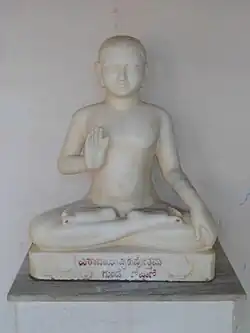
Samantabhadra was a Jain ācārya (head of the monastic order) who lived about the later part of the second century CE.[1][2] He was a proponent of the Jaina doctrine of Anekāntavāda. The Ratnakaranda śrāvakācāra is the most popular work of Samantabhadra. Samantabhadra lived after Umaswami but before Pujyapada.
Life
Samantabhadra is said to have lived from 150 to 250 CE. He was from southern India during the era of the Cholas. He was a poet, logician, eulogist and an accomplished linguist.[3] He is credited with spreading Jainism in southern India.[4]
In the early stages of his asceticism, Samantabhadra was afflicted with a disease known as bhasmaka (a condition of insatiable hunger).[5] Because Digambara monks do not eat more than once a day, he endured great pain. Eventually, he sought permission from his preceptor to undertake the vow of Sallekhana.[6] The preceptor refused and instructed him to leave monasticism and have the disease treated.[5] After being cured, he rejoined the monastic order and became a great Jaina ācārya.[7]
Thought
Samantabhadra affirmed Kundakunda's theory of the two nayas - vyavahāranaya (‘mundane') and niścayanaya (ultimate, omniscient). He argued however that the mundane view is not false, but is only a relative form of knowledge mediated by language and concepts, while the ultimate view is an immediate form of direct knowledge.[8] Samantabhadra also developed further the Jaina theory of syādvāda.
Works

Jaina texts authored by Ācārya Samantabhadra include:[9]
- Ratnakaranda śrāvakācāra[10] (150 verses)- The Ratnakaranda śrāvakācāra discusses the conduct of a Śrāvaka (Jain laity) in detail.[4]
- Gandhahastimahabhasya, a monumental commentary on the Tattvartha Sutra. The Gandhahastimahābhāṣya, with the exception of its Maṅgalācaraṇa (salutation to the deity), is extant now.[11] The Maṅgalācaraṇa is known as the 'Devāgama stotra' or Āpta-mīmāṁsā.[4][12]
- Āpta-mīmāṁsā- A treatise of 114 verses, it discusses the Jaina concept of omniscience and the attributes of the Omniscient.[4][13]
- Svayambhūstotra (fifth century CE)[14] - A Sanskrit adoration of The Twenty-four Tīrthaṅkaras[15] - 143 verses.[4] It was later translated by Dhyanatray (1676-1726) in Agra.[14]
- Yuktyanuśāsana- Sixty-four verses in praise of Tīrthaṅkara Vardhamāna Mahāvīra.[4]
- Jinaśatakam (Stutividyā)[16](116 verses)- Poetical work written in Sanskrit in praise of twenty-four Jinas.[17]
- Tattvānuśāsana[18]
Praise
Jinasena, in his celebrated work, Ādi purāṇa praises the Samantabhadra as[19]
Acharya Samantrabhadra’s glory reigned supreme among all poets, scholars, disputants, and preachers; he was like a jewel on their heads.
See also
References
Citations
- ↑ Gokulchandra Jain 2015, p. 82.
- ↑ Champat Rai Jain 1917, p. iv.
- ↑ Natubhai Shah 2004, p. 48.
- 1 2 3 4 5 6 Natubhai Shah 2004, p. 49.
- 1 2 Vijay K. Jain 2015, p. xviii.
- ↑ Long 2009, p. 110.
- ↑ Vijay K. Jain 2015, p. xx.
- ↑ Long 2009, p. 130.
- ↑ Gokulchandra Jain 2015, p. 84.
- ↑ Samantabhadra, Ācārya (1 July 2006), Ratnakaranda Shravakacara, Hindi Granth Karyalay, ISBN 9788188769049
- ↑ Champat Rai Jain 1917, p. v.
- ↑ Ghoshal 2002, p. 7.
- ↑ Vijay K. Jain 2015, p. xvii.
- 1 2 Orsini & Schofield 1981, p. 89.
- ↑ Vijay K. Jain 2015, p. xi.
- ↑ Samantabhadrasvāmī (1969), Kevalajñānapraśnacūḍāmaṇi
- ↑ Gokulchandra Jain 2015, p. 92.
- ↑ Yougveer Jugalkishor (1925). Swami Samantbhadra (itihas).
- ↑ Vijay K. Jain 2015, p. xv.
Sources
- Ghoshal, Saratchandra (2002), Āpta-mīmāṁsā of Āchārya Samantabhadra, Bharatiya Jnanpith, ISBN 9788126307241
- Jain, Vijay K. (2015), Acarya Samantabhadra's Svayambhustotra: Adoration of The Twenty-four Tirthankara, Vikalp Printers, ISBN 978-81-903639-7-6,
 This article incorporates text from this source, which is in the public domain.
- Jain, Gokulchandra (2015), Samantabhadrabhāratī (1st ed.), Budhānā, Muzaffarnagar (U.P.): Achārya Shāntisāgar Chani Smriti Granthmala, ISBN 978-81-90468879
- Jain, Champat Rai (1917), The Ratna Karanda Sravakachara, The Central Jaina Publishing House, This article incorporates text from this source, which is in the public domain.
- Long, Jeffery D. (2009), Jainism: An Introduction, I.B. Tauris, ISBN 978-1-84511-625-5
- Orsini, Francesca; Schofield, Katherine Butler, eds. (1981), Tellings and Texts: Music, Literature and Performance in North India, Open Book Publishers, ISBN 978-1-78374-105-2
- Shah, Natubhai (2004) [First published in 1998], Jainism: The World of Conquerors, vol. I, Motilal Banarsidass, ISBN 81-208-1938-1
Further reading
- Jain, Vijay K. (2016). Ācārya Samantabhadra’s Āptamīmāmsā (Devāgamastotra) आचार्य समन्तभद्र विरचित "आप्तमीमांसा". Dehradun: Vikalp Printers. ISBN 81-903639-8-0.
- Jain, Vijay K. (2016). Ācārya Samantabhadra’s Ratnakarandaka-śrāvakācāra. Dehradun: Vikalp Printers. ISBN 81-903639-9-9. OCLC 953615751.
- Jain, Vijay K. (2015). Ācārya Samantabhadra’s Svayambhūstotra आचार्य समन्तभद्र विरचित "स्वयम्भूस्तोत्र". Dehradun: Vikalp Printers. ISBN 81-903639-7-2.
| Gods | |||||
|---|---|---|---|---|---|
| Philosophy | |||||
| Branches |
| ||||
| Practices | |||||
| Literature | |||||
| Symbols | |||||
| Ascetics | |||||
| Scholars | |||||
| Community |
| ||||
| Jainism in |
| ||||
| Jainism and | |||||
| Dynasties and empires | |||||
| Related | |||||
| Lists | |||||
| Navboxes |
| ||||
