Acacia imitans
| Gibson wattle | |
|---|---|
Scientific classification  | |
| Kingdom: | Plantae |
| Clade: | Embryophytes |
| Clade: | Tracheophytes |
| Clade: | Angiosperms |
| Clade: | Eudicots |
| Clade: | Rosids |
| Order: | Fabales |
| Family: | Fabaceae |
| Subfamily: | Caesalpinioideae |
| Clade: | Mimosoid clade |
| Genus: | Acacia |
| Species: | A. imitans |
| Binomial name | |
| Acacia imitans | |
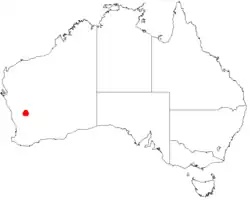 | |
| Occurrence data from AVH | |
| Synonyms[2] | |
|
Racosperma imitans (Maslin) Pedley | |

Acacia imitans, also commonly known as Gibson wattle,[3] is a species of flowering plant in the family Fabaceae and is restricted to a small area of inland Western Australia. It is a low, dense, spreading, prickly shrub with asymmetically bow-shaped or widely elliptic phyllodes, oblong to short cylindrical heads of golden yellow flowers and tightly coiled, firmly papery pods.
Description
Acacia imitans is a low, dense, spreading, semi-prostrate shrub that typically grows to a height of 0.3–1 m (1 ft 0 in – 3 ft 3 in) and 3 m (9.8 ft) wide. It has glabrous, grey branches and many short, straight, rigid spiny branchlets, often without phyllodes. The phyllodes are 3.5–7 mm (0.14–0.28 in) long and 1.5–2.5 mm (0.059–0.098 in) wide, asymmetric, bow-shaped or widely elliptic, the upper edge straight to slightly concave and the lower edge markedly concave, with an upturned point on the end. The flowers are golden yellow and borne in an oblong to shortly cylindrical head 6–8 mm (0.24–0.31 in) long and 4–5 mm (0.16–0.20 in) wide in axils, on a peduncle 3–4 mm (0.12–0.16 in) long. Flowering occurs in August to September, and the pods are tightly coiled, 7 mm (0.28 in) long unexpanded, firmly papery and glabrous. The seeds are oblong to oval, dull dark brown with a minute aril near the end.[3][4][5]
Taxonomy
Acacia imitans was first formally described in 1999 by Bruce Maslin in the journal Nuytsia from specimens collected by Basil Herbert Smith[6] on Ningham Station in 1985.[4][7] The specific epithet (imitans) refers to its superficial resemblance to A. kochii.[4]
Distribution and habitat
Gibson wattle grows on rocky hills in rocky red loamy soils on slopes in tall shrubland and is only known from six subpopulations in the area around Mount Singleton, about 300 km (190 mi) north east of Perth in the Yalgoo bioregion of inland Western Australia. Four of these subpopulations are found about Ningham Station and two at Mount Gibson Station. The total population is estimated at 550 mature plants.[3][8][9]
Conservation status
Acacia imitans is listed as "endangered" under the IUCN Red List and as "Priority Four" by the Government of Western Australia Department of Biodiversity, Conservation and Attractions,[9] meaning that is rare or near threatened.[10] It has an estimated area of occupancy of only 30 to 100 square kilometres,[1] and is threatened by grazing from sheep and feral goats, inappropriate fire regimes, possible mining activities, and by climate change.[1]
See also
References
- 1 2 3 Williams, E. (2017). "Acacia imitans". IUCN Red List of Threatened Species. 2017 e.T22483967A22484227. doi:10.2305/IUCN.UK.2017-2.RLTS.T22483967A22484227.en. Retrieved 11 November 2021.
- 1 2 "Acacia imitans". Australian Plant Census. Retrieved 20 April 2026.
- 1 2 3 Maslin, Bruce R. "Acacia imitans". Flora of Australia. Australian Biological Resources Study, Department of Climate Change, Energy, the Environment and Water: Canberra. Retrieved 20 April 2026.
- 1 2 3 Maslin, Bruce R. (1999). "Acacia miscellany 16. The taxonomy of fifty-five species of Acacia, primarily Western Australian, in section Phyllodineae (Leguminosae: Mimosoideae)". Nuytsia. 12 (3): 356–358. Retrieved 20 April 2026.
- ↑ Maslin, Bruce R. "Acacia imitans". Australian Biological Resources Study. Retrieved 20 April 2026.
- ↑ "Basil Herbert Smith". Council of the Heads of Australian Herbaria. Retrieved 20 April 2026.
- ↑ "Acacia imitans". Australian Plant Name Index. Retrieved 20 April 2026.
- ↑ Acacia imitans, Species Profile and Threats Database, Department of the Environment and Heritage, Australia.. Retrieved 16 November 2018.
- 1 2 "Acacia imitans". FloraBase. Western Australian Government Department of Biodiversity, Conservation and Attractions.
- ↑ "Conservation codes for Western Australian Flora and Fauna" (PDF). Government of Western Australia Department of Parks and Wildlife. Retrieved 21 April 2026.