Acacia kochii
| Acacia kochii | |
|---|---|
Scientific classification  | |
| Kingdom: | Plantae |
| Clade: | Embryophytes |
| Clade: | Tracheophytes |
| Clade: | Angiosperms |
| Clade: | Eudicots |
| Clade: | Rosids |
| Order: | Fabales |
| Family: | Fabaceae |
| Subfamily: | Caesalpinioideae |
| Clade: | Mimosoid clade |
| Genus: | Acacia |
| Species: | A. kochii |
| Binomial name | |
| Acacia kochii | |
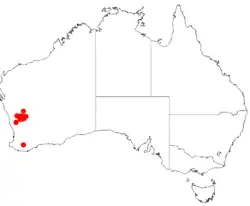 | |
| Occurrence data from AVH | |
| Synonyms[1] | |
Acacia kochii is a species of flowering plant in the family Fabaceae and is endemic the south-west of Western Australia. It is a spreading, intricate shrub with thorns along the branchlets, asymmetrical narrowly oblong phyllodes in groups, oblong to short-cylindrical heads of golden yellow flowers and leathery, glabrous pods, appearing like a string of beads.
Description
Acacia kochii is a spreading, intricate shrub that typically grows to a height of 0.5–2 m (1 ft 8 in – 6 ft 7 in) and has more or less glabrous branchlets with one or two thorns 5–20 mm (0.20–0.79 in) long at many of its nodes. It has phyllodes are clustered at mature lobes, asymetrically narrowly oblong, often half-moon shaped, 10–20 mm (0.39–0.79 in) long, 2–7 mm (0.079–0.276 in) wide thin and more or less glabrous. The flowers are borne in up to three oblong to short-cylindrical heads in each cluster of phyllodes, on peduncles 10–20 mm (0.39–0.79 in) long, each head 7–15 mm (0.28–0.59 in) long and 5–6 mm (0.20–0.24 in) in diameter with golden yellow flowers. Flowering occurs in August, and the pods are leathery, up to 90 mm (3.5 in) long and 5 mm (0.20 in) wide, glabrous, with a slight covering of white powdery bloom and appearing like a string of beads. The seeds are elliptic, about 5 mm (0.20 in) long, dull black with a more or less conical aril.[2][3][4][5]
Taxonomy
Acacia kochii was first formally described in 1911 by Alfred Ewart and Jean White-Haney in the Proceedings of the Royal Society of Victoria from an unpublished description by William Fitzgerald of specimens collected near the "Watheroo Rabbit fence" by Max Koch in 1905.[6][7] The specific epithet (kochii) honours Max Koch.[8]
Distribution and habitat
This species of wattle grows in rocky clay loam, clay or clayey sand in the area between Wubin and Paynes Find in the Avon Wheatbelt, Geraldton Sandplains, Yalgoo bioregions of south-western Western Australia.[2][5]
Conservation status
Acacia kochii is listed as 'not threatened' by the Government of Western Australia Department of Parks and Wildlife.[5]
See also
References
- 1 2 "Acacia kochii". Australian Plant Census. Retrieved 8 July 2026.
- 1 2 Maslin, Bruce R. "Acacia kochii". Flora of Australia. Australian Biological Resources Study, Department of Climate Change, Energy, the Environment and Water: Canberra. Retrieved 9 July 2026.
- ↑ Maslin, Bruce R. "Acacia kochii". Australian Biological Resources Study. Retrieved 9 July 2026.
- ↑ "Acacia kochii". World Wide Wattle. Western Australian Herbarium. Retrieved 14 May 2019.
- 1 2 3 "Acacia kochii". FloraBase. Western Australian Government Department of Biodiversity, Conservation and Attractions.
- ↑ "Acacia kochii". Australian Plant Name Index. Retrieved 7 July 2026.
- ↑ Ewart, Alfred J.; White, Jean; Wood, Bertha (1911). "Contributions to the Flora of Australia, No. 16". Proceedings of the Royal Society of Victoria. 23 (2): 285–286. Retrieved 9 July 2026.
- ↑ George, Alex S.; Sharr, Francis A. (2023). Western Australian Plant Names and Their Meanings - A Glossary (fifth ed.). Kardinya: Four Gables Press. p. 238. ISBN 9780645629538.