Presidency of Nicolás Maduro
| Presidency of Nicolás Maduro | |||
|---|---|---|---|
| 19 April 2013[a] – 3 January 2026[b] | |||
| |||
 Maduro in 2023 | |||
| Location | Venezuela | ||
| Including | War on drugs | ||
| Leader | Nicolás Maduro | ||
| President | Nicolás Maduro | ||
| Prime Minister(s) | Himself, Jorge Arreaza,[c] Aristóbulo Istúriz, Tareck El Aissami, Delcy Rodríguez | ||
| Key events | 2013 Venezuelan presidential election 2018 Venezuelan presidential election Crisis in Venezuela 2024 Venezuelan presidential election Guyana–Venezuela crisis (2023–2024) Operation Southern Spear 2026 United States intervention in Venezuela | ||


| ||
|---|---|---|
|
Personal
  |
||

The Maduro regime[1] refers to the period in Venezuelan history from 2013 to 2026, when Venezuela was ruled by Nicolás Maduro's authoritarian regime. The period began with Maduro's assumption of the presidency on 14 April 2013, and formally came to an end with the U.S. intervention in Venezuela, on 3 January 2026. While Maduro initially operated in a hybrid regime, Venezuela turned into a full dictatorship following the 2017 constitutional crisis.
The second presidency of Nicolás Maduro (2019–2025)[d] represents the fifth governmental period in Venezuela under the Bolivarian Revolution. It began amidst a 68% voter abstention rate[2] and concluded with allegations of electoral fraud, with Maduro assuming an early start to what would be his third term.[3]
The foreign policy of Maduro's second term was characterized by the severance of diplomatic relations with Argentina, Bolivia (restored in 2020),[4] Brazil (restored in 2022),[5] Colombia (restored in 2022),[6] El Salvador, the United States,[7] Guatemala[8] and Paraguay. As well as a territorial dispute with Guyana over the Essequibo region. In March 2024, Venezuela passed a law that designates Essequibo as a new state of Venezuela, governed from the city of Tumeremo. The law was submitted to the Supreme Court to validate its constitutionality.[9][10]
Following the growing geopolitical and electoral tensions of 2024 and 2025, the United States' Trump administration began preparing an intervention against Nicolás Maduro's regime, officially accusing the Venezuelan government of running a narco-terrorist network and conspiring to flood the United States with cocaine.[11] On 3 January 2026, Venezuela was targeted by a swift U.S. military raid, dubbed Operation Absolute Resolve, which bombed the country's air defense infrastructure and removed Maduro from power within three hours. During this raid, American troops captured Maduro alongside his wife, Cilia Flores, at their Caracas residence and immediately extradited them to New York. Followed by the capture of Alex Saab, in February 2026. Starting in March 2026, Maduro was put on trial before the U.S. Federal Court in the Southern District of New York to face charges of drug trafficking, criminal conspiracy, and possession of heavy weapons.[12][13]
History
On 14 April 2013, Nicolás Maduro was elected President of Venezuela, narrowly defeating opposition candidate Henrique Capriles with just a popular vote lead of 1.5%. Capriles immediately demanded a recount, refusing to recognize the outcome as valid.[14] Maduro was later formally inaugurated as president on 19 April, after the election commission had promised a full audit of the election results.[15][16] On 24 October 2013, he announced the creation of a new agency, the Vice Ministry of Supreme Happiness, to coordinate all the social programmes.[17]
Beginning six months after being elected, Maduro ruled by decree for the majority of his presidency: from 19 November 2013 to 19 November 2014,[18] 15 March 2015 to 31 December 2015, 15 January 2016 to present.[19]
2013–2014
In October 2013, Maduro requested an enabling law to rule by decree in order to fight corruption[20][21] and to also fight what he called an "economic war" which had the goal of radically reducing poverty.[22] Implementing price controls, wage controls, profit controls, and general economic restructuring. On 19 November 2013, the National Assembly granted Maduro the power to rule by decree until 19 November 2014.[23]
2015–2016
On 10 March 2015, Maduro asked to rule by decree for a second time following the sanctioning of seven Venezuelan officials by the United States, requesting the Enabling Law to be used to "confront" what Maduro called "the aggression of the most powerful country in the world, the United States".[24] Days later on 15 March 2015, the National Assembly granted Maduro power to rule by decree until 31 December 2015.[25]
2016–2017
After a coalition of opposition parties won in the 6 December 2015 elections, the lame duck Assembly named 13 new Justices sympathetic toward Maduro to the Supreme Court.[26] On 15 January 2016, Maduro declared an economic emergency and issued a "vaguely worded" decree that would grant himself extraordinary powers for 60 days, or until 15 March 2016.[27][28] Days after on 18 March 2016, the expiration of the decree powers, the Supreme Court granted Maduro the power to rule by decree for an additional 60 days, or until 17 May 2016.[29]
Days before his second 60-day rule by decree were to end, Maduro stated on 11 May 2016 that he would continue to rule by decree through the rest of the year until 2017.[30]
2017–2018
While meeting with the Supreme Tribunal of Justice on 15 January 2017, Maduro signed a new economic decree, extending his rule by decree for the sixth time since the original ruling in January 2016.[31] On 19 January, the Supreme Tribunal of Justice established the "Decree on the State of Emergency and Economic Emergency", granting Maduro to rule by decree further into 2017.[32]
On 13 May 2017 at a time of rising unrest during the 2017 Venezuelan protests, President Maduro extended his decree powers for the eighth time since January 2016, allowing him to rule by decree for another 60 days.[19] The powers were extended again on 13 July 2017 for an additional 60 days.[33]
On 15 October, the Bolivarian government Great Patriotic Pole won 18 of the 23 governorships while the opposition only 5 during the 2017 Venezuelan regional elections.
On 10 December, the Bolivarian government Great Patriotic Pole won 306 of the 337 Mayorships during the 2017 Venezuelan municipal elections.
Cabinet of Maduro
Cult of personality

Just like his predecessor, Maduro maintained a cult of personality, framing himself as the "Son of Chávez," dominating public media with heroic iconography, such as the Súper Bigote y su mano de hierro cartoon,[8][5] and flooding urban landscapes with official murals and billboards. Following Maduro's ousting during the 2026 U.S. intervention, Maduro's cult of personality was systematically erased by authorities.[34]
Military authority
Since coming to power three years ago, Mr. Maduro has relied increasingly on the armed forces as a spiraling economic crisis pushed his approval ratings to record lows and food shortages led to lootings. ... The armed forces have swiftly repressed all opposition rallies as well as the food riots that flare up daily across the country.
Maduro relied on the military to maintain power since he was initially elected into office.[35] According to Luis Manuel Esculpi, a Venezuelan security analyst, "The army is Maduro's only source of authority."[35] As time passed, Maduro grew more reliant on the military, showing that Maduro was losing power as described by Amherst College professor, Javier Corrales.[36] Corrales explains that "From 2003 until Chavez died in 2013, the civilian wing was strong, so he did not have to fall back on the military. As civilians withdrew their support, Maduro was forced to resort to military force."[36] The New York Times stated that Maduro no longer had the oil revenue to buy loyalty for protection, instead relying on favorable exchange rates, as well as the smuggling of food and drugs, which "also generate revenue".[37]

On 12 July 2016, Maduro granted Defense Minister Vladimir Padrino López the power to oversee product transportation, price controls, the Bolivarian missions, while also having his military command five of Venezuela's main ports.[38][39][40] This action performed by President Maduro made General Padrino one of the most powerful people in Venezuela, possibly "the second most powerful man in Venezuelan politics".[39][41] The appointment of Padrino was also seen to be similar to the Cuban government's tactic of granting the Cuban military the power to manage Cuba's economy.[39] It is the first time since the dictatorship of General Marcos Perez Jimenez in 1958 that a military official has held such power in Venezuela.[40] According to Corrales, "For all of the ministers of the cabinet to have to respond to a soldier, this is associated with military dictatorships".[35]
According to Nicolás Maduro:[39]
All ministries and government institutions are subordinated to the National Command of the Great Mission for Safe Sovereign and Safe Supply, which is under the command of the President and of the top General, Vladimir Padrino López.
Domestic policy

Maduro said that Venezuela was not facing a humanitarian crisis.[42] Maduro stuck to his predecessor Hugo Chávez's policies in order to remain popular to those who find a connection between the two. Despite the increasingly difficult crises facing Venezuela, such as a faltering economy and high crime rate, Maduro continued the use of Chávez's policies.[43]
After continuing Chávez's policies, Maduro's support among Venezuelans began to decrease, with Bloomberg explaining that he held on to power by placing opponents in jail and impeding upon Venezuela's freedom of press.[44] According to Marsh, instead of making any policy changes, Maduro placed attention on his "hold on power by closing off the legal channels through which the opposition can act".[45] Shannon K. O'Neil of the Council on Foreign Relations stated that "After Chavez's death, Maduro has just continued and accelerated the authoritarian and totalitarian policies of Chavez".[46]

Regarding Maduro's ideology, Professor Ramón Piñango, a sociologist from the Venezuelan University of IESA, "Maduro has a very strong ideological orientation, close to the Communist ideology. Contrary to Diosdado, he is not very pragmatic".[47] Maduro himself stated that Venezuela must build a more socialist nation, highlighting that the country needs an economic overhaul, a political-military union and government involvement in the workplace.[48]
Crime
One of the first important presidential programs of Maduro became the "Safe Homeland" program, a massive police and military campaign to build security in the country. Three thousand soldiers were deployed to decrease homicide in Venezuela, which has one of the highest rates of homicide in Latin America.[49] Most of these troops were deployed in the state of Miranda (Greater Caracas), which has the highest homicide rate in Venezuela. According to the government, in 2012, more than 16,000 people were killed, a rate of 54 people per 100,000, although the Venezuela Violence Observatory, a Venezuelan NGO, state that the homicide rate was 73 people per 100,000.[49] The program had to be reinitiated one year later after the program's creator, Miguel Rodríguez Torres, was replaced by Carmen Melendez Teresa Rivas. Murder also increased over the years since the program's initiation according to the Venezuela Violence Observatory, with the murder rate increasing to 82 per 100,000 in 2014.[50] 23,047 homicides were committed in Venezuela in 2018, a rate of 81.4 per 100,000 people.[51]
Economic
When elected in 2013, Maduro continued the majority of existing economic policies of his predecessor Hugo Chávez. When entering the presidency, Maduro's Venezuela faced a high inflation rate and large shortages of goods[52][53][54] that was left over from the previous administration of President Chávez.[55][56][57][58]
Maduro blamed wealthy businessmen for hoarding goods and speculation that is driving high rates of inflation and creating widespread shortages of staples, and often said he was fighting an "economic war", calling newly enacted economic measures "economic offensives" against political opponents he and loyalists state are behind an international economic conspiracy.[59][60][61][62][63][64] However, Maduro was criticized for only concentrating on public opinion instead of tending to the practical issues economists have warned the Venezuelan government about or creating any ideas to improve the economic situation in Venezuela such as the "economic war".[65][66]
Venezuela was ranked as the top spot globally with the highest misery index score in 2013,[67] 2014,[68] 2015,[69][70] and 2016.[71] In 2014, Venezuela's economy entered an economic depression[72] that continued as of 2017.[45] Under Maduro's rule, GDP approximately halved.[73]
Defense
In 2023, Nicolás Maduro conducted a significant reshuffling of the Venezuelan military high command, retiring the general commanders of all branches: the Army, Military Aviation, National Guard, and Navy, as well as the commanders of the civilian-military Bolivarian Militia, the Integrated Aerospace Defense Command (Codai), and the Inspector General of the Armed Forces.[74]
In May 2024, it was announced that one million members of the Bolivarian Militia would undergo weapons training.[75]
Media policy
In 2019, several international news channels were taken off the air in Venezuela, including Canal 24 Horas, TV Chile, Antena 3, National Geographic, CNN, BBC, Telearuba, and TeleCuraçao. Between 2021 and 2022, the National Commission of Telecommunications (Conatel) blocked 45 news websites. The Inter American Press Association condemned these actions as a "gag on independent journalism."[76][77] In 2023, TBS and TruTV also ceased broadcasting in the country. Following a report on corruption in Venezuela, the German broadcaster Deutsche Welle was taken off the air in March 2024, with President Maduro criticizing the outlet as "Nazi."[78]
According to the Chapultepec Index by the Inter American Press Association, Venezuela was ranked last (#22) in the index of freedom of expression and the press in the Americas for both 2020 and 2021, receiving the classification of a country "without freedom of expression." The country rose to the #21 position in 2022 and remained there in 2023, still with the classification of "without freedom of expression."[79][80]
Military
Since coming to power three years ago, Mr. Maduro has relied increasingly on the armed forces as a spiraling economic crisis pushed his approval ratings to record lows and food shortages led to lootings. ... The armed forces have swiftly repressed all opposition rallies as well as the food riots that flare up daily across the country.
Maduro relied on the military to maintain power since he was initially elected into office.[35] He promised to make Venezuela a great power by 2050, stating that the Venezuelan military would lead the way to make the country "a powerhouse, of happiness, of equality".[81]
On 12 July 2016, Maduro granted Defense Minister Vladimir Padrino López the power to oversee product transportation, price controls, the Bolivarian missions, while also having his military command five of Venezuela's main ports.[82][83][84] This action performed by President Maduro made General Padrino one of the most powerful people in Venezuela, possibly "the second most powerful man in Venezuelan politics".[41][83] The appointment of Padrino was also seen to be similar to the Cuban government's tactic of granting the Cuban military the power to manage Cuba's economy.[83]
According to Nicolás Maduro:[83]
All ministries and government institutions are subordinated to the National Command of the Great Mission for Safe Sovereign and Safe Supply, which is under the command of the President and of the top General, Vladimir Padrino López.
It was the first time since the dictatorship of General Marcos Pérez Jiménez in 1958 that a military official has held such power in Venezuela.[84]
Judicial policy
Appointment of magistrates
The 2015 Venezuelan parliamentary election was held on 6 December 2015.[85] The elections resulted in the victory of the Democratic Unity Roundtable (MUD), the main opposition movement to the government of President Nicolás Maduro, with 112 of the 167 seats in the National Assembly (56.2% of the vote), and the first major electoral victory for the opposition in 17 years.[86]
In response to the opposition's victory, Chavismo reacted with the appointment of 13 principal magistrates and 21 substitutes to the Supreme Tribunal of Justice (TSJ), carried out on 23 December 2015 by the National Assembly dominated by Chavistas in a record time of less than fifteen days.[87] Both the opposition and various legal scholars described the appointments as illegal because they were not carried out in accordance with the Constitution of Venezuela and the Organic Law of the Supreme Tribunal of Justice, including violations of the objection period, the lack of responses to objections, and the omission of the final selection of candidates, in addition to the fact that the appointments were made after the legislative year had ended on 15 December.[88]
Suspension of Amazonas deputies
On 5 January 2016, the constitutional term of the National Legislative Power began, with a total of 163 of the 167 deputies elected in December 2015, due to the suspension of the election in Amazonas state by the Venezuelan Supreme Tribunal of Justice (TSJ), affecting four deputies.[89] On 6 January 2016, before the beginning of the first ordinary session, three of the four deputies whose elections had been suspended by the TSJ were sworn in by Assembly president Henry Ramos Allup, arguing that the court's decision was unconstitutional.[90] The remaining deputy, who belonged to the United Socialist Party of Venezuela, decided not to be sworn in. Days later, the deputies decided to step down in order to end the supposed "contempt", with the Parliament approving the measure and notifying the TSJ of the decision on 13 January; however, the TSJ has not issued a ruling lifting the contempt sentence to this day.
Institutional crisis
As a result of the 2017 Venezuelan constitutional crisis, the Public Ministry formally requested the annulment of the appointments, arguing that the process had been flawed.[91] Consequently, the National Assembly, now with an opposition majority, on 13 June 2017 swore in the Judicial Nominations Committee, chaired by deputy Carlos Berrizbeitia, for the election of new principal TSJ magistrates.[92] Although all the stages contemplated in the constitution and in the Organic Law of the Supreme Tribunal of Justice were completed, Venezuela's Republican Moral Council refused to carry out the preselection, arguing that the process was untimely.[93] Despite the council's refusal, on 21 July 2017 the National Assembly appointed 13 principal magistrates and 21 substitutes; by 24 July, three magistrates had been detained and 30 were in hiding.[94]
Attorney General Luisa Ortega Díaz criticized the appointments, arguing that they created disorder within the state.[95] For its part, the TSJ warned that the appointments were null under the pretext of the alleged contempt in which the National Assembly remained, while simultaneously requesting that civilian and military courts exercise the necessary measures of coercion.[96]
Electoral policy
2013 municipal elections
Dakazo

The Dakazo was a series of actions taken by the Venezuelan government forcing consumer electronics stores, mainly Daka, to sell products at much lower prices on 8 November 2013, weeks before the municipal elections that same year and one month before Christmas. The price changes helped the ruling party, the PSUV, win some of the municipal elections, but also caused looting and product shortages in the following months.[97]
Municipal elections
The municipal elections had originally been scheduled for Sunday, 14 April 2013, but due to the death of President Hugo Chávez and the announcement of new presidential elections for the same day, the National Electoral Council decided to postpone them until 8 December 2013.[98] The results announced by the CNE indicated a victory for the PSUV and its allies in most municipalities of the country, obtaining 240 of the 337 mayoralties,[99] although the major cities were governed by opposition candidates. The ruling alliance also obtained the majority of municipal councils and the majority of votes nationwide, with 5,216,522 votes representing 48.69%, while the opposition alliance MUD obtained 4,373,910 votes representing 39.34%. The opposition won at least 81 mayoralties, an increase of 33.9% compared to the 56 mayoralties it had held four years earlier.[100]
Suspension of the presidential recall referendum
On 20 October 2016, the Venezuelan National Electoral Council (CNE) suspended, until further notice, the collection of signatures corresponding to 20 percent of those registered in the national electoral registry required to request a recall referendum against the president's mandate.[101] This occurred because five different courts in the states of Carabobo, Aragua, Bolívar, Monagas and Apure simultaneously ruled to annul the first signature collection process for the referendum. On 21 October, the criminal court of Zulia state did the same.
Reactions
Opponents of the Maduro government considered the annulment a breakdown of Venezuela's constitutional order, and it was denounced by the Secretary General of the Organization of American States, since this popular vote was guaranteed and protected by the 1999 Constitution of Venezuela, established during the government of Hugo Chávez.[102] Eleven OAS member states expressed concern over the suspension of the recall referendum in a public letter.[103]

Opponents also argued that the supposed constitutional breakdown was worsened by the adoption of a ruling by a lower court of regional jurisdiction as if it were valid nationwide. According to critics, this action would have been irregular because it went against standard Venezuelan legislative mechanisms, whereby only a court with national jurisdiction would be valid to modify or suspend a national referendum.[104]
The 2016 Venezuelan general strike was called for Friday, 28 October 2016, by several Venezuelan trade union organizations, including Democratic Action, Alianza Bravo Pueblo, Convergence, Liberal Force, Justice First, A New Era, and movements such as the Venezuelan student movement, as a protest against the suspension of the presidential recall referendum.
2018 presidential election

The presidential elections in Venezuela for the 2019–2025 term were held on Sunday, 20 May 2018. International organizations such as the Office of the United Nations High Commissioner for Human Rights, the European Union, the Organization of American States and other countries rejected the election call due to its lack of transparency and electoral guarantees and stated that they would not recognize the results. However, countries such as Russia, China, Turkey, North Korea, Iran, Bolivia, Cuba, El Salvador and Nicaragua expressed support for the elections.[105]
The election, criticized for lacking transparency in the process of calling and conducting it, as well as for allegations concerning the use of political checkpoints near polling centers and the bias of the electoral authority, was internationally condemned. The contest registered the highest abstention rate in presidential election history since the return of democracy in 1958.[106]
Subsequently, at the beginning of January 2019, close to the inauguration date of reelected candidate Nicolás Maduro, a series of statements were issued expressing non-recognition of him as president, including by the Organization of American States, the European Union and its member states.[107]
Security policy
At the end of 2012, Venezuela's Minister of Interior and Justice, Néstor Reverol, said that murders had increased by 14% in 2012, reaching the figure of 16,072 homicides.[108] On 13 May 2013 the Safe Homeland Plan began, which involved the deployment of 3,000 troops of the National Army in Caracas to assume functions of public security.[109]
On 22 September 2014, President Maduro announced that his government would invest $47 million for the creation of 60 new disarmament centers, and $39 million to finance the disarmament plan under which National Guard troops would patrol the most dangerous neighborhoods.[110]
On 13 July 2015 Maduro launched Operation Liberation of the People (OLP), a police deployment as a response to the increase of violence in Venezuela. It consists of operations where citizens are detained and verified in the Integrated Police Information System (SIIPOL) in order to determine whether any crime has been committed.[111] In April 2016 the Special Actions Forces (FAES), a command of the Bolivarian National Police (PNB), was created.[112] The FAES have been accused of being a political instrument of President Nicolás Maduro,[112] as well as receiving accusations of being an extermination group[113] and repression of opponents.[114]
El Junquito massacre
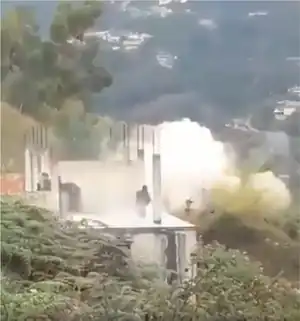
On 15 January 2018 the Operation Gideon was carried out in the El Junquito neighborhood, northwest of Caracas, where officials of the CONAS, SEBIN, DGCIM, GNB, FAES, PNB and Policaracas[115] stormed the El Junquito Parish in search of Oscar Pérez.[116] Immediately afterwards a confrontation occurred, leaving several dead and wounded.[117]
Óscar Pérez died during the police operation.[118] In the operation ten people died: seven members of the opposition group, two officers of the Bolivarian National Police Corps and one leader of the so-called colectivos. Various national and international movements and organizations categorized the action as a "massacre"[119] and/or "extrajudicial execution".[120]
After the death of Óscar Pérez, people close to him revealed that those responsible for the homicide had received the order not to take anyone alive and to kill Pérez. Shortly afterwards, Maduro confirmed that he had given the order to kill Óscar Pérez and threatened to apply the same tactic to any opposition group that he considered terrorist.
In the aftermath, Masonic lodges in Venezuela were raided. The death of Perez, a Free Mason, and subsequent government activities, were publicly condemned by lodges. It marked a history of Maduro's opposition to the fraternity.[121][122] Maduro had previously called Perez a terrorist.[123]
2018 Caracas attack

On 4 August 2018, in Caracas, Maduro was giving a speech at an event for the commemoration of the 81 years since the creation of the Bolivarian National Guard (GNB), when an explosion of a drone loaded with the explosive C-4 occurred.[124] The president was unharmed, but seven members of the GNB were reported injured.[125] As a consequence the detention of Juan Requesents, deputy of the National Assembly, occurred, in addition to the arrest and assassination of opposition leader Fernando Albán Salazar.
Transport policy
Crisis with airlines
Beginning in November 2013 some airlines began to have problems for the repatriation of capital to their main headquarters, after selling tickets in bolívares for reimbursement in dollars through the Cadivi system.[126] The government maintains a debt with around 32 airlines since before 2014 in the time of CADIVI for a value of US$3.5 billion, expressed the president of the Association of Airlines in Venezuela (Alav), Humberto Figuera[127][128]
On 17 March 2014 Air Canada announced that it suspended indefinitely its operations in Venezuela due to the lack of cancellation of the debt that the government maintained with the airline.[129] On 2 June Alitalia suspended operations in Venezuela due to the multimillion-dollar debt of the government with the airline.[130] By November 2019 the debt to the airlines remained, year for which there were nine foreign airline companies firmly operating[131][127]
Odebrecht case in Venezuela
Allegations of bribery
The United States Department of Justice investigated the Brazilian construction company Odebrecht and determined that it had paid around 788 million dollars in bribes to 11 countries, apart from Brazil, beginning in 2001. Of this amount, Odebrecht allegedly gave around 98 million dollars to government officials and intermediaries in order to obtain State contracts. Odebrecht admitted responsibility and agreed to pay a fine of around 3.5 billion dollars.[132]
In Venezuela, 31 projects awarded to the Brazilian company without bidding became known under the alleged binational agreement (agreement between states) but which was carried out between the Venezuelan state and a private company from Brazil, as in the case of the Tocoma Dam[133] when in February 2016 the external adviser of the Brazilian Odebrecht company and representative of the OIV Consortium could not satisfactorily explain to deputies of the National Assembly how the Tocoma Hydroelectric Plant project had four years of delay when he was questioned, for which political responsibility was declared for seven former electricity ministers: Rafael Ramírez Carreño; Alí Rodríguez Araque; Jesse Chacón; Argenis Chávez; Nervis Villalobos, and Javier Alvarado.[134]
Conviction of Marcelo Odebrecht in Brazil
On 7 March 2016, the former president of the company, Marcelo Odebrecht, was sentenced to 19 years and four months in prison in Brazil for having paid more than 30 million dollars in bribes to Petrobras executives in exchange for contracts and influence.[135]
Allegations of financing Chávez and Capriles campaigns
Between June and December 2017 it was alleged that the Odebrecht company had financed the campaigns of the two main presidential candidates of the 2012 elections: Hugo Chávez (the Brazilian publicist Mônica Moura was detained by the Brazilian justice system and declared that Chávez's campaign cost 35 million dollars and was illegally financed by Odebrecht)[136] and Henrique Capriles[137] (who denied the accusations)[138] for a smaller figure, with him being denounced before the Prosecutor's Office by politician Luis Tellerías because of these events.[139]
Freezing of Swiss accounts linked to a relative of Haiman El Troudi
In July 2017, prosecutors in Switzerland froze 42 million dollars from eight bank accounts that received transfers from offshore companies linked to Odebrecht in the name of Elita Zacarías, mother-in-law of former minister Haiman El Troudi, and both Elita del Valle and El Troudi's wife, María Baptista, were summoned as defendants for allegedly being related to the corruption case. The court in charge of the case in Venezuela exempted the family from responsibility, disregarding the investigations carried out in Switzerland.[140][141] During his administration, El Troudi used supplementary documents to modify the amounts in contracts for works such as Caracas Metro Guarenas-Guatire, Line 5 of the Caracas Metro, Line 2 of the Los Teques Metro and Metrocable (Caracas) Mariche-La Dolorita.[142]
Complaint against Maduro by the Prosecutor's Office
On 19 August 2017 attorney general Luisa Ortega Díaz made a complaint against Nicolás Maduro through an audio released by the prosecutor's office of Puebla in the Odebrecht bribery case; around 98 million dollars would have been received between 2005 and 2015. This led her to flee the country, leaving from the Paraguaná Peninsula on a yacht toward Aruba and then to Colombia. The attorney general and another 64 Venezuelan prosecutors were prohibited from leaving the country.[143][144]
In October 2017 attorney general Ortega Díaz made public a video where Euzenando Prazeres de Azevedo, the former director of Odebrecht in Venezuela, declared before the Attorney General's Office of Brazil that Maduro had received US$35 million to finance his presidential campaign in 2013. In the recording, Euzenando Prazeres de Azevedo says that Américo Mata, whom he identified as a representative of Maduro, contacted him to request money for Maduro's campaign.[145]
Trial of Nicolás Maduro


On 22 February 2018, the magistrates of the Full Chamber of the Supreme Tribunal of Justice of Venezuela in exile admitted the request for a preliminary hearing presented by attorney general Luisa Ortega Díaz against Nicolás Maduro for the crimes of corruption and money laundering related to the payment of bribes allegedly made by the company Odebrecht to several Venezuelan politicians with the purpose of obtaining contracts in major public works. Luisa Ortega stated that in an investigation carried out by her office it was possible to verify that in 2012 the presidential campaign of Hugo Chávez was paid for by Odebrecht and the money was received by Maduro, who served as foreign minister.[146]
On 28 March the Supreme Tribunal notified Nicolás Maduro to appear on 3 April at a preliminary hearing for corruption accusations related to the Odebrecht case.[147] In the face of his nonappearance, the Supreme Tribunal proceeded to appoint trial lawyer Andrés Felipe Lindo as public defender, in order to guarantee the right to defense.[148] On 9 April the tribunal admitted the preliminary hearing against Maduro requested by the attorney general, ordering preventive detention against the president and requesting a red notice from Interpol against him.[149]
On 17 April the National Assembly approved with 105 votes in favor, from the opposition bloc, and two against, Juan Marín (PSUV) and Ilenia Medina (PPT) from the ruling party, the continuation of the trial against president Nicolás Maduro for corruption in response to the request submitted by the magistrates of the Supreme Tribunal. The agreement voted on by the deputies established declaring that sufficient merits exist to continue the judicial process and continue with the investigations carried out in the National Assembly in accordance with Article 187 of the constitution for acts of corruption that could derive from Maduro. The vote was carried out nominally and the leadership of the assembly decided to approve the trial with a simple majority; that is, 84 votes, based on Article 89 of the Parliament's Internal Rules and Debates Regulations. The leader of the bloc of the Democratic Unity Roundtable (MUD), Juan Guaidó, read the report in which president Nicolás Maduro approved 30 billion dollars for the execution of works in charge of Odebrecht that were halted or unfinished. By orders of colonel Bladimir Lugo of the Bolivarian National Guard (GNB), the media were unable to enter the Legislative Palace; the colonel kept journalists waiting for more than one hour at the San Francisco corner to finally decide that they would not have access.[150]
On 3 May 2018 the Supreme Tribunal declared Maduro suspended as president and ordered his disqualification from any other public office.[151][152] OAS secretary general Luis Almagro recognized Maduro's disqualification and suspension as president.[153] The political party Vente Venezuela published a statement supporting the tribunal's decision, stating that "it ratifies that Maduro cannot be a candidate in any election" and that with this decision it corresponds to the National Assembly to begin a new process "to occupy that vacuum and advance in the restoration of democratic order in the country".[154] The suspension from office and detention order was also supported by the Federation of Law Students of Venezuela (Fedeve), which rejected "the persecution and abuses carried out by the repressive dictatorship against the magistrates of the Supreme Tribunal of Justice (TSJ) in exile, and consequently against their relatives in Venezuela" in a statement, and its members demanded that the competent international organizations take pertinent actions in response to such acts.[155]
On 15 August, the Supreme Tribunal sentenced Nicolás Maduro to 18 years and 3 months in prison in Ramo Verde prison for the corruption crimes imputed to him, in addition to ordering him to pay 35 billion dollars for the damage to the country's public patrimony.[156] The sentence has not yet been carried out, since the Maduro government only recognizes the Supreme Tribunal of Justice of Venezuela.[157]
Foreign policy
The foreign policy of Maduro's second term was characterized by the continuation of alliances with Cuba, Nicaragua, Russia, China, Iran, and Turkey,[158] alongside the severance of diplomatic relations with Argentina, Bolivia (restored in 2020),[4] Brazil (restored in 2022),[159] Colombia (restored in 2022),[6] El Salvador, the United States,[7] Guatemala[8] and Paraguay.
Americas
Argentina

In December 2023 it became known that the government of Javier Milei would not appoint an ambassador to Venezuela. Milei did not invite Maduro to his inauguration.[160]
After a Venezuelan Boeing 747 aircraft in Buenos Aires was seized and handed over to the United States in 2024 because, according to the United States Department of Justice, it had been sold by the Iranian company Mahan Air, which was sanctioned by U.S. authorities, Maduro declared on television on 15 February 2024 that "the bandit Milei stole Venezuela's plane" and that "he pretends to be crazy or he is crazy or both at the same time".[161]
On 18 July 2024 Nicolás Maduro called Javier Milei a "bastard" and accused him of being involved in an alleged plot to suspend the presidential elections.[162] One day later, the Argentine Foreign Ministry informed the International Criminal Court (ICC) of Argentina's return to the trial concerning human rights in the country due to the "deterioration of the political and human rights situation in Venezuela".[163] On 22 July Argentine presidential spokesman Manuel Adorni declared: "Maduro is a figure who has become, or perhaps always was, a dictator".[162]
On 23 July 2024 former Peronist president Alberto Fernández confirmed his participation as an electoral observer, declaring that he would meet with opposition leaders to "listen to their concerns" and reiterated that "if (Nicolás Maduro) is defeated, what he has to do is accept it".[164] The following day Fernández confirmed that his invitation had been cancelled because his statements "caused discomfort and generated doubts about my impartiality"; Fernández protested the decision and criticised that his opinion coincided with Brazilian president Lula Da Silva's criticism of Maduro's statements about a possible "bloodbath" following an eventual electoral defeat.[165] Chilean president Gabriel Boric supported him.[166]
Following the presidential elections, the Argentine Foreign Ministry issued a statement that day together with the foreign ministers of Costa Rica, Ecuador, Panama, Paraguay, Peru and Uruguay, requesting guarantees that the government would respect the election results.[167] President Milei declared "Dictator Maduro, out", establishing that "Argentina is not going to recognise another fraud" and asking "that the Armed Forces this time defend democracy and the popular will".[168] Former president Mauricio Macri said "Maduro must leave power. Now Venezuela's Armed Forces have the opportunity to stand on the right side of history".[169]
Pedro Urruchurtu, a political asylum seeker in the Argentine embassy in Venezuela, denounced a siege by hooded individuals at the ambassador's residence that day, where five more dissidents from Maduro's government were taking refuge.[170] On the same day, in Argentina, Venezuelan ambassador Stella Lugo accused Security Minister Patricia Bullrich of being "interventionist" following her support for Venezuelan migrants who voted and awaited the results of the presidential elections on 28 July.[171]
On 29 July Maduro's government ordered the expulsion from the country of the diplomatic staff of the Argentine Embassy in Venezuela, accusing it of interventionism following statements by Milei's government regarding its refusal to recognise the results announced by Elvis Amoroso on behalf of the CNE after the opposition denounced fraud;[172] it later cut off electricity and water at the embassy.[170] The Argentine Foreign Ministry condemned the "harassment" of its embassy.[170] The Socialist International condemned the expulsion of the Argentine diplomatic corps[173] and President Lula reiterated to Maduro that guaranteeing the security of the embassy was his responsibility.[170] The foreign ministers of Argentina and Brazil agreed that Lula's government would take charge of Argentina's interests in Venezuela, including its embassy, beginning on 1 August.[174]
Following the ruling of the TSJ on 22 August endorsing Nicolás Maduro's victory for his third term, the governments of Argentina, Chile, Costa Rica, Ecuador, the United States, Guatemala, Panama, Paraguay, Peru, the Dominican Republic and Uruguay issued a statement the following day rejecting the ruling.[175] That day a Venezuelan employee of the Argentine embassy was detained by the Sebin and released the following day after diplomatic efforts.[176]
Nicolás Maduro's government stated in a communiqué that Venezuela had been "forced" to make the decision to revoke Brazil's permission because of alleged "terrorist activities" and "attempts at assassination against Nicolás Maduro".[177]
Bolivia

President Jeanine Áñez announced the severance of relations with Venezuela in 2019.[178] Relations were restored the following year after the arrival of Luis Arce to the presidency.[179]
Former president Jorge Quiroga, who was going to serve as an international observer in the 2024 presidential elections, was prevented from travelling to the country from Panama on 26 July of that year after Venezuelan airspace was blocked to his plane, which carried other Latin American former presidents and ordinary passengers.[180] The government of Luis Arce recognised Nicolás Maduro as the winner of the elections and congratulated him.[181]
Brazil


Venezuela-Brazil relations have swung from amicable during the leftist administrations of Luiz Inácio Lula da Silva (2003–2010; 2023–present) and Dilma Rousseff (2010–2016), to antagonistic during the right-wing administrations of Michel Temer (2016–2019) and Jair Bolsonaro (2019–2023).[182]
On 14 January 2019, days after Brazil recognized Venezuelan opposition leader Juan Guaidó as the country's interim president, Maduro called Brazilian President Jair Bolsonaro "a Hitler of the modern era".[183]
Chile
Between 2018 and 2023 Chile did not appoint any ambassador to Venezuela, until president Gabriel Boric appointed Jaime Gazmuri in May 2023. Boric asked the United States and the European Union to lift the economic sanctions against Venezuela. Boric opposed Brazilian president Lula Da Silva's statement in May 2023 that "authoritarianism (in Venezuela) is a narrative construction", saying "I have had the opportunity to see (that reality) in the eyes and pain of hundreds of thousands of Venezuelans who today are in our homeland and who also demand a firm and clear position".[184][185]
Following the kidnapping and murder of former Venezuelan serviceman Ronald Ojeda, a political dissident granted asylum in Chile, in February 2024, relations between both countries deteriorated. Chilean prosecutor Héctor Barros determined in April that so far the only possible motive was political due to the victim's profile as an active dissident. He declared Walter Rodríguez, whose fingerprint was found on Ojeda's mobile phone, and Maickel Villegas, who took his family out of Chile one month before the former lieutenant's murder, as suspects. In June, Venezuelan prosecutor Tarek William Saab described the crime as a "false flag operation", remarks that Foreign Minister Alberto van Klaveren described as "unacceptable".[186]
Following Nicolás Maduro's statements on the eve of the presidential elections regarding the possibility of a "bloodbath" in the country if he lost the elections, Gabriel Boric declared: "One cannot threaten bloodbaths under any circumstances", calling for respect for the popular will.[166] After the elections, Boric did not recognise the electoral results declaring Maduro the winner, considering them "difficult to believe", and requested transparency regarding the tally sheets and electoral process.[187] On 29 July Maduro's government ordered the expulsion from the country of the diplomatic staff of the Chilean Embassy in Venezuela, accusing it of interventionism following statements by Boric's government.[172] The Socialist International condemned the expulsion of the Chilean diplomatic corps.[173] Following the ruling of the TSJ on 22 August endorsing Nicolás Maduro's victory for his third term, Boric declared that "Today Venezuela's TSJ finishes consolidating the fraud. Maduro's regime obviously welcomes its ruling, which will be marked by infamy" and clarified that "Venezuela's dictatorship is not the left".[188]
Colombia
Government of Juan Manuel Santos
In 2014 Nicolás Maduro's government accused Juan Manuel Santos' government of being behind the protests of that year.[189]

In 2015 the government responded to the murder of three Venezuelan soldiers on the border with Colombia by establishing a state of emergency, during which 1,012 Colombians were deported and 10 alleged paramilitaries from that country were captured, according to statements by then-governor José Vielma Mora,[190] with estimates of around 20,000 undocumented Colombians displaced by government policies intended to secure control of the border.[191][192]
In 2018 Nicolás Maduro's government accused Juan Manuel Santos' government of being behind the attack of that year against him.[189]
Government of Iván Duque
Venezuela and Colombia broke diplomatic relations in February 2019 after Colombia recognised Juan Guaidó as president.[178] Venezuela gave Colombian diplomats 24 hours to leave the country.[193]
Government of Gustavo Petro
Relations between both countries were restored in 2022 after the arrival of Gustavo Petro to the presidency.[194]
In March 2024 Colombia's Foreign Ministry expressed "concern" regarding the "difficulties faced by major sectors of the opposition" in nominating their candidates, in reference to Corina Yoris.[195] Foreign Minister Yván Gil responded: "Driven by the need to satisfy the wishes of the U.S. State Department, Colombia's Foreign Ministry takes a false step and commits a gross act of interference in matters that concern only Venezuelans".[196]
On 2 April 2024 Petro described the disqualification of María Corina Machado as a "democratic coup".[196] On 10 April Maduro and Petro met.[197]
Petro proposed an agreement on democratic guarantees between the government and the opposition; Colombian Foreign Minister Luis Gilberto Murillo expressed the Colombian government's intention to ensure that Venezuela could have a peaceful transition after the elections.[198] Former vice president Diosdado Cabello responded: "Who sent you to say that? Your president of Colombia or your president of the United States? Who do you work for? Who gives you the right to speak about transition in Venezuela?", stating that the only transition that would come to Venezuela would be "the transition to socialism".[199] Colombia did not officially respond to Cabello; however, when questioned on the matter, Murillo stated: "To foolish words, deaf ears".[200]
Former Colombian vice president Marta Lucía Ramírez, who was going to serve as an international observer in the 2024 presidential elections, was prevented from travelling to the country from Panama on 26 July of that year after Venezuelan airspace was blocked to her plane, which also carried other Latin American former presidents and ordinary passengers, causing her and the others to disembark so that the aircraft could continue without restrictions.[180]
Foreign Minister Luis Gilberto Murillo declared that "We call for the total counting of votes, their verification and an independent audit to proceed as soon as possible", requesting that "any doubts regarding the results be dispelled". Former president Andrés Pastrana declared: "In Venezuela there was not electoral fraud, but rather a coup d'état through the disregard of the popular will!".[201]
Costa Rica
Former Costa Rican president Miguel Ángel Rodríguez, who was going to serve as an international observer in the 2024 presidential elections, was prevented from travelling to the country from Panama on 26 July of that year after Venezuelan airspace was blocked to his plane, which carried other Latin American former presidents and ordinary passengers, causing him and the others to disembark so that the aircraft could continue without restrictions.[180]
Following the presidential elections, Costa Rica's Foreign Ministry issued a statement together with the foreign ministers of Argentina, Ecuador, Panama, Paraguay, Peru and Uruguay, requesting guarantees that the government would respect the election results.[167]
Following the Venezuelan elections, president Rodrigo Chaves declared that "The government of Costa Rica categorically repudiates the proclamation of Nicolás Maduro as president of the Bolivarian Republic of Venezuela, which we consider fraudulent". On 29 July Maduro's government ordered the expulsion from the country of the diplomatic staff of the Costa Rican Embassy in Venezuela.[172] The Socialist International condemned the expulsion of the Costa Rican diplomatic corps.[173] On 31 July Costa Rica offered political asylum to Edmundo González Urrutia and María Corina Machado, leaders of the opposition to the government,[202] an option they appreciated but declined.
On 2 August 2024 Chaves' government recognised Edmundo González Urrutia as president-elect. Following the ruling of the TSJ on 22 August endorsing Nicolás Maduro's victory for his third term, the governments of Argentina, Chile, Costa Rica, Ecuador, the United States, Guatemala, Panama, Paraguay, Peru, the Dominican Republic and Uruguay issued a statement the following day rejecting the ruling.[175]
Ecuador
Government of Lenín Moreno
In 2018, after Jorge Rodríguez called president Lenín Moreno a "liar" and accused him of "inflating" the figures of Venezuelan emigrants, Venezuelan ambassador Carol Delgado was given 72 hours to leave the country, which was reciprocated in Venezuela with the expulsion of Ecuador's chargé d'affaires.[203][204]
In 2019 Lenín Moreno accused former president Rafael Correa and Nicolás Maduro of conspiring against him and of being behind the social unrest in Ecuador, describing it as an "attempted coup d'état".[205] Following this, Correa clarified that he had been in Venezuela working as a consultant for Maduro's government.[206]
Government of Daniel Noboa
In April 2024, following the raid by Daniel Noboa's government on the Mexican embassy in Ecuador, Maduro's government announced the closure of Venezuela's embassy in Ecuador as well as its consulates in the country.[207] On 18 July 2024 Maduro accused Noboa of being behind an alleged plan to suspend the presidential elections in Venezuela.[162]
Following the Venezuelan presidential elections, Ecuador's Foreign Ministry issued a statement together with the foreign ministers of Argentina, Costa Rica, Panama, Paraguay, Peru and Uruguay, requesting guarantees that the government would respect the election results.[167]
Ecuador's Foreign Ministry rejected the results declaring Maduro the winner because of their "lack of transparency"; for the country, the "lack of guarantees" in the vote-counting process "delegitimises and taints the election results". President Noboa declared that he had asked Foreign Minister Gabriela Sommerfeld to convene the Permanent Council of the OAS to address the "delicate situation Venezuela is experiencing", adding that this was "the danger of dictatorship".[208] On 2 August Noboa's government recognised Edmundo González Urrutia as president-elect. Following the ruling of the TSJ on 22 August endorsing Nicolás Maduro's victory for his third term, the governments of Argentina, Chile, Costa Rica, Ecuador, the United States, Guatemala, Panama, Paraguay, Peru, the Dominican Republic and Uruguay issued a statement the following day rejecting the ruling.[175]
El Salvador

Nicolás Maduro expelled the Salvadoran diplomatic corps, which was reciprocated by president Nayib Bukele with the expulsion of all representatives of the Venezuelan embassy in the country.[203]
Guatemala
President Alejandro Giammattei closed Guatemala's embassy in Caracas in 2020 and broke diplomatic relations with Nicolás Maduro's government.[178][203]
Following the results of the 2024 presidential elections, president Bernardo Arévalo wrote on the social network X that "Venezuela deserves transparent, accurate electoral results in accordance with the will of its people" and that "we received the results announced by the CNE with many doubts. Therefore, the reports of the electoral observation missions are indispensable and, today more than ever, they must defend the votes of Venezuelans". Following the ruling of the TSJ on 22 August endorsing Nicolás Maduro's victory for his third term, the governments of Argentina, Chile, Costa Rica, Ecuador, the United States, Guatemala, Panama, Paraguay, Peru, the Dominican Republic and Uruguay issued a statement the following day rejecting the ruling.[175]
Guyana
Honduras
In 2019 Honduras withdrew its chargé d'affaires in Caracas and recognised Juan Guaidó as president.[178] Both countries broke relations until 2022, when they were resumed.[209] The government of Xiomara Castro recognised Nicolás Maduro as the winner of the 2024 presidential elections, congratulating him.[210]
Mexico
Government of Enrique Peña Nieto
After Maduro's election as president in April 2013, the government of Enrique Peña Nieto further emphasised the close ties between both countries and the willingness to overcome differences regarding political structures. However, in January 2015 Maduro accused former Mexican president Felipe Calderón Hinojosa (Peña Nieto's predecessor) of conspiring with the Venezuelan opposition to overthrow his government.[211] In 2017 Maduro expressed support for Peña Nieto during the diplomatic crisis with the government of Donald Trump regarding issues such as the border wall and the renegotiation of NAFTA.[212]
Government of Andrés Manuel López Obrador
Following Andrés Manuel López Obrador's victory in July 2018, president Maduro travelled to Mexico to attend the inauguration in December of that same year.[213] On 23 January 2019 López Obrador's government reiterated Mexico's traditional stance of non-intervention in the affairs of other countries, supporting Maduro's government by refusing to recognise Juan Guaidó as president of Venezuela.[214]
Former president Vicente Fox, who was going to serve as an international observer in the Venezuelan presidential elections, was prevented from travelling to the country from Panama on 26 July of that year after Venezuelan airspace was blocked to his plane, which carried other Latin American former presidents and ordinary passengers, causing him and the others to disembark so that the aircraft could continue without restrictions.[180]
Panama
Government of Ricardo Martinelli
In March 2014 Nicolás Maduro announced the severance of diplomatic relations with Panama after the latter country requested that the Permanent Council of the Organization of American States (OAS) convene a meeting of foreign ministers regarding the situation in Venezuela.[215]
Government of Juan Carlos Varela
Panama designated Maduro and other Venezuelan officials as "high-risk" subjects for money laundering. Nicolás Maduro responded on 5 April 2018 by declaring sanctions against Panamanian companies, as well as against the president of Panama, Juan Carlos Varela, and other businessmen. The crisis ended on 26 April when Maduro announced that he had spoken by telephone with Varela and they agreed on the return of ambassadors and the restoration of air communication between both countries.[216][217]
Government of José Raúl Mulino
On 26 July 2024 a Copa Airlines aircraft was prevented from travelling from Panama to Venezuela after Venezuelan airspace was blocked because of the presence of former presidents Mireya Moscoso (Panama), Vicente Fox (Mexico), Miguel Ángel Rodríguez (Costa Rica) and Jorge Quiroga (Bolivia), and former Colombian vice president Marta Lucía Ramírez, who were going to serve as international observers in the 2024 presidential elections. The politicians disembarked so that the aircraft could continue without restrictions.[180]
Following the 2024 Venezuelan presidential elections, Panama's Foreign Ministry issued a statement together with the foreign ministers of Argentina, Costa Rica, Ecuador, Paraguay, Peru and Uruguay, requesting guarantees that the government would respect the election results.[167] The following day, on 29 July, president Mulino announced the suspension of relations between both countries after rejecting and denouncing irregularities regarding the announcement of Maduro's presidential victory.[218] On 29 July Maduro's government ordered the expulsion from the country of the diplomatic staff of the Panamanian Embassy in Venezuela.[172] The Socialist International condemned the expulsion of the Panamanian diplomatic corps.[173]
On 2 August 2024 president Mulino announced that Panama was joining the recognition of Edmundo González Urrutia as president-elect. Following the ruling of the TSJ on 22 August endorsing Nicolás Maduro's victory for his third term, the governments of Argentina, Chile, Costa Rica, Ecuador, the United States, Guatemala, Panama, Paraguay, Peru, the Dominican Republic and Uruguay issued a statement the following day rejecting the ruling.[175]
Paraguay
On 10 January 2019 the government of Mario Abdo Benítez broke relations with Venezuela and closed the Paraguayan embassy in Caracas.[178] Relations were restored in November 2023 following the arrival of Santiago Peña.[219]
Following the 2024 presidential elections, Paraguay's Foreign Ministry issued a statement together with the foreign ministers of Argentina, Costa Rica, Ecuador, Panama, Peru and Uruguay, requesting guarantees that the government would respect the election results.[167]
Peru
The government of Nicolás Maduro and the government of Dina Boluarte experienced diplomatic friction after the National Police of Peru injured members of Venezuela's national football team during the match between both countries held in Lima in 2023[220] and the Venezuelan team's aircraft was denied fuel for several hours without any apparent reason.[221]
Following the presidential elections, Peru's Foreign Ministry issued a statement together with the foreign ministers of Argentina, Costa Rica, Ecuador, Panama, Paraguay and Uruguay, requesting guarantees that the government would respect the election results.[167]
After the results of the 2024 presidential elections, Peruvian foreign minister Javier González-Olaechea declared that Peru "will not accept the violation of the popular will of the Venezuelan people", rejecting the results.[201] On 29 July Maduro's government ordered the expulsion from the country of the diplomatic staff of the Peruvian Embassy in Venezuela.[172] The Socialist International condemned the expulsion of the Peruvian diplomatic corps.[173] Following the results published by the Democratic Unitary Platform, which contradicted those of the CNE, Peru recognised Edmundo González Urrutia as president-elect. Following the ruling of the TSJ on 22 August endorsing Nicolás Maduro's victory for his third term, the governments of Argentina, Chile, Costa Rica, Ecuador, the United States, Guatemala, Panama, Paraguay, Peru, the Dominican Republic and Uruguay issued a statement the following day rejecting the ruling.[175]
Dominican Republic
Following the 2024 presidential elections, the Dominican Foreign Ministry joined a statement together with the foreign ministers of Argentina, Costa Rica, Ecuador, Panama, Paraguay, Peru and Uruguay, requesting guarantees that the government would respect the election results.[222] On 29 July Maduro's government ordered the expulsion from the country of the diplomatic staff of the Dominican Embassy in Venezuela.[172] The Socialist International condemned the expulsion of the Dominican diplomatic corps.[173] Following the ruling of the TSJ on 22 August endorsing Nicolás Maduro's victory for his third term, the governments of Argentina, Chile, Costa Rica, Ecuador, the United States, Guatemala, Panama, Paraguay, Peru, the Dominican Republic and Uruguay issued a statement the following day rejecting the ruling.[175]
United States of America
Maduro accused the United States of intervention in Venezuela several times with his allegations ranging from post-election violence by "neo-Nazi groups", economic difficulties from what he called an "economic war" and various coup plots.[223][224] The United States denied such accusations.[224]

In early 2015 the Obama administration signed an executive order which imposed targeted sanctions on seven Venezuelan officials whom the White House argued were instrumental in human rights violations, persecution of political opponents and significant public corruption and said that the country posed an "unusual and extraordinary threat to the national security and foreign policy of the United States".[225] Maduro responded to the sanctions in a couple of ways. He wrote an open letter in a full-page ad in The New York Times in March 2015, stating that Venezuelans were "friends of the American people" and called President Obama's action of making targeted sanctions on the alleged human rights abusers a "unilateral and aggressive measure".[226][227] Examples of accusations of human rights abuses from the United States to Maduro's government included the murder of a political activist prior to legislative elections in Venezuela.[228] Maduro threatened to sue the United States over an executive order issued by the Obama Administration that declared Venezuela to be a threat to American security.[229] He also planned to deliver 10 million signatures, or signatures from about 1/3 of Venezuela's population, denouncing the United States' decree declaring the situation in Venezuela an "extraordinary threat to US national security".[230][231] and ordered all schools in the country to hold an "anti-imperialist day" against the United States with the day's activities including the "collection of the signatures of the students, and teaching, administrative, maintenance and cooking personnel".[231] Maduro further ordered state workers to apply their signatures in protest, with some workers reporting that firings of state workers occurred due to their rejection of signing the executive order protesting the "Obama decree".[231][232][233][234][235][236] There were also reports that members of Venezuelan armed forces and their families were ordered to sign against the United States decree.[231]
Proposed United States invasion of Venezuela
The possibility of a United States-led invasion of Venezuela has been frequently discussed during the presidencies of Donald Trump.
In 2017, during his first presidency, Trump said that he was "not going to rule out a military option" to address the worsening crisis in Venezuela. In 2025, during his second presidency, the United States surged military assets to the Caribbean as part of Operation Southern Spear, citing the fight against drug cartels as its stated objective. During this buildup, experts, analysts and current and former government officials stated that the assets deployed were insufficient for an invasion and that they viewed an invasion as unlikely.
In 2026, the United States launched Operation Absolute Resolve, conducting airstrikes on Venezuela and capturing President Nicolás Maduro and his wife Cilia Flores. This led to questions being raised about the possibility of long-term military intervention involving ground troops in Venezuela.
Uruguay
On 13 February 2024 president Luis Lacalle Pou said that it was "obvious" that in Venezuela "there is a dictatorship".[237] On 17 February former president José Mujica declared: "The government of Venezuela is an authoritarian government, (Maduro) can be called a dictator".[238]
Following the 2024 presidential elections, Uruguay's Foreign Ministry issued a statement together with the foreign ministers of Argentina, Costa Rica, Ecuador, Panama, Paraguay and Peru, requesting guarantees that the government would respect the election results.[167] Following the results, president Luis Lacalle Pou declared that "The process up to election day and the counting process were clearly tainted. One cannot recognise a victory if there is no confidence in the methods and mechanisms used to achieve it" and that he would not recognise the CNE results declaring Nicolás Maduro the winner.[201] On 29 July Maduro's government ordered the expulsion from the country of the diplomatic staff of the Uruguayan Embassy in Venezuela.[172] The Socialist International condemned the events.[173] On 2 August Lacalle Pou's government recognised Edmundo González Urrutia as president-elect. Following the ruling of the TSJ on 22 August endorsing Nicolás Maduro's victory for his third term, the governments of Argentina, Chile, Costa Rica, Ecuador, the United States, Guatemala, Panama, Paraguay, Peru, the Dominican Republic and Uruguay issued a statement the following day rejecting the ruling.[175]
Europe
Spain
The Spanish government recognised Juan Guaidó as interim president of Venezuela in 2019, leaving the position of ambassador to Venezuela vacant from 2020 until 2022, when a new ambassador was appointed.[239]
France
Nicolás Maduro concluded his 2017 international tour in France, meeting with president François Hollande.[240]
Italy
Following the 2024 presidential elections in Venezuela, Italian foreign minister Antonio Tajani declared: "I have many doubts about the regular conduct of the elections in Venezuela", requesting "results that can be verified".[241]
Portugal
On 30 March, at 00:45 hours (Venezuelan time), the Venezuelan coast guard vessel AB Naiguatá (GC-23) sighted the Portuguese cruise ship Resolute and ordered it to follow it to a Venezuelan port. The captain of the Resolute was consulting with his superiors when the Naiguatá deliberately collided with the cruise ship's bow with the apparent intention of diverting its course toward the Venezuelan coast. However, the Resolute was a ship with a reinforced hull designed for navigation in ice fields, causing the Naiguatá to take on water and eventually sink. Its crew was rescued by Venezuelan vessels, and the Resolute, which was not significantly damaged, after waiting in the area received instructions to head to Curaçao.[112]
The Resolute, with its 32 crew members, had already been adrift for a day.[112]
The government of Nicolás Maduro (partially recognised) denounced the incident, calling it an "act of international piracy",[242] while the Bolivarian National Armed Forces likewise described the Portuguese cruise ship's "action" as "cowardly and criminal".[243] The government of Portugal offered to assist in the investigations.[244]
On 1 April, Curaçao reported that it had not had access to the Resolute.[245] On 2 April, Nicolás Maduro stated that "someone from the north" was preventing Curaçao from investigating what had happened, in reference to the United States.[246]
Russia

In 2015 Russian companies began leading international oil extraction in Venezuela, surpassing China.[189]
In 2017 the Russian state-owned company Rosneft paid Venezuela an advance of 6 billion dollars for oil sales.[189]
By 2020 the channel CNBC considered Russia Venezuela's principal geopolitical ally, and Russia's "most prominent" Latin American relationship was with Venezuela.[247]
Due to the COVID-19 pandemic, an agreement was reached with Russia at the end of December 2020 for the delivery of 10 million units of Russian vaccines, beginning with 1.43 million first doses; by August 2021 the second dose had not arrived,[248] despite the fact that the second dose was supposed to be administered after 21 days. Russia responded that it first had to meet the needs of the Russian population, which totalled 140 million people.[249]
In February 2022 Nicolás Maduro expressed his "strong support" for Russia in its invasion of Ukraine during a telephone call with Vladimir Putin[250] and condemned the sanctions imposed on Russia by Western nations.[251]
Asia
China
Maduro reached out to China for economic assistance while China funneled billions of dollars from multiple loans into Venezuela.[252] China is Venezuela's second largest trade partner with two-thirds of Venezuelan exports to China composed of oil.[252] According to Mark Jones, a Latin American expert of the Baker Institute, China was "investing for strategic reasons" rather than ideological similarities.[252] The Venezuelan military also used military equipment from China using the NORINCO VN-4 armoured vehicle against protesters during the 2014–15 Venezuelan protests, ordering hundreds more as a result of the demonstrations.[253][254]
Iran

Since 2020, during the fuel crisis in Venezuela, the government resorted to importing oil and refining supplies from Iran.[255] Through an agreement, Maduro's government handed over the El Palito Refinery to Iran for the maintenance and restoration of production at the plant in May 2022.[256][257] In June of that year, Nicolás Maduro and Ebrahim Raisi signed a 20-year cooperation agreement between Venezuela and Iran.[258] At the end of July, it was reported that the government ceded one million hectares of arable land to the Iranian government.[259] According to the constitution, this decision could not be implemented without consulting the population, in accordance with Article 13.[260]
Iranian foreign minister Nasser Kanaani recognised Nicolás Maduro as the winner following the 2024 presidential elections, congratulating him.[210]
Israel and Palestine
In the Israeli–Palestinian conflict, Maduro frequently supported the Palestinian cause in international forums including his stance that his country recognizes Jerusalem as the eternal capital of Palestine after the US embassy move to Jerusalem which he called an "extremist decision" that lacks legal validity and violates international law.[261][262][263][264] In January 2019, Maduro reaffirms the unconditional support for the struggle of the Palestinians in defense of their sovereignty in accordance with the principles of the Charter of the United Nations and international law.[265]
In December 2017, Maduro was invited as the special honorary guest at the Extraordinary Summit of the OIC (Organisation of Islamic Cooperation) in Istanbul, Turkey with the main issue being to unify the response of the Muslim world to the US embassy move to Jerusalem, which Maduro called a "colonial act."[266]
Syria
Nicolás Maduro expressed support for the government of Bashar al-Assad in Syria on numerous occasions, opposing intervention in the country.[267]
International organizations
UN

BRICS
The government of Nicolás Maduro intended for Venezuela to join the BRICS.[268] In 2024 Brazil vetoed Venezuela's entry into BRICS after Venezuela refused to publish electoral tally sheets from the 2024 elections amid opposition allegations of electoral fraud. This was criticised by Maduro's government.[269]
OAS
Minutes after Nicolás Maduro was sworn in, the Organization of American States, in an extraordinary meeting of its Permanent Council, approved a resolution declaring Maduro illegitimate as president of Venezuela and urging that new elections be called.[270]
Declaration of Panama
On 6 April 2015, twenty-five (25) ex-presidents issued a Declaración de Panamá (Declaration of Panama),[271] a statement denouncing the VII Cumbre de las Américas, what they called "democratic alteration" in Venezuela, promoted by the government of Nicolas Maduro. The statement calls for the immediate release of "political prisoners" in Venezuela. Among the former heads of government that have called for improvements in Venezuela are: Jorge Quiroga (Bolivia); Sebastián Piñera (Chile): Andrés Pastrana, Álvaro Uribe and Belisario Betancur (Colombia); Miguel Ángel Rodríguez, Rafael Ángel Calderón Guardia, Laura Chinchilla, Óscar Arias, Luis Alberto Monge (Costa Rica), Osvaldo Hurtado (Ecuador); Alfredo Cristiani and Armando Calderón (EL Salvador); José María Aznar (Spain); Felipe Calderón and Vicente Fox (México), Mireya Moscoso (Panamá), Alejandro Toledo (Perú) and Luis Alberto Lacalle (Uruguay).[272]
Non-Aligned Movement
At the 17th Summit of the Non-Aligned Movement (NAM) in 2016, hosted by Venezuela at Margarita Island, Maduro was elected chairperson by acclamation, a position that he is to hold until the 18th Summit in Azerbaijan in 2019.[273] Maduro's administration spent over US$120 million on the event,[274] and Maduro billed it as a meeting that would "be remembered for centuries"; according to Al Jazeera, the "delegates who did come complained privately of a lack of organisation, delays and shabby hotels".[275] The Maduro administration did not respond to a request from Al Jazeera for a list of delegations present;[275] of the 120 NAM member states, media sources estimated between 10[276] and 15[277] heads of state attended, including Bolivia,[275] Cuba, Ecuador, Palestine, Iran, Syria and Zimbabwe.[276] For only the second time since NAM was founded, India did not attend;[276] of the countries that did attend, many are recipients of Venezuelan oil subsidies, according to Foreign Policy and Fox News.[276][278]
International Criminal Court investigation
An investigation by the International Criminal Court (ICC) to analyze possible crimes against humanity committed in Venezuela was opened in 2021.[279] A preliminary examination was initially opened in 2006, and closed after concluding that the requirements to start an investigation had not been met.[280] In February 2018, the ICC announced that it would open preliminary probes into alleged crimes against humanity performed by Venezuelan authorities since at least April 2017.[281] In 2020, the Office of the Prosecutor of the ICC stated that it believed there was a "reasonable basis" to believe that "since at least April 2017, civilian authorities, members of the armed forces and pro-government individuals have committed the crimes against humanity",[282] and on 2021 ICC Prosecutor Karim Khan announced the opening of an investigation regarding the situation in the country.[279]
International trips
This list provides a summary of the official foreign visits made by Maduro as president of Venezuela.


2013
| Date | Place | Areas visited | Main purpose |
|---|---|---|---|
| 18 April |  Peru |
Lima | Attended the extraordinary meeting of UNASUR.[283] |
| 7 May |  Uruguay |
Montevideo | Guest at the Mercosur Summit.[284] |
| 8 May |  Argentina |
Buenos Aires | Meeting with President Cristina Fernández de Kirchner.[285] |
| 25 May |  Bolivia |
Cochabamba | Meeting with President Evo Morales.[286] |
| 2 June |  Nicaragua |
Managua | Meeting with President Daniel Ortega.[287] |
| 2–3 June |  Russia |
Moscow | Meeting with President Vladimir Putin.[288] |
| 17 June |  Vatican City |
 Meeting with Pope Francis.[289] |
| 26 June |  Haiti |
Port-au-Prince | Meeting with President Michel Martelly.[290] |
| 29 June | Nicaragua |
Managua | Guest at the Petrocaribe summit.[291] |
| 3 July |  Belarus |
Minsk | Meeting with President Alexander Lukashenko.[292] |
| 30 August |  Suriname |
Paramaribo | Attended the UNASUR summit.[291] |
2014
| Date | Place | Areas visited | Main purpose |
|---|---|---|---|
| 28–29 January |  Cuba |
Havana | Guest at the CELAC Summit.[293] |
| 24 September |  United States |
New York City | Guest at the general debate of the United Nations session period.[294] |
2015
| Date | Place | Areas visited | Main purpose |
|---|---|---|---|
| 10 January |  Iran |
Tehran | Visit to OPEC member states because of the fall in oil prices. |
| 11–12 January |  Saudi Arabia |
Jeddah | Working visit.[295] |
| 22 January | Bolivia |
La Paz | Guest at the third presidential inauguration of Evo Morales.[296] |
| 8 May | Russia |
Moscow | Celebrations of the 70th Victory Day (9 May).[297] |
| 30 August |  Vietnam |
Hanoi | Working visit.[298] |
| 3 September |  China |
Beijing | Attended the 2015 China Victory Day Parade.[299] |
| 5 September |  Jamaica |
Kingston | Guest at the 10th Petrocaribe Summit.[300] |
| 23–24 September |  Dominica |
Roseau | Meeting with Prime Minister Roosevelt Skerrit.[301] |
| 25 September |  Saint Kitts and Nevis |
Basseterre | Working visit.[301] |
| 16 October | Suriname |
Paramaribo | Working visit.[302] |
| 17 October |  Antigua and Barbuda |
Saint John's | Meeting with Prime Minister Gaston Browne.[303] |
| 23 November | Iran |
Tehran | 3rd Gas Exporting Countries Forum Summit.[304] |
2016
| Date | Place | Areas visited | Main purpose |
|---|---|---|---|
| 18 March | Cuba |
Havana | Meeting with President Raúl Castro, decorated with the Order José Martí.[305] |
| 21–22 May | Jamaica |
Kingston | Meeting with Prime Minister Andrew Holness.[306] |
| 23 May |  Trinidad and Tobago |
Port of Spain | Meeting with Prime Minister Keith Rowley.[307] |
| 9–13 October |  Turkey |
Istanbul | World Energy Council.[308] |
| 22–23 October | Iran |
Tehran | International tour to boost oil prices.[309][310] |
| 23 October | Saudi Arabia |
Riyadh | |
| 24 October |  Qatar |
Doha | |
| 24 October | Vatican City |
Vatican City | Meeting with Pope Francis.[311] |
| 4 December | Cuba |
Havana | Guest at the state funeral of Fidel Castro.[312] |
2017
| Date | Place | Areas visited | Main purpose |
|---|---|---|---|
| 15 August | Cuba |
Havana | Working visit. Meeting with General Secretary Raúl Castro. Visited the tomb of Fidel Castro at Santa Ifigenia Cemetery.[313] |
| 9 September |  Kazakhstan |
Astana | 1st Summit of the Organisation of Islamic Cooperation.[314] |
| 4 October | Russia |
Moscow | International energy forum, discussion of Venezuelan debt restructuring.[315] |
| 5–6 October | Turkey |
Ankara | Meeting with President Recep Tayyip Erdoğan.[308] |
2018
| Date | Place | Areas visited | Main purpose |
|---|---|---|---|
| 21–22 April | Cuba |
Havana | Meeting with President and First Secretary of the Communist Party Miguel Díaz-Canel.[316] |
| 13–16 September | China |
Beijing | Meeting with President and General Secretary of the Communist Party Xi Jinping.[317] |
| 26 September | United States |
New York City | Delivered a speech in the general debate of the United Nations session period.[318] |
| 31 October | Cuba |
Havana | Meeting with General Secretary Raúl Castro.[319] |
| 1 December |  Mexico |
Mexico City | Guest at the presidential inauguration of Andrés Manuel López Obrador.[320] |
| 4 December | Russia |
Moscow | Review of bilateral relations.[321] |
2019

| Date | Place | Areas visited | Main purpose |
|---|---|---|---|
| 25 September | Russia |
Moscow | Review of bilateral relations.[322][323] |
2022
| Date | Place | Areas visited | Main purpose |
|---|---|---|---|
| 10 January | Nicaragua |
Managua | Guest at the fourth inauguration of Daniel Ortega.[324] |
| 7 June | Turkey |
Ankara | Review of bilateral relations.[325] |
| 8 June |  Algeria |
Algiers | Meeting with President Abdelmadjid Tebboune.[326] |
| 11–12 June | Iran |
Tehran | Meeting with President Ebrahim Raisi.[327] |
| 13–14 June |  Kuwait |
Kuwait City | Working visit.[328] |
| 15 June | Qatar |
Doha | Meeting with Emir Tamim bin Hamad Al Thani.[329] |
| 6–18 November |  Egypt |
Sharm El Sheikh | 2022 United Nations Climate Change Conference.[330] |
2023

| Date | Place | Areas visited | Main purpose |
|---|---|---|---|
| 16 February |  Colombia |
Cúcuta | Signing of a Partial Scope Agreement of a Commercial Nature.[331] |
| 6 June | Saudi Arabia |
Jeddah | Working visit.[332] |
| 8–13 September | China |
Beijing | Meeting with President and General Secretary of the Communist Party Xi Jinping.[333] |
| 22 October | Mexico |
Palenque | Summit on migration.[334] |
| 14 December |  Saint Vincent and the Grenadines |
Kingstown | Meeting with President of Guyana Irfaan Ali, to discuss the Essequibo crisis.[335] |
2024
| Date | Place | Areas visited | Main purpose |
|---|---|---|---|
| 22–24 October | Russia |
Kazan | 16th BRICS summit.[336] |
Opposition
2014–present: Venezuelan protests
Since 2014, a series of protests, political demonstrations, and civil insurrection began in Venezuela due to the country's high levels of violence, inflation, and chronic shortages of basic goods[337][338] attributed to economic policies such as strict price controls.[52][339] Maduro's government saw the protests as an undemocratic coup d'etat attempt[340] orchestrated by "fascist opposition leaders and the United States".[341]
If they want to march every day, go ahead and march ... I will use the iron fist granted to me by Chávez. Make no mistake about me. I am willing to do anything to defend the homeland, its sovereignty and our people.
Although Maduro, a former trade union leader, says he supports peaceful protesting,[343] the Venezuelan government was widely condemned for its handling of the protests. Venezuelan authorities have reportedly gone beyond the use of rubber pellets and tear gas to instances of live ammunition use and torture of arrested protestors, according to organizations like Amnesty International[344] and Human Rights Watch,[345] while the United Nations[346][347][348] accused the Venezuelan government of politically motivated arrests, most notably former Chacao mayor and leader of Popular Will, Leopoldo Lopez, who used the controversial charges of murder and inciting violence against him to protest the government's "criminalization of dissent."[349][350][351]
Protests dwindled through 2015 and into 2016, though a movement to recall Maduro rekindled anti-government sentiment among Venezuelans, culminating with over one million protesting nationwide on September 1, 2016.[352][353] Protests since then have continued, especially due to controversies surrounding the recall movement and the continued socioeconomic hardships Venezuelans face on a daily basis.
Recall referendum project
The process to hold a recall referendum to vote on recalling Maduro was started on May 2, 2016. On that date, opposition leaders in Venezuela handed in a petition to the National Electoral Council (CNE) that started a several stage process.[354] As of July 2016, the Venezuelan government had stated that if enough signatures were collected, a recall vote would be held no sooner than 2017.[355]

Initial petition
On May 2, 2016, opposition leaders in Venezuela handed in a petition calling for a recall referendum. On June 21, 2016, the BBC reported that signatures for a referendum to recall Maduro were being recorded by the National Electoral Council (CNE), with the process ongoing for several days. The petition required 1% of the electorate to endorse it before the next stage of voting could be held.[354] According to opposition leaders, in July during a preliminary signature drive for the recall, the CNE "rejected more than half a million signatures for reasons ranging from unclear handwriting to smudged fingerprints."[356]
In early July 2016, Barack Obama urged Venezuela to allow the recall referendum.[357] On July 5, 2016, the Venezuelan intelligence service detained five opposition activists involved with the recall referendum, with two other activists of the same party, Popular Will, also arrested.[357]
According to a July 27, 2016 article in The Guardian, "Venezuela's opposition has demanded authorities move forward on a referendum to force Nicolás Maduro from office, amid complaints that the government is digging in its heels to delay the process." Several days before protests on the issue at the headquarters of the CNE had been held after the CNE missed a deadline on announcing whether a recent petition had collected enough valid signatures. The government, in response, argued the protestors were part of a plot to topple Maduro. At the time, a poll by Venebarómetro found that "88% of 'likely' voters in a recall would choose to oust Maduro."[358]
Second phase of the referendum
On August 1, 2016, the CNE announced that enough signatures had been validated for the recall process to continue. A date was not set by the CNE for the second phase to take place, which requires raising 20 percent of the electorates' signatures. While opposition leaders pushed for the recall to be held before the end of 2016, allowing a new presidential election to take place, the government vowed a recall would not occur until 2017, ensuring the current vice president would potentially come to power. Reuters reported that the government had launched 9,000 lawsuits alleging fraud in signature collection by that time.[355]
On August 9, 2016, the CNE presented a timeline for the referendum that made it unlikely it would be held before the end of 2016, in part due to a new 90-day verification period for signatures.[356][359] The second stage of the petition was estimated by the CNE to likely take place in October 2016,[359] resulting in a vote likely happening in February 2017.[356] Opposition leaders were reported to be planning a large protest march in response,[359] with leaders accusing the CNE of favoring the incumbent Socialist Party with the wait time.[356] According to Reuters on August 9, "Socialist Party leaders have dismissed the recall effort as fraudulent and noted that the elections council found nearly 10,000 signatures corresponding to people who were deceased."[356]
Early on September 21, 2016, the National Electoral Council set new guidelines for the recall campaign that The Associated Press described as "unfavorable to the opposition."[360] Among other rules, officials announced that signatures would need to be gathered from 20 percent of Venezuelan voters over three days, specifically October 26 until October 28. In addition, officials required campaigners to gather 20 percent from the electorate in each state, although "opposition leaders say they should only have to gather signatures from 20 percent of voters nationwide." The opposition, which had asked for 20,000 voting machines, was granted 5,400 by officials.[360] On September 21, 2016, the National Electoral Council announced the recall referendum would not be held before January 10, meaning new elections would be ruled out in favor of the VP assuming Maduro's place until the end of the term in 2019. The CNE said that the vote "could be held in the middle of the first quarter of 2017."[361]
Suspension of referendum
When this happens there is no democracy. What Venezuela has is dictatorship...
On 21 October 2016, the CNE suspended the referendum only days before preliminary signature-gatherings were to be held.[363] The CNE blamed alleged voter fraud as the reason for the cancellation of the referendum.[363]
Domestic reaction
Opposition leaders responded by calling on protests against the CNE's actions.[363] The day after the government's announcement, several thousand Venezuelans marched through Caracas protesting against the suspension.[364] Demonstrators were led by Lilian Tintori and Patricia Gutiérrez, wives of arrested opposition politicians.[364]
Experts described the suspension as "unconstitutional".[362] Venezuelan constitutional law expert Jose Vicente Haro stated that the move by the Bolivarian government shows no respect for the constitution while the Washington Office on Latin America called the suspension "a setback for democracy".[362]
International reaction
Reuters reported on August 4, 2016, that U.S. Secretary of State John Kerry had stated that "we encourage Venezuela to embrace the recall not in a delayed way that pushes it into next year, but to do this as a sign of respect for the constitution of the country and the needs of the people of the country."[365] On August 11, 2016, 15 countries in the Organization of American States released a joint statement urging for the referendum to be held "without delay," to "contribute to the quick and effective resolution of the current political, economic and social difficulties in the country."[366]
Presidential crisis
The Venezuelan presidential crisis was a political crisis concerning the leadership and legitimacy of the president of Venezuela between 2019 and 2023, with the nation and the world divided in support for Nicolás Maduro or Juan Guaidó.
Venezuela is engulfed in a political and economic crisis which has led to seven million people leaving since 2015. The process and results of the 2018 presidential elections were widely disputed.[367][368] The opposition-majority National Assembly declared Maduro a usurper of the presidency on the day of his second inauguration and disclosed a plan to set forth its president Guaidó as the succeeding acting president under article 233 of the Venezuelan Constitution.[368][369] A week later, the Supreme Tribunal of Justice declared that the presidency of the National Assembly was the "usurper" of authority and declared the body to be unconstitutional.[368] Minutes after Maduro took the oath as president, the Organization of American States (OAS) approved a resolution declaring Maduro's presidency illegitimate and urging new elections.[370] Meetings of the OAS on 24 January and the United Nations Security Council on 26 January were held but no consensus reached.[371] During the 49th General Assembly of the Organization of American States on 27 June, Guaidó's presidency was recognized by the organization.[372] Guaidó and the National Assembly declared he was acting president and swore himself in on 23 January.[373]
At his peak, Guaidó was recognized as legitimate by about 60 countries, despite never running as president; Maduro by about 20 countries.[374][375][376] However, Guaidó's international support waned.[377] Support followed geopolitical lines, with Russia, China, Cuba, Iran, Syria, and Turkey supporting Maduro, while most Western and Latin American countries supported Guaidó.[374][378][379] Support for Guaidó began to decline when an uprising attempt in 2019 failed.[380][381] Following this failure, representatives of Guaidó and Maduro began mediation.[382] After a second meeting in Norway, no deal was reached.[383] In July 2019, negotiations started again in Barbados.[384][385][386] In September, Guaidó announced the end of dialogue following a forty-day absence by the Maduro government as a protest against US sanctions. In March 2020, the US proposed a transitional government that would exclude Maduro and Guaidó from the presidency.[387] U.S. Secretary of State Mike Pompeo said the US would lift sanctions if Maduro agreed to organize elections that did not include him.[388] Guaidó accepted the proposal,[389] while Venezuela's foreign minister, Jorge Arreaza, rejected it.[390]
By January 2020, efforts by Guaidó to create a transitional government had been unsuccessful and Maduro continued to control state institutions.[391][392][393] In January 2021, the European Union stopped recognizing Guaidó as president, but still did not recognize Maduro as president;[394] the European Parliament reaffirmed its recognition of Guaidó as president,[395][396] and the EU threatened with further sanctions.[394] After the announcement of regional elections in 2021, Guaidó announced a "national salvation agreement" and proposed negotiation with Maduro, with a schedule for free and fair elections, with international observers, in exchange for lifting sanctions.[397]
In December 2022, three of the four main opposition political parties backed and approved a plan to dissolve the interim government and create a commission of five members to manage foreign assets, as deputies sought a united strategy ahead of the 2024 Venezuelan presidential election,[398][399] stating that the interim government had failed to achieve the goals it had set.[400]
2019 Venezuelan protests
The 2019 Venezuelan protests were a collection of protests that were organized, since 11 January, as a coordinated effort to remove Nicolás Maduro from the presidency. Demonstrations began following Maduro's controversial second inauguration, developing into a presidential crisis between Maduro and National Assembly president Juan Guaidó. The protests also included counter-demonstrations organized by those who support Maduro.
The protests partially resumed early in 2020, but were suspended due to the arrival of COVID-19 to Venezuela.
2019 Venezuelan uprising attempt
On 30 April 2019, during the Venezuelan presidential crisis, a group of several dozen military personnel[401] and civilians joined Juan Guaidó in his call for the removal of Nicolás Maduro as part of what he labeled "Operation Freedom" (Spanish: Operación Libertad). Reuters reported an "uneasy peace" by the afternoon of 30 April.[401] During the unrest, opposition leader Leopoldo López was freed from house arrest after being imprisoned for five years.[402] Manuel Cristopher Figuera, the head of the Bolivarian Intelligence Service, denounced the Maduro government and was dismissed from his position[403] before going into hiding.[404] At least 25 military men who opposed Maduro sought asylum at the Brazilian embassy in Caracas.[405]
Overthrow attempts
On 3 May 2020 Venezuelan security forces prevented an attempt to overthrow Maduro by armed deserters from Venezuela's security forces. The attempt, named Operation Gideon, was organised by former United States Army Special Forces operator Jordan Goudreau and the men were trained in Colombia. Goudreau said the operation had involved 60 troops, including two former US special forces members.[406][407] The Venezuelan government stated that the United States and its Drug Enforcement Administration (DEA) were responsible for the operation and had support from Colombia.[408] Juan Guaidó denied involvement in the operation, however, Goudreau said that Guaidó and two political advisers had signed a contract with him for $213 million in October 2019.[407]
2022 Venezuelan recall referendum project
On 26 January 2022, the Venezuelan opposition promoted a recall referendum against the Nicolás Maduro government. The National Electoral Council ordered the collection of the required signatures, 20% of the electoral registry, to be carried out in a single day, the equivalent of having to collect four million signatures in twelve hours, which resulted in not reaching the required signatures, the referendum being declared inadmissible and making it impossible to summon for another recall for Maduro's second presidential term.[409]
2024 Venezuelan presidential election protests
Protests followed the 2024 Venezuelan presidential election on 28 July, in response to voter fraud and other irregularities during the election cycle, as part of the 2024 Venezuelan political crisis. The election and unrest occurred in the context of the ongoing crisis in Venezuela.
Statistical analyses by multiple organizations[410] indicated that the election was won convincingly by Edmundo Gonzalez but those results have not been recognized by incumbent Nicolás Maduro; the Democratic Unitary Platform (PUD), an alliance of opposition parties, released vote tallies at the precinct level indicating that González won by a wide margin, while the government-controlled National Electoral Council (CNE) announced an unsubstantiated result, without any precinct-level tallies, stating Maduro won. Both candidates claimed victory, while many countries recognized González as the winner.
Demonstrations to uphold the results of the election, along with vigils for political prisoners, occurred worldwide after the July election. Spontaneous protests broke out immediately after the election, while later rallies were organized by the Venezuelan opposition;[411] Maduro claimed the opposition was encouraging a coup and has charged demonstraters with terrorism, while initiating an unprecedented crackdown.[412] Maduro's security forces have gone door-to-door seeking to arrest protesters, poll workers and members of the opposition in what Maduro has referred to as Operation Tun Tun, and armed bands of Maduro supporters known as colectivos have joined security forces in repressing dissent. As of 14 August 2024, at least 2,200 persons are reported to have been arrested, and 25 killed;[413] Maduro has announced plans to continue to seek the arrest of dissenters, and to rehabilitate two prisons to house those detained.
The repression has been widely condemned by international groups; Amnesty International penned an open letter requesting urgent action from the International Criminal Court (ICC),[414] on the basis of an ongoing ICC investigation of possible crimes against humanity under Maduro's regime.
Capture of Maduro

On January 3, 2026, U.S. forces captured Maduro and his wife, Cilia Flores, in an operation, codenamed "Operation Absolute Resolve". The operation involved coordinated airstrikes across northern Venezuela and a surprise pre-dawn raid by elite U.S. troops on a Caracas military compound. The couple was transported to New York City to face federal charges of narco-terrorism and drug trafficking. Many analysts have likened the operation to Operation Nifty Package which led to the capture of Panamanian military leader, Manuel Noriega,[415] as well as Operation Red Dawn, which led to the capture of former Iraqi president, Saddam Hussein.[416]
Aftermath
Vice President Delcy Rodríguez assumed the presidency, following the ousting of Maduro.[417] In just a few months, Rodríguez reshuffled roughly 40% of her cabinet, replacing 17 ministers and updating military leadership to install her own loyalists. Powerful Maduro loyalists, such as long-serving Defense Minister Vladimir Padrino López and Attorney General Tarek William Saab, were stripped of their posts.[418][419] This consolidation was further highlighted when Venezuela’s Minister of Industry and National Production, Alex Saab, was also captured in February 2026 in a joint operation by American and Venezuelan intelligence agencies.[420][421] In May 2026, he was deported to the US.[422]
See also
Notes
- ↑ He was sworn in as Acting President on 5 March 2013 following the Death of Hugo Chávez, but his acting presidency ended on 19 April 2013 when he won the 2013 elections.
- ↑ He was captured by the United States and is being judged in US courts. His vice president Delcy Rodriguez was appointed as interim president two days later.
- ↑ Acting Vice President from 8 March to 19 April 2013.
- ↑ Also called the Second Maduro Government, Second Maduro Cabinet, Second Government of Nicolás Maduro, or the Second Cabinet of Nicolás Maduro
References
- ↑ García-Manso, Marcos (26 April 2021). "Rhetoric as a fundamental pillar of Nicolás Maduro's regime". Global Affairs - Universidad de Navarra. Retrieved 17 July 2026.
- ↑ "Maduro se juramentó ante el TSJ a pesar de críticas sobre su legitimidad" [Maduro was sworn in before the TSJ despite criticism over his legitimacy]. TalCual (in Spanish). 10 January 2019. Retrieved 19 April 2022.
- ↑ "La comunidad internacional no reconoce la victoria de Maduro en Venezuela y pide "que se cuente cada voto"" [The international community does not recognize Maduro's victory in Venezuela and asks "that every vote be counted"]. 20minutos.es (in Spanish). 29 July 2024.
- 1 2 "Gobierno de Bolivia restablece relaciones con Venezuela" [Bolivian government restores relations with Venezuela]. Deutsche Welle (in Spanish). 12 November 2020.
- 1 2 Luján, Raylí (13 March 2023). "Detrás de "Súper Bigote", un muñeco de acción venezolano creado por compañías sin rastro". Bloomberg News (in Spanish).
- 1 2 "Maduro recibe al embajador de Colombia en Caracas, marcando el restablecimiento de las relaciones diplomáticas entre ambos países" [Maduro receives Colombia's ambassador in Caracas, marking the restoration of diplomatic relations between the two countries] (in Spanish). BBC News Mundo. 2022.
- 1 2 "Nicolás Maduro: "He decidido romper relaciones diplomáticas con Estados Unidos"" [Nicolás Maduro: "I have decided to break diplomatic relations with the United States"]. Infobae (in Spanish). 23 January 2019.
- 1 2 3 "De Bolívar a Súper Bigote, pasando por Chávez: el culto a los líderes de Venezuela". La Nación (in Spanish). 2 March 2023.
- ↑ "Le Venezuela adopte une loi affirmant sa souveraineté sur l'Essequibo, actuel territoire du Guyana". Le Monde.fr (in French). 23 March 2024. Archived from the original on 24 March 2024. Retrieved 25 March 2024.
- ↑ "Venezuela's parliament approves creation of state in disputed oil-rich Essequibo". France 24. 22 March 2024. Archived from the original on 25 March 2024. Retrieved 25 March 2024.
- ↑ "USS Gerald R. Ford Arrives in St. Thomas, U.S. Virgin Islands" (Press release). United States Navy. 1 December 2025. Archived from the original on 2 December 2025. Retrieved 21 December 2025.
- ↑ Benner, Katie; Rashbaum, William K.; Weiser, Benjamin (26 March 2020). "Venezuelan President Is Charged in the U.S. With Drug Trafficking". The New York Times.
- ↑ Ewing, Philip (26 March 2020). "U.S. Unseals Drug Trafficking Charges Against Venezuela's President Maduro". NPR.org.
- ↑ Shoichet, Catherine (15 April 2013). "Chavez's Political Heir Declared Winner; Opponent Demands Recount". CNN. Archived from the original on 16 April 2013. Retrieved 15 April 2013.
- ↑ "Nicolas Maduro sworn in as new Venezuelan president". BBC News. 19 April 2013. Archived from the original on 24 June 2018. Retrieved 19 April 2013.
- ↑ Kroth, Olivia (18 April 2013). "Delegations from 15 countries to assist Maduro's inauguration in Venezuela" Archived 2013-04-19 at the Wayback Machine. Pravda.ru. Retrieved 18 April 2013.
- ↑ "Venezuela fights shortage blues with new "happiness" agency". Associated Press. Archived from the original on 27 October 2013 – via The Washington Post.
- ↑ Diaz-Struck, Emilia; Forero, Juan (19 November 2013). "Venezuelan president Maduro given power to rule by decree". The Washington Post. Archived from the original on 19 June 2015. Retrieved 27 April 2015.
- 1 2 Kraul, Chris (17 May 2017). "Human rights activists say many Venezuelan protesters face abusive government treatment". Los Angeles Times. Archived from the original on 21 May 2017. Retrieved 22 May 2017.
- ↑ "Nicolás Maduro requests enabling law for one year" [Nicolás Maduro requests enabling law for one year]. Archived from the original on 1 June 2016. Retrieved 27 April 2016.
- ↑ "Venezuela's President Maduro seeks to govern by decree". BBC News. 9 October 2013. Archived from the original on 21 March 2016. Retrieved 27 April 2016.
- ↑ Anatoly Kurmanaev and Corina Pons (9 October 2013). "Venezuela's Maduro Seeks New Decree Powers for 'Economic War'". Bloomberg.com. Archived from the original on 12 January 2015. Retrieved 27 April 2016.
- ↑ Cawthorne, Andrew; Ellsworth, Brian (19 November 2013). "Venezuela's Congress approves decree powers for Maduro". Reuters. Archived from the original on 17 January 2016. Retrieved 7 March 2015.
- ↑ "Venezuela's Nicolas Maduro Asks for Decree Powers to Counter U.S." NBC News. 11 March 2015. Archived from the original on 27 April 2015. Retrieved 27 April 2015.
- ↑ "Venezuela: President Maduro granted power to govern by decree". BBC News. 16 March 2015. Archived from the original on 12 January 2017. Retrieved 27 April 2015.
- ↑ Soto, Noris; Rosati, Andrew (22 December 2016). "Venezuela's Lame-Duck Congress Names New Supreme Court Justices". Bloomberg. Archived from the original on 4 July 2019. Retrieved 24 February 2016.
- ↑ Brodzinsky, Sibylla (15 January 2016). "Venezuela president declares economic emergency as inflation hits 141%". The Guardian. ISSN 0261-3077. Archived from the original on 27 February 2016. Retrieved 24 February 2016.
- ↑ Margolis, Mac (7 January 2016). "A Troubling Welcome for Venezuela's New Congress". BloombergView. Archived from the original on 19 February 2016. Retrieved 24 February 2016.
- ↑ Worely, Will (18 March 2016). "Venezuela is going to shut down for a whole week because of an energy crisis". The Independent. Archived from the original on 25 May 2016. Retrieved 12 May 2016.
- ↑ "Venezuela tense as cops block anti-president march". Yahoo News. 12 May 2016. Archived from the original on 12 May 2016. Retrieved 12 May 2016.
- ↑ "Maduro signs new "economic emergency" decree to deal with crisis". La Oferta. Archived from the original on 17 January 2017. Retrieved 21 January 2017.
- ↑ "TSJ declara constitucional Decreto de Estado de Excepción y Emergencia Económica" [TSJ declares the Decree on the State of Exception and Economic Emergency constitutional]. La Patilla (in European Spanish). Retrieved 21 January 2017.
- ↑ "Gobierno extiende por décima vez el decreto de emergencia económica" [Government extends the economic emergency decree for the tenth time]. La Patilla (in European Spanish). 18 July 2017. Archived from the original on 18 July 2017. Retrieved 19 July 2017.
- ↑ Phillips, Tom (10 June 2026). "The vanishing of Nicolás Maduro: how the former dictator is being erased from Venezuela". The Guardian. Caracas. Retrieved 16 July 2026.
- 1 2 3 4 5 6 Kurmanaev, Anatoly (12 July 2016). "Venezuelan President Puts Armed Forces in Charge of New Food Supply System". Dow Jones & Company, Inc. The Wall Street Journal. Archived from the original on 24 July 2016. Retrieved 25 July 2016.
- 1 2 Usi, Eva (14 July 2016). "Vladimir Padrino: el hombre fuerte de Venezuela" [Vladimir Padrino: Venezuela's strongman]. Deutsche Welle. Archived from the original on 20 July 2016. Retrieved 25 July 2016.
- ↑ Taub, Amanda; Fisher, Max (6 May 2017). "In Venezuela's Chaos, Elites Play a High-Stakes Game for Survival". The New York Times. Retrieved 23 May 2017.
- ↑ "Venezuela Military Seizes Major Ports as Economic Crisis Deepens". Voice of America. 13 July 2016. Archived from the original on 16 July 2016. Retrieved 25 July 2016.
- 1 2 3 4 Martín, Sabrina (13 July 2016). "Venezuela: Maduro Hands over Power to Defense Minister". PanAm Post. Archived from the original on 14 July 2016. Retrieved 25 July 2016.
- 1 2 Camacho, Carlos (12 July 2016). "Defense Minister Becomes 2nd Most Powerful Man in Venezuela". Latin American Herald Tribune. Archived from the original on 14 July 2016. Retrieved 25 July 2016.
- 1 2 "Venezuela Gets a New Comandante". Bloomberg News. 19 July 2016. Archived from the original on 22 July 2016. Retrieved 25 July 2016.
- ↑ "Maduro niega la diáspora venezolana en la ONU: Se ha fabricado por distintas vías una crisis migratoria - LaPatilla.com" [Maduro denies the Venezuelan diaspora at the UN: A migration crisis has been fabricated in different ways]. LaPatilla.com (in European Spanish). 26 September 2018. Archived from the original on 27 September 2018. Retrieved 27 September 2018.
- ↑ Porzucki, Nina (13 January 2016). "It's not Hugo Chavez's Venezuela anymore, or is it?". Public Radio International. Archived from the original on 16 January 2016. Retrieved 14 January 2016.
- ↑ "Venezuela's Collapse". Bloomberg. 14 May 2018. Retrieved 22 May 2018.
- 1 2 "Marsh Political Risk Map | 2017". Marsh. Archived from the original on 4 May 2017. Retrieved 6 May 2017.
- ↑ "What's behind Venezuela's crippling crisis, and why it matters to the U.S." NBC News. 8 May 2017. Archived from the original on 10 May 2017. Retrieved 11 May 2017.
- ↑ "Profile: Nicolas Maduro – Americas". Al Jazeera. March 2013. Archived from the original on 3 December 2018. Retrieved 9 March 2013.
- ↑ "Maduro: El Plan de la Patria 2025 debe estar orientado a construir el socialismo" [Maduro: The Plan de la Patria 2025 must be oriented toward building socialism]. La Patilla (in European Spanish). 11 October 2018. Archived from the original on 12 October 2018. Retrieved 12 October 2018.
- 1 2 "Venezuela launches massive street security operation". BBC News. 13 May 2013. Archived from the original on 26 February 2019. Retrieved 3 March 2019.
- ↑ "Venezuela Ranks World's Second In Homicides: Report". NBC News. 29 December 2014. Archived from the original on 2 January 2015. Retrieved 3 January 2015.
- ↑ "Venezuela murder rate dips, partly due to migration: monitoring group". Reuters. 27 December 2018. Archived from the original on 25 January 2019. Retrieved 3 March 2019.
- 1 2 "Venezuela's economy: Medieval policies". The Economist. Archived from the original on 13 June 2018. Retrieved 23 February 2014.
- ↑ "Venezuela's April inflation jumps to 5.7 percent: report". Reuters. 17 May 2014. Archived from the original on 17 January 2016. Retrieved 18 May 2014.
- ↑ "Venezuela's black market rate for US dollars just jumped by almost 40%". Quartz (publication). 26 March 2014. Archived from the original on 13 April 2019. Retrieved 27 March 2014.
- ↑ Kevin Voigt (6 March 2013). "Chavez leaves Venezuelan economy more equal, less stable". CNN. Archived from the original on 11 April 2020. Retrieved 6 March 2013.
- ↑ Corrales, Javier (7 March 2013). "The House That Chavez Built". Foreign Policy. Archived from the original on 11 April 2020. Retrieved 6 February 2015.
- ↑ Siegel, Robert (25 December 2014). "For Venezuela, Drop In Global Oil Prices Could Be Catastrophic". NPR. Archived from the original on 13 April 2020. Retrieved 4 January 2015.
- ↑ Scharfenberg, Ewald (1 February 2015). "Volver a ser pobre en Venezuela" [Becoming poor again in Venezuela]. El Pais. Archived from the original on 27 June 2017. Retrieved 3 February 2015.
- ↑ "Mr. Maduro in His Labyrinth". The New York Times. 26 January 2015. Archived from the original on 26 January 2015. Retrieved 26 January 2015.
- ↑ "Venezuela's government seizes electronic goods shops". BBC. Archived from the original on 29 September 2014. Retrieved 19 February 2014.
- ↑ "Maduro anuncia que el martes arranca nueva "ofensiva económica"" [Maduro announces that a new "economic offensive" starts on Tuesday]. La Patilla. 22 April 2014. Archived from the original on 22 April 2014. Retrieved 23 April 2014.
- ↑ "Maduro insiste con una nueva "ofensiva económica"" [Maduro insists on a new "economic offensive"]. La Nacion. 23 April 2014. Archived from the original on 2 May 2014. Retrieved 1 May 2014.
- ↑ "Decree powers widen Venezuelan president's economic war". CNN. 20 November 2013. Archived from the original on 26 February 2014. Retrieved 21 February 2014.
- ↑ Yapur, Nicolle (24 April 2014). "Primera ofensiva económica trajo más inflación y escasez" [First economic offensive brought more inflation and shortages]. El Nacional. Archived from the original on 24 April 2014. Retrieved 25 April 2014.
- ↑ Gupta, Girish (3 November 2014). "Could Low Oil Prices End Venezuela's Revolution?". The New Yorker. Archived from the original on 17 November 2014. Retrieved 15 November 2014.
- ↑ "New Year's Wishes for Venezuela". The Washington Post. Bloomberg. 2 January 2015. Archived from the original on 4 March 2016. Retrieved 4 January 2015.
- ↑ Hanke, John H. (24 April 2014). "Measuring Misery around the World". The Cato Institute. Archived from the original on 16 May 2025. Retrieved 30 April 2014.
- ↑ "Amid Rationing, Venezuela Takes The Misery Crown". Investors Business Daily. Archived from the original on 29 August 2014. Retrieved 1 September 2014.
- ↑ Anderson, Elizabeth (3 March 2015). "Which are the 15 most miserable countries in the world?". The Telegraph. Archived from the original on 4 March 2015. Retrieved 4 March 2015.
- ↑ Saraiva, A Catarina; Jamrisko, Michelle; Fonseca Tartar, Andre (2 March 2015). "The 15 Most Miserable Economies in the World". Bloomberg. Archived from the original on 24 September 2015. Retrieved 4 March 2015.
- ↑ Kissi, Dawn (7 February 2016). "Venezuela flirts with default, could be worse than Argentina". CNBC. Retrieved 1 November 2025.
- ↑ Pons, Corina; Cawthorne, Andrew (30 December 2014). "Recession-hit Venezuela vows New Year reforms, foes scoff". Reuters.
- ↑ "How Venezuela's economy can recover from the Maduro regime". The Economist. 31 January 2019. Archived from the original on 2 March 2019. Retrieved 3 March 2019.
- ↑ Barráez, Sebastiana (7 July 2023). "Nicolás Maduro pasa a retiro a casi todo el Alto Mando Militar" [Nicolás Maduro retires almost the entire Military High Command]. Infobae (in Spanish).
- ↑ "Más de 1 millón de venezolanos recibieron adiestramiento en armas dentro de la Milicia" [More than 1 million Venezuelans received weapons training within the Militia]. El Nacional (in Spanish). 20 May 2024.
- ↑ "La SIP denunció el cierre de medios en Venezuela: "Dejó de existir el periodismo independiente en el país"" [The IAPA denounced the closure of media outlets in Venezuela: "Independent journalism ceased to exist in the country"]. Infobae (in Spanish). 30 October 2022.
- ↑ "Venezuela: Más de 400 medios de comunicación cerrados en dos décadas" [Venezuela: More than 400 media outlets closed in two decades]. Voz de América (in Spanish). 8 January 2024.
- ↑ "Nicolás Maduro cae aún más bajo con la censura de la cadena alemana DW en Venezuela" [Nicolás Maduro sinks even lower with the censorship of the German broadcaster DW in Venezuela]. Reporteros Sin Fronteras (in Spanish). 8 March 2024.
- ↑ "Libertad de prensa cae al más bajo nivel en América Latina" [Press freedom falls to the lowest level in Latin America]. Deutsche Welle (in Spanish). 10 November 2023.
- ↑ "Índice Chapultepec de Libertad de Expresión y Prensa" [Chapultepec Index of Freedom of Expression and Press] (PDF). Índice Chapultepec (in Spanish).
- ↑ "Maduro prometió que Venezuela será una potencia en 2050" [Maduro promised that Venezuela will be a power by 2050]. El Nacional (in Spanish). 8 July 2018. Archived from the original on 8 July 2018. Retrieved 10 July 2018.
- ↑ "Venezuela Military Seizes Major Ports as Economic Crisis Deepens". Voice of America. 13 July 2016. Archived from the original on 16 July 2016. Retrieved 25 July 2016.
- 1 2 3 4 Martín, Sabrina (13 July 2016). "Venezuela: Maduro Hands over Power to Defense Minister". PanAm Post. Archived from the original on 14 July 2016. Retrieved 25 July 2016.
- 1 2 Camacho, Carlos (12 July 2016). "Defense Minister Becomes 2nd Most Powerful Man in Venezuela". Latin American Herald Tribune. Archived from the original on 14 July 2016. Retrieved 25 July 2016.
- ↑ "Elecciones parlamentarias serán 6 diciembre" [Parliamentary Elections Will Be on 6 December]. Agencia Venezolana de Noticias (in Spanish). Retrieved 22 April 2022.
- ↑ Semana (6 December 2015). "Tras 17 años la oposición obtiene el control del Legislativo en Venezuela" [After 17 Years the Opposition Gains Control of the Legislature in Venezuela]. Semana.com (in Spanish). Retrieved 22 April 2022.
- ↑ "Designados nuevos magistrados del TSJ" [New TSJ Magistrates Appointed]. El Nacional (in Spanish). 23 December 2015. Retrieved 22 April 2022.
- ↑ "Sentencias de la Sala Constitucional son firmadas por magistrados que incumplen requisitos para el cargo" [Constitutional Chamber Judgments Are Signed by Magistrates Who Fail to Meet the Requirements for Office]. 19 April 2018. Archived from the original on 19 April 2018. Retrieved 22 April 2022.
- ↑ "Amazonas se queda sin diputados electos por decisión del TSJ" [Amazonas Left Without Elected Deputies by TSJ Decision]. 7 January 2016. Archived from the original on 7 January 2016. Retrieved 22 April 2022.
- ↑ "La oposición reta al chavismo y les toma juramento a los diputados impugnados" [The Opposition Defies Chavismo and Swears In the Challenged Deputies]. La Nación (in Spanish). 7 January 2016. Retrieved 22 April 2022.
- ↑ "Fiscal Díaz: "Magistrados son los ilegítimos, no toleran una auditoría"" [Attorney General Díaz: “The Magistrates Are the Illegitimate Ones, They Do Not Tolerate an Audit”]. 2 August 2017. Archived from the original on 2 August 2017. Retrieved 26 April 2022.
- ↑ Nacional (13 June 2017). "AN juramentó a Comité de Postulaciones para elección de magistrados" [National Assembly Swore In Nominations Committee for the Election of Magistrates]. El Nacional (in Spanish). Retrieved 26 April 2022.
- ↑ "Consejo Moral Republicano rechaza preseleccionados magistrados TSJ" [Republican Moral Council Rejects Preselected TSJ Magistrates]. 28 August 2017. Archived from the original on 28 August 2017. Retrieved 26 April 2022.
- ↑ "Asamblea Nacional juramentó a nuevos magistrados del TSJ" [National Assembly Swore In New TSJ Magistrates]. 28 August 2017. Archived from the original on 28 August 2017. Retrieved 26 April 2022.
- ↑ Web, El Nacional (21 August 2017). "Ortega Díaz criticó designación de magistrados por parte de la Asamblea" [Ortega Díaz Criticized the Assembly's Appointment of Magistrates]. El Nacional. Archived from the original on 21 August 2017. Retrieved 26 April 2022.
- ↑ Lapatilla (21 July 2017). "TSJ amenaza con "reprimir moral o físicamente" a nuevos magistrados mediante "justicia militar"" [TSJ Threatens to “Morally or Physically Repress” New Magistrates Through “Military Justice”]. LaPatilla.com (in Spanish). Retrieved 26 April 2022.
- ↑ "La resaca del "dakazo", un año después" [The Aftermath of the “Dakazo”, One Year Later]. 12 November 2014. Archived from the original on 12 November 2014. Retrieved 22 April 2022.
- ↑ "Elecciones municipales se harán el próximo 8 de diciembre" [Municipal Elections Will Be Held Next 8 December]. El Universal (in Spanish). Retrieved 22 April 2022.
- ↑ "DIVULGACIÓN MUNICIPALES 2013" [2013 MUNICIPAL RESULTS].
- ↑ Lapatilla (11 December 2013). "Psuv ganó 71,64% de municipios, pero tiene 23 alcaldías menos" [PSUV Won 71.64% of Municipalities but Has 23 Fewer Mayoralties]. LaPatilla.com (in Spanish). Retrieved 22 April 2022.
- ↑ Tiempo, Casa Editorial El (20 October 2016). "Suspenden recolección de firmas para convocar a referendo en Venezuela" [Collection of Signatures to Call a Referendum in Venezuela Suspended]. El Tiempo (in Spanish). Retrieved 22 April 2022.
- ↑ Tiempo, Casa Editorial El (21 October 2016). "Con suspensión de referendo, Nicolás Maduro instala 'autocracia'" [With Suspension of Referendum, Nicolás Maduro Establishes 'Autocracy']. El Tiempo (in Spanish). Retrieved 22 April 2022.
- ↑ Tiempo, Casa Editorial El (22 October 2016). "Colombia y 11 países muestran preocupación por la crisis en Venezuela" [Colombia and 11 Countries Express Concern Over the Crisis in Venezuela]. El Tiempo (in Spanish). Retrieved 22 April 2022.
- ↑ "- YouTube". YouTube. Retrieved 22 April 2022.
- ↑ "Los países que sí felicitaron al presidente Nicolás Maduro por su victoria en las elecciones presidenciales de Venezuela" [The Countries That Congratulated President Nicolás Maduro on His Victory in Venezuela's Presidential Elections]. BBC News Mundo (in Spanish). Retrieved 22 April 2022.
- ↑ "Maduro gana con la abstención histórica más alta en comicios presidenciales" [Maduro Wins with the Highest Historical Abstention in Presidential Elections]. 21 December 2018. Archived from the original on 21 December 2018. Retrieved 22 April 2022.
- ↑ EFE (9 January 2019). "La mayoría de los países de América desconoce nuevo periodo de Maduro" [The Majority of Countries in the Americas Reject Maduro's New Term]. El Nacional (in Spanish). Retrieved 22 April 2022.
- ↑ "Gobierno venezolano admite que los homicidios aumentaron 14% en 2012" [Venezuelan government admits that homicides increased 14% in 2012].
- ↑ Torrealba, Daniel (2013). "Maduro: Tres mil efectivos integrarán plan Patria Segura" [Maduro: Three thousand troops will join the Safe Homeland Plan]. Últimas Noticias. Archived from the original on 6 March 2016. Retrieved 13 January 2020.
- ↑ "Venezuela's Maduro launches civilian disarmament plan". BBC News. 22 September 2014. Retrieved 22 September 2014.
- ↑ Globovisión. "Conozca en qué consiste la nueva fase de la OLP" [Learn what the new phase of the OLP consists of]. Globovisión (in European Spanish). Retrieved 14 July 2017.
- 1 2 3 4 Maduro ordered the FANB to create Special Actions Forces this year. Published on 26 April 2016. Retrieved 13 February 2019.
- ↑ FAES, from police force to "extermination group". Archived 2019-02-14 at the Wayback Machine Published on 4 March 2018. Retrieved 13 February 2019.
- ↑ FAES, the darkest arm of repression of Maduro's regime. Published on 3 February 2019. Retrieved 13 February 2019.
- ↑ González, Rosibel C. (16 January 2018). "Mataron a ex policía Oscar Pérez en operación policial en El Junquito" [Former police officer Oscar Pérez killed in police operation in El Junquito]. El Nacional (in Spanish). Retrieved 17 January 2018.
- ↑ "Doce claves: Así explicó Reverol el asedio y muerte de Oscar Pérez" [Twelve keys: This is how Reverol explained the siege and death of Oscar Pérez]. efectococuyo.com (in European Spanish). 16 January 2018. Archived from the original on 18 January 2018. Retrieved 17 January 2018.
- ↑ "Varios muertos y cinco detenidos en la operación contra el ex policía que atacó el Supremo venezolano" [Several dead and five detainees in the operation against the former police officer who attacked the Venezuelan Supreme Court]. ELMUNDO (in Spanish). 15 January 2018. Retrieved 22 April 2022.
- ↑ "Muere el expolicía Óscar Pérez en enfrentamiento con la policía en Venezuela, dice fuente" [Former police officer Óscar Pérez dies in confrontation with the police in Venezuela, source says]. CNN (in Spanish). 15 January 2018. Retrieved 22 April 2022.
- ↑ "Iglesia calificó como "masacre" asesinato Óscar Pérez" [Church described Óscar Pérez killing as a "massacre"]. DEBATE.
- ↑ Castro, Maolis; Moleiro, Alonso (19 January 2018). "La oposición venezolana califica de ejecución extrajudicial la muerte de Óscar Pérez" [The Venezuelan opposition describes the death of Óscar Pérez as an extrajudicial execution]. El País – via elpais.com.
- ↑ "Maduro lanza "caza de brujas" contra masonería", El Pais. January 20, 2018. Accessed July 13, 2026
- ↑ "Masonería en la Venezuela de Maduro: persecución, arrestos, desapariciones y ajusticiamientos "Masonería en la Venezuela de Maduro: persecución, arrestos, desapariciones y ajusticiamientos", Esteban Oria. El Nacional. December 8, 2022. Accessed July 13, 2026
- ↑ "Venezuela helicopter attack: Who is pilot Oscar Pérez?", BBC. June 5, 2017. Accessed July 29, 2026
- ↑ Nacional, El (4 August 2018). "Roman Camacho reportó detonación de drone en la avenida Bolívar" [Roman Camacho reported drone detonation on Bolívar Avenue]. EL NACIONAL (in Spanish). Retrieved 22 April 2022.
- ↑ Nacional, El (4 August 2018). "Siete heridos de la GNB tras detonación de drone en la avenida Bolívar" [Seven injured members of the GNB after drone detonation on Bolívar Avenue]. EL NACIONAL (in Spanish). Retrieved 22 April 2022.
- ↑ Árbol, Maruxa Ruiz Del; Scharfenberg, Ewald (16 June 2014). "Una veintena de aerolíneas reclama a Venezuela 3.000 millones de deuda" [About twenty airlines claim Venezuela owes 3 billion dollars]. El País.
Some have suspended their services in the country, while others reduce them. The airline that has waited the longest is Air Canada, which received its last payment in October 2012. The executive director of IATA, Tony Tyler
- 1 2 "Deuda del gobierno con líneas aéreas se mantiene en $ 3.700 millones" [Government debt with airlines remains at $3.7 billion]. Panorama.com. 26 November 2019. Archived from the original on 27 November 2019. Retrieved 26 November 2019.
- ↑ "¡DEBES SABERLO! Denuncian que el régimen de Maduro aun no cancela millonaria deuda a las aerolíneas (+Vea el monto)" [You should know! They denounce that Maduro's regime still has not paid the multimillion-dollar debt to the airlines (+See the amount)]. TenemosNoticias. 26 November 2019.
- ↑ "Air Canadá suspendió indefinidamente sus vuelos a Venezuela" [Air Canada indefinitely suspended its flights to Venezuela]. Diario Panorama. 2014.
- ↑ "Alitalia suspenderá operaciones en Venezuela a partir del 2 de junio" [Alitalia will suspend operations in Venezuela starting on 2 June]. Agencia Carabobeña de Noticias. 2014.
- ↑ "Deuda del gobierno se mantiene en US$ 3.700 millones En Venezuela temen seguir perdiendo aerolíneas" [Government debt remains at US$3.7 billion. Venezuela fears continuing to lose airlines]. Hosteltur. 27 November 2018.
Maduro's government does not allow income in dollars to be sent to headquarters. Of the 32 companies, among national and international ones, that operated routes and covered local demand, currently only 18 operate
- ↑ "Odebrecht sobornó a funcionarios venezolanos" [Odebrecht bribed Venezuelan officials]. El Nacional (in Spanish). 22 December 2016. Archived from the original on 26 April 2019. Retrieved 24 December 2016.
- ↑ "Caso Odebrecht: El desfalco en Tocoma alcanza los 3.000 millones de dólares" [Odebrecht case: Embezzlement in Tocoma reaches 3 billion dollars] (in Spanish). Konzapata.com. 16 February 2017. Archived from the original on 29 May 2019. Retrieved 16 August 2020.
- ↑ "Caso Odebrecht: El desfalco en Tocoma alcanza los 3.000 millones de dólares" [Odebrecht case: Embezzlement in Tocoma reaches 3 billion dollars] (in Spanish). Konzapata.com. 16 February 2017. Archived from the original on 29 May 2019. Retrieved 29 May 2019.
- ↑ Mundo, Redacción BBC (8 March 2016). "Brasil: condenan a 19 años de cárcel a Marcelo Odebrecht, expresidente de la mayor constructora de América Latina" [Brazil: Marcelo Odebrecht, former president of the largest construction company in Latin America, sentenced to 19 years in prison]. BBC News Mundo (in Spanish). Retrieved 15 October 2019.
- ↑ "Corrupción en Brasil: denuncian pagos ilegales de Odebrecht a Hugo Chávez" [Corruption in Brazil: illegal Odebrecht payments to Hugo Chávez alleged]. Infobae (in Spanish). 1 December 2017.
- ↑ "El escándalo Odebrecht salpica a Henrique Capriles" [The Odebrecht scandal splashes Henrique Capriles]. euronews (in Spanish). 1 June 2017.
- ↑ "Señalado por un ex ejecutivo de Odebrecht, Capriles se desligó de la acusación" [Pointed out by a former Odebrecht executive, Capriles distanced himself from the accusation]. Télam (in Spanish). 21 August 2017.
- ↑ "El opositor venezolano Capriles es denunciado ante la Fiscalía por el "caso Odebrecht"" [Venezuelan opposition leader Capriles denounced before the Prosecutor's Office over the "Odebrecht case"]. El Mundo (in Spanish). 25 February 2017.
- ↑ Poliszuk, Joseph; Marcano, Patricia (20 May 2018). "Haiman El Troudi no tiene quien lo investigue" [Haiman El Troudi has no one to investigate him] (in Spanish). Armando Info. Archived from the original on 12 October 2019. Retrieved 8 March 2019.
- ↑ "Fiscalía suiza congela 42 millones de dólares en cuentas de suegra de Haiman El Troudi" [Swiss prosecutors freeze 42 million dollars in accounts of Haiman El Troudi's mother-in-law]. Runrun.es (in Spanish). 15 July 2017. Archived from the original on 25 August 2018. Retrieved 23 August 2018.
- ↑ "Identificación de propiedades vinculadas a El Troudi en Francia demuestra la importancia de conocer los beneficiarios finales" [Identification of properties linked to El Troudi in France demonstrates the importance of knowing the ultimate beneficiaries] (in Spanish). 2022. Retrieved 15 February 2024.
- ↑ García, Jacobo; Palomino, Sally (19 August 2017). "Los vínculos entre Maduro y Odebrecht que aceleraron la huida de la fiscal rebelde de Venezuela" [The links between Maduro and Odebrecht that accelerated the flight of Venezuela's rebel prosecutor] (in Spanish). El País.
- ↑ "Diosdado Cabello would have received around 100 million dollars in kickbacks, deposited in the company of two cousins in Spain" Meza, Alfredo (25 August 2017). "Maduro, el hombre orquesta de Odebrecht en Venezuela" [Maduro, Odebrecht's orchestra man in Venezuela] (in Spanish). El País.
- ↑ Redacción (13 October 2017). "El exjefe de Odebrecht en Venezuela dice que entregó US$35 millones para la campaña presidencial de Nicolás Maduro" [Former Odebrecht chief in Venezuela says he delivered US$35 million for Nicolás Maduro's presidential campaign]. BBC Mundo. Retrieved 20 April 2018.
- ↑ "Magistrados en el exilio designaron ponente para antejuicio contra Maduro" [Magistrates in exile appointed rapporteur for preliminary hearing against Maduro]. Runrunes (in Spanish). Tal Cual Digital. 24 February 2018. Retrieved 26 February 2018.
- ↑ "El #3Abr será la comparecencia de Maduro ante el TSJ en el exilio #29Mar" [On 3 April Maduro will appear before the TSJ in exile]. El Impulso (in Spanish). 29 March 2018. Retrieved 3 April 2018.
- ↑ "Exfiscal venezolana entrega pruebas para juzgar a Maduro por el caso Odebrecht #4abr" [Former Venezuelan prosecutor delivers evidence to try Maduro over the Odebrecht case #4abr]. Agencia EFE (in Spanish). 4 April 2018. Retrieved 24 August 2018.
- ↑ Martín, Sabrina (9 April 2018). "Tribunal Supremo en el exilio admite juicio contra Maduro y ordena prisión" [Supreme Tribunal in exile admits trial against Maduro and orders imprisonment]. PanAm Post (in Spanish). Archived from the original on 14 June 2018.
- ↑ León, Ibis (17 April 2018). "AN aprueba enjuiciamiento contra el presidente Nicolás Maduro con 105 votos a favor" [National Assembly approves trial against president Nicolás Maduro with 105 votes in favor]. Efecto Cocuyo (in Spanish). Archived from the original on 26 April 2019.
- ↑ "TSJ en el exilio declaró la suspensión de Maduro como presidente de Venezuela" [TSJ in exile declared Maduro suspended as president of Venezuela]. RunRun.es (in Spanish). El Impulso. 3 May 2018.
- ↑ "TSJ en el exilio declaró la suspensión de Maduro como presidente" [TSJ in exile declared Maduro suspended as president]. El Nacional (in Spanish). 3 May 2018.
- ↑ "Almagro reconoce decisión del TSJ en el exilio de inhabilitar a Maduro" [Almagro recognizes decision of the TSJ in exile to disqualify Maduro]. El Nacional (in Spanish). 3 May 2018.
- ↑ "Vente Venezuela respaldó decisión del TSJ en el exilio" [Vente Venezuela supported decision of the TSJ in exile]. El Nacional (in Spanish). 3 May 2018.
- ↑ "Federación de Estudiantes de Derecho respaldó suspensión del cargo a Maduro" [Federation of Law Students supported suspension of Maduro from office]. El Cooperante (in Spanish). 4 May 2018.
- ↑ "El TSJ de Venezuela en el exilio condena a Maduro a 18 años y 3 meses de cárcel por corrupción" [Venezuela's TSJ in exile sentences Maduro to 18 years and 3 months in prison for corruption]. Europress (in Spanish). 16 August 2018.
- ↑ "El Supremo venezolano en el exilio condena a 18 años de cárcel a Nicolás Maduro por corrupción" [Venezuelan Supreme Court in exile sentences Nicolás Maduro to 18 years in prison for corruption]. ELMUNDO (in Spanish). 16 August 2018. Retrieved 14 October 2019.
- ↑ "Venezuela y su puente "casi quebrado" en relaciones con América Latina" [Venezuela and its "almost broken" bridge in relations with Latin America]. Forbes (in Spanish). 17 January 2020.
- ↑ "Brasil restablecerá relaciones con Venezuela a partir del 1 de enero" [Brazil will restore relations with Venezuela starting January 1]. Swissinfo (in Spanish). 14 December 2022.
- ↑ Lejtman, Román (19 December 2023). "Giro diplomático: Milei no designará embajadores ante las dictaduras de Cuba, Nicaragua y Venezuela" [Diplomatic shift: Milei will not appoint ambassadors to the dictatorships of Cuba, Nicaragua and Venezuela]. Infobae (in European Spanish).
- ↑ "Maduro acusa a Milei de "robar" un avión trasladado a EEUU tras su decomiso en Argentina" [Maduro accuses Milei of "stealing" a plane transferred to the U.S. after its seizure in Argentina]. Swissinfo. 16 February 2024.
- 1 2 3 "Maduro llamó "malparido" a Milei y el gobierno argentino lo acusó de "dictador"" [Maduro called Milei a "bastard" and the Argentine government accused him of being a "dictator"]. CNN (in Spanish). 22 July 2024.
- ↑ "El Gobierno reincorporó a la Argentina al juicio de la Corte de La Haya sobre las violaciones a los derechos humanos en Venezuela" [The Government reincorporated Argentina into the Hague Court trial over human rights violations in Venezuela]. Clarín (in Spanish). 19 July 2024.
- ↑ "Alberto Fernández será veedor de las elecciones en Venezuela: "Si Maduro es derrotado, lo tiene que aceptar"" [Alberto Fernández will be an observer of the elections in Venezuela: "If Maduro is defeated, he has to accept it"]. Perfil (in Spanish). 23 July 2024.
- ↑ Molina, Federico Rivas (24 July 2024). "Alberto Fernández cancela su viaje como observador a Venezuela ante la negativa del Gobierno de Maduro" [Alberto Fernández cancels his trip as observer to Venezuela following the refusal of Maduro's government]. El País.
- 1 2 "Gabriel Boric cuestionó a Nicolás Maduro: No puede amenazar con baños de sangre" [Gabriel Boric questioned Nicolás Maduro: He cannot threaten bloodbaths]. La Gaceta (in Spanish). 2024.
- 1 2 3 4 5 6 7 "Cancilleres latinoamericanos piden a Venezuela garantías de que respetará resultados de elecciones" [Latin American foreign ministers ask Venezuela for guarantees that it will respect election results]. LA NACION (in Spanish). 29 July 2024.
- ↑ "Javier Milei sobre las elecciones de Venezuela: "Argentina no va a reconocer otro fraude. Dictador Maduro, afuera"" [Javier Milei on the Venezuelan elections: "Argentina is not going to recognise another fraud. Dictator Maduro, out"]. Ámbito Financiero. 29 July 2024.
- ↑ "El contundente mensaje de Mauricio Macri sobre las elecciones en Venezuela: "Maduro debe dejar el poder"" [Mauricio Macri's forceful message on the Venezuelan elections: "Maduro must leave power"]. LA NACION (in Spanish). 29 July 2024.
- 1 2 3 4 "El enviado de Lula en Caracas intenta una mediación por los asilados en la Embajada: cortaron la luz y el agua" [Lula's envoy in Caracas attempts mediation for the asylum seekers in the Embassy: they cut off the electricity and water]. La Política Online (in Spanish).
- ↑ "Denuncian el asedio de la embajada argentina en Venezuela: allí hay opositores asilados" [The siege of the Argentine embassy in Venezuela is denounced: opposition asylum seekers are there]. Ámbito Financiero. 29 July 2024.
- 1 2 3 4 5 6 7 "Tensión diplomática en Venezuela: cuáles son los países tienen que deben sacar sus embajadores" [Diplomatic tension in Venezuela: which countries must withdraw their ambassadors]. Ámbito Financiero. 30 July 2024.
- 1 2 3 4 5 6 7 "La Internacional Socialista condena la expulsión de embajadores de Venezuela" [The Socialist International condemns the expulsion of ambassadors from Venezuela]. Swissinfo (in Spanish). 30 July 2024.
- ↑ Taglioni, Augusto. "Mondino acordó que Brasil se haga cargo de la embajada en Caracas y negocian una gestión de Meloni por los asilados" [Mondino agreed that Brazil would take charge of the embassy in Caracas and they are negotiating a role for Meloni regarding the asylum seekers]. La Política Online (in Spanish).
- 1 2 3 4 5 6 7 8 "Once países de América rechazan fallo del Supremo venezolano que valida la reelección de Maduro" [Eleven American countries reject Venezuelan Supreme Court ruling validating Maduro's reelection]. France 24. 23 August 2024.
- ↑ Chaves, Facundo (24 August 2024). "Tras gestiones diplomáticas, la dictadura de Maduro liberó a un empleado local de la Embajada argentina en Caracas" [After diplomatic efforts, Maduro's dictatorship released a local employee of the Argentine Embassy in Caracas]. Infobae (in European Spanish).
- ↑ "La dictadura de Maduro revocó el permiso para que Brasil custodie la Embajada de Argentina en Caracas" [Maduro's dictatorship revoked the permission for Brazil to protect the Argentine Embassy in Caracas]. Infobae (in European Spanish). 7 September 2024.
- 1 2 3 4 5 "¿Cuáles son los países con los que Maduro ha roto relaciones?" [Which countries has Maduro broken relations with?]. El Espectador. 1 July 2020.
- ↑ "Gobierno de Bolivia restablece relaciones con Venezuela" [Bolivian government restores relations with Venezuela]. Deutsche Welle. 12 November 2020.
- 1 2 3 4 5 "Maduro bloquea el espacio aéreo venezolano; expresidentes no pueden viajar" [Maduro blocks Venezuelan airspace; former presidents cannot travel]. La Estrella de Panamá (in Spanish). 26 July 2024.
- ↑ "Arce felicita a Maduro por su victoria y reivindica la "integración soberana" de Bolivia y Venezuela" [Arce congratulates Maduro on his victory and reaffirms the "sovereign integration" of Bolivia and Venezuela]. La Razón. 29 July 2024.
- ↑ Zegarra, Germán; Padinger, Gonzalo (2 December 2025). "Venezuela's Maduro lost two allies in a week. What regional partners does he have left?". CNN. Retrieved 4 January 2026.
- ↑ "'Bolsonaro is Hitler!' Venezuela's Maduro exclaims amid Brazil spat". Reuters. 14 January 2019. Archived from the original on 25 April 2019. Retrieved 3 March 2019.
- ↑ El, Redacción (30 May 2023). "Lula Da Silva defendió a Maduro: "El autoritarismo es narrativa"" [Lula Da Silva defended Maduro: "Authoritarianism is a narrative"]. El Litoral.
- ↑ Ayala, Daniel Felipe Santanilla (30 May 2023). "Boric lanza duras críticas a Maduro por situación de derechos humanos en Venezuela" [Boric launches harsh criticism of Maduro over the human rights situation in Venezuela]. El Tiempo (in Spanish).
- ↑ Sanhueza, Ana María (17 June 2024). "El fiscal de Venezuela sube el tono y tilda la investigación en Chile del crimen de Ronald Ojeda de "pobreza extrema" y "débil"" [Venezuela's prosecutor escalates rhetoric and calls the Chilean investigation into Ronald Ojeda's murder "extremely poor" and "weak"]. El País (in Spanish).
- ↑ Taglioni, A. (2024). "El gobierno venezolano anunció el triunfo de Maduro y la oposición denuncia fraude" [The Venezuelan government announced Maduro's victory and the opposition denounces fraud]. La Política Online (in Spanish).
- ↑ "Boric: "La dictadura de Venezuela no es la izquierda"" [Boric: "Venezuela's dictatorship is not the left"]. Deutsche Welle (in Spanish). 22 August 2024.
- 1 2 3 4 Rozental, Dmitry M.; Jeifets, Víctor L. (10 October 2018). "POLÍTICA EXTERIOR DE VENEZUELA EN EL AMBIENTE DE INESTABILIDAD" [Venezuela's Foreign Policy in an Environment of Instability] (PDF). Iberoamérica (in Spanish).
- ↑ "1.012 colombianos deportados de Venezuela y 10 presuntos paramilitares capturados" [1,012 Colombians deported from Venezuela and 10 alleged paramilitaries captured]. El Espectador (in Spanish). 24 August 2015.
- ↑ "Venezuela pushing resident Colombian nationals back across the border". Los Angeles Times (in Spanish). 9 September 2015.
- ↑ Forero, Juan. "Colombia's Leader Says He'd Meet With Venezuela to Resolve Crisis". The Wall Street Journal.
- ↑ "Venezuela rompe relaciones diplomáticas con Colombia y da 24 horas a sus diplomáticos para que abandonen el país" [Venezuela breaks diplomatic relations with Colombia and gives its diplomats 24 hours to leave the country]. BBC News Mundo (in Spanish).
- ↑ "Maduro recibe al embajador de Colombia en Caracas, marcando el restablecimiento de las relaciones diplomáticas entre ambos países" [Maduro receives Colombia's ambassador in Caracas, marking the restoration of diplomatic relations between both countries]. BBC News Mundo (in Spanish). 2022.
- ↑ "Las inusuales críticas de Lula y Petro al gobierno de Venezuela por no permitir la inscripción de la candidata presidencial opositora" [The unusual criticism by Lula and Petro of Venezuela's government for not allowing the registration of the opposition presidential candidate]. BBC News Mundo (in Spanish). 29 March 2024.
- 1 2 Quesada, Juan Diego (2 April 2024). "Petro califica de "golpe antidemocrático" la inhabilitación a María Corina Machado" [Petro describes María Corina Machado's disqualification as an "anti-democratic coup"]. El País América (in Spanish).
- ↑ Singer, Florantonia (10 April 2024). "Petro y Maduro entierran temporalmente sus diferencias" [Petro and Maduro temporarily bury their differences]. El País América (in Spanish).
- ↑ "Colombia quiere garantizar una transición tranquila en Venezuela" [Colombia wants to guarantee a peaceful transition in Venezuela]. El Nacional. 8 May 2024.
- ↑ Gómez, Licsa (17 May 2024). "Luis Gilberto Murillo respondió a Diosdado Cabello tras llamarlo "cachorrito del imperio"" [Luis Gilberto Murillo responded to Diosdado Cabello after being called an "imperial lapdog"]. Infobae (in Spanish).
- ↑ Gómez, Licsa (9 May 2024). "Luis Gilberto Murillo respondió a Diosdado Cabello tras críticas en su contra: "A palabras necias, oídos sordos"" [Luis Gilberto Murillo responded to Diosdado Cabello after criticism against him: "To foolish words, deaf ears"]. Infobae (in European Spanish).
- 1 2 3 "Luis Lacalle Pou no reconocerá el resultado anunciado por el chavismo: "El proceso estuvo viciado"" [Luis Lacalle Pou will not recognise the result announced by Chavismo: "The process was tainted"]. Infobae (in European Spanish). 29 July 2024.
- ↑ "Costa Rica ofrece asilo a los venezolanos María Corina Machado y Edmundo González" [Costa Rica offers asylum to Venezuelans María Corina Machado and Edmundo González]. Swissinfo (in Spanish). 30 July 2024.
- 1 2 3 "Venezuela y su puente "casi quebrado" en relaciones con América Latina" [Venezuela and its "almost broken" bridge of relations with Latin America]. Forbes (in Spanish). 17 January 2020.
- ↑ "La embajadora venezolana Carol Delgado tiene 72 horas para dejar Ecuador" [Venezuelan ambassador Carol Delgado has 72 hours to leave Ecuador]. Infobae. 18 October 2018.
- ↑ "El presidente de Ecuador, Lenín Moreno, denunció un intento de golpe de Estado en su contra organizado por Rafael Correa y Nicolás Maduro" [Ecuadorian president Lenín Moreno denounced an attempted coup d'état against him organised by Rafael Correa and Nicolás Maduro]. Infobae (in European Spanish). 8 October 2019.
- ↑ "Rafael Correa admitió hacer trabajos de "consultoría" para el régimen de Nicolás Maduro" [Rafael Correa admitted carrying out "consultancy" work for Nicolás Maduro's regime]. Infobae (in European Spanish). 10 October 2019.
- ↑ "Venezuela - Ecuador: el gobierno de Caracas anuncia el cierre de su embajada en Quito" [Venezuela - Ecuador: Caracas government announces the closure of its embassy in Quito]. BBC News Mundo. 16 April 2024.
- ↑ "Daniel Noboa tras elecciones en Venezuela: 'Ese es el peligro de la dictadura'" [Daniel Noboa after the elections in Venezuela: "That is the danger of dictatorship"]. Primicias. 29 July 2024.
- ↑ "Honduras restablece relaciones con Venezuela y las mantiene con Taiwán" [Honduras restores relations with Venezuela and maintains them with Taiwan]. France 24. 4 February 2022.
- 1 2 "Elecciones en Venezuela: Vladimir Putin y Xi Jinping se sumaron a los mensajes de apoyo para Nicolás Maduro" [Elections in Venezuela: Vladimir Putin and Xi Jinping joined the messages of support for Nicolás Maduro]. Clarín (in Spanish). 29 July 2024.
- ↑ Venezuela: New Military Authority to Curb Protests (in English)
- ↑ "Quien se mete con México, se mete con Venezuela: Maduro" [Whoever messes with Mexico messes with Venezuela: Maduro]. Milenio. 27 January 2017.
- ↑ "Nicolás Maduro llega a México para asistir a la comida con AMLO" [Nicolás Maduro arrives in Mexico to attend the meal with AMLO]. La Verdad Noticias. 1 December 2018.
- ↑ "Por qué México sigue reconociendo como presidente de Venezuela a Nicolás Maduro" [Why Mexico continues to recognise Nicolás Maduro as president of Venezuela]. Univision. 23 January 2019.
- ↑ "Venezuela rompe relaciones diplomáticas con Panamá" [Venezuela breaks diplomatic relations with Panama]. 5 March 2014.
- ↑ "Venezuela y Panamá anuncian la reposición de sus embajadores y de las conexiones aéreas" [Venezuela and Panama announce the reinstatement of their ambassadors and air connections]. BBC Mundo. 26 April 2018.
- ↑ "Presidentes de Panamá y Venezuela acuerdan restablecer las relaciones diplomáticas" [The presidents of Panama and Venezuela agree to restore diplomatic relations]. France 24. 26 April 2018.
- ↑ Mera, Maria Juliana Gonzalez (29 July 2024). "Gobierno de Panamá pone 'en suspenso' relaciones diplomáticas con Venezuela tras el resultado de las elecciones presidenciales" [Panama's government puts diplomatic relations with Venezuela "on hold" following the presidential election results]. El Tiempo (in Spanish).
- ↑ "Paraguay y Venezuela restablecen sus relaciones diplomáticas y consulares, rotas desde 2019" [Paraguay and Venezuela restore diplomatic and consular relations, broken since 2019]. France 24. 15 November 2023.
- ↑ "Maduro tilda de "malvados" a agresores de la Vinotinto en Perú" [Maduro calls the attackers of the Vinotinto in Peru "evil"]. ESPN (in Spanish). 23 November 2023.
- ↑ "Maduro califica de "malvados" a los autores de las agresiones jugadores de la Vinotinto en el Perú" [Maduro calls the perpetrators of the attacks against Vinotinto players in Peru "evil"]. El Comercio. 23 November 2023. ISSN 1605-3052.
- ↑ "Argentina y 8 países "exigen la revisión completa de los resultados" de las elecciones en Venezuela" [Argentina and 8 countries "demand the complete review of the election results" in Venezuela]. Diario El Norte (in Spanish). 29 July 2024.
- ↑ "Maduro blames US for violence over Venezuela vote". Associated Press. 16 April 2013. Archived from the original on 2 April 2015. Retrieved 20 March 2015.
- 1 2 Otis, John (8 March 2015). "Venezuela's President Sees Only Plots As His Economy Crumbles". NPR. Retrieved 20 March 2015.
- ↑ "Seven Venezuelan officials targeted by US". BBC. 10 March 2015. Archived from the original on 8 September 2021. Retrieved 3 March 2019.
- ↑ "Venezuelan president's son, Nicolas Maduro Jr., showered in dollar bills as economy collapses". Fox News Latino. 19 March 2015. Archived from the original on 21 March 2015. Retrieved 20 March 2015.
- ↑ "Venezuela launches anti-American, in-your-face propaganda campaign in the U.S." Fox News Latino. 18 March 2015. Archived from the original on 2 April 2015. Retrieved 20 March 2015.
- ↑ "Venezuela lashes U.S., opposition amid blame over activist's slaying". Reuters. 27 November 2015. Archived from the original on 29 November 2015. Retrieved 30 November 2015.
- ↑ Vyas, Kejal. "Venezuelan President Nicolás Maduro Says He Will Sue U.S." The Wall Street Journal. ISSN 0099-9660. Archived from the original on 8 September 2021. Retrieved 30 November 2015.
- ↑ "Expresidentes iberoamericanos piden cambios en Venezuela" [Former Ibero-American presidents call for changes in Venezuela]. Panamá América. 6 April 2015. Archived from the original on 22 March 2021. Retrieved 27 April 2016.
- 1 2 3 4 Tegel, Simeon (2 April 2015). "Venezuela's Maduro is racing to collect 10 million signatures against Obama". GlobalPost. Archived from the original on 27 May 2016. Retrieved 6 April 2015.
- ↑ "Trabajadores petroleros que no firmen contra el decreto Obama serán despedidos" [Oil workers who do not sign against the Obama decree will be fired]. Archived from the original on 20 July 2016. Retrieved 27 April 2016.
- ↑ "Despiden a dos trabajadores de Corpozulia por negarse a firmar contra decreto Obama" [Two Corpozulia workers fired for refusing to sign against the Obama decree]. April 2015. Archived from the original on 10 October 2017. Retrieved 27 April 2016.
- ↑ "Confirman despido de dos trabajadores de Corpozulia por no firmar contra decreto Obama" [Dismissal of two Corpozulia workers confirmed for not signing against the Obama decree]. Archived from the original on 4 March 2016. Retrieved 27 April 2016.
- ↑ "Diario El Vistazo". Archived from the original on 8 September 2021. Retrieved 27 April 2016.
- ↑ Martín, Sabrina (26 March 2015). "Bajo amenazas, chavismo recolecta firmas contra Obama en Venezuela" [Under threats, Chavismo collects signatures against Obama in Venezuela]. PanAm Post. Archived from the original on 12 April 2015. Retrieved 27 April 2016.
- ↑ "Lacalle Pou aseguró que "rompe los ojos" que en Venezuela "hay una dictadura"" [Lacalle Pou stated that it is "obvious" that in Venezuela "there is a dictatorship"]. Ámbito Financiero (in Spanish).
- ↑ Singer, Gabriel Díaz; Campanella, Florantonia (17 February 2024). "Pepe Mujica: "En Venezuela hay un gobierno autoritario y se lo puede llamar dictador o llámenlo como quieran"" [Pepe Mujica: "In Venezuela there is an authoritarian government and it can be called a dictator or call it whatever you want"]. El País (in Spanish).
- ↑ Ángel Bermúdez (15 February 2023). "Cómo Maduro logró reubicarse en la escena internacional después de que 60 países dejaran de reconocer su presidencia" [How Maduro managed to reposition himself on the international stage after 60 countries stopped recognising his presidency]. BBC News Mundo (in Spanish).
- ↑ "Las 5 claves de la gira presidencial de Nicolás Maduro" [The 5 key points of Nicolás Maduro's presidential tour]. El Mundo. Archived from the original on 4 August 2017.
- ↑ "Así reaccionó la comunidad internacional tras la reelección de Maduro" [This is how the international community reacted following Maduro's reelection]. El Estímulo (in Spanish). 29 July 2024.
- ↑ "Maduro: Un acto de piratería lo ocurrido con barco de bandera portuguesa" [Maduro: What happened with the Portuguese-flagged vessel was an act of piracy]. Cambio16. 2 April 2020. Retrieved 3 April 2020.
- ↑ "Comunicado oficial de la Fuerza Armada Nacional Bolivariana" [Official statement of the Bolivarian National Armed Forces]. Ministerio del Poder Popular para la Comunicación e Información. 31 March 2020. Retrieved 3 April 2020.
- ↑ "Choque entre barcos de Portugal y Venezuela sacuden relaciones entre estos países" [Collision between Portuguese and Venezuelan ships shakes relations between the two countries]. El Carabobeño. 1 April 2020. Retrieved 3 April 2020.
- ↑ "Autoridades de Curazao no han tenido acceso a tripulación de buque que atacó a unidad de la Armada venezolana" [Curaçao authorities have not had access to crew of vessel that attacked Venezuelan Navy unit]. Venezolana de Televisión. 1 April 2020. Retrieved 3 April 2020.
- ↑ "Venezuela.- Maduro dice que "alguien del norte" prohíbe a Curazao identificar el buque que atacó a la Guardia Costera" [Venezuela.- Maduro says that "someone from the north" prevents Curaçao from identifying the vessel that attacked the Coast Guard]. Notimérica. 2 April 2020. Retrieved 3 April 2020.
- ↑ Ellyatt, Holly (10 February 2020). "From Africa to Azerbaijan, here's how far Russia's global influence stretches". CNBC.
- ↑ "Breaking International News & Views". Reuters.
- ↑ "Rusia se compromete a resolver retrasos en entrega de segunda dosis de vacuna Sputnik V" [Russia commits to resolving delays in the delivery of the second dose of the Sputnik V vaccine]. Crónica Uno (in Spanish). 5 August 2021.
- ↑ "Russia receives Venezuela's 'strong support'". France 24. 1 March 2022.
- ↑ "Venezuela's Maduro slams sanctions against Russia as 'madness'". France 24. 3 March 2022. Retrieved 3 March 2022.
- 1 2 3 Rey Mallén, Patiricia (15 April 2014). "China's Paying Venezuela To Stay Afloat. Now Maduro Wants To Be Friends". International Business Times. Archived from the original on 2 April 2015. Retrieved 20 March 2015.
- ↑ "Chinese systems get 'combat experience' in Venezuela". IHS Jane's. Archived from the original on 5 November 2014. Retrieved 21 May 2014.
- ↑ "Venezuela will buy 300 new anti-riot vehicles". Army Recognition. 8 August 2014. Archived from the original on 18 March 2022. Retrieved 29 August 2014.
- ↑ "Maduro anuncia una subida del precio de la gasolina en Venezuela y la participación de empresarios privados en el suministro" [Maduro announces a rise in gasoline prices in Venezuela and the participation of private businessmen in supply]. BBC News Mundo (in Spanish). 31 May 2020.
- ↑ "IRÁN Y VENEZUELA FIRMAN CONTRATO PARA REPARAR REFINERÍA EL PALITO" [IRAN AND VENEZUELA SIGN CONTRACT TO REPAIR EL PALITO REFINERY]. La Prensa. 14 May 2022.
- ↑ "Irán y Pdvsa firman contrato por 110 millones de euros para reparar El Palito" [Iran and PDVSA sign a contract worth 110 million euros to repair El Palito]. Crónica Uno. 13 May 2022.
- ↑ "El dictador venezolano Nicolás Maduro firmó un acuerdo de cooperación de 20 años con el régimen de Irán" [Venezuelan dictator Nicolás Maduro signed a 20-year cooperation agreement with Iran's regime]. Infobae. 11 June 2022.
- ↑ "Maduro entregó a Irán un millón de hectáreas de campo para cultivos" [Maduro handed over one million hectares of farmland to Iran for crops]. El Nacional (Venezuela). 28 July 2022.
- ↑ ""Causa infinito asombro y rechazo" (Las preguntas que Maduro no contestará)" [""It causes infinite astonishment and rejection" (The questions Maduro will not answer)]. TN Tenemos Noticias. 4 August 2022.
- ↑ "One moment, please..." www.stlucianewsonline.com. Archived from the original on 1 September 2018.
- ↑ Rasgon, Adam (24 January 2019). "Palestinian official slams US over its support for Venezuelan opposition leader". Archived from the original on 8 October 2019 – via www.timesofisrael.com.
- ↑ America, Arab (19 January 2018). "Venezuela Recognizes Jerusalem as the Capital of Palestine as Trump Accelerates U.S. Embassy Move". Archived from the original on 31 March 2019.
- ↑ "Venezuela recognizes Jerusalem as eternal capital of State of Palestine". WAFA Agency. Archived from the original on 31 March 2019.
- ↑ President Maduro Relations Palestine Archived 2019-03-31 at the Wayback Machine
- ↑ Muslim Leaders Declare East Jerusalem the Palestinian Capital Archived 2019-06-28 at the Wayback Machine New York Times
- ↑ "Maduro habla con Al Assad" [Maduro speaks with Al-Assad]. El Nacional. Archived from the original on 5 October 2013.
- ↑ "Maduro en China: reunión con Xi Jinping y el pedido de Venezuela para entrar al BRICS" [Maduro in China: meeting with Xi Jinping and Venezuela's request to join BRICS]. Ámbito Financiero. 10 September 2023.
- ↑ "Venezuela furious at Brazil's Brics snub". BBC. 25 October 2024.
- ↑ "La OEA aprobó la resolución que declara ilegítimo al nuevo gobierno de Nicolás Maduro" [The OAS approved the resolution declaring Nicolás Maduro's new government illegitimate]. Infobae (in Spanish). 10 January 2019.
- ↑ "MCM: Declaración de Panamá es un hito histórico en la lucha por la democracia en Venezuela" [MCM: Declaration of Panama is a historic milestone in the fight for democracy in Venezuela]. Archived from the original on 4 March 2016. Retrieved 27 April 2016.
- ↑ "25 expresidentes iberoamericanos firmaron Declaración de Panamá" [25 former Ibero-American presidents signed the Declaration of Panama]. El Mundo Economía y Negocios. Archived from the original on 13 April 2015. Retrieved 27 April 2016.
- ↑ "NAM Summits". Non-Aligned Movement. Archived from the original on 31 March 2019. Retrieved 6 April 2019.
Nicolás Maduro Moros, President of the Bolivarian Republic of Venezuela, who was elected by acclamation as Chair of the Non-Aligned Movement (NAM)
- ↑ "Only eight foreign leaders confirm attendance at lavish Venezuela summit". Deutsche Welle. 17 September 2016. Archived from the original on 25 March 2019. Retrieved 4 April 2019.
Fewer than a dozen world leaders have made an appearance at a meeting of a large Cold War-era bloc in Venezuela. The cash-strapped country has spent more than $120 million to prepare for the event.
- 1 2 3 "Venezuela: Non-Aligned summit fizzles for Maduro". Al Jazeera. 18 September 2016. Retrieved 6 April 2019.
- 1 2 3 4 Surana, Kavitha (19 September 2016). "Venezuela's no good, rotten, terrible meeting of the Non-Aligned club". Foreign Policy. Archived from the original on 25 March 2019. Retrieved 6 April 2019.
Only 10 heads of state turned up to the event, out of 120 nominal member countries in the movement, many of them left-wing allies or recipients of oil subsidies.
- ↑ Castro, Maolis (19 September 2016). "Non-Aligned Movement summit in Venezuela overshadowed by crisis". El Pais. Archived from the original on 6 April 2019. Retrieved 6 April 2019.
Poor attendance by foreign dignitaries, accusations of wasteful spending and widespread protests across the troubled nation dogged the five-day event, which finished on Sunday. Just 15 heads of state from the 120-member bloc bothered to attend the summit ...
- ↑ "Only 12 heads of state arrive to non-aligned summit due to Venezuela's economic crisis". Fox News. 18 September 2016. Archived from the original on 25 March 2019. Retrieved 6 April 2019.
Of those leaders present, more than half are Maduro's close ideological allies and recipients of oil subsidies in Latin America and Caribbean.
- 1 2 "Venezuela faces landmark ICC investigation over alleged crimes against humanity". Associated Press. The Guardian. 4 November 2021. Retrieved 20 January 2022.
- ↑ "OTP letter to senders re Venezuela 9 February 2006" (PDF). International Criminal Court. 9 February 2006. Archived from the original (PDF) on 7 December 2019. Retrieved 7 December 2019.
- ↑ "Situations & Cases - Overview". International Criminal Court Project. 22 March 2022. Retrieved 22 March 2022.
- ↑ "ICC prosecutor sees 'reasonable basis' to believe Venezuela committed crimes against humanity". Reuters. 14 December 2020. Retrieved 12 May 2021.
- ↑ "With the support of Unasur and a vote-audit promise, Maduro takes the oath of office". MercoPress. Retrieved 27 September 2025.
- ↑ "El presidente de Venezuela visita Uruguay y atrae a opositores" [The president of Venezuela visits Uruguay and attracts opponents]. subrayado.com.uy (in Spanish). 6 May 2013. Retrieved 12 December 2024.
- ↑ "Visita oficial de Nicolás Maduro" [Official visit of Nicolás Maduro]. Cristina Fernandez de Kirchner | Website oficial de Cristina Fernandez de Kirchner, Ex Presidenta de la Nación Argentina. 8 May 2013. Retrieved 11 December 2024.
- ↑ Bolivia.com, Redacción- (25 May 2013). "Nicolás Maduro llegó a Bolivia para su primera visita oficial al país andino" [Nicolás Maduro arrived in Bolivia for his first official visit to the Andean country]. Bolivia.com (in Spanish). Retrieved 12 December 2024.
- ↑ Redacción, La (2 June 2013). "Presidente Nicolás Maduro llega a Nicaragua para fortalecer lazos bilaterales" [President Nicolás Maduro arrives in Nicaragua to strengthen bilateral ties] (in Spanish). Retrieved 14 December 2024.
- ↑ "Beginning of meeting with President of Venezuela Nicolas Maduro". President of Russia. 2 July 2013. Retrieved 27 September 2025.
- ↑ "Pope Francis meets Venezuelan President Maduro". Reuters. 17 June 2013. Retrieved 27 September 2025.
- ↑ "Nicolás Maduro visitará Haití este martes" [Nicolás Maduro will visit Haiti this Tuesday]. BBC News Mundo (in Spanish). 25 June 2013. Retrieved 15 December 2024.
- 1 2 venezueladmin (6 September 2013). "Venezuela's Maduro Calls for Less Bureaucracy in Unasur, Promotes New Relations with Paraguay". Venezuelanalysis. Retrieved 27 September 2025.
- ↑ "Maduro y Lukashenko ratificaron amistad y solidaridad entre Venezuela y Bielorrusia" [Maduro and Lukashenko ratified friendship and solidarity between Venezuela and Belarus]. DiarioRepublica.com (in Spanish). Retrieved 15 December 2024.
- ↑ "Zone of Peace Announced at CELAC Summit". Americas Quarterly. 30 January 2014. Retrieved 27 September 2025.
- ↑ "Spotlighting regional issues, UN reform, Latin American leaders address General Assembly". UN News. 24 September 2014. Retrieved 27 September 2025.
- ↑ "Maduro visita Arabia Saudita para analizar la caída del precio del petróleo" [Maduro visits Saudi Arabia to analyze the fall in oil prices]. SinEmbargo MX (in Spanish). Retrieved 15 December 2024.
- ↑ "Maduro en Bolivia: Venimos a compartir nuestros ideales" [Maduro in Bolivia: We come to share our ideals]. El Estímulo (in Spanish). 22 January 2015. Retrieved 14 December 2024.
- ↑ "El viaje de Nicolás Maduro a Rusia costaría US$ 700.000" [Nicolás Maduro's trip to Russia would cost US$700,000]. El Comercio (in Spanish). 8 May 2015. Retrieved 22 February 2024.
- ↑ "VENEZUELA-VIETNAM. En visita oficial, Maduro firma con su par vietnamita acuerdo de cooperación agrícola" [Venezuela–Vietnam. On an official visit, Maduro signs an agricultural cooperation agreement with his Vietnamese counterpart]. Resumen Latinoamericano (in Spanish). 31 August 2015. Retrieved 11 December 2024.
- ↑ Tiezzi, Shannon. "30 Heads of State Will Watch China's Military Parade Next Week". The Diplomat. Retrieved 27 September 2025.
- ↑ Guerrero, Andrea (6 September 2015). "Maduro llega a Jamaica para cumbre de Petrocaribe" [Maduro arrives in Jamaica for Petrocaribe summit]. La Verdad (in Spanish). Retrieved 15 December 2024.
- 1 2 Agencia Venezolana de Noticias (23 September 2015). "Presidente Maduro visitará este miércoles a San Cristobal y Nieves y Dominica" [President Maduro will visit Saint Kitts and Nevis and Dominica this Wednesday]. Aporrea (in Spanish). Retrieved 15 December 2024.
- ↑ González, Wilmayra (16 October 2015). "Maduro visita Surinam para afianzar relaciones de hermandad y cooperación con el Caribe" [Maduro visits Suriname to strengthen relations of brotherhood and cooperation with the Caribbean]. Desde la Plaza (in Spanish). Retrieved 15 December 2024.
- ↑ Montero, Glexi (17 October 2015). "Maduro llegó a Antigua y Barbuda para fortalecer alianzas" [Maduro arrived in Antigua and Barbuda to strengthen alliances]. Analitica.com (in Spanish). Retrieved 15 December 2024.
- ↑ "Maduro reafirma alianza con Irán para 'combatir a EUA'" [Maduro reaffirms alliance with Iran to 'combat the USA']. La Prensa. Retrieved 8 August 2022.
- ↑ "Maduro visita Cuba donde planteará plan de cooperación con la isla hasta 2030" [Maduro visits Cuba where he will propose a cooperation plan with the island until 2030]. El Comercio (in Spanish). 18 March 2016. Retrieved 12 December 2024.
- ↑ "Maduro visita Jamaica, mientras sus tropas militares se preparan en Venezuela" [Maduro visits Jamaica while his military troops prepare in Venezuela]. Tvn Panamá (in Spanish). 22 May 2016. Retrieved 15 December 2024.
- ↑ Borges, Yarelis (23 May 2016). "El presidente Nicolás Maduro llegó a Trinidad y Tobago" [President Nicolás Maduro arrived in Trinidad and Tobago]. Televen (in Spanish). Retrieved 15 December 2024.
- 1 2 "Relations between Turkey and Venezuela". Ministry of Foreign Affairs of Turkey.
- ↑ "Nicolás Maduro finaliza en Catar su gira para impulsar el precio del crudo" [Nicolás Maduro ends in Qatar his tour to boost oil prices]. La Vanguardia. 24 October 2016. Retrieved 25 November 2021.
- ↑ "Maduro termina hoy en Catar su gira para impulsar al alza el precio del crudo" [Maduro ends today in Qatar his tour to raise oil prices]. ElDiario.es. 24 October 2016. Retrieved 25 November 2021.
- ↑ O’Connell, Gerard (24 October 2016). "Breaking: Pope Francis meets with Venezuela's President Maduro". America Magazine. Retrieved 27 September 2025.
- ↑ Wintour, Patrick (28 November 2016). "Fidel Castro funeral presents dilemma for world leaders". The Guardian. ISSN 0261-3077. Retrieved 14 December 2024.
- ↑ "Venezuela's Maduro makes surprise visit to Cuba". AFP News via Yahoo News. 16 August 2017. Retrieved 27 September 2025.
- ↑ "Presidente Nicolás Maduro arriba a Kazajistán para participar en Cumbre para la Cooperación Islámica en Ciencia y Tecnología" [President Nicolás Maduro arrives in Kazakhstan to participate in the Summit for Islamic Cooperation in Science and Technology]. Ministerio de Relaciones Exteriores de Venezuela. 9 September 2017. Archived from the original on 22 February 2019. Retrieved 17 December 2021.
- ↑ Bonet, Pilar (5 October 2017). "Maduro pide a Putin en Moscú que le dé oxigeno y reestructure la deuda" [Maduro asks Putin in Moscow to give him oxygen and restructure the debt]. El País (in Spanish). ISSN 1134-6582. Retrieved 3 November 2024.
- ↑ "Cuba: Miguel Díaz-Canel recibió a Nicolás Maduro en su primera visita oficial" [Cuba: Miguel Díaz-Canel received Nicolás Maduro on his first official visit]. France 24. 21 April 2018. Retrieved 12 December 2024.
- ↑ "Maduro heads to China as he tries to salvage Venezuelan economy". South China Morning Post. 13 September 2018. Retrieved 27 September 2025.
- ↑ "Maduro 'brings the truth' about Venezuela to UN Assembly; says he is ready to meet US President Trump | UN News". news.un.org. 26 September 2018. Retrieved 27 September 2025.
- ↑ DDC (15 November 2019). "Visita sorpresa y enigmática de Nicolás Maduro a La Habana | DIARIO DE CUBA" [Surprise and enigmatic visit of Nicolás Maduro to Havana]. diariodecuba.com (in Spanish). Retrieved 12 December 2024.
- ↑ "Nicolás Maduro llega a México para asistir a la comida con AMLO" [Nicolás Maduro arrives in Mexico to attend the lunch with AMLO]. La Verdad. Retrieved 3 November 2024.
- ↑ "Nicolás Maduro viaja a Rusia para mantener una reunión "necesaria" con Vladimir Putin" [Nicolás Maduro travels to Russia to hold a "necessary" meeting with Vladimir Putin]. Clarín. 4 December 2018. Retrieved 7 December 2018.
- ↑ "Presidente venezolano Maduro emprende viaje a Rusia" [Venezuelan President Maduro embarks on trip to Russia]. France 24. 24 September 2019. Retrieved 20 February 2024.
- ↑ R. Sahuquillo, María (25 September 2019). "Un Maduro asfixiado por las sanciones busca en Moscú el apoyo de Putin" [A Maduro suffocated by sanctions seeks Putin's support in Moscow]. El País. Retrieved 22 February 2024.
- ↑ "Ortega se autojuramenta con el respaldo del eje revolucionario" [Ortega swears himself in with the backing of the revolutionary axis]. ELMUNDO (in Spanish). 11 January 2022. Retrieved 12 December 2024.
- ↑ "Nicolás Maduro llegó a Turquía; sostendrá una reunión con Erdoğan" [Nicolás Maduro arrived in Turkey; he will hold a meeting with Erdoğan]. Semana. 7 June 2022.
- ↑ "Nicolás Maduro llega a Argelia, segunda parada de su gira internacional" [Nicolás Maduro arrives in Algeria, second stop on his international tour]. Swissinfo. 8 June 2022. Retrieved 14 June 2022.
- ↑ Efe, Agencia (10 June 2022). "Maduro llega a Irán en visita oficial a invitación del presidente" [Maduro arrives in Iran on an official visit at the president's invitation]. Rcn Radio (in Spanish). Retrieved 11 December 2024.
- ↑ "Venezuela's Maduro in Kuwait for official visit". Reuters. 13 June 2022. Retrieved 27 September 2025.
- ↑ "El dictador venezolano Nicolás Maduro viajó a Qatar y abordó la cooperación económica y comercial con el emir" [Venezuelan dictator Nicolás Maduro traveled to Qatar and discussed economic and commercial cooperation with the emir]. infobae (in European Spanish). 15 June 2022. Retrieved 15 December 2024.
- ↑ Quesada, Juan Diego (9 November 2022). "Maduro estrena su nueva posición internacional en la cumbre del clima al verse con Macron, Kerry y Petro" [Maduro debuts his new international position at the climate summit by meeting with Macron, Kerry, and Petro]. El País. Retrieved 18 November 2024.
- ↑ EFE (16 February 2023). "Petro y Maduro consolidan en la frontera la nueva dinámica comercial" [Petro and Maduro consolidate the new trade dynamic at the border]. Caracol Radio. Retrieved 17 February 2023.
- ↑ Betancourt, Ángela (5 June 2023). "Maduro inició visita oficial a Arabia Saudita tras asistir a investidura de Erdogan" [Maduro began an official visit to Saudi Arabia after attending Erdoğan's inauguration]. El Nuevo País (in Spanish). Retrieved 11 December 2024.
- ↑ marmonreal (13 September 2023). "Maduro se reúne con Xi Jinping en su visita oficial a China" [Maduro meets with Xi Jinping during his official visit to China]. EFE Noticias (in European Spanish). Retrieved 11 December 2024.
- ↑ ""Encuentro por una Vecindad Fraterna y con Bienestar", un paso correcto para unificar a AL y el Caribe, destaca Nicolás Maduro" ['"Meeting for a Fraternal Neighborhood and with Well-Being", a correct step to unify Latin America and the Caribbean, Nicolás Maduro emphasizes']. El Universal. Retrieved 3 November 2024.
- ↑ Bermúdez, Esteban RojasyMargioni (14 December 2023). "Nicolás Maduro e Irfaan Ali se reúnen en St. Vincent en medio de las tensiones entre Venezuela y Guyana" [Nicolás Maduro and Irfaan Ali meet in St. Vincent amid tensions between Venezuela and Guyana]. infobae (in European Spanish). Retrieved 15 December 2024.
- ↑ Gortázar, Alonso; Moleiro, Naiara Galarraga (24 October 2024). "La doble cara de Venezuela en los BRICS: Putin recibe a Maduro y Brasil veta su entrada en el organismo" [Venezuela's double face in the BRICS: Putin receives Maduro and Brazil vetoes its entry into the organization]. El País. Retrieved 18 November 2024.
- ↑ "Venezuela's Maduro says 2013 annual inflation was 56.2 pct". Reuters. 30 December 2013. Archived from the original on 16 January 2014. Retrieved 19 January 2014.
- ↑ "Venezuela Inflation Hits 16-Year High as Shortages Rise". Bloomberg. 7 November 2013. Archived from the original on 22 February 2014. Retrieved 16 February 2014.
- ↑ "Inflation rate (consumer prices)". CIA World Factbook. Archived from the original on 13 June 2007. Retrieved 26 February 2014.
- ↑ Kurmanaev, Anatoly; Pons, Corina. "Venezuela Protests Drive Poor to Maduro as Death Toll Mounts". Bloomberg Businessweek. Archived from the original on 14 July 2014. Retrieved 6 June 2014.
- ↑ Milne, Seumas. "Venezuela protests are sign that US wants our oil, says Nicolás Maduro". The Guardian. Archived from the original on 11 August 2021. Retrieved 9 April 2014.
- ↑ Soto, Nathan Crooks nmcrooks Noris (1 September 2016). "Venezuela's Capital Caracas Pulses With Opposition Protest". Bloomberg. Retrieved 25 September 2016.
- ↑ "Maduro pedirá a la AN una "comisión de la verdad". El-Nacional. 23 February 2014. Archived from the original on 27 July 2014. Retrieved 17 July 2014.
- ↑ "Amnesty Reports Dozens of Venezuela Torture Accounts". Bloomberg. Archived from the original on 14 April 2014. Retrieved 13 April 2014.
- ↑ "Punished for Protesting" (PDF). Human Rights Watch. Archived from the original (PDF) on 13 May 2014. Retrieved 6 May 2014.
- ↑ "ONU insta a la inmediata liberación de Leopoldo López" [UN urges immediate release of Leopoldo López]. El Nacional. 8 October 2014. Archived from the original on 9 October 2014. Retrieved 9 October 2014.
- ↑ "ONU pide al gobierno liberación inmediata de Daniel Ceballos" [UN calls on government for immediate release of Daniel Ceballos]. El Nacional. 12 October 2014. Archived from the original on 13 October 2014. Retrieved 13 October 2014.
- ↑ "Venezuela: UN rights chief calls for immediate release of opposition leader, politicians". United Nations. 20 October 2014. Archived from the original on 21 October 2014. Retrieved 22 October 2014.
- ↑ Lopez, Leopoldo (25 March 2014). "Venezuela's Failing State". New York Times. Archived from the original on 2 August 2017. Retrieved 28 February 2017.
- ↑ "Venezuela arrests one opposition mayor, jails another". Archived from the original on 24 September 2015. Retrieved 5 July 2021.
- ↑ Taylor, Guy (25 December 2014). "Sliding oil prices leave socialist Venezuela on brink of financial collapse President Nicolas Maduro under international pressure for jailing opposition figures". Washington Times. Archived from the original on 28 December 2014. Retrieved 29 December 2014.
- ↑ "Venezuela protests: Large anti-Maduro march held in Caracas", BBC News, 2 September 2016, retrieved 28 March 2017
- ↑ Ore, Diego (1 September 2016), "Venezuelan opposition floods Caracas in vast anti-Maduro protest", Reuters
- 1 2 "Venezuela starts validating recall referendum signatures". BBC. 21 June 2016. Archived from the original on 8 November 2020. Retrieved 8 August 2016.
- 1 2 Cawthorne, Andrew (1 August 2016). "Venezuela election board okays opposition recall push first phase". Reuters. Archived from the original on 18 November 2020. Retrieved 8 August 2016.
- 1 2 3 4 5 Ellsworth, Brian (9 August 2016). "Venezuela timeline for Maduro recall makes 2016 vote unlikely". Reuters. Archived from the original on 9 August 2016. Retrieved 9 August 2016.
- 1 2 Kurmanaev, Anatoly (6 July 2016). "Venezuela Detains Activists Calling for Maduro's Ouster". The Wall Street Journal. Archived from the original on 12 August 2016. Retrieved 8 August 2016.
- ↑ Sibylla Brodzinsky (27 July 2016). "Venezuela government stalling recall vote to keep power, opposition claims". The Guardian. Archived from the original on 29 July 2016. Retrieved 9 August 2016.
- 1 2 3 Crooks, Nathan (9 August 2016). "Effort to Oust Maduro Derailed as Venezuela Recall Hindered". Bloomberg. Archived from the original on 9 August 2016. Retrieved 9 August 2016.
- 1 2 "Venezuela to Gather Signatures for Recall in Late October". The New York Times - The Associated Press. 21 September 2016. Retrieved 21 September 2016.
- ↑ "Venezuela electoral authority rules out Maduro 2016 recall vote". Digital Journal. 21 September 2016. Retrieved 21 September 2016.
- 1 2 3 Mogollon, Mery; Kraul, Chris (21 October 2016). "Anger grows as Venezuela blocks effort to recall president". The Los Angeles Times. Archived from the original on 26 November 2020. Retrieved 23 October 2016.
- 1 2 3 "Venezuela Suspends Recall Campaign Against President Maduro". Fox News. 20 October 2016. Archived from the original on 30 September 2018. Retrieved 21 October 2016.
- 1 2 Buitrago, Daisy; Oré, Diego (22 October 2016). "Maduro opponents march after Venezuela referendum sunk". Reuters. Retrieved 23 October 2016.
- ↑ Bronstein, Hugh (4 August 2016). "U.S. urges patience in Argentina, wants Venezuela recall vote this year". Reuters. Archived from the original on 8 August 2016. Retrieved 8 August 2016.
- ↑ "OAS members urge recall vote on Venezuela's President Maduro". Reuters - Deutsche Welle. 12 August 2016. Retrieved 16 August 2016.
- ↑ Bullock, Penn (10 January 2019). "Climate Change, U.S. Shutdown, Michael Cohen: Your Friday Briefing". New York Times (Online).
President Nicolás Maduro was inaugurated for a second term after an election last year that was widely considered illegitimate — and despite a plummeting economy and skyrocketing violence, hunger and migration.
Also available online. - 1 2 3 "El Tribunal Supremo de Justicia de Venezuela declara "inconstitucional" a la Asamblea Nacional y anula el nombramiento de Juan Guaidó como su presidente". BBC. 21 January 2019. Retrieved 29 January 2019.
- ↑ "Prensa de la AN rectifica comunicado que proclama a Juan Guaidó Presidente de la República". Efecto Cocuyo. 11 January 2019. Archived from the original on 2 July 2019. Retrieved 12 January 2019.
- ↑ "La OEA aprobó la resolución que declara ilegítimo al nuevo gobierno de Nicolás Maduro" [The OAS approved the resolution that declared the new government of Nicolás Maduro illegitimate]. Infobae (in Spanish). 10 January 2019.
- ↑ "UN political chief calls for dialogue to ease tensions in Venezuela; Security Council divided over path to end crisis". UN News. 26 January 2019. Retrieved 29 January 2019.
- ↑ "México, Uruguay, Bolivia y Nicaragua respaldaron al régimen de Maduro e intentaron desplazar al enviado de Guaidó de la Asamblea de la OEA". Infobae (in Spanish). EFE. 27 June 2019.
Si se convalidan las credenciales (por las del enviado de Guaidó) se reconoce un nuevo gobierno de Venezuela y Uruguay eso no lo puede aceptar
- ↑ "National Assembly President Juan Guaido swears himself in as President of Venezuela". CNN. 29 January 2019. Retrieved 23 January 2019.
- 1 2 "More dollars and fewer protests in Venezuela". The Economist. 18 December 2019. ISSN 0013-0613. Retrieved 27 December 2019.
Most Western and Latin American countries recognise Mr Guaidó's claim
- ↑ "Troops that revolted against Venezuela's Maduro have fled the country". NBC News. 9 December 2019. Retrieved 27 December 2019.
National Assembly President Juan Guaidó, who is recognized as Venezuela's rightful leader by the U.S. and some 60 countries
- ↑ "Venezuelan gov't, opposition blame each other for blackouts". EFE. Retrieved 27 December 2019.
Juan Guaido, acknowledged as interim president of Venezuela by some 60 countries
- ↑ Lawler, Dave (4 January 2023). "U.S. no longer recognizes Guaidó as Venezuela's president, Biden official confirms". Axios. Retrieved 5 January 2023.
- ↑ Vasilyeva, Nataliya (24 January 2019). "Venezuela crisis: Familiar geopolitical sides take shape". Associated Press. Retrieved 25 February 2019.
- ↑ "Maduro isolated as Latin American nations back Venezuela opposition leader". Reuters. 24 January 2019. Retrieved 22 December 2019.
- ↑
- Rodríguez, Jesús A (8 May 2019). "We are going to take over the premises". Politico. Retrieved 10 May 2019.
In Venezuela, though the number of people who say they recognize Guaidó as the legitimate president has dwindled to about 50 percent since January, his approval remains much stronger than Maduro's abysmal 4 percent.
- Wyss, Jim (6 May 2019). "As Guaido's popularity in Venezuela begins to dwindle, what's next for the opposition?". Miami Herald. Chicago Tribune. Archived from the original on 10 May 2019. Retrieved 10 May 2019.
... last week's failed military uprising and a spate of violent but fruitless demonstrations have some wondering if Guaido, and the opposition at large, have what it takes to oust Maduro ... A poll released Monday by Caracas-based Meganalisis found that Guaido's approval ratings dropped to 50 percent, down from 84 percent in January. He's still far more popular than Maduro whose approval rating is at 4 percent but the precipitous drop can't be ignored ...
- Casoni, Giampiero (7 May 2019). "Venezuela, il gradimento di Guaidò cala a picco: meno 34% in soli tre mesi". Ci Siamo (in Italian). Archived from the original on 10 May 2019. Retrieved 10 May 2019.
The popularity of Juan Guaidò is in sharp decline and the 'liberator' of Venezuela seems to have exhausted the original propulsive thrust ... At the center of this drop in consensus, especially the failure (because of its failure) of the coup in recent weeks ...
- Rodríguez, Jesús A (8 May 2019). "We are going to take over the premises". Politico. Retrieved 10 May 2019.
- ↑ "Trump Weighs More-Muscular Venezuela Moves on Doubts Over Guaido". Bloomberg News. 6 December 2019. Retrieved 9 December 2019.
- ↑ "Guaidó confirma contactos y anuncia la 'liberación' de Simonovis" (in Spanish). Euronews. 17 May 2019.
- ↑ "Meeting between envoys for Venezuela's government, opposition ends with no deal". Reuters. 29 May 2019. Retrieved 29 May 2019.
- ↑ "Oposición y oficialismo retoman negociaciones en Barbados". Voz de América (in Spanish). 9 July 2019. Retrieved 12 July 2019.
- ↑ "Gobierno de Maduro irá a reunión en Barbados con un "ala rota", según expertos". TalCual (in Spanish). 9 July 2019. Retrieved 12 July 2019.
- ↑ vuelta -, ALnavío-Noticias de ida y. "Cómo el informe Bachelet presiona las negociaciones de Guaidó y Maduro en Barbados". ALnavío – Noticias de ida y vuelta - (in Spanish). Archived from the original on 3 June 2020. Retrieved 12 July 2019.
- ↑ Faiola, Anthony; Morello, Carol (31 March 2020). "U.S. proposes transitional government for Venezuela, without Maduro or Guaidó". Washington Post. Retrieved 31 March 2020.
- ↑ "Mike Pompeo dijo que EEUU levantará las sanciones a Venezuela si el chavismo acepta ir a elecciones libres" [Mike Pompeo said that the US will lift sanctions against Venezuela if Chavismo agrees to go to free elections]. Infobae Mexico (in Spanish). 31 March 2020.
- ↑ "Guaidó acepta el gobierno de transición que propone EEUU". Atlántico (in Spanish). 1 April 2020.
- ↑ "Arreaza rechaza la propuesta de EEUU para una "transición democrática" en Venezuela". Europa Press (in Spanish). 31 March 2020. Retrieved 1 April 2020.
- ↑ "Venezuela: Thousands take to the streets of Caracas for rival protests". Deutsche Welle. 16 November 2019. Retrieved 4 December 2019.
- ↑ "Venezuela: Rival rallies held as Guaido calls for daily protests". Al Jazeera. Retrieved 4 December 2019.
- ↑ "'Missed his moment': opposition corruption scandal undermines Venezuela's Guaido". Reuters. 3 December 2019. Retrieved 4 December 2019.
- 1 2 Emmott, Robin (6 January 2021). "EU no longer acknowledges Venezuela's Guaido as interim president". Reuters. Retrieved 7 January 2021.
- ↑ "MEPs: Juan Guaidó is the legitimate interim President of Venezuela". European Parliament. 21 January 2021. Retrieved 21 January 2023.
- ↑ "Juan Guaidó remains legitimate interim president, according to European Parliament". Agence Europe. Retrieved 21 January 2023.
- ↑ "Juan Guaidó abre la puerta a la negociación con Nicolás Maduro al invocar un acuerdo de salvación nacional". El Mundo. 11 May 2021. Retrieved 14 May 2021.
- ↑ Armas, Mayela (31 December 2022). "Venezuela opposition removes interim President Guaido". Reuters. Retrieved 31 December 2022.
- ↑ Martínez, Deisy (30 December 2022). "AN de 2015 aprueba su extensión por otro año y elimina gobierno interino" [2015 NA approves its extension for one more year and eliminates interim government]. Efecto Cocuyo (in Spanish). Retrieved 31 December 2022.
- ↑ "Mayoría de la AN-2015 ratifica disolución del Gobierno interino". Tal Cual (in Spanish). 30 December 2022. Retrieved 31 December 2022.
Hemos tenido algo que pasó de ser provisional a convertirse en algo perpetuo. Y no se celebraron las elecciones, de manera que el artículo 233 perdió su razón de ser para justificar el gobierno interino.
- 1 2 Sequera, Vivian and Angus Berwick (30 April 2019). "Venezuela's Guaido calls on troops to join him in uprising against Maduro". Reuters. Retrieved 30 April 2019.
- ↑ "Leopoldo López y su familia ingresaron como huéspedes a la residencia del embajador de Chile". La Patilla (in European Spanish). 30 April 2019. Retrieved 30 April 2019.
- ↑ Nicolás Maduro destituyó a Manuel Ricardo Cristopher Figuera, director del Servicio Bolivariano de Inteligencia, que denunció la corrupción del régimen. Publicado el 1 de mayo de 2019. Consultado el 1 de mayo de 2019.
- ↑ "Tras escapar de Maduro, exjefe del Sebin revela quienes se niegan a dejar el poder". NTN24 (in Spanish). 5 May 2019. Retrieved 6 May 2019.
- ↑ "Unos 25 militares venezolanos piden asilo en la embajada de Brasil en Caracas". El Comercio. 30 April 2019. Retrieved 7 May 2019.
- ↑ Hall, Louise (4 May 2020). "Former Green Beret claims to have led failed plot to overthrow Venezuelan president Maduro". The Independent. AP. Archived from the original on 7 May 2020. Retrieved 5 May 2020.
- 1 2 Phillips, Tom (4 May 2020). "Venezuela: anti-Maduro battle isn't over as ex-US soldier says he launched raid". The Guardian. Archived from the original on 4 May 2020. Retrieved 5 May 2020.
- ↑ "Venezuela: Two US nationals arrested for plotting to overthrow Maduro regime". The Asian Age. AFP. 5 May 2020. Archived from the original on 8 May 2020. Retrieved 5 May 2020.
- ↑ Moleiro, Alonso; Singer, Florantonia (25 January 2022). "La inviable activación del revocatorio contra Nicolás Maduro". El País. Retrieved 26 January 2022.
- ↑ Amaya, Sol; Jiménez, Sebastián; Raza, Jhasua (9 August 2024). "After Venezuela's contested presidential vote, experts say government results are a 'statistical improbability'". CNN. Retrieved 13 August 2024.
- ↑ "Venezuela opposition leader Machado vows to make Maduro 'yield' on election 'fraud'". France 24. 28 August 2024.
- ↑ Phillips, Tom; Torres, Patricia (3 August 2024). "'Maduro has lost the streets': In Venezuela's barrios, former loyal voters risk all in protests". The Guardian. The Observer.
- ↑ Delgado, Antonio Maria; Ortiz Blanes, Syra (14 August 2024). "A hundred thousand Venezuelans are considering leaving the country right now, poll says". Miami Herald. Yahoo News.
- ↑ "Open letter to the Prosecutor of the International Criminal Court: Urgent call for action on Venezuela" (PDF). Amnesty International. 9 August 2024.
- ↑ Corn, Geoffrey (12 January 2026). "Maduro and Noriega: Assessing the Analogies". The Cipher Brief. Retrieved 16 July 2026.
- ↑ Uras, Umut (3 January 2026). "Maduro joins Iraq's Saddam, Panama's Noriega as latest leader taken by US". Al Jazeera. Retrieved 16 July 2026.
- ↑ "Venezuela's top court orders VP Rodriguez to assume presidency". Reuters. 3 January 2026. Retrieved 4 January 2026.
- ↑ "Venezuela's interim leader sacks Maduro ally Alex Saab as industry minister". France 24. 16 January 2026. Retrieved 29 January 2026.
- ↑ "Delcy Rodríguez releva a Vladimir Padrino López como ministro de Defensa de Venezuela". CNN en Español (in Spanish). 18 March 2026. Retrieved 18 March 2026.
- ↑ Freixes, Josep (4 February 2026). "FBI Arrests Alex Saab, Maduro's Alleged Front Man, in Venezuela". Colombia One: News from Colombia and the World. Retrieved 4 February 2026.
- ↑ "Maduro ally Saab, Venezuelan businessman once held in US, arrested again, US official says". Reuters. Retrieved 4 February 2026.
- ↑ "Venezuela deports Maduro ally Alex Saab to US". dw.com. Retrieved 18 May 2026.
External links
- "A Dangerous Assignment: Uncovering Corruption in Maduro's Venezuela". Frontline. Season 42. Episode 16. 14 May 2024. PBS. WGBH. Archived from the original on 7 May 2025. Retrieved 19 May 2025.

