2013 Cameroonian Senate election
 | ||||||||||||||||||||||
14 April 2013
| ||||||||||||||||||||||
70 of the 100 seats in the Senate 36 seats needed for a majority | ||||||||||||||||||||||
|---|---|---|---|---|---|---|---|---|---|---|---|---|---|---|---|---|---|---|---|---|---|---|
| Registered | 9,889 | |||||||||||||||||||||
| Turnout | 98.95% | |||||||||||||||||||||
| ||||||||||||||||||||||
| ||||||||||||||||||||||

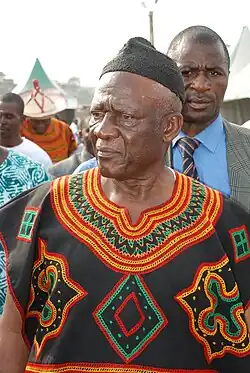
The first senatorial elections in Cameroon were held on 14 April 2013. The ruling Cameroon People's Democratic Movement won a large majority of the seats.
Background
The existence of a Cameroon Senate was provided for by the 1996 constitution. However, no elections were organized before 2013, despite several announcements in previous years.[1] Furthermore, critics noted that the existing municipal councilors were serving on extended mandates or "bonus time," since their terms had expired the previous year, leaving the electoral college unrepresentative of the 2013 electorate.[2]
The announcement of the election date, 14 April, caused an outcry within the opposition. This date meant the senatorial elections would take place before the 2013 Cameroonian municipal elections, which guaranteed a landslide victory for the CPDM, as they held the majority in the outgoing municipal councils.[3][4]
Electoral system
The Senate is the upper house of Cameroon's bicameral parliament.[5] It consists of 100 senators who are completely renewed every five years.[6] Each of the 10 regions of Cameroon is represented by ten senators, seven of whom are elected by an indirect electoral college.[5] While the constitution provides for regional councils to participate, the pioneer 2013 election relied solely on an electoral college composed of the country's 360 municipal councils because regional bodies had not yet been established.[7] The remaining three senators from each region are appointed by decree of the President, totaling thirty appointed senators.[8]
In each region, the seats for the seven elected senators are filled using a mixed-member electoral system with a majority lean: it combines a party-list proportional representation system with a majority jackpot awarded to the leading list.[9] Voters cast their ballots for a closed list of candidates, with no panachage or preferential voting allowed.[10] The list that wins an absolute majority of the votes cast receives all seven seats available in the region.[9] If no list reaches this majority, the list in first place receives a majority bonus of four seats, and the remaining three seats are distributed proportionally using the largest remainder method among all lists that pass the regional electoral threshold of 5% of the votes cast, including the leading list.[9] In the event of a tie between the two leading lists, the bonus is split equally, with two seats awarded to each.[9]
The vote by the electors takes place in the chief towns of the departments by secret ballot.[11] Voting is compulsory, and failure to do so without a valid legal justification results in forfeiture of the mandate as a municipal councilor.[11] In return, the state covers travel expenses and permits proxy voting through another member of the electoral college, with a strict limit of one proxy per member.[11] Candidates for the post of Senator must be at least forty years old on the date of the election, be Cameroonian citizens by birth, demonstrate effective residence within the region where they are running, and be nominated by a legally recognized political party.[12][11]
Since regional councilors had not yet been elected in 2013, the electoral college was composed exclusively of the 9,889 registered municipal councilors.[13]
Results
A total of 9,785 municipal councilors took part in the voting, representing a turnout rate of 98.95%.[14] The African Union praised the smooth running of the election.[15] However, the opposition accused the CPDM of bribing SDF elected officials in the North West Region.[15] The CDU and NUDP filed official petitions for annulment on 17 April.[15]
The election results were announced on 29 April 2013 by the Supreme Court, acting in place of the Constitutional Council. Following the proclamation, President Paul Biya issued Decree No. 2013/149 on 8 May 2013 to complete the house composition by appointing the remaining 30 senators,[16] consisting of 26 members from the CPDM and 4 members from the opposition, including one member each from the MDR, ANDP, FSNC, and NUDP.[17] One of these appointed members, Marcel Niat Njifenji of the CPDM, was elected as the pioneer President of the Senate on 12 June 2013.[18]
 | ||||
|---|---|---|---|---|
| Party | Votes | % | Seats | |
| Cameroon People's Democratic Movement | 7,018 | 73.72 | 56 | |
| Social Democratic Front | 1,684 | 17.69 | 14 | |
| National Union for Democracy and Progress | 583 | 6.12 | 0 | |
| Cameroon Democratic Union | 235 | 2.47 | 0 | |
| Appointed Senators | 30 | |||
| Total | 9,520 | 100.00 | 100 | |
| Valid votes | 9,520 | 97.29 | ||
| Invalid/blank votes | 265 | 2.71 | ||
| Total votes | 9,785 | 100.00 | ||
| Registered voters/turnout | 9,889 | 98.95 | ||
| Source: ELECAM[19] | ||||
By region
| Region | Elected Senators | Party | Appointed Senators | Party | ||
|---|---|---|---|---|---|---|
| Adamawa | Siroma Aboubakar Aboulahi Maikano Paul Haman Paul Maande Joël Nguimbe Madeleine Haoua Tidjani Ahmadou |
SDF | Baba Hamadou Moussa Sabo Mohama Gabdo |
CPDM | ||
| Centre | Sylvestre Naah Ondoua Jean-Marie Mama Elie Essomba Tsoungui Pascal Andong Adibime Luc René Bell Nicole Okala Bilaï Emmanuel Nemde |
CPDM | Laurent Nkodo Pius Ondoua Jean-Marie Pongmoni |
CPDM | ||
| East | Charles Salé Isabelle Tokpanou Monique Ouli Ndongo Badel Ndanga Ndinga Benjamin Amama Amama Marie Claire Moampea Jean Mboundjo |
CPDM | Joseph Mata René ze Nguele Marlyse Aboui |
CPDM | ||
| Far North | Boukar Abba Mahamat Abdoulkarim Hamadou Alioum Aladji Marava Abdoulaye Wouyack Mrs. Zakiatou Julienne Djakaou Martin Amrakaye |
CPDM | Manouf Mahamat Bhar Jean-Baptiste Baskouda Daissala Dakole |
CPDM | ||
| Littoral | Geneviève Tjoues Thomas Tobbo Eyoum Marie Armande Din Bell Roger Victor Mbassa Ndine Simon Kingue Jean-Jules Ebongue Ngo Claude Kemayou |
CPDM | Songue Madiba David Etame Massoma Pierre Flambeau Ngayap |
CPDM | ||
| North | Youssoufa Daoua Pierre Namio Amadou Ali Yvonne Asta Payounni Bebnone Maurice Amidou Mrs. Adamou |
CPDM | Aboubakary Abdoulaye Pierrette Hayatou Abbo Hamadou |
CPDM | ||
| North West | Simon Achidi Achu David Wallang Ignatus Bayin Dinga Emma Eno Lafon Wanlo Chiamua John Zacharie Awanga Stephen Yeriwa Jikong |
CPDM | Fon Doh Ganyonga III Francis Nkwain Njei Fon Teche |
CPDM | ||
| West | Jean Tsomelou Bernard Tantse Tagne Paul Tchatchouang Delphine Metiedje Nguifo Tchetagne Etienne Sonkin Raoul Tchomnou Nono |
SDF | Ibrahim Mbombo Njoya Marcel Niat Njifenji Victor Ndjomo Kamga |
CPDM | ||
| South | Delphine Medjo Calvin Zang Oyono Samuel Obam Assam Grégoire Mba Mba Thérèse Eloumba Medjo Mrs. Nnanga Ndoume Mbita Mvaebeme |
CPDM | Pierre Henri Ngallé Ngoa François Xavier Menye Ondo Paulette Bisseck |
CPDM | ||
| South West | Tabe Tando Ndiep Nso Rebecca Amah Ankie Affiong Lucas Fontem Njifua Daniel Matute Agnès Ndode Ntube Andrew Moffa Otte Charles Mbella Moki |
CPDM | Peter Mafany Musonge Victor Fon Mukete Simon Onjwo Chief An Jan |
CPDM | ||
References
- ↑ "CAMEROON (Sénat – Senate), ELECTIONS IN 2013". Inter-Parliamentary Union. Retrieved 22 May 2026.
- ↑ "'Appoint all 100 Senators Now and Save State Coffers'– Chris Fomunyoh to Biya". Langaa Research & Publishing Common Initiative Group. 21 March 2013. Retrieved 22 May 2026.
- ↑ Agbasso, Georges (12 April 2013). "Cameroun : les clés des élections sénatoriales". Jeune Afrique. Retrieved 22 May 2026.
- ↑ "'Appoint all 100 Senators Now and Save State Coffers'– Chris Fomunyoh to Biya". Langaa Research & Publishing Common Initiative Group. 21 March 2013. Retrieved 22 May 2026.
- 1 2 "Cameroon – Government and society". Britannica. Retrieved 22 May 2026.
- ↑ "Configuration and Mode of Election". Sénat du Cameroun. Retrieved 22 May 2026.
- ↑ "Cameroonian Senate 2013 General". IFES Election Guide. Retrieved 22 May 2026.
- ↑ "Cameroon Senate: Electoral System". IPU Parline. Inter-Parliamentary Union. Retrieved 22 May 2026.
- 1 2 3 4 "CAMEROON (Sénat – Senate), Electoral system". Inter-Parliamentary Union Parline Database. Retrieved 22 May 2026.
- ↑ "Law No. 2012/001 of 19 April 2012 relating to the Electoral Code" (PDF). ACE Electoral Knowledge Network. Retrieved 22 May 2026.
- 1 2 3 4 "Law No. 2012/001 of 19 April 2012 relating to the Electoral Code" (PDF). ACE Electoral Knowledge Network. Retrieved 22 May 2026.
- ↑ "Presentation of the Cameroonian Senate". Sénat du Cameroun. Retrieved 22 May 2026.
- ↑ Report by the Ministry of Justice on Human Rights in Cameroon 2013 (PDF) (Report). Ministry of Justice (Cameroon). 13 November 2013. p. 175. Retrieved 22 May 2026.
- ↑ "Cameroonian Senate 2013 General: Data and Metrics". IFES Election Guide. Retrieved 22 May 2026.
- 1 2 3 "Élections sénatoriales camerounaises de 2013". fr.wikipedia.org. Retrieved 22 May 2026.
- ↑ "Décret N°2013/149 du 08 mai 2013 portant nomination de Sénateurs". Présidence de la République du Cameroun. 8 May 2013. Retrieved 22 May 2026.
- ↑ "Cameroon's Senate Goes Operational On May 14". Cameroon Tribune via AllAfrica. 9 May 2013. Retrieved 22 May 2026.
- ↑ "Senate : Niat Elected President". Le Journal L'Action. 13 June 2013. Retrieved 22 May 2026.
- ↑ ELECAM Report