1976 New Hampshire Democratic presidential primary
 | |||||||||||||||||||||||||||||||||||||||||||||
February 24, 1976
| |||||||||||||||||||||||||||||||||||||||||||||
| |||||||||||||||||||||||||||||||||||||||||||||
 County results Carter: 20–30% 30–40% 40–50% Udall: 20–30% 30–40% | |||||||||||||||||||||||||||||||||||||||||||||

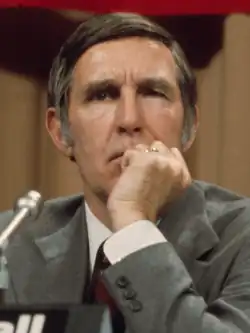
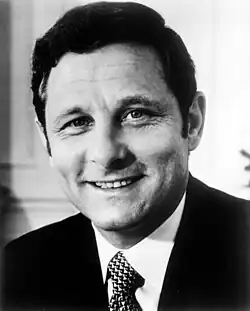
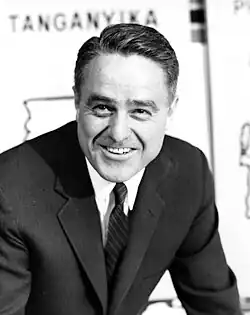

The 1976 New Hampshire Democratic presidential primary was held on February 24, 1976, in New Hampshire as one of the Democratic Party's statewide nomination contests ahead of the 1976 United States presidential election.[1][2] The primary followed the Iowa caucuses and was the first presidential primary election of the 1976 campaign.[3][4][5]
Former Governor of Georgia Jimmy Carter won the primary with 23,373 votes, or 28.6 percent. Representative Mo Udall of Arizona placed second with 22.9 percent, followed by Senators Birch Bayh and Fred Harris, former vice-presidential nominee Sargent Shriver, and an undeclared write-in campaign for former vice president Hubert Humphrey.[1][2][6][7] Carter also secured 15 of New Hampshire's 17 elected Democratic delegates, while the remaining two were pledged to Udall.[2][8]
| Elections in New Hampshire |
|---|
 |
Background
The 1976 contest occurred during the first presidential election following the Watergate scandal and the resignation of President Richard Nixon.[9][10] It was also conducted under recently adopted campaign-finance and party reforms that encouraged candidates to compete in a larger number of primaries and caucuses.[11][12][13] Nine Democratic candidates received federal matching funds at the beginning of January 1976, contributing to an unusually large and unsettled field.[3][14][15]
New Hampshire had already developed a reputation for producing unexpected results.[5][16][17] Senator Eugene McCarthy's unexpectedly strong showing against President Lyndon B. Johnson in the 1968 primary preceded Johnson's withdrawal from the race,[12][18] while Senator George McGovern's closer-than-expected second-place finish behind Edmund Muskie in the 1972 primary helped undermine Muskie's position as the Democratic frontrunner.[16][12][19]
Carter, who was little known outside Georgia when he began his campaign, made the early contests central to his strategy.[16][20][21] On February 13, 1975, he announced in Concord that he intended to make a "major effort" in New Hampshire, compete in every primary, and spend much of the year campaigning outside Georgia.[22][23] His advisers believed that strong performances in Iowa and New Hampshire could generate the press attention and contributions needed to compete in later contests, particularly the primary in neighboring Florida.[16][20][24][25]
Campaign
The principal candidates actively competing in New Hampshire were Carter, Udall, Bayh, Harris, and Shriver.[1][26][7] Contemporary coverage generally grouped Udall, Bayh, Harris, and Shriver together as competitors for liberal and progressive voters.[12][6][27] Senator Henry M. Jackson did not participate in the presidential preference contest, although a slate of delegates pledged to him appeared on the separate delegate ballot.[3][2] Humphrey, Jackson, George Wallace, and several others nevertheless received write-in votes in the preference primary.[1][2]
Carter relied heavily on personal campaigning.[24][16][22] He visited stores, restaurants, schools, factories, private homes, and small community gatherings, often introducing himself directly to voters.[16][21][7] Members of his family and other volunteers from Georgia, informally known as the "Peanut Brigade", also canvassed the state and stayed with local supporters.[16][28][29][9] Carter's campaign received a substantial increase in national attention after he finished ahead of every other named candidate in the Iowa caucuses, although an uncommitted slate received the largest overall share there.[3][20][23][30]
Udall presented himself as the leading progressive alternative to Carter and emphasized his detailed policy proposals.[26][6][31][27] Bayh, Harris, and Shriver competed for many of the same liberal voters, preventing any single candidate from consolidating that portion of the electorate before the primary.[32][12][6] Post-election analysis found that Carter performed particularly well among blue-collar and less-educated voters, while his four principal liberal opponents collectively received a large majority among voters with at least some college education.[33][12][6]
Results
Carter received 23,373 of the 81,821 votes cast. Udall finished 4,663 votes behind him, while Bayh placed third with 12,510 votes.[1][2][6][7]
| Candidate | Votes | Percentage |
|---|---|---|
| Jimmy Carter | 23,373 | 28.6% |
| Mo Udall | 18,710 | 22.9% |
| Birch Bayh | 12,510 | 15.3% |
| Fred Harris | 8,863 | 10.8% |
| Sargent Shriver | 6,743 | 8.2% |
| Hubert Humphrey (write-in) | 4,596 | 5.6% |
| Henry M. Jackson (write-in) | 1,857 | 2.3% |
| George Wallace (write-in) | 1,061 | 1.3% |
| Rick Loewenberg | 1,007 | 1.2% |
| Ronald Reagan (write-in) | 875 | 1.1% |
| Arthur Blessitt | 828 | 1.0% |
| Gerald Ford (write-in) | 405 | 0.5% |
| Stanley N. Arnold | 371 | 0.5% |
| Billy Joe Clegg | 174 | 0.2% |
| Bernard B. Schechter | 173 | 0.2% |
| Frank J. Bona | 135 | 0.2% |
| Robert L. Kelleher | 87 | 0.1% |
| Terry Sanford | 53 | 0.1% |
| Other write-ins | 0 | 0.0% |
| Total | 81,821 | 100.0% |
Source: New Hampshire Elections Database and the State of New Hampshire Manual for the General Court.[1][2] Percentages may not total 100 due to rounding.
New Hampshire voters elected delegates individually rather than assigning them solely according to the statewide preference vote.[2][12] All nine delegates elected from the 1st congressional district were pledged to Carter. Six Carter delegates and two Udall delegates were elected from the 2nd congressional district, giving Carter a 15–2 advantage in the state's delegation.[2][8]
Aftermath
The first-in-the-nation primary was won in an upset by political outsider and former Governor of Georgia Jimmy Carter, who would later go on to win the nomination and the presidency.[16][1][21][20][23][9] Finishing behind Carter in a narrow second place was Arizona Representative Mo Udall, followed by Birch Bayh, Fred Harris, Sargent Shriver, and Hubert Humphrey, who was not actively running.[1][2][6][12][7]
On election night, Carter said that his Southern background had not been the disadvantage in New England that some observers had predicted.[34][6][7] Udall congratulated Carter but also characterized his own result as a success, saying that his campaign had achieved its goal of emerging as the leader of the progressive candidates.[6][27]
Although Carter's victory substantially increased his visibility, it did not immediately make him the preferred candidate of a plurality of Democrats nationwide.[35][36][20] Gallup polling placed his national support at five percent before Iowa and New Hampshire and 14 percent immediately afterward, behind the undeclared Ted Kennedy, Wallace, and Humphrey.[35] Carter's national support continued to rise during March as he defeated Wallace in the Florida primary and won additional contests.[35][20][6]
Carter ultimately secured the Democratic presidential nomination on the first ballot at the 1976 Democratic National Convention and defeated President Ford in the general election.[20][23][37][38] His New Hampshire campaign subsequently became a frequently cited example of how an initially little-known candidate could use personal campaigning and victories in early contests to build a national presidential campaign.[16][20][24][11][25][29]
References
- 1 2 3 4 5 6 7 8 "NH Elections Database » 1976 President Democratic Primary". NH Elections Database. Retrieved August 6, 2026.
- 1 2 3 4 5 6 7 8 9 10 State of New Hampshire Manual for the General Court. Concord, New Hampshire: New Hampshire Department of State. 1977. pp. 301–315. Retrieved August 6, 2026.
- 1 2 3 4 Drew, Elizabeth (May 10, 1976). "Winter Notes—I". The New Yorker. Retrieved August 6, 2026.
- ↑ "The Law That Requires the NH Presidential Primary to be First". New Hampshire Secretary of State. Retrieved August 6, 2026.
- 1 2 "The Primary Election That Put New Hampshire on the Political Map". Time. February 5, 2016. Retrieved August 6, 2026.
- 1 2 3 4 5 6 7 8 9 10 "The Campaign: On to the Showdown in Florida". Time. March 7, 1976. Retrieved August 6, 2026.
- 1 2 3 4 5 6 Fletcher, Elaine; Haskins, Paul (February 25, 1976). "Carter wins; Ford ahead in N.H." The Michigan Daily. pp. 1–2. Retrieved August 6, 2026.
- 1 2 "Carter: Outsider at the Threshold of Power". CQ Almanac. CQ Press. Retrieved August 6, 2026.
- 1 2 3 Barrow, Bill; Sanz, Alex (December 29, 2024). "Jimmy Carter, the 39th US president, has died at 100". Associated Press. Retrieved August 6, 2026.
- ↑ "Watergate: The aftermath". Miller Center. University of Virginia. Retrieved August 6, 2026.
- 1 2 "What the 2020 Democrats Can Learn From One of the Most Crowded Primary Fields in History". Time. June 7, 2019. Retrieved August 6, 2026.
- 1 2 3 4 5 6 7 8 Rovere, Richard H. (March 1, 1976). "Letter from Washington". The New Yorker. Retrieved August 6, 2026.
- ↑ 1976 Presidential Campaign Receipts and Expenditures (PDF) (Report). Federal Election Commission. May 25, 1977. Retrieved August 6, 2026.
- ↑ Annual Report 1976 (PDF) (Report). Federal Election Commission. 1977. Retrieved August 6, 2026.
- ↑ "Public funding of presidential elections". Federal Election Commission. Retrieved August 6, 2026.
- 1 2 3 4 5 6 7 8 9 Chooljian, Lauren (January 10, 2025). "How New Hampshire catapulted an unknown Jimmy Carter to the White House". New Hampshire Public Radio. Retrieved August 6, 2026.
- ↑ "The Year New Hampshire Became First in the Nation: 1920". New Hampshire Secretary of State. Retrieved August 6, 2026.
- ↑ "Democratic drama and Biden write-ins promise a New Hampshire primary to remember". Associated Press. January 18, 2024. Retrieved August 6, 2026.
- ↑ "NH Elections Database » 1972 President Democratic Primary". NH Elections Database. Retrieved August 6, 2026.
- 1 2 3 4 5 6 7 8 "Jimmy Carter: Campaigns and Elections". Miller Center. University of Virginia. Retrieved August 6, 2026.
- 1 2 3 "A Legacy of Service and Redemption". Dartmouth College. February 23, 2023. Retrieved August 6, 2026.
- 1 2 Carter, Jimmy (February 13, 1975). "Statement Announcing Intention to Compete in the New Hampshire Presidential Primary Election". The American Presidency Project. University of California, Santa Barbara. Retrieved August 6, 2026.
- 1 2 3 4 "Jimmy Carter Event Timeline". The American Presidency Project. University of California, Santa Barbara. Retrieved August 6, 2026.
- 1 2 3 "Feeling Good About America: The 1976 Presidential Election". PBS. Retrieved August 6, 2026.
- 1 2 "From Politics to Poetics". The Carter Center. January 24, 1995. Retrieved August 6, 2026.
- 1 2 "Primaries: The First Face-Off". Time. February 22, 1976. Retrieved August 6, 2026.
- 1 2 3 "Carter tops Dems in N.H." The Michigan Daily. February 25, 1976. p. 2. Retrieved August 6, 2026.
- ↑ "Jimmy Carter, the Peanut Brigade, and the '76 Democratic Primaries". Google Arts & Culture. Jimmy Carter Presidential Library and Museum. Retrieved August 6, 2026.
- 1 2 "History of Volunteers at The Carter Center". The Carter Center. Retrieved August 6, 2026.
- ↑ Yglesias, Matthew (May 1, 2019). "The last time the Democratic field was so crowded, a peanut farmer won the White House". The Washington Post. Retrieved August 6, 2026.
- ↑ "Presidential Campaign". The Udall Brothers: Voices for the Environment, Civil Rights, and American Politics. University of Arizona Libraries. Retrieved August 6, 2026.
- ↑ Hilder, David B. (March 1, 1976). "Mo Udall in the Land of the Blind". The Harvard Crimson. Retrieved August 6, 2026.
- ↑ Popkin, Samuel L. (1991). The Reasoning Voter: Communication and Persuasion in Presidential Campaigns. Chicago: University of Chicago Press. pp. 158–159. ISBN 978-0-226-67544-2.
- ↑ "Carter takes New Hampshire race" (PDF). The Observer. Associated Press. February 25, 1976. p. 1. Retrieved August 6, 2026.
- 1 2 3 Gallup Poll Editorial Staff (January 28, 2004). "Gallup Editors: New Hampshire in Context". Gallup. Retrieved August 6, 2026.
- ↑ "Time Soundings: Three Candidates Look Strong—Now". Time. March 21, 1976. Retrieved August 6, 2026.
- ↑ "1976 Electoral College Results". National Archives and Records Administration. Retrieved August 6, 2026.
- ↑ "Jimmy Carter". The Carter Center. Retrieved August 6, 2026.