1966 in paleontology
| List of years in paleontology |
|---|
| (table) |
Paleontology or palaeontology is the study of prehistoric life forms on Earth through the examination of plant and animal fossils.[1] This includes the study of body fossils, tracks (ichnites), burrows, cast-off parts, fossilised feces (coprolites), palynomorphs and chemical residues. Because humans have encountered fossils for millennia, paleontology has a long history both before and after becoming formalized as a science. This article records significant discoveries and events related to paleontology that occurred or were published in the year 1966.
Arthropods
Newly named Insects
| Name | Novelty | Status | Authors | Age | Unit | Location | Notes | Images |
|---|---|---|---|---|---|---|---|---|
| Oligomyrmex antiqua[2] | Comb nov | jr synonym | (Mayr, 1868) | Middle Eocene | Baltic amber |  Europe |
Fossil myrmicine ant, moved to Carebara antiqua in 2004 |
 |
| Sphecomyrminae[3] | Subfam. Gen. et sp. nov | Valid | Wilson & Carpenter | Turonian | New Jersey Amber |  USA |
Basal most ant subfamily. One genus Sphecomyrma | |
Conodonts
| Name | Novelty | Status | Authors | Age | Unit | Location | Notes | Images |
|---|---|---|---|---|---|---|---|---|
| Declinognathodus[4] | Gen. nov | Valid | David L. Dunn | Pennsylvanian | USA |
|||
Anapsids
Newly named mesosaurs
| Name | Novelty | Status | Authors | Age | Unit | Location | Notes | Images |
|---|---|---|---|---|---|---|---|---|
| Brazilosaurus[5] | Gen. et sp. | Valid | Shikama & Ozaki | Artinskian | Irati Formation |  Brazil |
A mesosaur. | |
Dinosaurs
Newly named dinosaurs
Data courtesy of George Olshevsky's dinosaur genera list.[6]
| Name | Novelty | Status | Authors | Age | Unit | Location | Notes | Images |
|---|---|---|---|---|---|---|---|---|
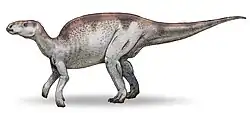
| Probactrosaurus[7] | Gen et sp nov | Valid | Rozhdestvensky | Early Cretaceous (Albian) | Dashuigou Formation |  China |
 | |
Newly named birds
| Name | Novelty | Status | Authors | Age | Unit | Location | Notes | Images |
|---|---|---|---|---|---|---|---|---|
| Arikarornis macdonaldi [8] | Gen et sp nov. | valid | Howard | Early Miocene | Middle Sharps Formation | USA |
An Accipitrid, type species A. macdonaldi | |
| Miortyx aldeni [8] | Sp. nov. | valid | Howard | Early Miocene | Middle Sharps Formation | USA |
An Odontophoridae. | |
| Diomedea milleri [9] | Sp. nov. | valid | Howard | Middle Miocene | Temblor Formation | USA |
A Diomedeid. | |
| Dissourodes milleri [10] | Gen et sp. nov. | jr synonym of Mycteria milleri | Short | Early Pliocene | Valentine Formation | USA |
||
| Pelecanus tirarensis [11] | Sp. nov. | valid | Miller | Miocene | Etadunna Formation |  Australia |
A Pelecanidae. | |
| Praemancalla [12] | Gen et sp. nov. | valid | Howard | Late Miocene | Laguna Hills Formation | USA |
An Alcidae, Mancallinae, type species P. lagunensis | |
| Speotyto megalopeza [13] | Sp. nov. | Jr synonym of Athene megalopeza | Ford | Late Pliocene | Rexroad Formation | USA |
||
| Wasonaka [14] | Gen et sp. nov. | valid | Howard | Middle Pliocene | Arroyo de las Barrancas Blancas |  Mexico |
An Anatidae, Type species W. yepormerae | |
Other animals
| Name | Novelty | Status | Authors | Age | Unit | Location | Notes | Images |
|---|---|---|---|---|---|---|---|---|
| Arborea[15] | Gen. et comb. nov | Valid | Glaessner & Wade | Ediacaran | Australia |
The type species is "Rangea" arborea Glaessner (1959). |  | |
| Conomedusites[15] | Gen. et sp. nov | Valid | Glaessner & Wade | Ediacaran | Australia |
The type species is C. lobatus. | ||
| Sp. nov | Synonym of Dickinsonia costata | Glaessner & Wade | Ediacaran | Australia |
||||
| Sp. nov | Valid | Glaessner & Wade | Ediacaran | Australia  Russia |
||||
| Kimberia[15] | Gen. et sp. nov | Junior homonym | Glaessner & Wade | Ediacaran | Australia |
The type species is K. quadrata. Wade (1972) coined a replacement name Kimberella.[16] |  | |
| Lorenzinites[15] | Gen. et sp. nov | Glaessner & Wade | Ediacaran | Australia |
The type species is L. rarus. | |||
| Mawsonites[15] | Gen. et sp. nov | Valid | Glaessner & Wade | Ediacaran | Australia |
The type species is M. spriggi. |  | |
| Medusinites[15] | Gen. et comb. nov | Valid | Glaessner & Wade | Ediacaran | Australia |
The type species is "Medusina" asteroides Sprigg (1949). |  | |
| Ovatoscutum[15] | Gen. et sp. nov | Valid | Glaessner & Wade | Ediacaran | Australia |
The type species is O. concentricum. |  | |
| Praecambridium[15] | Gen. et sp. nov | Valid | Glaessner & Wade | Ediacaran | Australia |
The type species is P. sigillum. |  | |
| Rangea grandis[15] | Sp. nov | Synonym of Charnia masoni | Glaessner & Wade | Ediacaran | Australia |
|||
| Rangea longa[15] | Sp. nov | Valid | Glaessner & Wade | Ediacaran | Australia |
Originally described as a species of Rangea; Grimes et al. (2023) transferred it to the genus Akrophyllas.[17] | 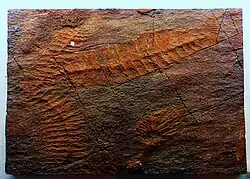 | |
| Rugoconites[15] | Gen. et sp. nov | Valid | Glaessner & Wade | Ediacaran | Australia |
The type species is R. enigmaticus. | 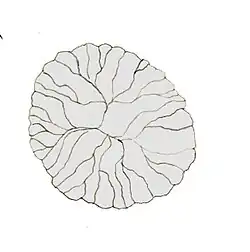 | |
| Spriggina? elongata[15] | Sp. nov | Valid | Glaessner & Wade | Ediacaran | Australia |
Originally described as a species of Spriggina; Glaessner (1976) transferred it to the genus Marywadea.[18] |
References
- ↑ Gini-Newman, Garfield; Graham, Elizabeth (2001). Echoes from the past: world history to the 16th century. Toronto: McGraw-Hill Ryerson Ltd. ISBN 9780070887398. OCLC 46769716.
- ↑ Ettershank, G (1966). "A generic revision of the world Myrmicinae related to Solenopsis and Pheidologeton (Hymenoptera: Formicidae)". Australian Journal of Zoology. 14: 73–171. doi:10.1071/zo9660073.
- ↑ Wilson, E. O.; Carpenter, F. M.; Brown, W. L. (1966). "The First Mesozoic Ant, with the Description of a New Subfamily" (PDF). Psyche: A Journal of Entomology. 74 (1): 1–19. doi:10.1155/1967/89604. Retrieved 2008-04-06.
- ↑ New Pennsylvanian Platform Conodonts from Southwestern United States. D. L. Dunn, Journal of Paleontology, Vol. 40, No. 6 (Nov., 1966), pages 1294-1303 (Stable URL)
- ↑ Shikama, T.; Ozaki, H. (1966). "On a Reptilian Skeleton from the Palaeozoic Formation of San Paulo, Brazil". Transactions and Proceedings of the Palaeontological Society of Japan. New Series. 64: 351–358.
- ↑ Olshevsky, George. "Dinogeorge's Dinosaur Genera List". Archived from the original on 2011-07-15. Retrieved 2008-08-07.
- ↑ Rozhdestvensky, A. K. (1966). "Novye igyanodonti ie tsentrallinoy Asii. Phillogeneticheskye y taksonomicheskye veaimoothoshenia poednich Iguanodontidae y rannich Hadrosauridae". Paleontologicheskii Zhurnal. 1966 (3): 103–116.
- 1 2 Howard, H. (1966). "Two fossil Birds from the Lower Miocene of South Dakota" (PDF). Museum of Natural History of Los Angeles County, Contributions in Science. 107: 1–8. Archived from the original (PDF) on 2014-12-08. Retrieved 2014-12-05.
- ↑ Howard, H. (1966). "Additional Avian Records from the Miocene of Sharktooth Hill, California" (PDF). Museum of Natural History of Los Angeles County, Contributions in Science. 114: 1–11. Archived from the original (PDF) on 2014-12-08. Retrieved 2014-12-05.
- ↑ Short, LL (1966). "A New Pliocene Stork from Nebraska" (PDF). Smithsonian Miscellaneous Collections. 149: 1–12.
- ↑ Miller, AH (1966). "The Fossil Pelicans of Australia". Memoirs of the Queensland Museum. 14: 181–190.
- ↑ Howard, H. (1966). "A Possible Ancestor of the Lucas Auk (Family Mancallidae) from the Tertiary of Orange County, California" (PDF). Museum of Natural History of Los Angeles County, Contributions in Science. 101: 2–8. Archived from the original (PDF) on 2014-12-08. Retrieved 2014-12-05.
- ↑ Ford, NL (1966). "Fossil Owls from the Rexroad Fauna of the Upper Pliocene of Kansas" (PDF). Condor. 68 (5): 472–475. doi:10.2307/1365319. JSTOR 1365319.
- ↑ Howard, H. (1966). "Pliocene Birds from Chihuahua, Mexico" (PDF). Museum of Natural History of Los Angeles County, Contributions in Science. 94: 1–12. Archived from the original (PDF) on 2014-12-07. Retrieved 2014-12-04.
- 1 2 3 4 5 6 7 8 9 10 11 12 13 14 Glaessner, M.F.; Wade, M. (1966). "The late Precambrian fossils from Ediacara, South Australia" (PDF). Palaeontology. 9 (4): 599. Archived from the original on 2013-09-22. Retrieved 2023-03-27.
- ↑ Wade, M. (1972). "Hydrozoa and Scyphozoa and other medusoids from the Precambrian Ediacara fauna, South Australia" (PDF). Palaeontology. 15: 197–225. Archived from the original on 2011-04-09.
- ↑ Grimes, K. F.; Narbonne, G. M.; Gehling, J. G.; Trusler, P. W.; Dececchi, T. A. (2023). "Elongate Ediacaran fronds from the Flinders Ranges, South Australia". Journal of Paleontology. 98 (2): 249–265. doi:10.1017/jpa.2023.45. S2CID 261631797.
- ↑ Glaessner, Martin F. (1976). "A new genus of late Precambrian polychaete worms from South Australia" (PDF). Transactions of the Royal Society of South Australia. 100 (3): 169–170. Archived from the original (PDF) on 2007-09-29.
Categories: