1935 Nobel Prize in Literature
 1935 Nobel Prize in Literature | |
|---|---|
 | |
| Date | 14 November 1935[a] (postponement) |
| First award | 1901 |
| Website | Official website |
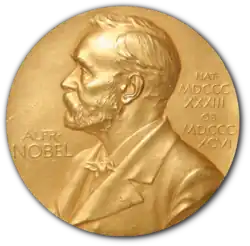
The 1935 Nobel Prize in Literature was not awarded after the Swedish Academy decided that no author in the field of literature was a suitable candidate.[2] Hence, the prize money for this year was 1⁄3 allocated to the Main Fund and 2⁄3 to the Special Fund of this prize section.[3]
Deliberations
Nominations
The Nobel Committee of the Swedish Academy received 52 nominations for 38 authors like Frans Eemil Sillanpää (awarded in 1939), Johannes V. Jensen (awarded in 1944), Paul Valéry, Dmitry Merezhkovsky, Roger Martin du Gard (awarded in 1937) and H. G. Wells.[4]
Fourteen of the nominees were newly recommended for the prize such as Shaul Tchernichovsky, Miguel de Unamuno, Jules Romains, John Masefield, Elise Richter, Edvarts Virza, Víctor Manuel Rendón, Émile Mâle, James Cousins and G. K. Chesterton. There were five women nominees: Ivana Brlić-Mažuranić, Violet Clifton, Ricarda Huch, Maria Madalena de Martel Patrício and Elise Richter.[4]
The authors Henri Barbusse, Ioan Bianu, Arthur Hoey Davis (known as Steele Rudd), Clarence Day, Ella Loraine Dorsey, Charlotte Perkins Gilman, Anna Katharine Green, Kaitarō Hasegawa, Mary R. P. Hatch, Louise Manning Hodgkins, Winifred Holtby, Panait Istrati, T. E. Lawrence, James Leslie Mitchell (known as Lewis Grassic Gibbon), Violet Paget (known as Vernon Lee), Fernando Pessoa, Lizette Woodworth Reese, George William Russell, Tsubouchi Shōyō, Kurt Tucholsky, William Watson and Stanley G. Weinbaum died in 1935 without having been nominated for the prize.
| No. | Nominee | Country | Genre(s) | Nominator(s) |
|---|---|---|---|---|
| 1 | Rufino Blanco Fombona (1874–1944) |  Venezuela |
essays, literary criticism | Several professors from American universities |
| 2 | Ivana Brlić-Mažuranić (1874–1938) |  Yugoslavia |
novel, short story | Gavro Manojlović (1856–1939) |
| 3 | Gilbert Keith Chesterton (1874–1936) |  United Kingdom |
philosophy, theology, essays, literary criticism, novel, short story, poetry | Torsten Fogelqvist (1880–1941) |
| 4 | Violet Clifton (1883–1961) | United Kingdom |
biography, essays | Nevill Coghill (1899–1980) |
| 5 | António Correia de Oliveira (1878–1960) |  Portugal |
poetry |
|
| 6 | James Cousins (1873–1956) |  Ireland  British India |
poetry, drama, essays, literary criticism |  Rabindranath Tagore (1861–1941) |
| 7 | Karel Čapek (1890–1938) |  Czechoslovakia |
drama, novel, short story, essays, literary criticism |
|
| 8 | Maria Madalena de Martel Patrício (1884–1947) | Portugal |
poetry, essays | Bento Carqueja (1860–1935) |
| 9 | Miguel de Unamuno (1864–1936) |  Spain |
novel, poetry, philosophy, essays, drama | Esteban Madruga Jiménez (1890–1980) |
| 10 | Roger Martin du Gard (1881–1958) |  France |
novel, drama, memoir |
|
| 11 | Olav Duun (1876–1939) |  Norway |
novel, short story |
|
| 12 | James George Frazer (1854–1941) | United Kingdom |
history, essays, translation | Jarl Charpentier (1884–1935) |
| 13 | Franz Karl Ginzkey (1871–1963) |  Austria |
poetry, short story, essays | Hjalmar Hammarskjöld (1862–1953) |
| 14 | Vilhelm Grønbech (1873–1948) |  Denmark |
history, essays, poetry | Sven Lönborg (1871–1959) |
| 15 | Jarl Hemmer (1893–1944) |  Finland |
poetry, novel | Hjalmar Hammarskjöld (1862–1953) |
| 16 | Ricarda Huch (1864–1947) |  Germany |
history, essays, novel, poetry | Ernst Robert Curtius (1886–1956) |
| 17 | Johannes V. Jensen (1873–1950) | Denmark |
novel, short story, poetry |
|
| 18 | Guðmundur Kamban (1888–1945) |  Iceland |
novel, drama | Bengt Hesselman (1875–1952) |
| 19 | Rudolf Kassner (1873–1959) | Austria |
philosophy, essays, translation | 6 professors of the University of Zurich |
| 20 | Erwin Guido Kolbenheyer (1878–1962) |  Austria |
novel, short story, poetry, drama | Hans-Friedrich Rosenfeld (1899–1993) |
| 21 | Sven Lönborg (1871–1959) |  Sweden |
philosophy, history, pedagogy, essays | Emil Rodhe (1863–1936) |
| 22 | John Masefield (1878–1967) | United Kingdom |
poetry, drama, novel, short story, essays, autobiography | Anders Österling (1884–1981) |
| 23 | Émile Mâle (1862–1954) |  France |
history | Emil Rodhe (1863–1936) |
| 24 | Dmitry Merezhkovsky (1865–1941) |  Soviet Union |
novel, essays, poetry, drama | Sigurd Agrell (1881–1937) |
| 25 | Eugene O'Neill (1888–1953) |  United States |
drama | Martin Lamm (1880–1950) |
| 26 | Kostis Palamas (1859–1943) |  Greece |
poetry, essays |
|
| 27 | Sarvepalli Radhakrishnan (1888–1975) | India |
philosophy, essays, law | Hjalmar Hammarskjöld (1862–1953) |
| 28 | Víctor Manuel Rendón (1859–1940) |  Ecuador |
novel, poetry, drama, biography, essays, translation | Celiano Monge Navarrete (1856–1940) |
| 29 | Elise Richter (1865–1943) | Austria |
philology |
|
| 30 | Jules Romains (1885–1972) | France |
poetry, drama, screenplay | Fredrik Böök (1883–1961) |
| 31 | Frans Eemil Sillanpää (1888–1964) | Finland |
novel, short story, poetry |
|
| 32 | Hermann Stehr (1864–1940) | Germany |
novel, short story, poetry, drama | Hermann August Korff (1882–1963) |
| 33 | Dezső Szabó (1879–1945) |  Hungary |
novel, essays | Björn Collinder (1894–1983) |
| 34 | Shaul Tchernichovsky (1875–1943) | Soviet Union Mandatory Palestine |
poetry, essays, translation | Joseph Klausner (1874–1958) |
| 35 | Paul Valéry (1871–1945) | France |
poetry, philosophy, essays, drama |
|
| 36 | Edvarts Virza (1883–1940) |  Latvia |
poetry, essays, translation |
|
| 37 | Herbert George Wells (1866–1946) | United Kingdom |
novel, short story, essays, history, biography | Sigfrid Siwertz (1882–1970) |
| 38 | Tadeusz Stefan Zieliński (1859–1944) |  Poland |
philology, history, translation, essays | Several professors at the University of Warsaw |
Prize decision
In 1935, considered authors by the Nobel committee included Karel Čapek, Miguel de Unamuno, John Masefield, G. K. Chesterton, H. G. Wells, Jarl Hemmer, Johannes V. Jensen, Paul Valéry, Eugene O'Neill and Roger Martin du Gard, but the committee found that no candidate met the criteria for the prize.[5] In their report to the Swedish Academy, Čapek was noted for his "thriving imagination and inventiveness" but dismissed for his "solubility and emptiness in philosophical contemplation", De Unamuno was acknowledged as the greatest Spanish writer alive and that his candidacy should be seriously considered, but was dismissed for his abstract ideas in his literary oeuvres; Masefield was dismissed for his uneven works; Du Gard was praised for his The Thibaults, but the committee decided to wait for its other volumes; Valéry was dismissed for being too obscure, Wells for not having produced anything significant in recent years and Chesterton because of "The high value of much of his preaching and the almost unparalleled critical acumen he possesses have been offset by a heavy burden of feverishly nervous, hasty, and distorted judgments and views."[5]
Committee member Hjalmar Hammarskjöld did not agree with the Nobel committee's conclusion that none of the candidates met the criteria for being awarded the prize and added a divergent opinion: "Since I have not been able to agree to the committee's request, I need not plead any other reason than that the committee in any event seems to me to have set far too strict requirements for competence for the Nobel Prize, requirements so strict that they could not be implemented during the past period, and that their maintenance in the future would certainly make the awarding of the Nobel Prize a rare occurrence." Hammarskjöld proposed that the Nobel Prize in Literature for 1935 should be awarded to Miguel de Unamuno, with Jarl Hemmer as his second proposal.[5]
On 14 November 1935 the Swedish Academy decided that the Nobel Prize in Literature for 1935 should be reserved to the following year.[5]
Notes
- ↑ The Swedish Academy decided on 14th November 1935 that this year's Nobel Prize in Literature would be reserved for the following year.[1]
- ↑ All eight were professors of history of literature at the University of Prague, Czechoslovakia.
- ↑ Three professors of literature and/or history from the University of Athens, Greece.
References
- ↑ Svensén, Bo (2001). Nobelpriset i litteratur. Nomineringar och utlåtanden 1901–1950. Svenska Akademien. ISBN 9789113010076. Retrieved 1 November 2025.
- ↑ "Why was no Nobel Prize for Literature awarded in 1935?". history.stackexchange.com. Retrieved 1 April 2023.
- ↑ The Nobel Prize in Literature 1935 nobelprize.org
- 1 2 Nomination archive – Literature 1935 nobelprize.org
- 1 2 3 4 Svensén, Bo (2001). "1935". Nobelpriset i litteratur. Nomineringar och utlåtanden 1920-1950. Svenska Akademien.