1932 Liechtenstein general election
 | ||||||||||||||||||||||||
6 March 1932 (first round)
13 March 1932 (second round) | ||||||||||||||||||||||||
All 15 seats in the Landtag 8 seats needed for a majority | ||||||||||||||||||||||||
| Turnout | 92.59% ( 0.50pp) | |||||||||||||||||||||||
|---|---|---|---|---|---|---|---|---|---|---|---|---|---|---|---|---|---|---|---|---|---|---|---|---|
This lists parties that won seats. See the complete results below.
| ||||||||||||||||||||||||

 |
|---|
General elections were held in Liechtenstein on 3 and 16 February 1932 to elect the 15 members of the Landtag.[1] The Progressive Citizens' Party (FBP) won thirteen seats and retained its majority in the Landtag, while the Christian-Social People's Party (VP) won two. Voter turnout was 92.6%.
The elections took place under a new electoral system, which had been introduced in a referendum less than a month earlier. The VP, which was still weakened following the 1928 embezzlement scandal, conducted little campaigning and the election was largely seen as a foregone conclusion in favour of the FBP. Following the elections, the majority government led by prime minister Josef Hoop remained. It was the last election contested by the VP before it merged with the Liechtenstein Homeland Service (LHD) to form the Patriotic Union (VU) ahead of the 1936 elections.
Background
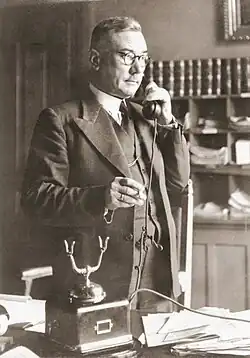
In the 1928 elections, held following the 1928 embezzlement scandal, the Progressive Citizens' Party (FBP) won a majority of eleven seats, while the Christian-Social People's Party (VP) won four.[2][3] As a result, the FBP formed a majority government ultimately under the leadership of Josef Hoop.[4]
The government's term was marked by efforts to support economic recovery following the 1927 Rhine flood and the Great Depression from 1929;[5][6] this included encouraging the opening of new businesses, public works, and social protection policies.[7][8] Hoop's government was also responsible for approving and initiating the construction of the Liechtenstein inland canal in 1930, which was intended to create jobs and increase the amount of arable land in the country.[8]
In 1930, the VP members of the Landtag resigned as they believed that the Landtag elected in 1928 was a continuation of the term dictated in the April 1926 elections. As a result, a by-election was held (which the VP did not participate in) in which the FBP won the four seats, thus the party held all fifteen seats in the Landtag.[9] The resignations were also intended to tactically support the upcoming VP-initiated referendum on the introduction of proportional representation, but primarily due to opposition from the FBP it was rejected by voters by a significant margin.[10] Instead, an FBP-led initiative to replace the majority system with direct mandates from Liechtenstein's municipalities was approved via referendum less than a month before the 1932 elections; this electoral reform was intended to ensure that the interests of the municipalities were now directly represented in the Landtag.[11]
Electoral system
Ten members of the Landtag were elected via direct mandates for one member representing each of Liechtenstein's eleven municipalities with a population equal to or larger than 300 (all except for Planken).[12] The remaining five members were elected via a national vote using a majority system, where the five candidates who received the most were elected.[12][13] Only men aged 21 and above were eligible to vote.[14][15]
Campaign
Both the FBP and VU campaigned primarily on their respective party newspapers − the Liechtensteiner Volksblatt and Liechtensteiner Nachrichten – and leaflets; unlike previous elections, the election campaign was calm. In the campaign, the FBP focused on the party's achievements in office and encouraged voters to elect men of "moral and economic seriousness". Additionally, the FBP continued to discredit the VP in connection to the 1928 embezzlement scandal, and also accused the party of being republican.[16] The FBP had Georg Frick, president of the Liechtenstein Workers' Association, as a candidate in the election, as he was intended to represent the workers in the Landtag.[17]
The VP, on the other hand, conducted a timid campaign and did not attack the FBP on any issues, instead calling for reconciliation; the VP already considered the election lost and it was largely seen as a foregone conclusion in favour of the FBP.[16] However, the VP indirectly accused the FBP of "vote buying".[17] It was reported that the party found difficulty in finding candidates for the election; the party did not present its candidates for the national vote until the day of the election.[17] Former President of the Landtag Wilhelm Beck, who had an ongoing inditement against him in connection to the embezzlement scandal, was particularly criticized by the FBP.[16]
Results
The FBP won thirteen seats, a two seat decrease from their 1930 by-election number, but a two seat increase from their 1928 performance. The VP won two, an increase of two from 1930 but a decrease of two from 1928. Voter turnout was 92.6%.[3]
 | ||||||||
|---|---|---|---|---|---|---|---|---|
| Party | Votes | % | Seats | |||||
| Municipal | National | Total | +/– | |||||
| Progressive Citizens' Party | 7,707 | 60.67 | 8 | 5 | 13 | –2 | ||
| Christian-Social People's Party | 4,996 | 39.33 | 2 | 0 | 2 | +2 | ||
| Total | 12,703 | 100.00 | 10 | 5 | 15 | 0 | ||
| Total votes | 2,173 | – | ||||||
| Registered voters/turnout | 2,347 | 92.59 | ||||||
| Source: Nohlen & Stöver, Vogt[13] | ||||||||
Municipal vote
National vote
| Party | Elected member | Votes | |
|---|---|---|---|
| Progressive Citizens' Party | Anton Frommelt | 1294 | |
| Progressive Citizens' Party | Bernhard Risch | 1271 | |
| Progressive Citizens' Party | Peter Büchel | 1262 | |
| Progressive Citizens' Party | Gebhard Brunhart | 1250 | |
| Progressive Citizens' Party | Georg Frick | 1217 | |
| Christian-Social People's Party | Josef Gassner | 896 | |
| Christian-Social People's Party | Heinrich Brunhart | 880 | |
| Christian-Social People's Party | Rudolf Amann | 869 | |
| Christian-Social People's Party | Julius Wanger | 860 | |
| Christian-Social People's Party | Ferdinand Heidegger | 830 | |
| Source: Vogt[13] | |||
Aftermath
Following the election, the majority government under Hoop remained;[18] the FBP agreed to appoint Josef Steger of the VP to government, but he would switch to the FBP during his term.[18][19] The VP declared that the new electoral system was unfair and planned legal action against it; conversely, the FBP asserted that under the previous electoral system the VP would have likely won no seats.[17]
The success of the FBP came from voters supporting the economic recovery encouraged by Hoop's government. On the other hand, for the VP it demonstrated that the 1928 embezzlement scandal continued to loom over the party, and the poor election result weakened the party further. Though Beck returning to the Landtag was expected to reinvigorate the opposition, this would not come to pass as he contracted an infection the same year and only occasionally attended Landtag sessions,[20] and would resign by 1935.[21] Instead, Basil Vogt was considered the sole de facto representative of the party.[22] The election was the last contested by the VP before it merged with the Liechtenstein Homeland Service (LHD) to form the Patriotic Union (VU) ahead of the 1936 elections.[23][24]
1935 by-election
A by-election was held on 3 February 1935 in Triesenberg following the resignation of Beck.[21] The result was a victory for Johann Beck of the FBP.[25]
| Municipality | Party | Candidate | Votes | |
|---|---|---|---|---|
| Triesenberg | Progressive Citizens' Party | Johann Beck | 142 | |
| Christian-Social People's Party | Alois Schädler | 94 | ||
| Source: Liechtensteiner Nachrichten[25] | ||||
References
- ↑ Nohlen & Stöver 2010, p. 1164.
- ↑ Büchel, Donat (31 December 2011). "Sparkassaskandal". Historisches Lexikon des Fürstentums Liechtenstein (in German). Archived from the original on 15 August 2023. Retrieved 17 May 2023.
- 1 2 Nohlen & Stöver 2010, p. 1182.
- ↑ "Mitglieder der Regierung des Fürstentums Liechtenstein 1862-2021" (PDF). www.regierung.li (in German). Archived (PDF) from the original on 16 February 2024. Retrieved 15 February 2024.
- ↑ Büchel, Donat; Geiger, Peter; Mayr, Ulrike; Merz, Anna; Niederstätter, Alois; Quaderer, Rupert (31 December 2011). "Liechtenstein (Land)". Historisches Lexikon des Fürstentums Liechtenstein (in German). Archived from the original on 2 June 2025. Retrieved 23 January 2025.
- ↑ Risch 1959, p. 12.
- ↑ Geiger, Peter (31 December 2011). "Hoop, Josef (1895–1959)". Historisches Lexikon des Fürstentums Liechtenstein (in German). Archived from the original on 2 June 2025. Retrieved 26 October 2022.
- 1 2 Haidvogl, Gertrud (31 December 2011). "Binnenkanal" [Inland canal]. Historisches Lexikon des Fürstentums Liechtenstein (in German). Archived from the original on 26 April 2025. Retrieved 30 July 2023.
- ↑ Geiger 1997, pp. 305–306.
- ↑ Geiger 1997, pp. 306–309.
- ↑ Geiger 1997, pp. 318–319.
- 1 2 Marxer, Wilfried; Frommelt, Fabian (31 December 2011). "Wahlsysteme". Historisches Lexikon des Fürstentums Liechtenstein (in German). Retrieved 17 November 2024.
- 1 2 3 4 Vogt 1987, p. 208.
- ↑ Marxer, Wilfried; Frommelt, Fabian (31 December 2011). "Stimm- und Wahlrecht". Historisches Lexikon des Fürstentums Liechtenstein (in German). Retrieved 28 July 2026.
- ↑ Frick, Julia (31 December 2011). "Frauenstimm- und -wahlrecht". Historisches Lexikon des Fürstentums Liechtenstein (in German). Retrieved 7 December 2024.
- 1 2 3 Geiger 1997, p. 321.
- 1 2 3 4 Geiger 1997, p. 322.
- 1 2 Geiger 1997, p. 324.
- ↑ Büchel, Donat (31 December 2011). "Steger, Joseph". Historisches Lexikon des Fürstentums Liechtenstein (in German). Retrieved 10 November 2023.
- ↑ Geiger 1997, p. 323.
- 1 2 "Bekanntmachung" [Official Notice.]. Liechtensteiner Volksblatt (in German). 26 January 1935. p. 4. Retrieved 6 August 2026.
- ↑ Büchel, Donat (31 December 2011). "Vogt, Basil". Historisches Lexikon des Fürstentums Liechtenstein (in German). Retrieved 23 November 2024.
- ↑ Marxer, Wilfred (31 December 2011). "Nationale Opposition". Historisches Lexikon des Fürstentums Liechtenstein (in German). Archived from the original on 23 January 2025. Retrieved 13 August 2024.
- ↑ Marxer, Wilfred (31 December 2011). "Vaterländische Union (VU)". Historisches Lexikon des Fürstentums Liechtenstein (in German). Archived from the original on 22 January 2025. Retrieved 18 October 2024.
- 1 2 "Gemeinde-Landtagswahl in Triesenberg" [Municipal and Landtag Election in Triesenberg.]. Liechtensteiner Nachrichten (in German). 6 February 1935. p. 1. Retrieved 6 August 2026.
Bibliography
- Nohlen, Dieter; Stöver, Philip (2010). Elections in Europe: A data handbook. Nomos. ISBN 978-3-8329-5609-7.
- Geiger, Peter (1997). Liechtenstein in den Dreissigerjahren 1928–1939 [Liechtenstein in the 1930s 1928–1939] (in German). Vol. 1. Zürich: Liechtenstein Institute, Chronos Verlag. ISBN 3-906393-28-3.
- Vogt, Paul (1987). 125 Jahre Landtag (in German). Vaduz: Landtag of the Principality of Liechtenstein.
- Risch, Martin (1959). Dr. Josef Hoop (in German). Vol. 59. Jahrbuch des Historischen Vereins für das Fürstentum Liechtenstein.
