(153814) 2001 WN5
| Discovery[1] | |
|---|---|
| Discovered by | LONEOS |
| Discovery site | Anderson Mesa Stn. |
| Discovery date | 20 November 2001 |
| Designations | |
| Orbital characteristics[1] | |
| Epoch 26 November 2017 (JD 2458083.5) | |
| Uncertainty parameter 0 | |
| Observation arc | 21.88 yr (7,990 days) |
| Aphelion | 2.5114 AU |
| Perihelion | 0.9125 AU |
| 1.7119 AU | |
| Eccentricity | 0.4670 |
| 2.24 yr (818 days) | |
| 46.227° | |
| 0° 26m 24s / day | |
| Inclination | 1.9197° |
| 277.51° | |
| 44.569° | |
| Earth MOID | 0.0015 AU (0.6 LD) |
| Physical characteristics | |
| 0.932±0.011 km[2] | |
| 0.097±0.016[2] | |
| 18.3[1] | |
(153814) 2001 WN5 is a sub-kilometer asteroid, classified as a near-Earth object and potentially hazardous asteroid of the Apollo group.
| Date & Time | Approach to |
Nominal distance | uncertainty region (3-sigma) |
|---|---|---|---|
| 2028-Jun-26 05:22 | Earth | 248694 km | ± 24 km[3] |
| 2028-Jun-26 07:43 | Moon | 502854 km | ± 26 km |
Description
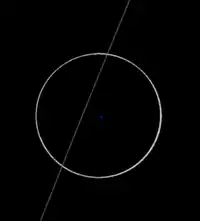
It was discovered by the Lowell Observatory Near-Earth-Object Search at Anderson Mesa Station on 20 November 2001,[4] The potentially hazardous asteroid was removed from the Sentry Risk Table on 30 January 2002.[5]
There are precovery images dating back to 10 February 1996.[1] The orbit is well determined with an observation arc of 14.9 years which includes two radar delay observations. It has an Uncertainty Parameter of 0.[1]
The asteroid will pass 248,700 km (0.647 LD) from the Earth on 26 June 2028.[1] During the close approach, the asteroid should peak at about apparent magnitude 6.7,[6] and will be visible in binoculars. It has an absolute magnitude (H) of 18.2.[1]
According to observations by the NEOWISE mission, the asteroid measures approximately 0.9 km in diameter and its surface has a rather low albedo of 0.097.[2]
| PHA | Date | Approach distance in lunar distances | Abs. mag (H) |
Diameter (C) (m) |
Ref (D) | ||
|---|---|---|---|---|---|---|---|
| Nominal(B) | Minimum | Maximum | |||||
| (152680) 1998 KJ9 | 1914-12-31 | 0.606 | 0.604 | 0.608 | 19.4 | 279–900 | data |
| (458732) 2011 MD5 | 1918-09-17 | 0.911 | 0.909 | 0.913 | 17.9 | 556–1795 | data |
| (163132) 2002 CU11 | 1925-08-30 | 0.903 | 0.901 | 0.905 | 18.5 | 443–477 | data |
| 69230 Hermes | 1937-10-30 | 1.926 | 1.926 | 1.927 | 17.5 | 700-900[7] | data |
| 69230 Hermes | 1942-04-26 | 1.651 | 1.651 | 1.651 | 17.5 | 700-900[7] | data |
| 2017 NM6 | 1959-07-12 | 1.89 | 1.846 | 1.934 | 18.8 | 580–1300 | data |
| (27002) 1998 DV9 | 1975-01-31 | 1.762 | 1.761 | 1.762 | 18.1 | 507–1637 | data |
| 2002 NY40 | 2002-08-18 | 1.371 | 1.371 | 1.371 | 19.0 | 335–1082 | data |
| (612901) 2004 XP1414 | 2006-07-03 | 1.125 | 1.125 | 1.125 | 19.3 | 292–942 | data |
| 2015 TB145 | 2015-10-31 | 1.266 | 1.266 | 1.266 | 20.0 | 620-690 | data |
| (137108) 1999 AN10 | 2027-08-07 | 1.014 | 1.010 | 1.019 | 17.9 | 556–1793 | data |
| (153814) 2001 WN5 | 2028-06-26 | 0.647 | 0.647 | 0.647 | 18.2 | 921–943 | data |
| 99942 Apophis | 2029-04-13 | 0.0981 | 0.0963 | 0.1000 | 19.7 | 310–340 | data |
| 2017 MB1 | 2072-07-26 | 1.216 | 1.215 | 2.759 | 18.8 | 367–1186 | data |
| 2011 SM68 | 2072-10-17 | 1.875 | 1.865 | 1.886 | 19.6 | 254–820 | data |
| (163132) 2002 CU11 | 2080-08-31 | 1.655 | 1.654 | 1.656 | 18.5 | 443–477 | data |
| (416801) 1998 MZ | 2116-11-26 | 1.068 | 1.068 | 1.069 | 19.2 | 305–986 | data |
| (153201) 2000 WO107 | 2140-12-01 | 0.634 | 0.631 | 0.637 | 19.3 | 427–593 | data |
| (276033) 2002 AJ129 | 2172-02-08 | 1.783 | 1.775 | 1.792 | 18.7 | 385–1242 | data |
| (290772) 2005 VC | 2198-05-05 | 1.951 | 1.791 | 2.134 | 17.6 | 638–2061 | data |
| (A) This list includes near-Earth approaches of less than 2 lunar distances (LD) of objects with H brighter than 20. (B) Nominal geocentric distance from the center of Earth to the center of the object (Earth has a radius of approximately 6,400 km). (C) Diameter: estimated, theoretical mean-diameter based on H and albedo range between X and Y. (D) Reference: data source from the JPL SBDB, with AU converted into LD (1 AU≈390 LD) (E) Color codes: unobserved at close approach observed during close approach upcoming approaches | |||||||
References
- 1 2 3 4 5 6 7 8 9 "JPL Small-Body Database Browser: 153814 (2001 WN5)" (2017-12-26 last obs.). Jet Propulsion Laboratory. Retrieved 13 January 2018.
- 1 2 3 Mainzer, A.; Grav, T.; Bauer, J.; Masiero, J.; McMillan, R. S.; Cutri, R. M.; et al. (December 2011). "NEOWISE Observations of Near-Earth Objects: Preliminary Results". The Astrophysical Journal. 743 (2): 17. arXiv:1109.6400. Bibcode:2011ApJ...743..156M. doi:10.1088/0004-637X/743/2/156. S2CID 239991. Retrieved 13 January 2018.
- ↑ "Horizons Batch for 2028-Jun-26 05:22 UT". JPL Horizons. Archived from the original on 24 January 2022. Retrieved 4 March 2025.
- ↑ "153814 (2001 WN5)". Minor Planet Center. Retrieved 13 January 2018.
- ↑ "Date/Time Removed". NASA/JPL Near-Earth Object Program Office. Archived from the original on 2 June 2002. Retrieved 16 October 2011.
- ↑ "2001WN5 Ephemerides for 26 Jun 2028". NEODyS (Near Earth Objects – Dynamic Site). Retrieved 16 October 2011.
- 1 2 Marchis, F.; et al. "Multiple asteroid systems: Dimensions and thermal properties from Spitzer Space Telescope and ground-based observations". Icarus. 221 (2): 1130–1161. Bibcode:2012Icar..221.1130M. doi:10.1016/j.icarus.2012.09.013. Retrieved 24 August 2018.
External links
- Sormano Astronomical Observatory: Close encounter between Asteroid (153814) 2001 WN5 and Earth, diagrams and orbit evolution
- (153814) 2001 WN5 at NeoDyS-2, Near Earth Objects—Dynamic Site
- (153814) 2001 WN5 at ESA–space situational awareness
- (153814) 2001 WN5 at the JPL Small-Body Database